Archive for 2025:

Netflix is treating YouTube like a “farm league” for creators. How’s that working out?

Netflix has been clear about its plan to add YouTube success stories to its original programming lineup. The streamer’s Co-CEO, Ted Sarandos, even called YouTube “a little bit of a farm league” earlier this year.

The YouTube-to-Netflix pipeline is still fairly new, so there haven’t been many opportunities to track the cross-platform viewership of the ported programs — until now. Netflix has released its What We Watched report for the first half of 2025, giving analysts a chance to see how creator-led Netflix shows measure up against their YouTube analogues.

Two shows that originated on YouTube can be found in the latest What We Watched data. Inside, the reality show engineered by the U.K. septet known as the Sidemen, earned 17.5 million hours of watch time and 2.4 million total views during the first half of 2025, placing it just inside the top 1000 Netflix programs globally. On YouTube, the first episode of Inside has 15.4 million views since its June 2024 premiere, while the second episode has racked up 6.9 million views.

Another YouTube transplant, Arlette Amuli‘s Pop the Balloon, has had a tougher time generating Netflix viewership. With one million hours of half-year watch time and 1.2 million views, the dating show fell short of its YouTube traffic.

The inconclusive results from Netflix’s creator push lead to an open-ended question: Do YouTube stars need Netflix, or does Netflix need YouTube stars? On one hand, the Sidemen said that they brought Inside to Netflix because they had already hit their ceiling on YouTube. On the contrary, Netflix needs to convert creator fanbases to its platform if it wants to avoid falling behind its rivals in the streaming arms race. YouTube has already pulled ahead in terms of market share and consumer trust, and as other platforms poach Netflix’s greatest hits, top YouTube creators will help fill the resulting void.

Sarandos has typically taken the middle ground on this subject, noting that YouTube and Netflix “feed each other pretty nicely.” Behind the scenes, however, Netflix is reportedly ramping up its overtures to creators. Deadline noted that there are “suggestions” that Netflix has had talks with major YouTube stars like Mark Rober and Dude Perfect.

The trend of YouTube creators going to Netflix is likely to continue, so accurately measuring the resulting performance of transplanted shows will be key. Both Netflix and YouTube have ways of massaging viewership numbers, so it’s hard to tell for sure if a show like Inside is more popular in its new surroundings. All we can do for now is take the What We Watched report at face value.

Do creators need traditional managers? The firm that reps Airrack and Yes Theory has a different idea.

One Day Entertainment is rebranding to express a bold new vision in the world of talent management. The firm that represents top creators like Airrack, Yes Theory, Drew Binsky, and the Cheeky Boyos is becoming Good Story Studios and shifting its approach to make brand partnerships its speciality.

The rebrand is informed by a bold assertion: Good Story Founder and CEO Zack Honarvar is making the case that creators don’t need managers. In an interview with Tubefilter, Honarvar argued that many creator business models have evolved past the point where they can be adequately served by traditional talent firms.

The typical creator, Honarvar said, is “much more business-minded and business-savvy than the traditional artist.” While more artistic creators can benefit from existing types of agency representation, Good Story’s clients should “operate like a business that hires specific agencies for different business functions.”

Good Story will serve as one of the specialized cogs in those creator businesses. The firm’s laser focus on brand deals will allow it to actively seek out partnerships on behalf of its clients, rather than taking a reactive approach by limiting itself to inbound offers. The result, according to a press release, will be “original content formats, recurring series, and organic brand fits” that incorporate sponsors in uninterruptive ways.

The firm’s previous work offers some examples of what its future partnerships might look like. When Airrack resolved to break the Guinness World Record for the largest pizza, the company then known as One Day reached out to chains in search of a partner. Pizza Hut ended up uniting with Airrack, and the result was one of the most memorable YouTube sponsorships in recent years.

The rebrand to Good Story emphasizes the company’s organic approach to influencer marketing. The focus, Honarvar told Tubefilter, will be on high-quality storytelling that unites major brands with a limited roster of top-tier creators. “Good Story is such a fitting name for that thesis,” Honarvar said.

Good Story, led by Honarvar alongside Managing Partner Benji Sudmann, Head of Partnership Barbara Abraul, and Content Development Manager Zak Chaouki, is only one piece of the puzzle. Honarvar hopes that creators repped by the firm will tap into “a network of companies that all help creators in different ways.” In doing so, they can “operate like a business that hires specific agencies for different business functions,” moving beyond the limitations of traditional talent houses.

Honarvar himself has helped launch several of those focused businesses. He established Boring Stuff to take care of back-of-house functions like accounting and payroll management, and he helped Yes Theory break into the world of product fulfillment by building out Fan of a Fan.

Taken together, those companies can offer “a similar level of dedicated service at a fraction of the cost” when compared to management firms, Honarvar said. Creators like MrBeast have split with their representation to bring more roles in-house, and that business model is inspiring Good Story more than the approach utilized by traditional agencies.

Even after its rebrand, Good Story will still keep its roster relatively small, though it is looking to announce some more creator partnerships in the near future. It will also work directly with brands, with a particular eye toward Fortune 500 companies that “don’t spend so much on YouTube,” Honarvar said. Good Story’s new brand clients will be revealed during the second half of 2025. Once the details are out, the firm formerly known as One Day will get the opportunity to bring its unique take on creator management to the public.

20 years of YouTube: In 2017, Logan Paul’s walk in the Japanese woods changed everything

In February 2025, YouTube turned 20. The video site has gone through a lot over the past two decades, including an acquisition, an earnings glow-up, and multiple generations of star creators. In our 20 Years of YouTube series, we’ll examine the uploads, trends, and influencers that have defined the world’s favorite video site — one year at a time. Click here for a full archive of the series.


13 years into our retrospective look at YouTube history, we’ve arrived at what is arguably the most pivotal video the platform has ever produced. It’s not “me at the zoo,” it’s not “Gangnam Style,” and if the star of the video in question had behaved himself, it wouldn’t have been anything notable at all.

This is the story of Logan Paul‘s fateful visit to Aokigahara, the Japanese woodland colloquially known as the “suicide forest.”

When Paul traveled to Japan in December 2017, he was on top of the creator world. His YouTube channel had recently set a new benchmark by going from zero subscribers to ten million in record time. He was a Teen Choice Award winner, the owner of a $6.5 million mansion, and a budding actor. His collaborators ranged from Jimmy Kimmel to Gucci Mane.

Paul’s behavior during his trip to Japan showed viewers what he thought about his cultural position. As he trampled over cultural norms, he seemed to imply he was beyond reproach — and that was before he ever set foot in Aokigahara. When he encountered the body of an apparent suicide victim and repurposed the corpse as a prop for one of his vlogs, he tested the limits of his purportedly infallible status.

What happened next completely changed the relationship between creators and the platforms that host them. Paul apologized, pledged $1 million to suicide prevention organizations, and lobbied for a second chance. “I’ve made a 15-minute TV show EVERY SINGLE DAY for the past 460+ days,” he wrote on the platform then known as Twitter. “One may understand that it’s easy to get caught up in the moment without fully weighing the possible ramifications.”

Though it was clear his fans were willing to give him a pass, many of his fellow YouTubers felt differently. “The general attitude you characterize of living on the edge, I think really clouds a lot of that much more meaningful ambition of wanting to inspire,” Casey Neistat told Paul during a 2018 collab. YouTube’s eventual punishment earned praise from a significant portion of the creator community.

That punishment was a multifaceted penalty that involved the cancellation of Paul’s YouTube Premium show and his removal from the roped-off ad tier then known as Google Preferred. When Paul’s ongoing antics suggested that he might not have learned his lesson, YouTube sanctioned him again.

That could have been the end of the story, but in the year following the Aokigahara incident, the narrative surrounding Paul shifted. By the end of 2018, Paul was playing the role of the victim, and YouTube was eating the brunt of the criticism thanks to its handling of the situation. Paul eventually called his post-Aokigahara period “the hardest time of my life,” and YouTube ended up issuing an apology of its own, with Chief Business Officer Robert Kyncl admitting that “we should have done better.”

Aside from losing a reported $5 million in Google Preferred ad revenue (which doesn’t even seem like that much for a guy who had just purchased a $6.5 million home), Paul was able to move past the Aokigahara incident with few lasting consequences. He went on to introduce the influencer boxing trend, sign with the WWE, and score a slam dunk in the realm of creator products. These days, Aokigahara rarely comes up in coverage of Paul, and when it does, it’s often filtered through the lens of his latest project.

Paul’s post-Aokigahara glow-up is the incident’s true legacy. A scandal that could have ended him instead boosted him to even greater heights. With one ill-fated decision, he ushered in a new era of creator agency that is still going strong today.

For much of its existence, YouTube had kept rambunctious stars under control by grabbing hold of their purse strings. For creators who wanted to generate substantial revenue from their videos, YouTube was essentially the only game in town, and it used its prominent financial position to fend off challenges from rivals.

That’s what YouTube tried to do with Logan Paul. The actions against his AdSense account and Google Preferred status were meant to hit him where it hurts, but instead, Paul ended up proving that he was right to think of himself as unfallible.

Multiple factors can help us understand why that star-handling strategy didn’t work as well in 2017 as it had in previous years. The Adpocalypse was still fresh in everyone’s minds, and one of the main takeaways from that incident was that creators couldn’t rely on a single platform to satisfy all their revenue-related needs. They had to diversify, whether that meant going independent or reposting content across multiple platforms.

Despite YouTube’s efforts to corner the creator market, its challengers had become too big to ignore. Twitch was getting serious with its own revenue-sharing programs, Facebook was pivoting to video (for the first time), and the merger between Musical.ly and TikTok portended the rise of the next great force in the world of social media. For the first time since the dawn of YouTube, the average creator had ample options for the distribution of their work.

Intentionally or not, Paul discovered that he was bigger than YouTube. His millions of fans would follow him wherever he went, nullifying many of the consequences he faced for his inappropriate actions.

During the era of multi-channel networks, the YouTube landscape represented the studio system of Hollywood’s Golden Age, when larger organizations used questionable contracts to restrict the movement of big-name stars. As MCNs declined (more on this in a future installment of this column), creators took complete control of their careers. They became more willing to take hiatuses (again, more on this next week) or pivot toward greater ambitions.

The Aokigahara incident paved the way for influencer-led businesses and platform-agnostic optimization. In other words, Logan Paul’s indiscretions led us to the creator economy as we understand it today. That may seem like a disheartening association, but this is YouTube we’re talking about. Drama has always been part of the platform’s DNA, and who better than a WWE star to mine those shocking stories for profit?

Ironmouse exits VShojo, alleges missing “significant” revenue and a $500k donation

Multiple VTubers have exited VShojo in the wake of Ironmouse‘s allegations that she’s owed “significant” money, and that VShojo did not forward her $500,000 donation to the Immune Deficiency Foundation.

“Unfortunately, I recently found out that for the past couple of months, I have been misled by VShojo,” the VTuber, who was one of VShojo’s first signings and went on to become its top talent, said in a YouTube video uploaded July 21. “With the information that I currently have, I believe that I am owed a significant amount of funds which I have not been paid.”

She added, “And most importantly, the thing that hurts me the most, is that the Immune Deficiency Foundation, which is the most important charity to me, and also the reason why I’m here today, is owed over half a million dollars from VShojo.”

That money came in thanks to Ironmouse’s record-setting subathon in October 2024. During the monthlong stream, her active subscriber count shot up to over 321,000–around $1.8 million, if all subscriptions were priced at the base $4.99. Ironmouse said that after Twitch took its cut, she would give half of anything she earned from the subathon straight to the Immune Deficiency Foundation. Do the math, and it means the foundation would’ve gotten a little over $560,000.

But it’s been almost a year, and Ironmouse claims that money was never forwarded by VShojo.

In case you’re unfamiliar with how money works in most digital creator management companies, it goes like this: Anything a YouTuber/VTuber/streamer/etc earns from platforms, brand deals, merch sales, and more goes first to their management company. The management company is supposed to hold the creator’s earnings in escrow while it takes its cut, then will disburse the rest to the creator’s account.

This system, when things are going well, works just fine. Ethical management companies will not touch creators’ money; it’s supposed to simply pass through them, since creators already did the work to earn it.

However, we’ve seen what can happen when things don’t go well. Defy Media is a prime example; it folded in 2018, declaring bankruptcy while still owing creators millions of dollars. MatPat, who was owed $1.7 million, alleged mishandling of funds, theorizing that Defy used creators’ earnings to pad its own bank accounts, then got overwhelmed by operational costs and couldn’t replace what it had already spent.

We’re not saying that’s what’s happening at VShojo. It’s simply what can happen with this sort of system.

In her video, Ironmouse told fans her attorney advised her not to say much more about the situation until “more of the legal procedure [unfolds].”

“For now, I just need to let you know that I will no longer be a part of VShojo,” she said.

Because VShojo operates more like a traditional YouTube talent management company than a traditional VTuber agency, Ironmouse will retain rights to her model, social accounts, and content. (Trad VTuber agencies like Hololive retain those rights, not the VTubers, so when members like Gawr Gura leave, they have to give up their models and accounts, and start over.)

Following her video, GEEGA and Zentreya, who both left VShojo last month, talked about their decisions to exit.

“There have been a lot of things that have gone on in the background that I have been completely unable to talk about,” GEEGA said on stream. “I wanted to, but that has been legally just not a thing I should do. So finally someone who is able to say those things has said them, and it’s good. There is a lot more, absolutely. There is a lot to be said. But that is what can be said at this moment in time, especially because it is stuff that pertains to mouse in particular.”

Zentreya, meanwhile, took to X, tweeting this:

Projekt Melody, another of VShojo’s top English-language creators, said she now plans to leave:

Yet another creator, Kson, alleged her payments from VShojo stopped way back in September 2024, and that she was already planning to leave:

All English-language VShojo streamers have removed the company’s name from their X bios and usernames. Some VTubers, including some from VShojo’s Japanese talent roster, have called for VShojo to make a public statement. It hasn’t, nor did it respond to our request for comment.

Ironmouse closed her announcement video by talking about the Immune Deficiency Foundation’s positive effect on her life. She linked out to a Tiltify fundraiser with a $10,000 goal, asking fans who could to contribute to its mission. At press time, the Tiltify is sitting at over $580,000.

After 42% year-over-year sales decline, is PRIME out of its prime?

In 2023, Bloomberg reported that Prime Hydration was set to do $1.2 billion in sales during its first year of operation. Logan Paul and KSI‘s beverage brand was flying high, but like with many energy drinks, that boost was followed by an epic crash.

The latest Prime data is concerning, to say the least. Citing Circana Food, business journalist Darren Rovell reported on X that Prime sales are down 42% year-over-year. Some other outlets have recently claimed that Prime’s year-over-year decline could be as steep as 90%.

So what happened? There are a few obvious issues. Scrutiny from the FDA — which questioned Prime’s combination of potent ingredients and kid-friendly marketing — didn’t help. Neither did claims about the “harmful chemicals” in Prime bottles or lawsuits related to alleged breaches of contract.

Those scandals didn’t help Prime, but the brand’s strategy was always designed to be boom-or-bust. It was born out of a boxing rivalry and had headline-grabbing drama in its DNA from the start.

Because of Prime’s origins, viral marketing seemed to make sense as a promotional strategy, and that’s exactly the lane KSI and Paul stepped into. Electric blue NASCAR vehicles, Los Angeles Laker slam dunks, and Super Bowl commercials all contributed to Prime’s first-year boom, but the beverage company’s founders have struggled to turn that momentum into a sustainable, long-term business strategy.

To salvage Prime, KSI and Paul should take some lessons from MrBeast. His first foray into consumable products, MrBeast Burger, had a bold marketing strategy that was marred by behind-the-scenes disputes. MrBeast has supported Feastables with a fully-organized business behind it, and sales traffic has been strong so far.

KSI and Paul could still get a lot out of Prime if they choose to rethink their marketing strategy — and maybe reformulate their beverage. It worked for MrBeast, and it would be nice if Prime could become Gordon Ramsay-approved.

The Washington Post turned its reporters into TikTok stars. Now one of them is going solo.

Dave Jorgenson is striking out on his own. After hosting videos across The Washington Post‘s social media channels, including its popular TikTok account, Jorgenson is becoming independent through a new venture called Local News International.

The Washington Post‘s 1.9 million TikTok followers will recognize Jorgenson as one of the foremost faces in the world of short-form journalism. In pithy updates, Jorgenson blends traditional reporting with comtemporary editing techniques to package the news in a format that appeals to Gen Z. Jorgenson got so good at short-form video that he even published a book replete with TikTok-ready prompts.

With Local News International, Jorgenson will continue to share top stories through unconventional means. In a YouTube video addressed to his former employer Jeff Bezos, the 34-year-old journalist outlined his plans for his new venture. He’ll release five short-form videos per week, one long-form video per month, and periodical newsletter updates.

“My boss and my boss’ boss are coming with me, so viewers can continue to expect the same high-quality, fact-checked videos,” Jorgenson said in the video. The editors in question are former WaPo Director of Video Micah Gelman and Gelman’s deputy Lauren Saks.

WaPo‘s social video presence, which grew in the late 2010s on platforms like YouTube and Twitch before blowing up on TikTok in the 2020s, has turned several of its reporters into FYP mainstays. But amid a tumultuous political climate, some of those voices are going solo in search of editorial freedom.

One notable departure was digital culture reporter Taylor Lorenz, who has launched a newsletter called User Mag. “I just wanted to get out of legacy media,” Lorenz told The Hollywood Reporter last year. “I feel like it’s just really, really difficult to do the kind of reporting that I want to do on the internet within these kind of older institutions as a primary job.”

The push and pull between legacy media companies and the talent they incubate is nothing new. A decade ago, we saw a similar type of friction at BuzzFeed, which lost many of its YouTube stars when those creators chose to strike out on their own. For those individuals, staying big without institutional support hasn’t always been easy, though standouts like Michelle Khare have found success.

Luckily for Jorgenson, the media landscape is now friendlier to independent personalities. Money is flowing into the newsletter biz through platforms like Substack and beehiiv, and Jorgenson is betting that he can absorb some of the viewership that enjoyed his WaPo segments. Local News International already has 100,000 YouTube subscribers, so Jorgenson has a nice base he can build on.

The Jet2holidays meme is the song of the summer

As the weather heats up and the days get longer, many outlets are asking a simple question: Where’s the song of the summer?

2025 has had no shortage of pop music releases, but as the calendar passes its midway point, many of the current chart toppers are reheated hits that broke out last year. The lack of a consensus song of the summer has led many writers to eulogize the once-ubiquitous trend. Several cultural factors, such as the rise of siloed social media platforms and the decline of Top 40 radio, have been blamed for the song of the summer’s downfall.

“The ‘song of the summer’ feels like a relic of the past,” Taylor Crumpton wrote in a Time article published earlier this year. “With the absence of music video programs, such as Total Request Live and 106 & Park, and the decline in relevance of televised award shows, like the MTV Video Music Awards, the idea of a pop monoculture has not only ceased to exist but has also resulted in the loss of shared cultural touch points that connect (or sometimes, some might say, thrust upon) millions of Americans. In its stead, a fragmented culture has come to exist, thanks to the rise of the curated algorithm and our social media feeds perfectly sculpted to fit our interests and experiences.”

On the surface, Crumpton’s argument is perfectly valid. The song of the summer used to distill an entire season into a single track. The Doors’ “Light My Fire” represented the cultural conflagration that was the Summer of Love. The disco fever of the late 70s gave Andy Gibb back-to-back song of the summer crowns. And if you were alive in 1996, you probably have a memory involving Los Del Rio’s “Macarena.”

In 2025, no song has come close to a “Macarena” level of cultural ubiquity, but a trend that originated on TikTok has. This year, the song of the summer is a short-form trend, because nothing beats a Jet2holiday.

If that last sentence caused you to involuntarily hum the chorus of Jess Glynne‘s 2015 song “Hold My Hand,” then you and I have probably been watching a lot of the same TikToks. An advertisement for the U.K.-based travel company Jet2holidays has become the soundtrack for 1.5 million TikToks, many of which poke fun at the gap between expected vacation experiences and reality.


View this post on Instagram


A post shared by absolutelyyasthetic (@glow.up.girlys)

The Jet2holidays meme has been inescapable in the way a song of the summer is supposed to be. The titular brand has inserted itself into the conversation. So have Glynne and Zoë Lister, the actor who provided the voiceover for the original ad. There has been a predictable stream of parodies and even some uploads that seem to play the ad completely straight.

But this viral fad’s claim to the song of the summer crown is not just a product of its ubiquity. The Jet2holidays meme also expresses the spirit of summertime fun that once defined the annual pop music competition. “Much like the unofficial, crowdsourced competition for ‘song of the summer,’ awarded to whatever catchy pop song becomes the most inescapable, a social media trend like the Jet2holidays ad remixes can spread quickly at a time when many people are sharing videos of summer escapades,” Claire Fahy recently wrote in The New York Times.

Much noise has been made about TikTok’s ability to turn its For You Page faves into global pop stars. The Jet2holidays meme shows us how that process works. It’s not that TikTokers have impeccable musical taste, though some do — it’s that the FYP facilitates the same sort of communal cultural osmosis that once flowed through Top 40 radio stations. That feeling drives TikTok’s prominent position in the music world, and like a Jet2holiday, nothing beats it.

Top 5 Branded Videos of the Week: Dave Ramsey vs 100,000 bees

Welcome to our rundown of the most-watched branded YouTube videos of the week.

We’re publishing this snippet of a larger Gospel Stats Weekly Brand Report in order to analyze sponsorship trends in the creator economy. Any video launched in tandem with an official brand partner is eligible for the ranking.

And – as the name up above would imply – all the data comes from Gospel Stats. If you’re interested in learning more about Gospel – and which brands are sponsoring what creators on YouTube – click here.


Is Dave Ramsey becoming the next MrBeast? OK, we kid, but really: financial guru Ramsey is once again on the rise, making our list twice this week. That’s because he’s blitzing YouTube with short content to the tune of ~30 videos a week. What’s interesting is he’s not the only one on the rise. The rest of our top 5 this week is made up of newcomers–creators who haven’t been at the top of the list before, but arrive this week pulling big views for their sponsoring brands.

Check ’em all out here:

#1 I let an AI Robot clean my pool…👀😳 (ruined)
Channel: Kaz Sawyer
Brand: Aiper
Views: 10,530,146

https://youtu.be/Jm8dO1zmnT0?si=EFyI5gWYerGnQB5E

The first newcomer this week is Kaz Sawyer, and we want to clarify that when we say “newcomer,” we just mean to the top 5 of our Gospel Stats Weekly Brand Reports. Sawyer has been uploading to his channel since 2018, and has settled firmly into the tech bro/14-year-old boy view-bait niche, with videos like I Sent A NFT To Space! and I Crashed The Worlds FASTEST Golf Cart [sic]. He made our Report this week with a Short where, after giving his luxury pool a rough go for the Vine, he brings in Aiper‘s $1,800 pool cleaning robot to do its best scrub-up. Aiper is, of course, the video’s sponsor, and timed this partnership for Prime Day, where it was offering various models up to $800 off. Here’s something interesting: In the video description, Sawyer didn’t plug a link directly to the product; instead, he specifically encouraged viewers to search “Aiper Scuba X1 Pro Max” on Amazon. Maybe a way to inflate traffic? 🤔

#2 Raising 10,000 Bees (in my home)
Channel: Dr. Plants
Brand: Opera
Views: 7,029,949

There’s a joke here somewhere about Dr. Plants being 10,000 bees in a trenchcoat. That being said, we’re bee-yond pleased to welcome him as our second Weekly Brand Report newcomer. He’s also somewhat of a YouTube newcomer, having just started his channel in 2022. From then to now, he’s uploaded 11 videos, all of them long-form. Wait, you think. Just 11? Yep. Just 11. And that’s because his videos document year (and sometimes years)-long projects recreating the cycles of nature in bioactive vivariums. He fills massive tanks with earth, plants, and animals at all levels of the food chain, and simulates natural events like weather patterns that would affect them out in the real world, then records how these miniature universes progress.

In this video, Dr. Plants brings in browser Opera to support one of his biggest projects yet: a bee colony that spent 100 days living in his house. Will it end in delicious honey, or dire tragedy? No spoilers…

#3 We’re $1,000,000 In Debt and Only 20% Is The House
Channel: The Ramsey Show Highlights
Brand: Yrefy
Views: 5,657,945

Debt is everywhere these days. Forget houses, cars, and educations–you can go into debt DoorDashing a burrito. But some people do still go into debt over houses. Unfortunately for the couple who calls in to Dave Ramsey‘s show in this first clip, the house isn’t their only debt. They’ve racked up $136K in credit card debt, $35K in personal loans, and over $300K in student loans. In total, they owe just under $1 million. What can they do, they ask Ramsey, without filing bankruptcy? His response begins ominously: “I’m getting ready to destroy your life as you know it.” And the commenters are very into this approach. “Dave isn’t going to destroy their lives, he’s going to help rebuild them,” one says reverently. However Ramsey’s advice works out, he’s walking away making some nice cash, both from sponsor Yrefy (a student loan company, which might prove useful for our callers) and YouTube’s AdSense.

#4 I Make $280,000, He Doesn’t Work — Is This a Deal Breaker?
Channel: The Ramsey Show Highlights
Brand: Zander Insurance
Views: 4,635,267

In Ramsey‘s second clip of the week, we have a couple with an entirely different problem. One is a successful surgeon expecting to make $500K this year. Nice! The issue? Her boyfriend, an aspiring actor, doesn’t want to get a job. Is that grounds for a breakup? Ramsey might not run a relationship show, but this sort of call is just as common as hard-line questions about cash-handling. In this case, his advice (delivered to YouTube thanks to sponsor Zander Insurance) is pretty predictable: Dump him, girl!

BONUS #2,195 the TV show that lets you watch and game at the same time!
Channel: Disguised Toast
Brand: Netflix
Views: 29,616

With the third and final season of Squid Game, Netflix took the “game” in its name seriously. We just wrote about how it did deals with both Roblox and Fortnite that would allow developers to use the platforms’ assets to build their own Squid Game-themed games. (That rollout went less than smoothly on Fortnite.) But Netflix wasn’t content with simply letting other people make games. It pushed its second-screen and mobile gaming ambitions by publishing Squid Game: Unleashed, a mobile party game that simulates the show’s high-priced competition (but, you know, with less death). Known gamer Disguised Toast was tapped to promote it, and racked up 30K views with his 59-second Short.


…and there’s a lot more data where that came from. If you’re interested in learning more about Gospel – and which brands are sponsoring what creators on YouTube – click here.

Clorox is entering its Nutter Butter era

Clorox has entered the Nutterverse.

The legacy cleaning brand we all grew up with is, like every other legacy brand, trying to figure out how to market to anticonsumption-leaning Gen Z and Alpha. (At least, mostly anti-consumption. Labubus may beg to differ.) Nutter Butter found a way in last year, uploading things like this extremely lo-fi video of a single shrimp being lovingly placed on top of a Nutter Butter with the caption “yes.”

The Dada-esque, nonsensical content worked for NutBut, and now it’s working for Clorox, too.

It first began testing this “unhinged” style of marketing with Pine-Sol, it told Ad Age. Its marketing team populated the account with dancing wizard frogs, memey cats, enough neon patterns to fill a 70s discotheque, and lo-fi graphics similar to Nutter Butter’s. It also introduced a new tagline it hoped would become a TikTok soundbite earworm: “oh em gee da Pine.”

Now, that tagline has become the focal point of Pine-Sol’s TikTok account. Clorox didn’t share growth numbers, but we can see how many views this new approach is bringing on videos. Pine-Sol used to be stuck beneath 5K views on most videos; now it regularly reaches over a million. Some, like the wizard frogs, have topped 5 million.

Compare this to the OG Clorox account, which is primarily comprised of aesthetic and cleaning FAQ vids. While a handful of uploads have reached the 50K mark, most are below 5,000 views.

Eric Schwartz, SVP and CMO of Clorox, told Ad Age that after seeing success on Pine-Sol’s account, Clorox pulled its various social media marketing divisions together into one core hub to produce similar Gen Z bait content.

Now, that team works with Clorox’s in-house agency, Electro Creative Workshop, to produce 300-400 pieces of content per month for the company’s stable of cleaning brands. This is a change for Clorox, which, as a legacy brand, has historically advertised through more traditional paid media.

“Now, we’re seeing social platforms and the algorithms that govern them as a landscape where we really need to activate differently,” Schwartz said. “It’s more about our consumer obsession—getting close to consumers, understanding consumers, participating with consumers—than it is about a media strategy.”

Rita Gorenberg, Clorox’s Senior Director of Marketing, added that its goal with TikTok content is “being top of mind, feeling like you’re a part of their life […] and like you’re creating this community [together].”

Clorox’s execs also told Ad Age that its social media method has become finding “cohorts” of audiences who share interests, instead of only targeting demographic groups. Yes, it’s targeting younger consumers, but within that broad demo are pinpoint niches like “married couples who share domestic chores.”

That particular cohort inspired Clorox to make TikTok videos with taglines like “If yo man doesn’t refill yo Brita, it’s time for divorce” and “Do they really love me if they don’t refill the Brita?”

It’s rarely easy for companies to inject their products into consumers’ lives, but the Nutterverse approach is working. And CLorox’s other approach, creating a memey ~personality moment~ around it, like making a viewer pause to think about their relationship in terms of Brita-refilling, is catnip for TikTok, where aspirational lifestyle content is a big view-driver.

For legacy brands like Nutter Butter and Clorox, which have become sort of baked in to everyday life, that content is doing what it’s meant to: putting their names in viewers’ minds.

Top 50 Most Subscribed U.S. YouTube Channels • Week Of 07/20/2025

[Tubefilter Charts is a periodic rankings column from Tubefilter with data provided by GospelStats. It’s exactly what it sounds like: a top number ranking of YouTube channels based on statistics collected within a given time frame. We use data directly from YouTube and in terms of subscribers, YouTube rounds that data to the first three significant figures. Check out all of our Tubefilter Charts with new installments every week right here.] 

Scroll down for this week’s Tubefilter Chart.


This week, only two U.S.-based channels got more than one million new subscribers. MrBeast led the way by adding two million new subscribers to his YouTube leading total (which is now higher than 415 million). The WWE, one of the longest-running channels on YouTube, continued its remarkable longevity by adding one million new subscribers during the week that was.

All of the channels that claimed spots in the U.S. Sub Top 50 added at least 180,000 new subscribers during the third week of July. That cohort included one precocious Texan whose approach to content is greatly influencing the creator community.

Sensitive boys are trending up

Are we witnessing the birth of the next Ryan Trahan effect?

In 2022, Trahan’s cross-country journey to deliver a penny to MrBeast became the biggest thing on YouTube, inspiring a wave of imitators across the platform. Three years later, Trahan is back with a new challenge, but his current impact on the YouTube charts feels a bit more subtle.

Trahan is currently visiting every U.S. state over a 50-day period to raise money for St. Jude’s. His voyage has become one of the biggest blockbusters on YouTube. Trahan ranked 42nd in this week’s U.S. Sub Top 50 thanks to the 200,000 new subs he brought into his main channel, and the first installment of his 50 states series is approaching ten million views.

So how is the 50-state challenge influencing other creators? It may not spawn literal imitators like the penny challenge did, but it seems to be lifting the fortune for sensitive, clean-cut, family-friendly guys on YouTube.

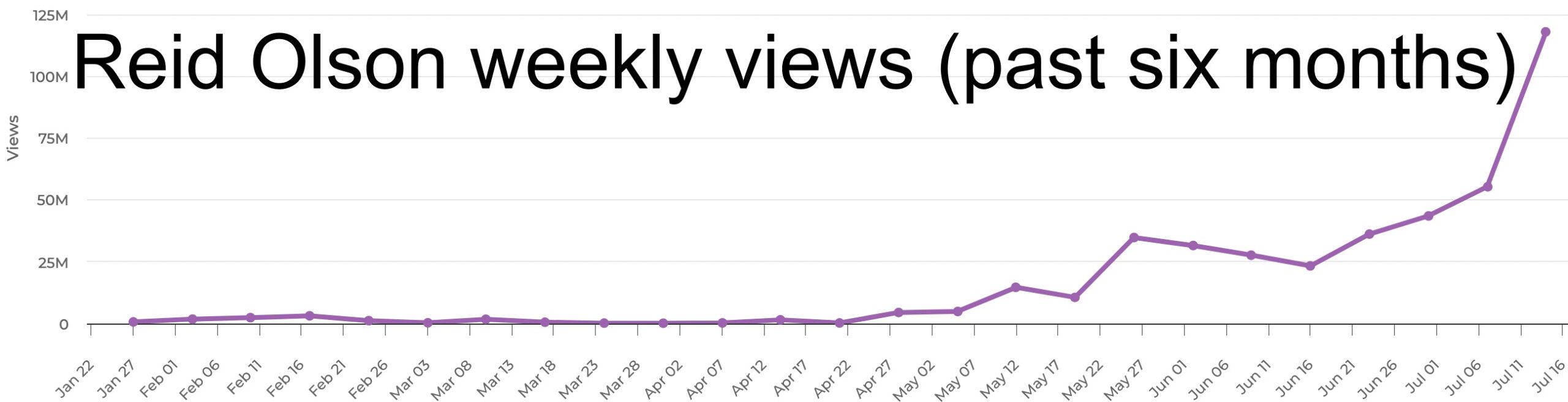
Part of what makes Trahan’s videos so popular is his inclusive approach, his squeaky-clean image, and his charming smile. There are a few creators who fit that description who are moving on up in the Global Sub Top 50. In particular, I have my eye on Reid Olson, who has started porting over TikTok and Instagram Reels uploads to his YouTube audience.

Olson added 220,000 new subscribers during the third week of July, bringing his total on YouTube up to 1.39 million subscribers. His most-watched uploads are pensive conversation pieces that use extended metaphors to consider ideas like love, loss, and emotional maturity. His long-form uploads, while less popular, are even more moody. They range in tone from inspirational to introspective to poetic, and viewers are taking notice.

Data via Gospel Stats

Perhaps Olson’s uptick is not related to Trahan’s recent success, but I’d like to think that YouTube Shorts is eager to check out easygoing, positive creators who engage their subscribers with thoughtful videos. Given some of the slop we’ve seen go viral on YouTube lately, this latest shift is a breath of fresh air.

Channel Distribution

This month, 38 channels in the Top 100 are primarily active on YouTube Shorts.

As always, keep up to speed with the latest Tubefilter Charts and all of our news at Tubefilter by following us on Twitter, becoming a fan on Facebook, and watching our videos on YouTube.

Top 50 Most Subscribed YouTube Channels Worldwide • Week Of 07/20/2025

[Editor’s Note: Tubefilter Charts is a weekly rankings column from Tubefilter with data provided by GospelStats. It’s exactly what it sounds like; a top number ranking of YouTube channels based on statistics collected within a given time frame. Check out all of our Tubefilter Charts with new installments every week right here.]

Scroll down for this week’s Tubefilter Chart. 👇


Alejo Igoa still leads MrBeast in our ranking of the 50 most-subscribed YouTube channels of the week. Seven days ago, MrBeast pulled the gap between the two creators to just 400,000, but Igoa has since expanded his lead. He got 3.7 million weekly subscribers during the third week of July, compared to two million new subscribers for MrBeast over the same period.

The top seven channels in the chart all added at least one million subs over the latest seven-day measurement period. Further down the list, creators are jockeying for attention by applying the best practices of the biggest channels on YouTube Shorts.

The summer blockbuster film junket is now on YouTube

Since the launch of YouTube Shorts, short-form creators have used the TikTok-like format as a distribution hub for film clips. In some cases, channels that aggregate content from popular movies gain millions of views and subscribers each week.

The channels we’re looking at this week are part of that short-form cinematic movement, but not in the way you might expect. Film World, which ranked 18th in this week’s Global Sub Top 50, certainly pertains to its titular topic. But instead of sharing literal film clips with its 21.7 million subscribers, Film World focuses more on behind-the-scenes culture.

Film World’s most-watched Shorts are shot at festivals, premieres, and other places where stars hobnob with one another on red carpets and in front of step-and-repeats. Celebrity culture is another interest of YouTube’s short-form community, and Film World gives those stargazers the content they crave.

Its particular focus is in India, the home country of many of the stars it profiles. Actors featured in top Film World uploads include Shahrukh Khan and members of Amitabh Bachchan’s family.

In a world where top social platforms have broken into film festivals like Cannes and Sundance — while also incubating some visionary voices who are breaking into Hollywood — the popularity of a channel like Film World makes sense. Movie-related content is so big on YouTube that channels can profit by invoking cinematic lingo on unrelated videos.

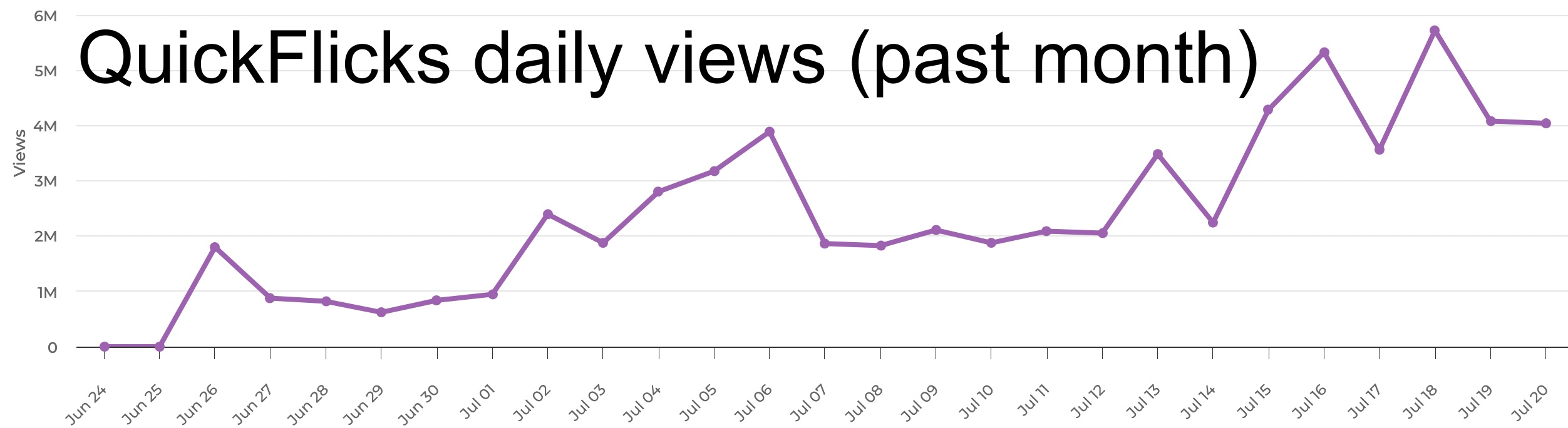
That’s the only explanation I have for QuickFlicks, the #14 channel in this week’s Global Sub Top 50. True to its name, QuickFlicks has only been active on YouTube for two months, but it has already climbed the charts by hauling in more than 500,000 subscribers per week.

Data via Gospel Stats

QuickFlicks is exactly the sort of channel that YouTube’s crackdown on repetitive content is meant to target. I mean, look at this short-form library — it’s the definition of repetitive.

The problem is, if YouTube does strip monetization from QuickFlicks, it would probably be too late. The channel has already profited from its nonsensical use of movie buzzwords, and its success shows just how hard it is for YouTube to stay on top of channels that are fudging its Partner Program rules.

Channel Distribution

Here’s a breakdown of the Top 50 Most Viewed channels this week in terms of their countries of origin:

  • United States: 15
  • India: 9
  • Brazil and Hong Kong: 3
  • Australia, Indonesia, Mexico, South Korea, and Spain: 2
  • Argentina, Bangladesh, Belarus, Belgium, China, Jordan, Kazakhstan, Singapore, Slovakia, and Vietnam: 1

This week, 34 channels in the Top 50 are primarily active on YouTube Shorts.

As always, keep up to speed with the latest Tubefilter Charts and all our news by subscribing to our newsletter. You’re going to love it. 👉  Newsletter.Tubefilter.com.

Meta’s smart glasses are getting sportier thanks to Oakley. Will the wearables winning streak continue?

Meta is emboldened by the public response to its push into wearable products, so it’s doubling down in that area. After generating strong sales with a smart glasses product designed by Ray-Ban, Meta is offering a second, more expensive line launched in tandem with Oakley.

HSTN, as the Oakley-branded devices are known, are currently available for pre-order. The new offering expands Meta’s collaboration with Paris-based EssilorLuxottica SA, the parent company of both Oakley and Ray-Ban.

Meta ushered in a new generation of wearable tech when it kicked off Orion, a product line that packs a plethora of features into stylish, portable devices. Consumers have been eager to try out Meta’s specs; in February 2025, 16 months after the digitized Ray-Bans first hit the market, EssilorLuxotica reported that two million pairs had been sold.

That revelation had significant ramifications. Meta and EssilorLuxotica accelerated their production pipeline, with plans to produce 10 million smart glasses per year by the end of 2026. Physical pop-ups gave Meta a new point of sale for its wearable devices. Rival tech companies like ByteDance got to work on competing pairs of fashionable smart glasses. And now, nearly two years after Meta’s Ray-Bans hit shelves, the Oakley-powered upgrade is here.

The upgrade in question is more aesthetic than technological. The HSTN glasses include many of the same features that can be found on the Meta Ray-Bans, including photo and video capabilities, voice commands, a portable charging case, and built-in AI. Bloomberg describes the HSTN charger as slightly bulkier than the corresponding Ray-Ban item, though the smart Oakleys offer increased camera resolution.

The big difference between the two products is HSTN’s sportier design, which will serve users who wish to capture fast-paced, on-the-go, outdoorsy footage. Meta is hoping that its sleek new wearables will justify a higher price tag. The Ray-Bans retail for $299, but prices for the Oakleys range from $399 to $500.

There could be a market out there for the more premium product. GoPro‘s portable cameras once powered an entire genre of action sports content before financial difficulties changed the brand’s fortune. With HSTN, Meta is keen to tap into the community of thrill-seeking videomakers. Those creators will have to pay a pretty penny to get their hands on Meta’s new tech, but at least the company known as Facebook is finally living up to its AR-focused rebrand.