Archive for 2025:

Swearing’s back on the YouTube menu, boys

YouTube is walking back its infamous seven seconds rule.

Swearing has always had an uneasy place on the platform. Back before 2019, it was clear (thanks to demonetization symbols given out with such frequency you’d assume Oprah was on staff) that brands weren’t thrilled with some amount of cursing in content.

But what constituted ‘some amount’? Why were some videos hit with swearing demonetization, but not others? Were certain words allowed? Was there a fuck frequency scale?

Turns out there was, sort of. In January 2019, YouTube finally codified an official stance: Cursing is fine, just don’t do it in the first 30-ish seconds of a video. YouTube said that words like “hell” and “damn” weren’t considered demonetization-worthy; the F-bomb was the biggest problem, and even it was allowed, so long as creators didn’t use it multiple times at the beginning of a video.

Then, in 2022, YouTube further narrowed the no-swearing window, saying that creators should be fine if they avoided using “strong profanity” in the first seven seconds of their videos. It also became stricter about enforcing that window.

It got backlash for this change–but not because of the policy itself. Instead, creators were upset with how little notice and explanation YouTube gave them. Some, like MoistCr1TiKaL, said they were hit with fresh demonetizations before they knew the rule existed, and others still weren’t clear on what exactly they could say without getting the big yellow button.

Now, YouTube is lifting the window altogether–and communicating this change with a clear, thorough Creator Insider video.

Creator Insider frontman Conor explains YouTube originally instituted the no-swearing window because it was adhering to TV broadcast standards. At the time, brands were just beginning to explore YouTube as a viable destination for ad dollars, and they didn’t seem to grasp that they couldn’t have the same standards for individual creators that they had for family dinnertime TV networks with squeaky-clean sitcoms.

“Advertisers expected ads on YouTube to have distance between profanity and the ad that just served,” Conor says. “Those expectations have changed, and advertisers already have the ability to target content to their desired level of profanity.”

We’re not surprised at the shift in expectations, considering YouTube has become the most-watched destination on TVs in the U.S., beating all traditional linear/broadcast networks and streaming services. Since it’s full of user-generated content with creators whose big draw is being real and relatable, advertisers who want to reach its sheer unbeatable volume of viewers have to loosen up.

Conor also acknowledges that the 2022 rollout didn’t go as smoothly as it could’ve. “Two years ago, we updated this policy, and you gave us feedback about how we could do better. You told us we didn’t do enough to explain the specifics. You may have even made a couple popular reaction videos based on that very policy update and how we approached it,” he says.

So what is the policy moving forward?

The official policy moving forward is that “strong profanity” like “fuck” can be used within the first seven seconds of a video without impacting that video’s monetization status.

Are there any caveats?

Yes. Creators still can’t use any swear words, strong or otherwise, in video thumbnails or titles. Swearing in those will get a video demonetized.

Additionally, “You have to pick and choose your fucks carefully,” Conor says, as YouTube still doesn’t allow “strong profanity with high frequency.”

“Think about a compilation video of the best swearing from a character in a show, where it’s used in most sentences in the upload,” he explains. “That high-frequency usage remains a violation of the advertiser-friendly content guidelines.”

So there you have it. Creators can rest assured now that they can still get paid while dropping F-bombs in the first seven seconds. And while we’re sure the next few weeks will be full of creators testing the limits of “high-frequency usage,” it’s clear YouTube is trying to make things more transparent for creators, while giving them more room to express their personalities.

Ryan Trahan, Haley Pham’s 50-state trek raises $11.5 million for St. Jude Children’s Research Hospital

Husband-and-wife duo Ryan Trahan and Haley Pham have completed an epic cross-country voyage, and they smashed several personal records along the way. Aided by an innovative approach to donations, Trahan and Pham raised $11.5 million to support the St. Jude Children’s Hospital — while visiting all 50 states in the process.

At each stop on their 50-state trek, Trahan and Pham stayed in an eclectic Airbnb, took in local curiosities, and met up with fans across the country. They encouraged donations by allowing their most generous supports to affect the course of their series. Anyone who gave at least $50,000, for example, bought an activation on the so-called “Wheel of Doom,” which required Trahan and Pham to negotiate tricky situations like temporary separations and phone-free periods.

The journey culminated in Hawaii, where Trahan and Pham enjoyed one last Airbnb stay, celebrated their impressive fundraising total, and feted the best lodgings they had stayed in during their trip. A lavish treehouse in Oklahoma ended up on the top of that ranking, and Trahan and Pham celebrated with cake. “I wish I could bake a cake big enough to give each of you watching a slice,” Trahan said in the video. “This has been the most unforgettable experience of our lives.”

Like its spiritual predecessor, Trahan’s “penny challenge,” the 50 states tour became the talk of YouTube and a major charitable drive that far outpaced its initial goals. But Trahan’s latest series is not just notable for its high viewership — it introduced a novel form of sponsorship that encouraged brands big and small to participate in the campaign.

Anyone who delivered at least $5,000 to the St. Jude drive earned an on-air shoutout from the starring couple, who spend much of their time on-air thanking their benefactors. Brands realized that Trahan’s recognition was a form of DIY influencer marketing presented with an organic twist. The shoutouts were a win-win-win-win scenario: Brands, viewers, St. Jude, and the two stars could all appreciate the big-hearted nature of this unique campaign.

That dynamic will arguably become the legacy of the 50 states challenge. Trahan and Phan may have many more adventurous videos in their shared future, but this particular trip broke new ground on YouTube, and advertisers would be wise to pay attention.

Samsung TV Plus’ plan to get creators in the FAST lane involves original content from Dhar Mann

Samsung is bringing more creators to its free, ad-supported TV (FAST) platform. Samsung TV Plus viewers will soon be able to access channels dedicated to top YouTube stars like Dhar Mann, Michelle Khare, Mark Rober, and Smosh.

The newly added offerings will join the existing creator-centric fare on Samsung TV Plus. At the 2025 NewFronts, the Korean tech company unveiled the Samsung Television Network, a platform that packages together creator-led programming in a centralized hub.

The first wave of creators who joined the Samsung Television Network included Rhett & Link and MrBeast (who is a longtime Samsung partner). With the new additions to its lineup, Samsung TV Plus now boasts access to creators who collectively reach more than 175 million subscribers.

These partnerships are not just notable for their breadth. Samsung is also locking in some exclusive content for its FAST platform. Dhar Mann Studios will produce 13 original videos for the service, bringing YouTube’s favorite moralist to Samsung TV Plus’ 88 million monthly active users.

“This is a major milestone for us as storytellers and producers,” Mann said in a statement. “Creating original episodes for Samsung TV Plus allows us to expand the reach of our mission, and bring purposeful, uplifting stories directly into even more people’s homes. It’s a powerful new chapter—not just for our shows, but for how Creators can lead on streaming.”

The cultural power of influencer marketing has convinced brands to allocate larger portions of their budgets to creator-led fare. Naturally, that shift is affecting ad-supported platforms as well. In addition to Samsung TV Plus, other FAST hubs that have onboarded creator channels include Roku and Tubi.

As Mann said, FAST partnerships are also opportunities for creators to show that they’re ready to take on their growing roles in the entertainment industry. For Mann, claims to cultural legitimacy have involved savvy business moves that have turned the creator’s namesake studio into a multifaceted operation.

Other creators are seeking a more direct form of mainstream recognition in the form of awards season buzz. That’s what Khare, Rhett & Link, and Hot Ones star Sean Evans pursued when they submitted their digital-native shows for Emmy consideration, but the Television Academy chose to shut them out. Through Samsung TV Plus, those YouTube standouts can expand their reach and make their expanding influence harder to ignore.

20 years of YouTube: In 2018, many creators needed breaks. Elle Mills took a memorable one.

In February 2025, YouTube turned 20. The video site has gone through a lot over the past two decades, including an acquisition, an earnings glow-up, and multiple generations of star creators. In our 20 Years of YouTube series, we’ll examine the uploads, trends, and influencers that have defined the world’s favorite video site — one year at a time. Click here for a full archive of the series.


As the creator economy has grown, more people have cited the influencer profession as their dream job. On the surface, the creator lifestyle seems glamorous, but success on platforms like YouTube requires a rare combination of hard work, persistence, luck, and patience — and 2018 was the year when we found out just how hard the job can be.

13 years into YouTube’s existence, its culture had evolved. Its tentpole and viral video eras were long gone, and the creators who defined the site’s first decade were ceding influence to a new wave of Gen Z stalwarts. These newcomers, who often got their starts on platforms like Vine and Musical.ly, supplanted their heroes and inspirations at the top of the YouTube charts.

Logan Paul showed creators that they could do whatever they want and get away with it. For many of Paul’s contemporaries, the thing they wanted the most was some time off. And that brings us to Elle Mills.

By 2018, Mills had become the latest in a storied line of under-20 YouTube superstars. Following in the footsteps of teenage world-beaters like Ryan Higa and Bethany Mota, Mills ascended to the top of the creator world by the time she turned 19. Thanks to her imaginative videos, she was a fast riser on YouTube, a mainstay on the creator festival circuit, and the star of a multi-city tour.

In May of that year, the trajectory of Mills’ career changed. She uploaded a vlog in which she discussed being “burnt out at 19” and ready for a break. “I’ve been going through a tough time so I’ll be taking a little break off social media to focus on my health,” she wrote in an accompanying tweet. “Promise i’ll be back soon. Thank you for understanding & not speculating.”

In the context of 2018 YouTube, Mills’ revelation was groundbreaking. For most creators — and especially for vloggers like Mills — an extended period of time off was out of the question. Early vloggers like Charles Trippy had worn grueling daily upload schedules as badges of pride, even if that strategy also came with a hefty burden.

That mindset wasn’t just a product of pride — creators could damage their career prospects if they ever upset their busy routines. At the time, the insatiable demands of YouTube algorithm required creators to upload at a frantic pace — often every day — if they wanted to avoid the viewership dips that had affected top channels. With that ecosystem in place, it’s no wonder that many YouTube veterans experienced the flames of burnout.

The new generation that tapped in for those veterans felt differently. Gen Z creators like Mills, Emma Chamberlain, James Charles, and The Dolan Twins did not fear the YouTube hiatus. They took breaks as needed and trusted their fans to celebrate them upon their eventual return to the platform.

Soon enough, the YouTube hiatus became a trend in its own right. Everyone from Sam and Colby to Lilly Singh to David Dobrik stepped away from their channels for extended periods. The length of those breaks varied, as did the reasoning behind them, but most of the creators who took time off admitted that they felt burnt out after years of consistent video production.

Mills didn’t necessarily kick off the trend of intermittent YouTube activity. After all, she wasn’t the first creator to go on hiatus, and the break she discussed in her “burnt out at 19” vlog only lasted a few weeks. What made her different was the emotional frankness she brought to her creator-fan dynamic. She was not performing a character or carefully curating her life before presenting it on YouTube. Instead, she brought a raw sense of openness to her channel, and her Gen Z viewers — who had turned internet culture into a vibier environment — appreciated her candor.

“It’s definitely been getting more raw on my channel, which is ironic because I hate being raw and vulnerable in person,” Mills told Tubefilter in a 2019 interview. “I think that’s why I’ve been drawn to making videos about subjects that I’m not exactly comfortable discussing in person. It’s therapeutic and an outlet for my thoughts. Making videos now is almost like a diary entry for me. It’s a way for me to explain what’s happening in my life, whether it be my brother going away for college or me experiencing burnout.”

That simple form of stress relief has informed years of YouTube content that came after it. In an era defined by parasocial relationships between creators and fans, some internet pros are still searching for more meaningful connections.

As for Mills herself? She’s still at it, though her focus is shifting from smaller screens to big ones. Her first short film, Reply, announced her entry into the world of filmmaking, and she’s still chasing that dream in 2025. Her project Don’t Forget About Me recently popped up as one of the launch titles for the innovative streaming hub Shibuya.

Mills’ story is a lesson to aspiring creators: If you’re burnt out at 19, you can be creatively fulfilled at 26. All it takes to make that change is a dose of introspection — and a step back from the camera.

Gen Alpha turns on the TV and heads to YouTube

YouTube eats up more watch time on TV screens than any other platform, and a new survey suggests that the youngsters of Generational Alpha are largely responsible for that phenomenon. A survey of U.K.-based consumers conducted by Ofcom revealed YouTube as the most common destination for kids when they turn on the TV.

Ofcom, a government-approved regulator, gathered viewership data from a cross-generational section of the U.K. population. Within that sample, members of Gen Alpha — who range in age from four to 15 — were most likely to cite YouTube as their platform of choice when watching TV.

20% of the respondents in that age range said YouTube was their first destination after turning on the telly. Netflix ranked second on that axis.

In one sense, this data set confirms preconceived notions about Gen Alpha. Ever since that generation gained cultural consciousness, it has cited YouTube and Netflix as its favorite streaming hubs. Trends like Skibidi Toilet and Italian Brainrot, which have been driven to mainstream recognition through billions of YouTube views, show us that YouTube still has considerable cultural import among today’s youngsters.

The interesting wrinkle here is that YouTube and Netflix are also Gen Z’s favorite platforms. Ofcom found that respondents between the ages of 18 and 34 watch 18 minutes on YouTube on TVs per day; that consumption habit accounts for nearly half of the average family’s TV-based YouTube use.

YouTube has often characterized itself as a Gen Z cultural phenomenon, arguing that brands need to place ads on its videos if they want to reach that cohort. These latest findings give more credence to the idea that YouTube has become universal, with no significant generation gap present. Ofcom found that respondents over the age of 55 have nearly doubled their YouTube consumption year-over-year, and 42% of that viewership comes on TV screen.

“Scheduled TV is increasingly alien to younger viewers, with YouTube the first port of call for many when they pick up the TV remote,” said Ofcom Interim Group Director for Strategy and Research Ed Leighton in a statement. “But we’re also seeing signs that older adults are turning to the platform as part of their daily media diet too.”

So there you have it: The over-55s may not be watching Skibidi remixes, but they’re enjoying YouTube almost as much as their younger counterparts. Maybe advertisers need to go on YouTube to reach Gen Z or Gen Alpha, but the buck doesn’t stop there. Everyone is on YouTube — and traditional broadcast TV hubs need to catch up.

TikTok’s latest overture to the music industry is its take on ‘American Idol’

TikTok is trading on its reputation as an incubator of up-and-coming musical talent by launching a new competition. The social app is teaming up with iHeartRadio to produce Next Up: LIVE Music, a musical contest that will use metrics such as likes, views, comments, and shares to determine which artists advance to a live-streamed finale.

Next Up: LIVE Music will progress across multiple rounds, with feedback from both viewers and judges influencing the eliminations. 50 artists will advance to the semifinals, and the final round will whittle that number down to 12.

Perks offered to the winners will include training and support that will help artists succeed on TikTok. The real prize, however, is the opportunity to participate in the September 28 finale: A concert that will be held at the iHeartRadio Theater in Burbank and streamed globally on TikTok LIVE.

“TikTok LIVE gives fans the power to engage directly, support their favorite performers, and truly shape their journey to success,” said TikTok exec Shen Gao in a statement. “TikTok has long been a launchpad for musical talent, helping undiscovered artists break through and reach global audiences. Together with iHeartRadio, Next Up: LIVE Music is building on that legacy by turning discovery into a shared, real-time experience.”

Next Up: LIVE Music represents a strategic pivot as TikTok looks to consolidate its cultural influence. It previously hobnobbed with the biggest names in the recording industry as it touted its ability to turn FYP faves into pop icons. After a planned app called TikTok Music failed to make an impact, the ByteDance-owned app is now shining its spotlight on independent talent. New features for songwriters are part of that effort, as is Next Up: LIVE Music.

The competition also offers some added utility for its organizers. TikTok LIVE has become a major moneymaker for its namesake company, and Next Up joins other LIVE promotional efforts, such as the annual LIVE Fest.

There’s also a long history of musical creators who broke out after first appearing on competition shows, with Lindsey Stirling serving as one of the more prominent examples. If TikTok can turn more artists into homegrown creators, it can add a powerful asset as it continues to fight regulatory battles.

Any artist who wishes to enter Next Up must be over 18 with at least 50,000 TikTok followers and one original song to their name. The audition period for the contest will run from July 28 and August 11. From that point on, the countdown to the live finale will begin.

Australia reverses course, will restrict YouTube as part of teen social media ban

In response to mounting pressure from major tech companies, the Australian government has shifted its stance on YouTube. After previously exempting the Google-affiliated hub from its upcoming ban on teen social media accounts, Aussie officials have indicated that YouTube will be subject to the applicable restrictions.

When the law takes effect in December, it will give the Australian government the power to fine platforms that fail to prevent under-16 users from opening accounts. Those rules will be applied across major social media feeds, including TikTok, Snapchat, Facebook, and Instagram.

Initially, Down Under authorities offered YouTube a carveout that would prevent the law from applying to it. At the time, a spokesperson for then-Communications Minister Michelle Rowland argued that the exemption “matched broad sentiment in the Australian community that YouTube is not a core social media application.”

That logic did not sit well with YouTube’s rivals, who argued that the exemption was nothing more than a “sweetheart deal.” In response, the Australian government resolved to reconsider the law’s scope, a move that led to a reversal of course. Prime Minister Anthony Albanese (pictured above) and current Communications Minister Anika Wells are expected to confirm the decision to include YouTube in the ban. YouTube Kids, which offers stronger safeguards than the standard version of the platform, will remain exempt.

“The Albanese government is giving kids a reprieve from the persuasive and pervasive pull of social media while giving parents peace of mind,” Wells said. “There’s a place for social media, but there’s not a place for predatory algorithms targeting children.”

YouTube may scold the Australian government for its about-face, but this decision is the latest in a series of regulatory setbacks for the Alphabet-owned hub. In the United States, regulatory pressure could lead to the breakup of Google’s ad and search businesses, and there have also been some contentious legal battles concerning the union status of contractors.

Now that Albanese and his deputies are putting the YouTube drama behind them, they must figure out how to enforce a law that could theoretically be sidestepped by something as simple as a VPN. The fines will target platforms that fail to take “reasonable steps” to prevent under-16 signups, but it’s not yet clear what those steps are. And since the ban won’t stop kids and teens from using social media while logged out, will it address the youth mental health crisis in a meaningful way?

Age verification tools employed by tech companies like YouTube and Roblox could answer some of those conundrums. At least one question has been definitively answered: According to the Australian government, YouTube is a social media platform, and the line between those apps and online video platforms is blurrier than ever before.

Sorry, kids: No more lying about your age on YouTube

Lying about your age is a time-honored practice. People did it well before the internet was invented, and they’ll do it until the heat death of the universe. But the internet makes it uniquely easy to lie about your age. ‘Age verification’ on most websites includes ticking a box. Some get fancy and ask you to enter a birthdate.

We personally think an effective age verification system would involve asking someone to identify a floppy disk…But maybe that just shows our ages.

And we’ll admit it: YouTube seems to have found a better system.

The Google-owned platform has historically faced issues with distinguishing young users from adults, which means kids have been able to access YouTube in the same way adults can. In the U.S., that becomes a serious legal problem, thanks to the Children’s Online Privacy Protection Act, aka COPPA, which makes it illegal for digital platforms and services to collect, use, and/or disclose personal information collected from kids under 13.

The Federal Trade Commission fined YouTube $170 million for COPPA violations back in 2019. Its ruling also led to YouTube making sweeping changes like disabling ads and comment sections on videos it thinks are aimed at kids.

Now, YouTube is introducing a machine learning system that it says will be able to distinguish between young viewers and adults.

The system uses AI, which YouTube and Google parent Alphabet has invested a lot in over the past couple years, and says is paying off for it in quarterly earnings. The AI works by rolling into a user’s account and “interpret[ing] a variety of signals” from it, like what kinds of videos the user searches for, the categories of videos they watch, and how old the account is.

If the system thinks an account is being operated by a kid/teen, it’ll automatically apply limits, including disabling ads, turning on YouTube’s suite of digital wellbeing tools, and “adding safeguards to recommendations, including limiting repetitive views of some kinds of content,” YouTube said in a company blog post.

It added, “YouTube was one of the first platforms to offer experiences designed specifically for young people, and we’re proud to again be at the forefront of introducing technology that allows us to deliver safety protections while preserving teen privacy. Families trust YouTube to provide a safe and enriching experience, and we’ll continue to invest to protect their ability to explore safely online.”

YouTube says the system is going out to a small set of users in the U.S. first, and that it’ll be “closely monitored” before it goes out to more people. It’ll apply to signed-in accounts only, across desktop, mobile, and connected TV usage.

In the wake of the $170M FTC ruling, YouTube’s new policies on kids’ content hit channels and videos that weren’t making content for children. People like adult reviewers of action figures and those who made fan content for shows like My Little Pony suddenly found their channels ad-less and comment-less, impacting their revenue and ability to engage with their communities. YouTube has course-corrected since, but we still occasionally see restrictions on videos that don’t appear to be aimed at kids.

That being said, YouTube already has plans for how to handle potential mistakes from this new system.

“If the system incorrectly estimates a user to be under 18, they will have the option to verify that they are 18 or over, such as using a credit card or a government ID,” it said. “We will only allow users who have been inferred or verified as over 18 to view age-restricted content that may be inappropriate for younger users.”

Worth a mention: YouTube is introducing this system after losing a tooth-and-nail fight against Australia. The country down under is on the cusp of introducing a law that will fine big social media platforms that fail to take “reasonable steps” to keep kids under 16 from creating accounts. Originally, YouTube was slated to be exempt from this law, but Australia reconsidered. So, beginning this December, YouTube could be on the hook for more cash if it can’t effectively age-gate. We’re assuming this new system will be a key player in its plan to avoid fines.

YouTube is the platform with the most AI chatbot referrals. Competitors want to catch up.

If generative AI chatbots are the next big thing in the world of virtual assistants, then the new form of search engine optimization involves referrals from those programs. That statistic is the subject of the latest AI-related research published by the digital marketing firm eMarketer, which noted the most common destinations for chatbot referrals.

eMarketer’s report uses data sourced from Similarweb, which tracked “The Top 50 Sites Getting Traffic From AI Chatbots” as part of a June 2025 report. The findings are clear: YouTube is outpacing its competitors in this particular area. Google’s video hub received 37.9 million chatbot referrals during May 2025. No other platform received even one-third as much outbound traffic. Facebook (10.9 million referrals) and Wikipedia (10.1 million) ranked second and third on the list, respectively.

YouTube’s dominance of this particular metric underscores its status as a long-trusted source for contextual searches — and its recent push into the world of generative AI. In its write-up of the data, eMarketer notes that 41% of U.S. adults use AI chatbots for “deeper, clearer answers.” For questions that require factual answers, 57% of U.S. consumers prefer a traditional Google search to an AI chatbot query.

That preference can be chalked up to the questionable veracity of AI-generated responses. Chatbots have made some high-profile errors since becoming common, and the list of platforms chosen for referrals reveals the magnitude of those accuracy issues. Of the top ten AI referral platforms cited by eMarketer, only one — the National Institute of Health — offers information that is guaranteed to be rigorously fact-checked. NIH links accounted for 5.4 million of the referrals tracked by Similarweb.

Generative AI’s version of SEO looks less like a quest for truth and more like a hack-a-thon. Most major platforms have found ways to increase their search engine relevancy through technological updates. TikTok, for example, has encouraged users to add more words to their video descriptions, while YouTube has experimented with conversational, Reddit-style comments. Instagram recently informed users that their public posts will be freely indexed, leading to more hits on results pages.

With Meta looking to make even bigger moves in the world of search, the referral arms race is only going to heat up from here. It’s not just the search engines that are changing — the pages they link back to are evolving as well.

Top 5 Branded Videos of the Week: MrBeast, Druski, Daddy

Welcome to our rundown of the most-watched branded YouTube videos of the week.

We’re publishing this snippet of a larger Gospel Stats Weekly Brand Report in order to analyze sponsorship trends in the creator economy. Any video launched in tandem with an official brand partner is eligible for the ranking.

And – as the name up above would imply – all the data comes from Gospel Stats. If you’re interested in learning more about Gospel – and which brands are sponsoring what creators on YouTube – click here.


Our latest Gospel Stats Weekly Brand Report looks more like an evening on early 2000s MTV than a day on YouTube in 2025. We’ve got MrBeast and Druski making next-gen reality shows, a true crime documentary reminiscent of The First 48, and a Love Island post-mortem that would make a Real Housewife proud. Then there’s the requisite Travel Channel content with a look at seerasan‘s life in Tokyo.

Tune in here:

#1 Survive 100 Days Trapped In A Private Jet, Keep It
Channel: MrBeast
Brand: DoorDash
Views: 112,434,426

It’s been a hot minute since MrBeast was on our list. Probably because he’s been busy turning himself into an animated shadow monster hunter/mad scientist. Now he’s back, with an ultraluxury prize. The kind of money he gives out in his challenge videos can make someone comfortable for the rest of their lives. A few hundred thousand is enough for someone to set themself up for the future, and a few million, which he’s given out a handful of times, can make someone financially free forever, if they save and invest wisely. But he’s never given out private jet-level money.

Until now, where he’s giving out a private jet. He spent $2.5 million on a jet and challenged a pilot to live 100 days inside it. If the pilot lasts all the way through, he keeps the jet. Of course, there’s some typical MrBeastly surprises along the way, and it all comes down to one choice. No spoilers!

(Oh, and this is sponsored by DoorDash. We get it; we’d also want meals hand-delivered delivered to our private jet prison.)

#2 How Cops Captured The Minnesota Mass Shooter
Channel: Dr Insanity
Brand: BetterHelp
Views: 7,583,998

Don’t get us wrong–this is a video about an extremely serious subject, so we’re not being blithe when we say it feels like settling in for a night watching A&E back in 2004. True crime may have found a bigger audience with podcasts during the pandemic, but the truth is, humans have always been drawn to it. In this case, YouTube true crimer Dr Insanity follows an eight-hour standoff at a Minnesota apartment complex in 2020. His video is documentary-style, using footage from the complex, 911 calls, and body cams to paint a full picture of what happened. We’ll ease your mind a little bit: while this was a mass shooting, all victims survived (though they required months of hospitalization and treatment). The gunman was sentenced to 50 years in prison.

This video, like ~60 others this week, is paid for by prolific YouTube sponsor BetterHelp.

#3 Huda: Love Island Tell All (Full Episode)
Channel: Call Her Daddy
Brand: Hidden Valley Ranch, Häagen-Dazs, White Claw, Neutrogena
Views: 7,344,222

MrBeast is making reality content for the era of Online, but we’ve still got some traditional reality hitting hard with viewers. Love Island, the show where a bunch of pretty people move into a luxury villa together and absolutely nothing goes wrong, has carved itself a place in the reality TV hall of fame, and Alex Cooper managed to get one of its most divisive stars on her podcast. Huda Mustafa was a contestant on Love Island Season 7, and quickly proved to be a fan favorite, but also faced accusations of being toxic. She walked out of the show on Day 32, and this is the first time she’s talked about her experience there.

Like many podcasts, Cooper’s Call Her Daddy has reams of sponsors for each episode. None of them seem very related to Mustafa’s story…but we figure Häagen-Dazs and White Claw are hoping reality fans might pick them up for the next Survivor watch party.

#4 Coulda Been House 2, Episode 1: Training Day
Channel: Druski
Brand: Raising Cane’s
Views: 4,895,306

You’ve heard of Coulda Been Love and Coulda Been Records, now get ready for Coulda Been House, Druski‘s latest YouTube reality show. He’s made our top 5 multiple times with episodes of both, and now Coulda Been House is cashing in too. The premise is not unlike Love Island‘s, sort of: Attractive people are put in a house together and filmed for the world’s entertainment. With Coulda Been House, though, the prize isn’t a wedding or multiple millions of dollars. It’s $50K and a record deal with Druski’s label. The premiere episode racked up 5 million views, so we’re expecting to see future eps on our list–and maybe they’ll also be sponsored by Raising Cane’s. Extra sauce, pls?

BONUS #1,595 My Work Life in Tokyo🗼
Channel: seerasan
Brand: Klook
Views: 56,921

And to wrap up our early aughts evening, here’s our Travel Channel wind-down. Lately, Japan’s work culture has been getting some spotlight on YouTube, with channels like Salaryman Tokyo showing the strict social rules that come with working at a “black company.” These businesses–usually large, long-established companies–hire fresh college grads and push them into grueling work schedules that often have them leaving home at dawn and returning close to midnight. But seerasan has a sunnier experience. She’s working as a full-time creator in Tokyo, and with this 20-minute video, documents a week in her life. Her sponsor? Tourism company Klook, which says it’ll find you something fun to do, no matter where you live.


…and there’s a lot more data where that came from. If you’re interested in learning more about Gospel – and which brands are sponsoring what creators on YouTube – click here.

MrBeast’s plan to sell more toys? Turn them into an animated series

Let us journey back to the 1980s. Kids came home from school, slapped on the wood-paneled TV, and were greeted by a swath of 2D-animated cartoons. Transformers. Teenage Mutant Ninja Turtles. He-Man and the Masters of the Universe. G.I. Joe: A Real American Hero.

Animation style and target market aside, these shows all had one core thing in common.

They were made to sell toys.

Solid plot and consistent characterization took a backseat to big blockbuster settings and clear divisions between good and evil, with secret societies full of cool-looking dudes, cool-looking cars, and cool-looking guns. These shows were vehicles (no pun intended, Transformers) designed to get kids tugging their parents’ sleeves in the local Walmart toy aisle.

And now MrBeast is building the digital version of this phenomenon.

MrBeast Lab: The Descent is an upcoming series of animated Shorts made in partnership with Moose Toys, which produces the MrBeast Lab toyline. Announced at San Diego Comic-Con this past weekend, the series stars MrBeast as himself, a YouTuber, but also the head of a lab that’s trying to stave off an invasion of “shadow monsters” (aka “The Shroud”) from another realm.

A 90-second trailer follows MrBeast as he introduces the lab, boasting that it’s “impenetrable,” before walking in on a shadow monster attack. He’s promptly dragged down through the lab’s 100 floors, to the mysterious darkness beyond.

The trailer gives us a glimpse of what the plan is here, showing a high-energy robotic sidekick character, some Danny Phantom-y evil guys, and a heroic, heavily muscled version of the wild cat from MrBeast’s logo (you’re welcome, furries). There’s also a brief flash of a gaggle of creatures that look suspiciously like MrBeast Lab Swarms.

Moose Toys describes the series as “another bold step forward in how Moose brings storytelling to life and turns our brands into iconic global experience.”

MrBeast Lab: The Descent will premiere on Moose Toys’ YouTube channel in October. We already know animation is the biggest driver of young viewership on YouTube, drawing kids to channels like Cocomelon. We’re curious to see if and how it affects MrBeast Lab sales…and whether this expensive method of advertising will catch on with other companies making YouTuber toys.

Top 50 Most Subscribed YouTube Channels Worldwide • Week Of 07/27/2025

[Editor’s Note: Tubefilter Charts is a weekly rankings column from Tubefilter with data provided by GospelStats. It’s exactly what it sounds like; a top number ranking of YouTube channels based on statistics collected within a given time frame. Check out all of our Tubefilter Charts with new installments every week right here.]

Scroll down for this week’s Tubefilter Chart. 👇


Alejo Igoa, who has been dubbed (by me specifically) as the Argentinian MrBeast, is still #1 in the Global Sub Top 50. He now has more than 83 million total subs after adding 1.9 million new ones during the last full week of July.

During Igoa’s run, the OG MrBeast has typically ranked right behind me, but this time out, Jimmy Donaldson finds himself in fifth place in the Global Sub Top 50. In his place, another U.S.-based creator is challenging Igoa by applying the lessons he has learned through a full career of short-form experiences.

In Ben Azelart’s Shorts, you never know what will happen (until you click)

In this week’s Global Sub Top 50, Ben Azelart is sitting in second place. The Dallas-born, Hawaii-bred creator added 1.6 million new subscribers during our most recent seven-day measurement period. With that performance, he pushed his YouTube subscriber count above 43 million while moving up to second place in our subscriber ranking.

As far as short-form creators go, few can say they have more experience than Azelart. He’s been making videos since the days of Musical.ly, and he’s been a steady performer in our Tubefilter charts ever since the introduction of YouTube Shorts. He also produces some of the biggest sponsored videos on YouTube, but that’s a story for another day.

Azelart has always been big, but his rise to the #2 spot makes me wonder what has driven his most recent viewership uptick. One solution I’ve stumbled upon concerns his thumbnails, and the way he uses them to command attention from potential viewers.

When you look through Azelart’s video library, you may see him perched in the middle of a dangerous stunt. That’s nothing new for a creator who loves a good challenge, but Azelart’s thumbnails suggest that his antics could go horribly awry. His thumbnails suggest that he’s about to be injured by a dangerous theme park ride or a katana mishap.

Curious viewers who click on the corresponding videos learn that reality is not as dire as the thumbnails make it seem. I’m happy that Azelart didn’t actually stab his feet on a surface of needles, even if he wanted us to believe that such an outcome was possible.

On YouTube Shorts, retention is key, so the art of the tease becomes a key skill for the most short-form-savvy creators. Azelart certainly falls into that category, and he is thriving thanks to some of the most shocking — and, in many cases, misleading — thumbnails in the business. Somewhere in Vietnam, I’m sure ToRung is proud.

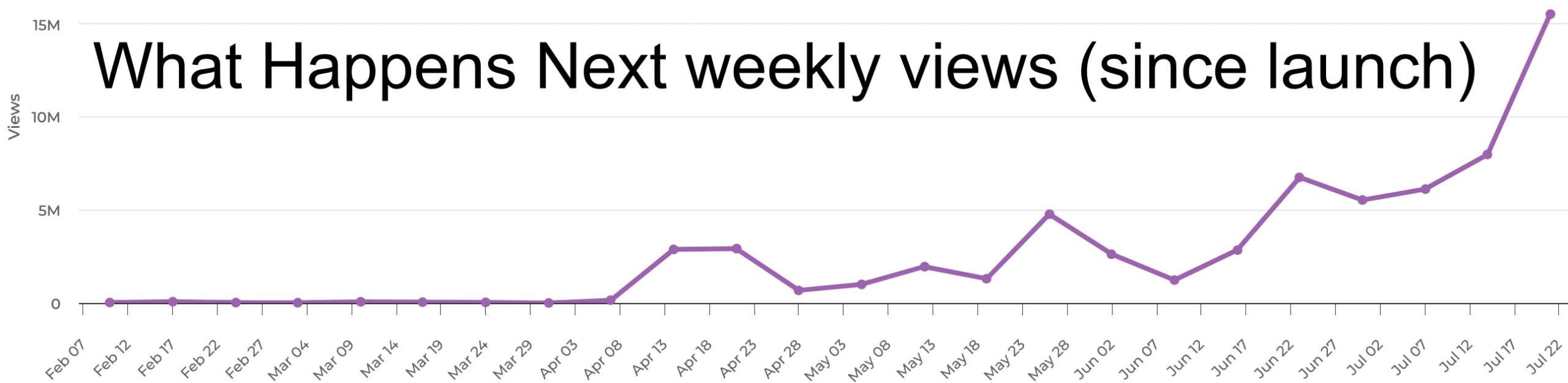
When you peruse the Global Sub Top 50, you find extreme teases everywhere. One of the channels in this week’s ranking applies that strategy to its name. What Happened Next wasn’t even active on YouTube at the start of the year, but it’s quickly become one of the 50 most-subscribed channels of the week by presenting viewers with fascinating situations that don’t resolve themselves until the very end of the video. That strategy brought 320,000 new subscribers to What Happened Next during the last full week of July.

Data via Gospel Stats

The power of a good tease is not new knowledge, but the strong results achieved by these channels show just how crucial that aspect of YouTube production has become. Vertical video producers should learn lessons from Azelart if they want to climb the rankings themselves, and if Andy Cohen ever wants to get huge on YouTube, he can change the name of Watch What Happens Live to What Happens Next Live.

Channel Distribution

Here’s a breakdown of the Top 50 Most Viewed channels this week in terms of their countries of origin:

  • United States: 15
  • India: 9
  • Hong Kong: 4
  • Japan: 3
  • Australia, Brazil, and Indonesia: 2
  • Argentina, Belarus, China, Egypt, Germany, Kazakhstan, Mexico, Singapore, South Korea, Spain, Taiwan, Uzbekistan, and Vietnam: 1

This week, 35 channels in the Top 50 are primarily active on YouTube Shorts.

As always, keep up to speed with the latest Tubefilter Charts and all our news by subscribing to our newsletter. You’re going to love it. 👉  Newsletter.Tubefilter.com.