Archive for 2025:

Will the WGA unionize the writers of YouTube?

Two years after the resolution of the Hollywood labor disputes, the Writers Guild of America is debating whether to include YouTube-based scribes in its numbers. With the WGA West election cycle underway, YouTube is a significant topic of discussion, as the platform pays the bills for a rising number of writers who are not currently represented by a traditional union.

Several candidates who are running for WGA West board seats have expressed the belief that YouTube-based programming is just as prominent as traditional studio fare. One of those candidates, Dahéli Hall, argued that the “non-union writers” in “the YouTube space” should “become partners and be protected as a union.

Another advocate for the collective bargaining of digital-native writers is Adam Conover, an incumbent WGA board member who has plenty of YouTube experience of his own. A decade ago, in tandem with the media company then known as CollegeHumor, Conover led Adam Ruins Everything, a sassy explainer series that was eventually picked up by TruTV.

“They now make scripted, narrative content like sitcoms and soap operas that compete directly with the studios that traditionally employ us,” Conover remarked on the subject of YouTube-based writers. “Like it or not, this is the future of television.”

The WGA is no stranger to the world of YouTube and has previously made overtures to the writers who earn their paychecks on the internet. The WGA Awards, for example, have long feted web series through a new media category.

The 2023 entertainment industry strikes changed the relationship between Hollywood unions and the creator economy. Unlike during the 2007-08 strike, when YouTube uploads were seen as wholly different from studio productions, the 2023 work stoppage clarified the parallels between the striking creatives and their digital-native brethren. Both groups, for example, have concerns about how generative AI will affect their shared livelihood. To underscore their solidarity with the WGA and SAG-AFTRA unions, many creators signed a “labor over likes” pledge, promising not to serve as scabs.

After the strikes subsided, the unions made moves to embrace the creators who had supported their grievances. That effort began at SAG-AFTRA, which announced earlier this year that it planned to bring influencers into its ranks. Now, the WGA is considering whether to make a similar move.

YouTube-based writers could certainly benefit from stronger representation, but the WGA must consider the same conundrum that has complicated previous unionization efforts in the digital space. Platforms like YouTube employ massive numbers of writers who have diverse and wide-ranging needs. Or to put it another way: Is it possible for one advocacy group to serve both MrBeast and Ms. Rachel?

Some previous attempts to answer that question, such as Hank Green’s Internet Creators Guild, ultimately stalled. The union-esque organizations that currently exist, such as the Creators Guild of America, focus more on professional services than traditional union duties like collective bargaining.

It won’t be easy for the WGA to solve that riddle, but as Conover expressed, it’s time to figure out a solution. Traditional studios are moving online, and creators are gunning for the biggest prizes in the TV world. In that environment, the needs of YouTube-based talent shouldn’t be minimized any longer; can the WGA be the organization that fills in the gaps?
Another creator group is headed to the big screen? Dude, perfect!

Dude Perfect has already attached its name to an NFL broadcast, a 3,600-square-foot facility, and even a cruise. So what’s next for the Texas-based, trick-shooting quintet? Thanks to a deal with Regal, the dudes are coming to a movie theater near you.

The second-largest theater chain in the United States will distribute a recorded version of Dude Perfect’s recently concluded cross-country swing. Dude Perfect: The Hero Tour, as both the arena show and the theatrical release are known, will arrive at Regal locations on September 26.

The Hero Tour brought classic Dude Perfect hijinks to large-scale venues across the United States. After a show in Nashville on August 3, the creator group took to Instagram to announce the big-screen version of their show. In a nod to their all-ages audience, the Dude Perfect crew dubbed their upcoming flick “the ultimate family movie night.”


View this post on Instagram


A post shared by Dude Perfect (@dudeperfect)

Regal’s effort to leverage creators to sell movie tickets dates back to the days of Vine, but that strategy has become more popular in recent years. Creator groups as diverse as Critical Role and Sam and Colby have enticed their fans out to the movies by releasing big-screen specials.

Dude Perfect is well-positioned to become the next creator outfit to get the Taylor Swift Eras Tour treatment. Ever since the group hired former NBA employee Andrew Yaffe as its first CEO, it has looked for new ways to expand a brand that was born on YouTube.

According to Bloomberg, Yaffe played an instrumental role in the theatrical deal. He met Regal Chief Commercial Officer Adam Rymer for dinner in Dallas, and the plans unfolded from there. “We need to innovate in the theatrical space, and this serves as a starting place,” Rymer told Bloomberg.

Rymer said that The Hero Tour has been slotted in for a two-week theatrical stint, but the run can be extended if demand is high enough. Here’s hoping the viewing experience will be free of the movie theater stereotypes Dude Perfect so expertly skewered on its channel.

Or, if tour recordings aren’t your jam, you could find other ways to support creators in movie theaters. A handful of influencers are becoming Hollywood directors, with more on deck. For example, the trailer just dropped for Shelby Oaks, a horror flick directed by YouTube film reviewer Chris Stuckmann. How long will it be before the entire multiplex is occupied by creators?

Amazon’s reshuffling from its podcast prime, putting more oomph into creator shows

It will forever baffle us how Quibi fumbled so badly. Its elevator pitch–celebrity- and creator-led narratives delivered in vertical format, designed for people to watch (or listen to) on the go. But while COVID lockdowns helped contribute to Quibi’s swift demise, all its core ingredients went on to see success individually. Short-form video content became king. Major Hollywood studios (many of which had funded Quibi) began snapping up deals with celebs and creators for their own productions.

And the concept of narrative-dense content for people to listen to on the go…Well, that’s podcasts.

Podcasts surged during the pandemic, and major players that had already experimented with them, like YouTube, Spotify, and Amazon, threw themselves into the expanding medium, making huge investments.

One of those investments was Amazon’s $300 million buy of podcast network/publisher Wondery. Now, five years later, Amazon says the podcast landscape has “evolved significantly,” and that it needs to change things up to meet audience needs.

‘Changing things up’ involves laying off 110 people, among them Wondery’s CEO Jen Sargent. What remains of the company will be carved in half. Wondery’s in-house, narrative-driven studio (responsible for shows like Dr. Death, American History Tellers, and Scam Factory) will merge with Audible, which Amazon acquired in 2008, also for a reported $300 million. Marshall Lewy, Wondery’s Chief Content Officer, will join Audible as well.

Meanwhile, celebrity-hosted shows like Jason and Travis Kelce‘s New Heights, LeBron James‘ Mind the Game (pictured above), and Dax Shepard‘s Armchair Expert will continue to publish under the Wondery branding, but the responsibility for handling them will move to a newly formed creator services team within Amazon that’s focused on “selling large sponsorships,” Bloomberg reports.

Steve Boom, Amazon’s VP of Audio, Twitch, and Games, said the major reason for this restructure is the rise of video podcasts–especially those led by creators (though it’s worth noting Amazon calls traditional celebrities and athletes “creators,” too, so when it says “creators,” it’s not necessarily talking about its three-season deal with MrBeast).

“[W]e have learned that creator-led, video-integrated shows have different audience needs and require distinct discovery, growth and monetization strategies compared to audio-first, narrative series,” Boom said. “The rise of video has also blurred the lines on what it means to be a podcast creator.”

In a staff memo, Boom said the new creator services team “unites Wondery’s growing slate of hit creator-led shows […] with Talent Services’ portfolio of strategic deals that span multiple businesses across Amazon.”

The team will work with “a select number of top creators to drive scaled listenership and unlock broader and long-lasting relationships across Amazon,” he added.

Our take on this? YouTube and Spotify have spent the past few years duking it out for podcast domination–specifically video podcast domination. YouTube has bulked its audio ad offerings and recently introduced its own weekly podcast charts, signaling a continuing commitment to making podcasts happen on its platform. Spotify, meanwhile, has revamped its podcast creator program and begun sending out its own creator award plaques.

Spotify has also sourced talent from YouTube, like its $100 million deal with Joe Rogan, while YouTube hasn’t really locked down talent, instead preferring to follow its usual UGC protocol and let creators populate its platform with whatever strikes their whimsy. Judging by our Gospel Stats Weekly Brand Reports, that’s led to heavy-hitting weekly shows getting millions of views and notable sponsorships.

Amazon, as Boom openly said, wants in on those sponsorship dollars, and appears to have come to the conclusion that celebrity- and creator-led programs are going to secure it. Considering how frequently we’ve written about creators’ now-commanding position among traditional media titans, and how we know content creators like Dude Perfect and MrBeast are securing long-term, multimedia sponsorships on their own, we think it’s probably right.

But we want to know if Amazon’s “creator services” team will ever expand to support the digital content creators who have built our industry from the ground up.

Top 50 Most Subscribed YouTube Channels Worldwide • Week Of 08/03/2025

[Editor’s Note: Tubefilter Charts is a weekly rankings column from Tubefilter with data provided by GospelStats. It’s exactly what it sounds like; a top number ranking of YouTube channels based on statistics collected within a given time frame. Check out all of our Tubefilter Charts with new installments every week right here.]

Scroll down for this week’s Tubefilter Chart. 👇


Alejo Igoa‘s run at the top of the Global Sub Top 50 is over — at least for now. Argentina’s answer to MrBeast got replaced by the OG MrBeast at the head of our ranking of the most-subscribed YouTube channels of the week.

The real Slim Shady MrBeast, a.k.a. Jimmy Donaldson, added three million new subscribers during the week that included the end of July and the beginning of August. Igoa was down in the next group alongside the channels that got one million weekly subscribers (KIMPRO, T-Series, and Kids Diana Show were the other members of that cohort.)

It’s Mexico’s big moment on YouTube Shorts

Spanish-language content is already trending up on platforms like Twitch, and it is now making un impresión on YouTube as well. This week’s Global Sub Top 50 features an unusually high representation of channels that fly the flags of Spain and Mexico. Spain claimed five of the Top 50 entrants, while three members of that group hailed from Mexico.

Ricky Limon has arguably benefitted the most from this surge of Spanish-language viewership. Seven days ago, Limon just barely cracked the Global Sub Top 50 in 49th place. After doubling his subscriber gains week-over-week and adding 600,000 new subs as the calendar turned over to August, Limon moved up to 16th place in our ranking of the most-subscribed YouTube channels of the week.

He is using that uptick to promote some of his original music, like his track “Triple Diamante.” But don’t get it twisted: Limon’s Shorts, which tend to be quite silly, are powering his drive up the charts.

In addition to Limon, there are a few other Mexican creators who have climbed into this week’s Global Sub Top 50. Juan de Dios Pantoja, who finds himself in 42nd place, offers a similar blend of original music and short-form comedy.

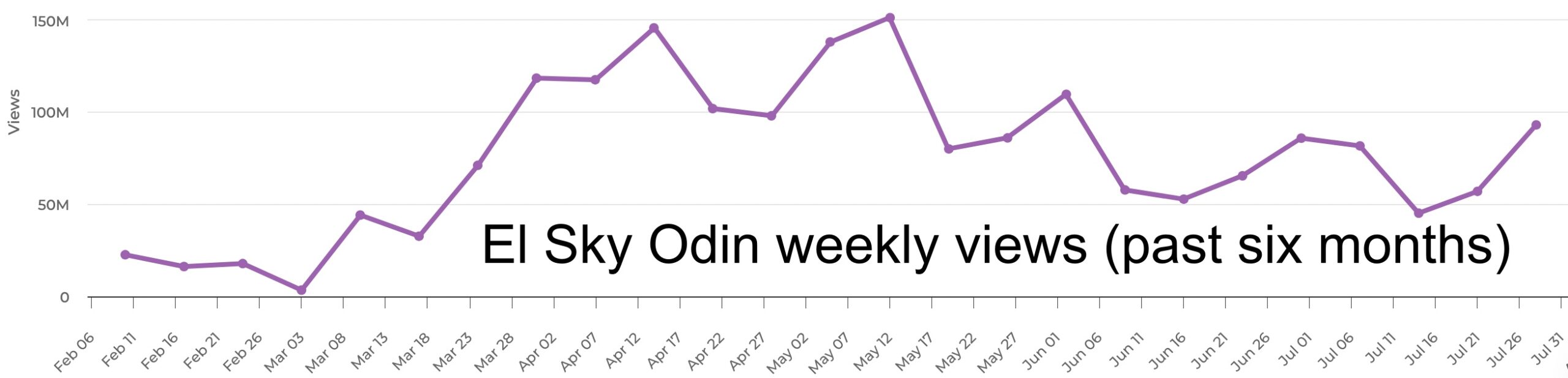
Other Mexican creators are taking different approaches. El Sky Odin is adding his name to the list of popular content aggregators on YouTube Shorts, and he’s climbing to the top of that busy category. He just added 500,000 new subs in a week, outpacing his previous weekly sum by 85%. He still hasn’t reached the viewership highs he achieved during the spring, but he’s getting there.

Data via Gospel Stats

So what is it about the current moment that is benefitting Mexican creators? The national pastime could be part of the solution: Soccer channels like CR7 Shorts (#25 in the Global Sub Top 50) and the official hub of FC Barcelona (#23) both cracked our latest ranking.

But the mix of Mexican and Spanish channels in the Top 50 suggests that Ibai‘s record-breaking influencer boxing event could be affecting YouTube viewership. La Velada del Año is best known for its activity on Twitch, where it sets new high-water marks each year, but its tide could be lifting ships on YouTube as well. Given Ibai’s supreme stature in the Hispanophone creator community, I wouldn’t put it past him.

Channel Distribution

Here’s a breakdown of the Top 50 Most Viewed channels this week in terms of their countries of origin:

  • India: 12
  • United States: 11
  • Hong Kong: 6
  • Spain: 5
  • Mexico: 3
  • Australia: 2
  • Argentina, Belarus, Brazil, China, Pakistan, Singapore, South Korea, Taiwan, Turkey, Uzbekistan, and Vietnam: 1

This week, 36 channels in the Top 50 are primarily active on YouTube Shorts.

As always, keep up to speed with the latest Tubefilter Charts and all our news by subscribing to our newsletter. You’re going to love it. 👉  Newsletter.Tubefilter.com.

Top 50 Most Viewed YouTube Channels Worldwide • Week Of 08/03/2025

[Editor’s Note: Tubefilter Charts is a weekly rankings column from Tubefilter with data provided by GospelStats. It’s exactly what it sounds like; a top number ranking of YouTube channels based on statistics collected within a given time frame. Check out all of our Tubefilter Charts with new installments every week right here.]

Scroll down for this week’s Tubefilter Chart. 👇


Short-form superstars are still holding off the AI slop channels at the top of our weekly YouTube viewership rankings. Though Australia’s Double Date stayed strong with 1.86 billion weekly views, it was just barely pipped for the top spot thanks to the upward surge of South Korea’s KIMPRO, which collected 1.87 billion weekly views.

Five channels got at least one billion weekly YouTube views, and 34 more hit at least 500 million weekly views as July turned into August. There are a lot of ways to crack the ranking, so let’s take a look at one common approach.

YouTube Shorts is becoming so unbelievable, it’s coming back around to believability

Now that there are billions of videos in YouTube’s Shorts library, I think it’s safe to say that the average viewer has seen it all. The most astonishing human skills have become commonplace as mass viewership and AI-generated fakery continue to up the ante.

In that landscape, how can a single channel astonish its audience? Many creators, especially in India, are going back to a tried-and-true formatting trick pioneered by bygone blogs like Upworthy, and you won’t believe what happens next.

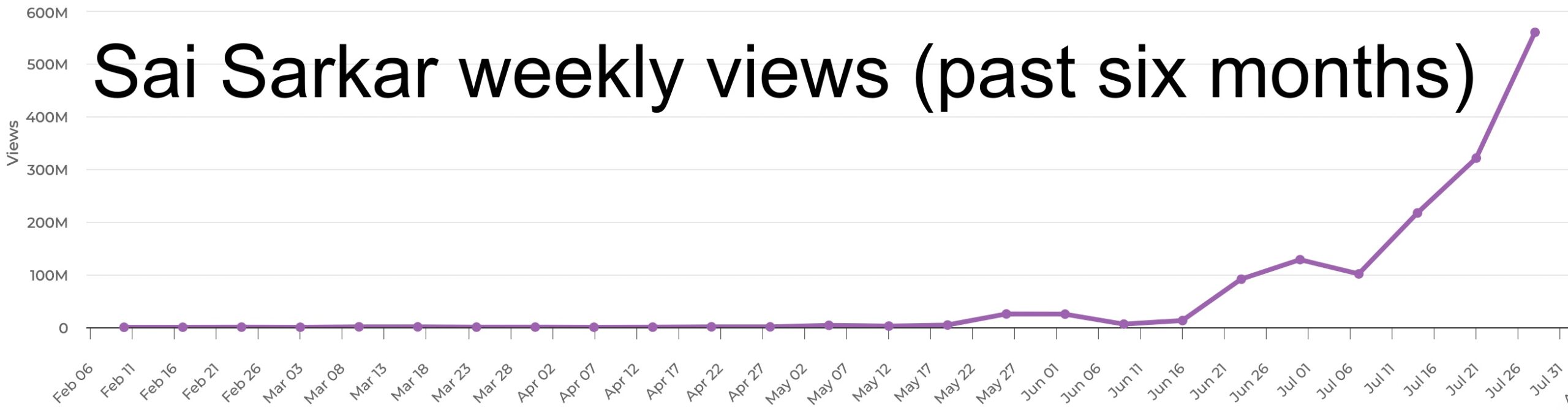
See what I did there? What I’m about to tell you is actually quite believable, but if YouTube Shorts is going to fill up with the most sensational, over-the-top videos imaginable, why not attach misleading sales pitches to otherwise unassuming content? One channel employing that strategy is Sai Sarkar, and YOU WON’T BELIEVE the results he’s getting. (OK, I’m done now.)

Sarkar has gone from obscurity up to 30th place in our Global Top 50. With 561 million weekly views, he increased his traffic (most of it on Shorts) by 74% week-over-week. You could argue that the Rubik’s Cube-built gift in Sarkar’s most-watched video is as unbelievable as the creator makes it out to be, even if it is a creative and thoughtful present. I wonder how many of the clip’s 99 million views resulted in disappointment about the gap between expected incredulity and reality.

Data via Gospel Stats

So creators are telling us we won’t believe what they’re about to post, even if we will. What ramifications does that have for YouTube culture as a whole?

One thought is that weightlifting could become the next big creator sport. Hear me out: It’s an activity whose competitors train their bodies to pull off athletic feats that are truly unbelievable. That makes it easy to advertise through formats like Shorts, and the inherent one-upsmanship could produce a lot of juicy drama in a theoretical creator weightlifting showdown.

If creator weightlifting ever becomes a thing, Fit Arshia will be the top-ranked competitor. The young Indian phenom is a rising force in the weightlifting world, and she posts some of her most impressive accomplishments for her 3.4 million subscribers to see.

These clips really are unbelievable, and their viewership reflects that description. Fit Arshia ranked 43rd in the Global Top 50 with 483.6 million weekly views, which was good for a 20% week-over-week increase.

As Arshia continues to consolidate her gains, she could see correlating traffic bumps on YouTube Shorts. If you want to produce your own unbelievable videos, which even the most jaded Shorts viewer won’t be able to resist, picking up some dumbbells may be the first step.

Channel Distribution

Here’s a breakdown of the Top 50 Most Viewed channels this week in terms of their countries of origin:

  • India: 19
  • United States: 12
  • Hong Kong: 5
  • Australia and Spain: 2
  • Belgium, Canada, China, Germany, Kazakhstan, Peru, South Korea, Taiwan, United Kingdom, and Vietnam: 1

This week, 44 channels in the Top 50 are primarily active on YouTube Shorts.

As always, keep up to speed with the latest Tubefilter Charts and all our news by subscribing to our newsletter. You’re going to love it. 👉  Newsletter.Tubefilter.com.

YouTube might card you to prove you’re over 18. VTubers are worried.

Earlier this week, we wrote about how YouTube–which just lost a fight to be exempt from a new Australian law keeping kids under 16 off social media–is introducing a new AI system it says can effectively guess users’ ages based on their account activity. Accounts flagged as being operated by a kid/teen will have safeguards automatically applied.

But since this is a machine-learning system, and a brand-new one to boot, YouTube is expecting some growing pains. It’s already laid out a procedure for what will happen if an account is mistakenly flagged as being run by someone under 18.

That procedure sounds simple: “If the system incorrectly estimates a user to be under 18, they will have the option to verify that they are 18 or over, such as using a credit card or a government ID,” YouTube said.

And, for many people, it is simple.

Not for VTubers, though.

If you’ve been anywhere on the internet over the last few years, you probably remember the fandom fervor surrounding the Minecraft server Dream SMP. Its eponymous head man was a faceless creator for years, keeping his IRL visage, name, and other personal details private. He eventually decided to do a face reveal (and regretted it), but I want you to think about what it was like before that reveal. How many people were desperate to know what he looked like, where he lived, and what he was like when he wasn’t streaming.

Now take that situation and remember most VTubers are women, with primarily male audiences, and that they regularly have to deal with people demanding to know who they really are, behind the buxom anime girl (or orca, or interdimensional genius, or sympathetic cyborg).

That gives you a primer for understanding why some VTubers are concerned about YouTube’s new rule.

Bao The Whale, a well-known VTuber signed with UTA, tweeted she’s worried about whether and how Google plans to protect the contents of VTubers’ government-issued IDs, if they had to submit them for verification.

She pointed to a still-ongoing incident where VTuber AmatsukaUto‘s YouTube channel was hacked by cryptocurrency scammers, saying, “So YouTube wants us to provide our IDs while our accounts are constantly being hacked by crypt0 scammers.”

Cryptocurrency scammers hijacking YouTube channels is not a new phenomenon, and apparently, despite Alphabet’s position as a tech giant, is a continuing problem.

Several other VTubers replied to Bao’s tweet, expressing similar concerns. These concerns are also not new: Being doxxed is one of the top things for all creators to be mindful of, because there are documented instances of it resulting in stalking, swatting, and more. Since government IDs usually contain full legal names and current addresses, it’s a serious security risk for any creator if they get leaked. But the faceless culture surrounding VTubing makes the situation potentially worse for them, as they could be targeted by bad actors who find their desire for privacy a challenge rather than a boundary worthy of respect.

This being said, it’s not clear how YouTube’s system will work. What tools will people use to send their IDs to YouTube? Will images of those IDs be stored long-term? What protections is YouTube putting in place not just for submitted IDs, but for creators’ accounts?

We also suspect the vast majority of VTubers and other established creators will be grandfathered in as exceptions, with this system mostly screening viewer accounts. It’s obvious that most creators are adults, and they appear on camera in some capacity, whether that’s via face or voice. User accounts are the actual faceless ones, and YouTube says it’ll analyze signals like what kinds of content users search for and watch in order to determine operators’ ages.

Still, VTubers could get caught up in this new system. But whether they do or not, Bao and co. raised ongoing concerns about creator safety. AmatsukaUto’s channel, where she has ~600,000 subscribers, was hacked July 29, and when she tweeted about it, she received a vague response from Team YouTube with general account recovery advice.

As of press time, she has not regained access to her channel. If you go to its URL, YouTube says it’s been deleted.

Have you heard? LoFi Girl graduates, FaZe Clan CEO departs, and Blippi hits the road

Each week, we handpick a selection of stories to give you a snapshot of trends, updates, business moves, and more from around the creator industry.

This week, there’s a changing of the guard at a notable entertainment organization, new info about a movie directed by a creator, and an update in the long-running Vine saga.

Creator commotion

After all that studying, LoFi Girl finally “graduates.” The animated character is the face of a lo-fi hip-hop playlist that attracts thousands of listeners at any given time. Seven years after her virtual study sesh began, LoFi Girl announced that she is “finished with all my homework.” If you’re worried that her graduation will cause her to disappear from her famous playlist, don’t fret: As of this post, LoFi Girl is still chilling at her desk.

Ricky Banks is stepping away from FaZe Clan. The gamer known as FaZe Banks served as the gaming organization’s CEO, but he’s taking some time off after being accused of perpetrating a pump-and-dump scam related to the MLG cryptocurrency. “For the time being, I’m gonna be stepping away from not only FaZe, but all this internet shit,” Banks said. Despite his decision, he still blames Adin Ross for the whole mess.

FaZe Lacy is going to China with James Harden. Speaking of FaZe Clan, another one of its star creators is going on tour with an NBA star. Lacy and Harden are in China for a six-day swing at the start of August. Harden already has a cool Chinese nickname; he’s called “The Mayor of Jingdazhen” as a roundabout reference to his foul-drawing ability. I hope that Lacy comes away from this trip with a rad nickname of his own.

Pop culture minute

Blippi is bringing “the ultimate road trip” to YouTube. The blue-and-orange-clad character will join his friend Meekah for a cross-country voyage that will include stops in New York, Philadelphia, and Nashville. The week-long event will culminate in the “Be Like Blippi Games,” a series of kid-friendly activities and challenges in Los Angeles. The fun begins on August 16.

The first poster has dropped for Chris Stuckmann’s Shelby Oaks. The YouTube film critic is becoming a big-boy director with a horror feature that has been picked up by noted distributor NEON. The movie’s spooky vibes are now on full display, and a trailer is coming on August 4 — though some sharp-eyed Redditors noticed that the trailer was briefly leaked a few days earlier.

TikTokers Adam Rose, Leah Kirkup get lead roles in comedy feature. In an R-rated, nuptial-themed laugher called Perfect Wedding Days, Kirkup will play the bride and Rose will portray a best man who has feelings for his friend’s future wife. More details are available via Deadline.

The biz

Good Good now has its own sunglasses line. The group of golf creators has teamed up with Shady Ray’s to roll out a line of specs designed for use on the links. It would be nice if the PGA Tour could be as forward-thinking as these apparel brands, but the golf org is still catching up with the world of creator culture.

Joe Budden’s podcast empire is a $20 million business. The gossipy ex-rapper offered a look into the finances of a sprawling podcast organization. Surprise, surprise: Business is booming. The CEO of Budden’s podcast company told The New York Times that The Joe Budden Network is on pace to haul in $20 million in 2025 alone.

IRL events are the hot new influencer marketing hack. Creator groups like Dude Perfect and Sam and Colby are putting on more in-person functions, partially because those events are prime real estate for brand partnerships. “One thing that a lot of brands don’t really get to see is how you can put butts in seats, or how you can get people off the couch or actually into a store or an experience,” Sam Golbach of Sam and Colby told Digiday. “So, not only will we be able to provide an experience to the fan, we also get to showcase the Sam and Colby fandom.”

Platform headlines

YouTube’s co-founder has thoughts about Shorts. Tech exec Steve Chen is always good for a juicy soundbite, and he delivered another one on the subject of his former company’s new format. He doesn’t think that videos featuring “addictive eyeballs” are healthy for his children, and he was them to have diverse media diets. “Just shorter form content equates to shorter attention spans,” he said.

Elon Musk is maybe, kinda, sorta still trying to bring back Vine. The Chief Twit has teased a potential Vine revival ever since he acquired the defunct platform’s assets by purchasing parent company X. Now Musk says he’s bringing back Vine “in AI form,” and as per usual, no one seems to be sure what that means or how it will impact human creators.

Can Roblox get you a hot date? The sandbox platform’s CEO thinks that Roblox worlds can serve as antidotes for the “loneliness epidemic” that currently plagues younger generations. This isn’t the first time a major platform has been positioned as a potential dating app, but much like the average Tinder connection, these plans always seem to flame out before long.

The internet is a strange place

If you don’t want to find love on Roblox, you can try the U.S. Open instead. With a YouTube series called Game, Set, Matchmaker, the United States Tennis Association is turning one of the sport’s four majors into a meeting ground for lonely singles. It’s a nice idea, but after watching Challengers, I’m not sure if tennis and romance is a good mix.

Chili’s sold out of boots made from the leather of its restaurant booths. Sing it with me now: I want my seat back, seat back, seat back, I want my seat back, seat back seat back…Chhhiiillllliiii’s, seat back boots!

ChatGPT is now smart enough to complete a CAPTCHA. The singularity will be here before you can say “Turing test.”

MrBeast and Mark Rober cleaned up oceans and forests. Now they’re addressing the global water crisis.

According to Water.org, there are 2.2 billion people around the world who lack access to safe drinking water. As climate change threatens to make that problem even more pervasive, two of YouTube’s biggest stars are taking action. Mark Rober and MrBeast have joined forces to launch #TeamWater, a campaign that is looking to raise $40 million to bring clean water to millions of households.

Rober and MrBeast (whose real name is Jimmy Donaldson) previously teamed up for a pair of philanthropic ventures. In 2019, they raised $20 million for #TeamTrees and used that money to plant 20 million trees. Two years after completing that terrestrial effort, they turned their attention to the Earth’s oceans. Through #TeamSeas, a $30 million fundraising campaign, Rober and Donaldson led an effort to remove more than 30 million pounds of trash from the ocean.

With the third chapter in their charitable trilogy, Rober and Donaldson are upping the ante once again. #TeamWater has a $40 million goal that, if achieved, will “get 2,000,000 people around the world clean water for decades,” Donaldson explained.

The video introducing #TeamWater arrived on Rober’s channel on August 1. The engineer-turned-creator took a trip to Kenya to check out GivePower, a company that uses reverse osmosis to turn seawater into a potable substance. To test the efficacy of GivePower’s technology, Rober made Donaldson channel Bear Grylls by drinking his own urine.

Rober’s video is linked to the month-long #TeamWater charity drive, which has already raised nearly $1 million less than four hours after its launch. To connect their philanthropy to real-world activism, Rober and Donaldson teamed with WaterAid, which is collecting donations on behalf of the two creators.

“We’ve seen the power of the internet when it rallies behind a cause, from planting millions of trees to removing millions of pounds of trash from the ocean,” Donaldson and Rober said in a joint statement. “Now, we’re taking on clean water, because no one should have to live without it.”

Many big-name creators, including Kai Cenat, Hank Green, Cleo Abram, and FaZe Rug, have pledged their support for the #TeamWater campaign. It’s nice to see Rober and Donaldson galvanizing their community to address a global crisis — and #TeamWater already looks as if it will be just as successful as its two predecessors.


As YouTube ages, its defunct channels are becoming hot commodities

The sale of a YouTube channel to the highest bidder is a violation of the platform’s Terms of Service, but the current conditions of the creator economy are making those transactions more common. A new report shared via Cornell University‘s arXiv database detailed the use of third-party sites to buy and sell defunct social media accounts that have thousands — and, in some cases, millions — of followers.

The research team, helmed by lead author Alejandro Cuevas of Carnegie Mellon University, used Fameswap to find its experimental sample. That’s the name of a virtual marketplace where creators can put their accounts up for sale. Some YouTube channels listed on Fameswap have more than seven million subscribers.

After examining 4,641 YouTube channels that were listed on Fameswap between October 2024 and March 2025, the researchers determined that those hubs had a combined 823 million subscribers, and the ones that found buyers collectively generated more than $1 million in sales.

YouTube confirmed to Fast Company that these transactions run afoul of platform rules. “If we detect that bad actors are creating channels with the intent to scam, mislead, spam, or defraud other users, we terminate those channels,” a spokesperson said.

Even with that policy in place, many of the people who are active on Fameswap are buying accounts for nefarious purposes. The researchers claimed that 37% of channels that were refashioned by a new owner were used to promote potentially harmful topics, such as political misinformation, crypto scams, and gambling ads.

Even as YouTube takes action against those bad actors, its technology encourages illicit channel sales. Algorithmic tendenices seem to favor channels that have built-in subscriber bases, even if the new owners of those hubs are sharing content that is completely incongruous with pre-purchase uploads.

“Part of the reason why this is so prevalent right now is because systematically, in these platforms, we’ve seen a decrease in the agency over what we consume,” said study co-author Manoel Horta Ribeiro. “The short-form content paradigm facilitates this a lot, because in the past, you would search for channels directly, maybe by name, or be more aware of that.”

Even if Shorts exacerbates existing issues, this is not just a YouTube problem. There is a lot of activity on Reddit from users who want to purchase old accounts, and “Hawk Tuah” girl Hailey Welch made a splash earlier this year when she sold her X account to the owner of a meme page.

X has come up with a potential solution by proposing a program that would distribute inactive accounts among verified users. YouTube could try something similar, but that move probably wouldn’t slow down sites like Fameswap. YouTube accounts with big followings have become serious business, and owners who choose to give up the creator lifestyle find themselves sitting on goldmines.

TikTok wants its fact-checking to be user-generated, too

We live in a disturbingly post-truth era, where public figures lie for clout and laypeople lap up conspiracy theories that suit their worldview, without bothering to check what’s real and what’s fake. And nowhere does “post-truth” spread better than online.

We saw this firsthand around the 2020 presidential election, when the Trump camp’s claims of voting interference found a home on YouTube. After the platform finally cracked down on that content, researchers at NYU saw the amount of related misinformation on platforms like Facebook and Twitter “drop sharply,” too.

This study showed that video is a primary source for misinformation online, and that by running a tight moderation ship, platforms can curb it.

Unfortunately, in the five years since, YouTube, Facebook, and more have significantly lessened the amount of misinformation moderation they’re responsible for. YouTube ruled that actually, creators are allowed to lie about elections, and just before Donald Trump took office for his second term, Meta ended its official fact-checking program altogether. YouTube also, in the months since Trump was reinstated, began telling human moderators to take down fewer videos that contain misinformation, derogatory language, and other forms of violative content. And then there’s Elon Musk’s X, which is a whole other story.

This leaves us in a social media environment where misinformation thrives. But platforms seem to recognize that simply abandoning moderation won’t sit well with many users, so instead of getting rid of all fact-checking systems, they turn to crowdsourcing.

X and Meta already have Community Notes systems where users submit fact-checks on one another’s posts. YouTube also has “information panels,” which are crowdsourced but only from an approved list of publishers, so it half counts.

Now TikTok is implementing its own version, called Footnotes.

First announced this past April, Footnotes “draws on the collective knowledge of the TikTok community by allowing people to add relevant information to content on our platform,” TikTok said.

It is doing some screening for the program. Users have to apply to become a fact-checker, and must meet certain criteria: be from the U.S., be over 18, be on TikTok for at least six months, and have no recent history of violating the platform’s Community Standards.

TikTok says nearly 80,000 people have been approved as Footnotes contributors so far.

Footnotes works very similarly to X and Meta’s programs, using a ranking system that is supposed to find an objective contribution or middle ground–a statement that people who typically have differing opinions can both agree with.

Submitted Footnotes become visible to other Footnotes contributors first. Then, if enough contributors rate a note as “helpful,” it goes out to the TikTok community at large, where anyone can vote on its helpfulness.

Worth noting: Though TikTok is leaning into crowdsourced fact-checking, it’s not stopping its own internal moderation program. Instead, Footnotes is intended as an ancillary force whose main objective is providing context around hot-button topics, while TikTok’s moderation team will continue enforcing all its policies, including those around misinformation.

In April, TikTok said Footnotes will “[add] to these efforts with more ways to add helpful details that may be missing, ultimately enriching discussions on TikTok and improving the experience for viewers, contributors and creators alike.”

One of the world’s biggest production companies has its sights set on YouTube

Banijay Entertainment sent a clear message during its first-half earnings call: It is looking to increase its output on YouTube. The Paris-based production company, which reported half-year earnings of approximately $236 million, wants to bring some of its well-known properties to the platform where many YouTube people turn for their entertainment needs.

The list of Banijay-owned properties includes reality favorites like Big Brother and MasterChef, as well as scripted fare like Black Mirror and Peaky Blinders. Those shows historically reached millions of viewers through linear TV channels, but with viewership and ad dollars shifting to YouTube, Banijay is following the money.

Banijay Entertainment CEO Marco Bassetti detailed the company’s “digital transformation efforts” during the recent earnings call. He said those activities will “rapidly unlock greater efficiencies, further amplify the value of our catalogue, and enhance our presence on YouTube specifically. In embracing new technologies and diversifying our revenue streams in areas like sport too, we continue to prepare the group for the future, cementing our house as the number one for talent, IP, and creative innovation.”

Despite the renewed push, Banijay already has a significant presence on YouTube. Its 2020 acquisition of Endemol Shine Group gave it a digital foothold thanks to that prodco’s previous operations as Endemol Beyond. Banijay has since unlocked new opportunities for digital-native channels like Simon’s Cat.

In recent years, however, Banijay has found new ways to extend its traditional properties to the digital sphere. It made a notable bet earlier this year when it announced MasterChef Creators, an influencer-led spinoff of the titular cooking competition.

Banijay is now looking to forge even more connections between linear TV and digital-native creators — and it is not alone in that effort. A wide range of production companies and distributors, including Sony Pictures Television and the U.K.’s Channel 4, have launched new units and channels that will allow them to ramp up studio operations on platforms like YouTube. The Google-affiliated hub is already the biggest thing on TV screens, and if the biggest formats in the world continue to set up shop there, YouTube’s slice of the pie is only going to get bigger.

On a new European app, TikTok tips the scales in favor of “joyful and entertaining content”

As it ramps up its presence in Europe, TikTok is trying to stay positive. A new app called TikTok Pro offers a more joyful experience for users in Germany, Portugal, and Spain, and it also connects to a charitable effort called the Sunshine Programme.

In a blog post, TikTok explained that it designed TikTok Pro to put safety first, offering a more educational and upbeat experience compared to the standard For You Page. The German App Store listing for the new product adds more context to that mission by citing “helpful videos” and “engaging STEM content” as two genres that are widely available on TikTok Pro.

TikTok Pro is also designed with nonprofits, NGOs, and other charitable organizations in mind. Through the Sunshine Programme, TikTok will debut an in-app currency called “virtual Sunshine.” Users can accumulate Sunshine by liking, reposting, and searching for content posted by charities. Those earnings can then be contributed to campaigns run by Sunshine Programme partners, with TikTok pledging to match the donations. Launch partners for the initiative include Doctors Without Borders, WaterAid, Aktion Deutschland Hilft, and the Nature and Biodiversity Conservation Union.

This is not the first time that TikTok has adjusted its algorithm to deliver more beneficial content to European communities. In 2023, it delivered a depersonalized version of its app in response to mounting pressure from the European Union, which has checked the power of social platforms through its Digital Services Act.

E.U. regulations have also hampered TikTok’s previous attempts to bring a gamified feed to European users. The ByteDance-owned company was compelled to scale back a rewards program called TikTok Lite after regulators determined that the product was “likely to have a critical impact on systemic risks.” By tying its latest form of in-app rewards to a charitable mission, TikTok is likely to draw a more favorable response from the E.U.

Of course, TikTok’s regulatory woes are not limited to Europe. As the app looks to skirt a federal ban in the United States, it has ramped up its investment in European regions, seemingly treating the continent as a contingency plan. TikTok Pro is the latest effort in that area — it’s currently available in Germany and Portugal and it will arrive in Spain soon.