Back in 2021, YouTube celebrated Minecraft‘s trillionth view on the platform with significant fanfare. The sandbox builder’s history is inextricable from YouTube’s: It’s where the Let’s Play genre–and arguably all of YouTube Gaming–began. And, despite the rise (and sometimes fall) of other mega-popular games, Minecraft has remained YouTube’s most-played title for well over a decade.
But there’s another creative game platform that, same as Minecraft is inextricable from YouTube’s past, might be inextricable from YouTube’s future: Roblox.
This week, YouTube marked Roblox’s own trillionth view–not just with a video featuring top Roblox YouTubers like Lana’s Life, MeEnyu, Caylus Cunningham, and MeganPlays, but also with an entire custom, visitable creator museum within Roblox itself.
The video was directed and produced by digital media studio Portal A, which has an overall deal with YouTube that also had it making content for the platform’s 20th anniversary celebration.
The museum, which Roblox consultant James Purell says was put together by studio Vector3, memorializes YouTube content from nearly 90 creators, recreating iconic videos in Roblox-style tableaus. Players walking through the exhibits see each creator’s handle and the view counts of memorialized videos.
YouTube also built a scavenger hunt into the museum, and those who complete it will receive mysterious “limited edition UGC” for their Roblox avatars.
And, of course, it wouldn’t be a branded Roblox destination without having something for sale, so there’s official YouTube x Roblox shirts, too.
That’s part of where Roblox-as-part-of-YouTube’s-future comes in. YouTube, like every other major platform, hopped on the metaverse trend, but (again, like every other major platform) its ambitions faded pretty quickly. Roblox, as we’ve written many times, has managed to sustain its foothold in the modern metaverse, aka just a digital version of real life where people come together from around the world to do everything they’d do IRL, like meeting for drinks, fishing, playing soccer, and shopping.
Minecraft and Roblox are both platforms where creative people can make in-game locations for others to visit. Minecraft, though, was never optimized for people (or publisher Mojang Studios) to monetize those locations. That’s Roblox’s deal–and so far, it seems to be working out. More brands are finding room for Roblox in their marketing budgets, and its recent quarterly earnings sent its stock to a near all-time high.
Maybe there’s something to say about how the game of the future is so commercialized. But it’s also paying out hundreds of millions of dollars to content creators, which is something we can get behind, and is proving to be a social and gaming gathering place for Gen Z and Alpha–and hey, some of us Millennials, too.
Filed under: Homepage Feature, Roblox, YouTube by James Hale Comments Off on YouTube memorializes Roblox’s trillion views with a metaverse-y museum
The ongoing rivalry between TikTok and YouTube presents few opportunities for partnerships between the two platforms, but they are now working together in the world of music streaming. YouTube Music has been added as one of the available export destinations for the “Add to Music App” feature TikTok launched in 2023.
The Add to Music App function looks to capitalize on TikTok’s cultural status by making it easier for viewers to locate, save, and stream the songs they hear while scrolling through the For You Page. The feature’s initial lineup of music apps included three of the most popular streaming hubs in the business: Spotify, Apple Music, and Amazon Music.
An update to Add to Music App brings YouTube’s audio hub into the fold. “Add to Music App continues to deliver real results for the music industry, with hundreds of millions of track saves translating into billions of streams on music streaming services,” TikTok Global Head of Music Business Development Tracy Gardner said in a statement. “By partnering with YouTube Music, we’re expanding this impact globally, helping artists reach new audiences while giving fans a seamless way to engage with the music they discover on TikTok.”
Notably, the list of export destinations for Add to Music App does not include any TikTok-owned streaming services. When the feature first debuted, TikTok was actively developing a music hub in regions outside of the U.S. Just two years later, however, TikTok Music shut down for good.
With that experience — and some other contentious dealings with major labels — TikTok seemed to learn that maneuvering through the recording industry is easier said than done. That’s a lesson YouTube has already learned. Before YouTube Music became the platform it is today, it went through years of development hell. During that period, interference from industry bigwigs was constant, especially before YouTube hired Lyor Cohen as its Global Head of Music.
Rather than endure that arduous process itself, TikTok has apparently concluded that it’s better off directing its users to existing services. The result is a win-win for both TikTok and YouTube: The former platform can continue to boost its FYP faves while the latter enjoys a traffic bump.
Filed under: Articles, Featured, Homepage Feature, News, TikTok by Sam Gutelle Comments Off on TikTok learned that building a music service is hard, so it’s integrating YouTube instead
If you want to know why the creator economy continues to draw interest from investors and advertisers alike, Patreon and Kajabi have each provided 10 billion explanations. Within days of one another, those two platforms both announced that they have paid out $10 billion to creators since their respective launches.
Patreon Co-Founder and CEO Jack Conte shared his company’s $10 billion milestone with Axios on August 5, while Kajabi CEO Ahad Khan discussed his team’s good fortunes in an interview with TheWrap that was published on August 6. Both execs used their media appearances to highlight the sizable user bases that led the way to 11-digit payouts. Patreon counts 25 million paid memberships, while Kajabi has nearly 1,800 creators who have earned at least $1 million via the platform.
By enabling direct funding from fans, companies like Patreon and Kajabi have helped creators expand beyond content and build multi-pronged digital empires. “What we’re seeing in creators is that, just like media companies, they’re multi-hyphenate,” Conte told Axios. “That multimedia multi-hyphenate approach works really well on Patreon’s infrastructure, because we’ve spent 10 years building horizontally across categories.”
Khan argued that Kajabi doesn’t just facilitate creator businesses; it also offers a security blanket for channel owners who struggle to keep up with the ever-changing nature of platform algorithms. “With Kajabi, you’re able to develop that direct relationship with your audience,” he told TheWrap. “You’re not at the whim of an algorithm change as much as you would be if you’re just building on YouTube.”
Kajabi and Patreon were founded three years apart (Kajabi in 2010 and Patreon in 2013), but they took very different paths to their respective $10 billion payouts. Kajabi, which had a slower rise, brought in no outside capital between 2010 and 2019. Since then, however, its on-platform earnings have accelerated rapidly. It reached the $10 billion mark just a few months after it surpassed $9 billion.
Within months of Patreon’s inception, it was touted as a breakthrough in the world of crowdfunding. There have been some up-and-down moments since then, but like Kajabi, Patreon is currently seeing its payouts accelerate. Conte noted that creators take in $2 billion per year through the platform.
The landscape of creator economy funding platforms is now much more crowded, but Patreon and Kajabi’s paired achievements show there is room for plenty of operators in this particular space. Creators rely on direct funding more than ever before, and they have plenty of options to choose from when going down that path.
We already knew Roblox was the king of the metaverse (better luck next time, Zuck). It’s emerged as the top platform for Gens Z and Alpha to live their digital ‘second lives,’ with thousands of user-generated experiences, plus brand-designed worlds that serve as giant ads. We’ve been seeing lots of chatter about that side of things, thanks to more and more companies getting savvy about using Roblox to reach finicky young customers.
But it’s also important to remember that Roblox has become one of the top gaming platforms for the same demographics–as well as a destination for indie game creators.
Last month, we wrote about how the growing sector of Roblox-focused studios, entities like DoBig and Voldex, have made multimillion-dollar acquisitions of games that proved promising.
Now, it’s worth zooming in from the industry to spotlight the solo and small-team developers who are using Roblox’s game-creation systems to make their next big idea.
They might not be our usual kind of creators, since we’re largely digital video specialists, but Roblox has made itself a massive presence in online culture, and developers show they can amass dedicated playerbases that follow them from title to title, the same way YouTubers and TikTokers have viewers that follow them from video to video.
One of those developers is Chrollo, who’s made top sports games Basketball: Zeroand Tennis: Zero. These games regularly have ~30K and ~5K concurrent players, respectively; to put that in context, that’s around half of the traffic to AAA and major games like Apex Legends (~65K on Steam at press time), Dead by Daylight (~60K), Elden Ring Nightreign (~25K), Red Dead Redemption 2(~25K), and Rocket League (~18K).
It’s also not far behind the only sports game to make top 20 on Steam’s charts: EA Sports FC 25, which has ~40K players right now.
Chrollo’s playerbase doesn’t stop at number of concurrent viewers, though. He’s snagged ~735K subscribers on YouTube from posting livestreams and videos about his development process and games. Meanwhile, his Discord server has nearly 1.5 million members, all of whom get updates directly from him about Basketball and Tennis, along with their upcoming sibling game, Soccer: Zero.
Ben Sarraille, who co-founded Roblox-focused influencer management/marketing company Makeshift, said Chrollo has found success developing his titles because (aside from the basics, making good games people want to play) he’s used YouTube and Discord to build “a loyal, portable audience […] so he isn’t just relying on Roblox’s discovery system to push him to the top of a category.”
Like other video game-related sites, from purchasing platform Steam to livestreamer Twitch, Roblox has reams of content and simply can’t effectively promote everything that’s good to everyone who might be interested. Some games get left behind; some categories aren’t given enough visibility. So Chrollo has followed the path of many Twitch streamers, and used other platforms to build his audience.
And that audience is keen to follow his projects. The first trailer for Soccer: Zero, dropped 11 days ago and has nearly 600K views on YouTube, with over 8,000 comments from people who dig the Grand Theft Auto-vibe visuals.
“WE USED TO PRAY FOR TIMES LIKE THESE,” one top comment says.
It’s rare to see this kind of hype for games that don’t have AAA marketing budgets behind them–which shows that, once again, fans are gung-ho to support projects from their favorite creators.
It also shows that Roblox (which has 118 million daily active users and just posted quarterly results that sent its stock to a near all-time-high) is shaping up to be the game industry’s equivalent of the YouTube/Hollywood relationship. Burgeoning talents are getting their start there and, like Chrollo, building careers. Roblox developers, like YouTubers, aren’t beholden to anyone else’s timelines. They make what they want, when they want, and fans dig it.
Filed under: Homepage Feature, Roblox by James Hale Comments Off on A new game on Roblox has half a million interested players–and it’s not even out yet
The third annual 1 Billion Followers Summit, which took place in Dubai this past January, was originally expected to have around 5,000 attendees. Instead, 30,000 creators, creator industry execs, entrepreneurs, and other digital media-savvy businesspeople ended up coming together at the Museum of the Future in the Emirates Towers.
Over the next three days, those attendees had the chance to check out 350 different sessions, panels, and workshops from 420 speakers across three different tracks (Creator Economy, Technology, and Content), all designed to help them develop as creators, small business owners, and denizens of our digital world.
How to Stay Relevant for a Decadewith magician/creator Zach King
Increasing CPMs For MENA Creators, a group panel discussing the “economic and creative roadblocks stifling growth” for creators in the Middle East and North Africa
Caspar Lee’s Journey from YouTube to Investing with (of course) Caspar Lee and Sasha Kaletsky, Managing Partner at Creator Ventures
Resilience, a keynote from longtime motivational creator Jay Shetty
Building a Viral Brand with YouTuber Airrack and Zack Honarvar, co-founder/CEO at Creator Now
How Dude Perfect’s $100M+ Deal Redefined Media with Tucker Brown (Managing Director of CAA’s investment arm) and Andrew Graham (Head of Business Development for CAA Digital)
Making it from Short-Form to Long-Form Content with a panel of experts
AI’s Impact on the Creator Economy: Challenges & Opportunities with Jeremiah Owyang, General Partner at Blitzscaling Ventures and founder of Llama Lounge AI
and How I Raised the Richest Man On Earthwith Elon Musk’s mother Maye Musk
And, on top of that, it divvied up $13.6 million among participants in a Shark Tank-esque competition called “1 Billion Pitches,” where startups went before a panel of investors and talked up their ideas in STEM, tech, and more. Winners there included “trainable pathology” program Halo AI and South Korean media company Eugenius.
1 Billion Followers Summit is financially supported by Sheikh Mohammed bin Rashid Al Maktoum, Prime Minister and Vice President of the UAE and ruler of Dubai, who in 2024 announced a $40.8 million governmental fund dedicated to promoting content creation.
That fund also supports Creators HQ, a governmental organization and creator makerspace whose plan is to bring 10,000 more content creators to come live and work in Dubai. Creators HQ was unveiled at 1 Billion Followers Summit 2025, and went on to select its first 100 Founding Members, including Dhar Mann, Supercar Blondie, and Yes Theory.
They, along with other paying members, receive community, technical, legal, and production assistance if they’re willing to relocate at least part-time to Dubai. All members get perks like help securing a Golden Visa, relocation support, and access to 300+ biz dev events per year, while Founding Members get additional exclusive pluses, like 24/7 concierge services, a guaranteed speaking slot at the next 1 Billion Followers Summit, and priority access to participate in the Dubai government’s influencer marketing campaigns.
The biz dev events are mini slices of the summit’s programming, and are meant to sustain the Dubai creator community for the 11-month gap between conventions.
Fast-forward to today, and it’s been eight months since the 2025 event. Organizers are in the midst of gearing up for 1 Billion Followers Summit 2026. We’ll have more information about speakers, programming, and tickets later this month, but for now, we can say that the summit will take place Jan 9-11, 2026, at the Museum of the Future and the Dubai International Financial Centre.
Filed under: 1 Billion Followers Summit, Creators HQ by Tubefilter Staff Comments Off on 1 Billion Followers Summit 2025 brought 30,000 digital content enthusiasts to Dubai. Are you ready for the 2026 event?
Earlier this week, ESPN made a splash when it announced the hiring of Katie Feeney, a sports correspondent with more than seven million followers on TikTok. Feeney’s role at The Worldwide Leader in Sports will involve social media content in the “sports and lifestyle” categories, as well as contributions to series like College Gameday and Monday Night Countdown.
The deal completes the 22-year-old Feeney’s rapid rise to the top of the sports broadcasting world. While studying that subject in college, she began posting on TikTok and soon amassed her seven-digit follower count. A sideline gig with the Washington Commanders came next, as did collabs with major sports leagues like the MLB.
“From capturing Penn State games on the sidelines to now joining the biggest platform in sports, this journey has been incredible,” Feeney said in a statement. “I grew up watching SportsCenter with my family, and I’m proud to now be part of the storytelling that brings ESPN to millions of fans around the world.”
At ESPN, Feeney will join a growing number of contributors who cut their teeth in the world of short-form video. One of the network’s employees is Omar Raja, who parlayed his founding role in the House of Highlights brand into a sports reporting gig. Since joining ESPN in 2020, Raja has occasionally taken his YouTube channel to the top of our Tubefilter charts. In December 2023, for example, Raja got more than 250 million YouTube views in a single week.
ESPN wants a bigger bite of the short-form pie, so it has added Feeney to its stable. That reasoning, however, doesn’t tell the whole story. Creators will also play a big role as ESPN looks to capitalize on its sizable investment in gridiron football. Like YouTube, which snapped up the rights to the NFL Sunday Ticket package in December 2022, Disney-owned ESPN is set to broadcast more NFL action than ever before. A blockbuster media deal will give the NFL a 10% stake in ESPN in exchange for coveted assets like NFL RedZone.
YouTube’s plan to advertise its NFL package involved a lot of creator content, some of which came from Feeney. If ESPN wants to take a similar approach to its new broadcast slate, it now has creators in-house who can execute that strategy.
Filed under: Articles, Featured, Homepage Feature, News by Sam Gutelle Comments Off on Want to know why ESPN hired Katie Feeney? Count the views.
The French populace is not exactly known for its loyalty to Prime Ministers. Over the past decade, eight different individuals have occupied that office, and only one of those politicians held the seat for more than three years.
So if you’re sitting PM François Bayrou, and you presumably want to hang onto your powerful position, what can you do? Bayrou believes that current economic conditions make sweeping budget cuts necessary, but that move could sour his reputation with the public and compel President Emmanuel Macron to select a new head of government.
Faced with that dilemma, Bayrou has come up with a novel solution: He has launched a YouTube series that puts his budget cuts under the microscope. On August 5, he launched the first episode of an explainer format called FB Direct, which — despite what its title might evoke — can be found on Bayrou’s YouTube channel.
Bayrou opens up FB Direct by arguing that France is in the midst of an urgent moment that requires decisive action. “All politicians are going on a well-deserved vacation. I will not because the days we’re going to live through during these weeks of August and early September are absolutely crucial,” Bayrou said. “This is the moment when everything is at stake.”
Even if Bayrou’s arguments fail to win over the citizens (and given his 12% approval rating, he faces an uphill battle), his chosen form of communication is fascinating. Creators on platforms like YouTube are becoming so influential in the political world that aspiring candidates must cater to them if they hope to connect with the next generation of voters. In that environment, Bayrou is determining whether the message is more important than the messenger. Can a creator-style political appeal work even when it’s presented by a boomer like Bayrou?
Bayrou’s budget cuts won’t be easy to sell, but if he sees some positive returns from FB Direct, other politicians could turn to YouTube to explain their own proposals. It has always surprised me, for example, that the sitting U.S. President is not more active on YouTube, given his growing presence there. But in all fairness — it’s complicated.
Filed under: Articles, Featured, Homepage Feature, News by Sam Gutelle Comments Off on France’s Prime Minister wants support for his budget cuts, so he explained them on YouTube
In February 2025, YouTube turned 20. The video site has gone through a lot over the past two decades, including an acquisition, an earnings glow-up, and multiple generations of star creators. In our 20 Years of YouTube series, we’ll examine the uploads, trends, and influencers that have defined the world’s favorite video site — one year at a time. Click here for a full archive of the series.
In 2018, Matthew Patrick surpassed ten million subscribers on his Game Theorists YouTube channel, and his wife Stephanie gave birth to the couple’s first child. Despite achieving those personal milestones, the man known as MatPat described the penultimate year of the 2010s as “the hardest year of my life” — and Defy Media was one of the biggest reasons why.
That description comes from a video MatPat posted in January 2019. Two months earlier, Defy had abruptly closed its doors, leaving dozens of employees and creators in the lurch. Defy had been one of the leading multi-channel networks (MCNs) on YouTube, but its deteriorating financial state ultimately led to its demise.
In the 2010s, MCNs like Defy, Maker Studios, Machinima, and Fullscreen built deep rosters by making tempting offers to some of YouTube’s biggest stars. The MCNs promised to supercharge creator revenue in exchange for a cut of the earnings. Since those companies also handled administrative tasks like rights management on behalf of their clients, many big-name creators took them up on their deals.
At the time of its collapse, Defy’s roster included notable YouTube-based IP like Smosh, Clevver Media, and The Warp Zone. Despite the star power affiliated with the network, it could not survive adverse “market conditions,” according to a statement that accompanied its shutdown.
MatPat saw the situation differently. To him and many others, Defy had bilked creators out of $1.7 million they were owed. By inserting itself as a middleman, it had harvested AdSense revenue in exchange for dubious claims to enhanced creator earnings. To MatPat, that enterprise bordered on criminal.
“You would have MCNs getting all this ad revenue money from checks that didn’t belong to them and then ultimately go around bragging about how much money they were earning,” MatPat said in his Defy autopsy video, “saying look at how rich and successful we are, don’t you want to invest money in us, become a part of our business, make it bigger, more successful, and then we all make tons of cash. [They were] hoping deep down inside to sell off before the bottom fell out of this whole Ponzi scheme. They were businesses founded with good intent, but ultimately built on nothing.”
The investments MatPat spoke of led MCNs like Maker, Fullscreen, and AwesomenessTV to come under new ownership. As the flawed business model of the MCN industry became apparent, those entities were mostly stripped for parts and left to fade into obscurity under their new parent companies.
When the MCNs fell apart, creators were sent scrambling. Some of Defy’s former clients were able to bounce back, but the entire community was left with sore feelings and a newfound jaded outlook. “These sorts of things change you. They make you more cynical,” MatPat said. “You go into every meeting with someone, every collaboration with someone, thinking ‘How is this person going to screw me over? How are they going to take advantage of me?'”
That take sums up the lasting legacy of the MCN downfall. The collapse of a company like Defy convinced many creators that they could not rely on middlemen if they wanted to turn their channels into full-fledged businesses. Six years later, we have blockbuster OnlyFans accounts, creator investors, and even bootstrapping teenage millionaires on Roblox. With increasing frequency, creators are making money for themselves rather than handing their earnings to third parties.
That pivot was much more difficult to pull off during the dawn of the MCNs, but by 2019, Logan Paul had already shown creators that they — not their partner networks, managers, sponsors, or anyone else — could be the ones in control of their destinies. Events like the Defy collapse hastened a shift that was already occurring.
Most people involved in the creator economy would argue that its current look is healthier for the community as a whole. Compared to five years ago, there are now more people making videos and more money generated from those videos. There are creators involved in politics and entrepreneurship. Heck, the term “creator economy” wasn’t even in common use when MatPat made his 2019 video. From a dollars-and-cents perspective, things are much better on YouTube now than they were when companies like Defy were skimming off the top.
And yet, as true as all those statements may be, the decline of the MCNs fundamentally changed creator culture, stripping away some of the key elements that had defined YouTube during the platform’s early years. Each MCN’s roster felt like a close-knit group of collaborators, and the networks instilled a sense of community, uniting creators through the shared goal of mutual growth. MCNs put the spotlight on the artistic side of the creator world, and that was a beautiful sight to behold — even if a cynic could argue that the emphasis was nothing more than lip service.
Ever since the MCNs faded into the background of YouTube, the platform has felt less like a single community and more like an interconnected tapestry of niches. That was arguably an inevitable transformation, since creator ranks continue to swell year after year, but I miss the creative energy once associated with MCNs.
In 2019, the creator business narrowed as its size ballooned. In our 2020 retrospective, we’ll say goodbye to another relic of YouTube’s past — and that one will be much more personal.
Here at Tubefilter, we’ve kept a close eye on the relationship between the Hollywood empire and content creators. Before YouTube, all the video content we watched, from movies to TV shows to news programs, had to pass through a gate. And those gates were maintained by titans: legacy studios, TV network executives, investors…
But the advent of digital media democratized what we watch–and what we create. YouTubers pioneered a new breed of creativity. They didn’t have to ask anyone’s permission to make content. There were no execs paging through their scripts or withholding distribution unless something was sanitized to be less controversial or more “market-oriented.”
With digital video, the membrane between idea and final product was so thin as to be nearly nonexistent, resulting in a golden age of webseries and (thanks to effective monetization and crowdfunding) a new culture of filmmaking creativity limited only by the fact that creators need to sleep sometimes.
Over the past two decades, the digital content industry has swelled from a niche hobby to a $250 billion titan all its own. YouTube is now the most-watched video destination in the United States, beating every single streaming service and linear/broadcast TV network–and the old guard is beginning to recognize its power.
There’s another option outside of getting picked up by giants: Creators like Sam & Colby and Inoxtag have self-produced feature-length films and brokered their own screening deals with movie theaters, to great success.
But what about established digital creators who have great ideas for new IPs and want support developing them?
Those services include helping some of the ~900 content creators on its roster “carve paths for their presence in more ‘traditional’ media formats,” it says.
“At Viral Nation, we are redefining what it means to develop entertainment for the traditional media landscape,” it tells Tubefilter. “And we’re doing it in deep partnership with the creators themselves.”
Viral Nation’s approach is to work “hand-in-hand with our roster of digital-native stars to build original IP–from unscripted to scripted to animated–that is rooted in their voice, their vision, and their audience.”
These efforts are led by Paul Telner, a longtime digital video veteran who started as a YouTuber himself back in 2005, with his content regularly featured on The View, MTV, and in GQ. He eventually leveraged his online success into his own TV show on national Canadian network MuchMusic.
He went on to become Director of Development at Studio71, where he helped launch Dwayne “The Rock” Johnson‘s YouTube channel and sold multiple creator-led series to traditional and digital platforms. From there he became Creative Director at BBTV, and finally joined Viral Nation in 2022 as its Head of Programming.
“When I started my career back in 2004, 2005, there was really one route,” he says. “You go to a television network and you pitch and you hope they say yes, but in most cases it’s very challenging and hard. And now the creators, really, in my mind, are starting to strategically steer the conversation and the narrative that there isn’t just one way forward.”
He says Viral Nation always hopes to get a creator in with a traditional titan, but it’s also not afraid to take a different path. “If you sell your show to a major U.S. broadcaster or network or streamer, that’s phenomenal. And that’s always a route we try. But,” he adds, “there are so many other ways to create original pieces of IP that we can start on their respective socials, which really are their own streaming networks.”
Some of Viral Nation’s creators, he says, “have numbers that are competitive and many times better than traditional television and streaming.”
Like the McCarty family: Mom Stephanie, dad Kevin, and kids Audriana (9) and Braxton (5), whose YouTube channel has nearly 16 million subscribers and brings ~500 million views per month. They started making content during COVID lockdowns, leaning into a silly-scary angle with a seemingly endless closet of costumes.
Telner describes the fam as “unbelievably talented,” and says they were among the first creators to catch his eye for potential IP development when he joined Viral Nation.
“They are brilliant,” he says. “The timing of the editing, the way they make their videos, the brand. Even though they were doing really well, I thought, ‘This is meant for greatness. This is meant for more.’ So I brought them to a very prolific traditional Hollywood producer named Catherine Winder.”
Winder has an impressive track record in blockbuster animation, including work on The Powerpuff Girls, the Ice Age franchise, Dexter’s Laboratory, Star Wars: The Clone Wars, and The Angry Birds Movie. When Telner brought her Viral Nation’s roster, she “immediately identified the McCartys and said, ‘There is a world we need to build around this family. It’s The Addams Family, it’s spooky, it’s crazy,'” he explains. “And when I spoke to the McCartys, they were like, ‘We would love our own cartoon.'”
So, Viral Nation and the McCartys partnered with Winder’s production company Wind Sun Sky Entertainment, and together cooked up Camp McCarty, a series about an all-year-round summer camp that serves as a refuge for monsters who want a sweet vacation away from judgmental humans.
The show recasts Kevin as “Dad,” the camp’s “main host, receptionist, unclogger of all things sewage-related,” and a staunch defender of monsters. Stephanie, meanwhile, becomes “Mom,” the half-human, half-demon camp manager who’s always in charge…until her demon side gets a little too wild. Then there’s Audriana’s fictional self, Audri, as the camp’s activities manager and “often the only adult in the room,” according to her official bio. Last but not least is Braxton, who inherited his mom’s demonic nature and enjoys sowing chaos around camp.
The McCartys unveiled the show in September 2024, and since then have been doing occasional lore drops, using the family’s YouTube content and social channels to drive viewers to Camp McCarty‘s official website, teasing characters and potential storylines for the show. Viral Nation and Wind Sun Sky hope this method will build enthusiasm for the cartoon, and may lead to interest from networks or streamers, as well as major brands.
“We’re starting to build a narrative of what Camp McCarty is to these subscribers,” Telner says. “As we speak, we’re building out programming for it. We’re building the actual animation of the show, we’re talking to potential partners, and we’re talking about all the ways we can bring this incredible piece of IP to the audience and beyond.”
Telner leads Viral Nation’s creator IP development division with one core objective: “I want creators to finally get the respect they deserve.”
“We respect actors, we respect directors, we respect comedians, we respect entrepreneurs who start their own businesses. Creators are all entrepreneurs who have succeeded,” he says. “If you have an audience of millions, that is a very unbelievable, amazing thing to do. I’m lucky enough to be working alongside these creators to help tell their stories in new ways.”
As Viral Nation continues to build this part of its business with more creators, it could expand IP development into graphic novels, comic books, and live experiences. Another creator who’s on the docket is Max Cohen, aka TikToker Murray Hill Boy. Telner says Cohen’s “premium sketch content and laser-sharp writing skills are prime for big wins, and we are working toward that.”
“There’s so much we can do here,” he adds. “There’s board games and apps and books for kids, and we’re just scratching the surface of what can be. We’re at the start of a boom of original IP and Hollywood waking up and saying, ‘We should probably be taking this really seriously.'”
Filed under: Homepage Feature, Viral Nation by James Hale Comments Off on Creators like the McCarty family are poised to take over Hollywood. Viral Nation wants to help them get there.
[Tubefilter Charts is a periodic rankings column from Tubefilter with data provided by GospelStats. It’s exactly what it sounds like: a top number ranking of YouTube channels based on statistics collected within a given time frame. We use data directly from YouTube and in terms of subscribers, YouTube rounds that data to the first three significant figures. Check out all of our Tubefilter Charts with new installments every week right here.]
Scroll down for this week’s Tubefilter Chart.
July was a busy time for U.S.-based YouTube channels. 27 of them of added at least one million new subscribers during the seventh month, with MrBeast leading the way. Jimmy Donaldson added seven million monthly subscribers on his main channel while also picking up 700,000 new subscribers on his secondary MrBeast 2 hub.
But the rankings aren’t all about MrBeast, no matter how ubiquitous his presence may seem. The hot animated film of the moment is also picking up lots of love — you might say it was a “golden” month for the flick’s digital-savvy distributor.
KPop Demon Hunters‘ short-form surge is good news for Sony
If 2024 was Brat Summer, then 2025 is the summer of Huntrix, the Saja Boys, and all the other colorful characters who inhabit the world of KPop Demon Hunters. The Netflix original film has become an international smash hit, with several of the songs from its soundtrack turning into charting singles.
The YouTube Shorts audience loves k-pop, so KPop Demon Hunters‘ dominance of the format almost feels like a formality. The film is tailor-made for short-form clips, and its producer has taken advantage of that proclivity.
The official YouTube home of Sony Pictures Animationcurrently has about 2.1 million subscribers, and about one-third of those subs joined the channel’s community during July 2025. By adding 640,000 new subscribers over our latest 31-day measurement period, Sony Pictures Animation reached 52nd place in the U.S. Sub Top 100.
Numerous animated Sony franchises are represented on the studio’s YouTube hub, including Spider-Man: Into the Spiderverseand Cloudy with a Chance of Meatballs. These days, however, the KPop Demon Hunters clips are in high demand, with fans fawning over Huntrix and the Saja Boys alike.
Sony Pictures Animation’s YouTube uptick is great news for the titular entertainment company, which is eager to engage with potential viewers on YouTube. Sony recently announced an effort to work directly with U.K.-based creators as it looks to up its digital presence. KPop Demon Hunters is the sort of exciting IP that can facilitate some of those collabs.
There’s also a side effect of KPop Demon Hunters‘ YouTube boom: Demonic characters are now in vogue. We’ve devoted a lot of space to the channels that share their love for God and Jesus with billions of YouTube viewers, but creators are also gathering subscribers with edgier looks.
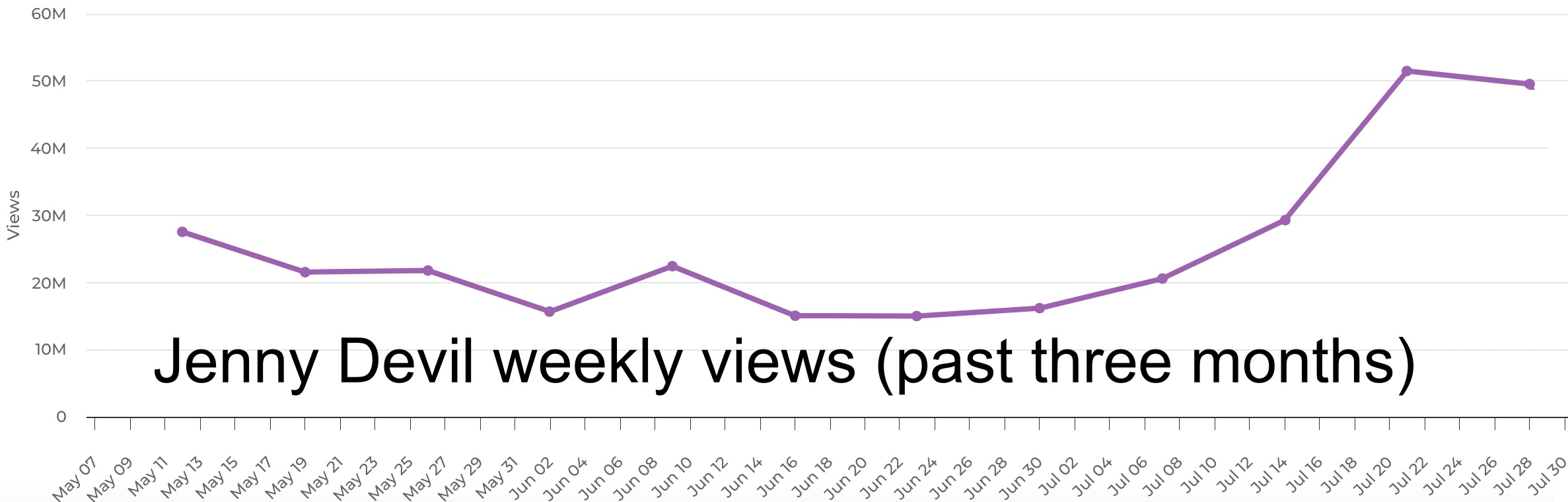
Jenny Devil is the most obvious example. Based on her handle, one would think she’s out of place in the God-obsessed world of YouTube Shorts, but she finished 34th in July’s Global Sub Top 100 after collecting 840,000 monthly subscribers. And you better believe she has some KPop Demon Hunters content mixed in with her other fare.
Data via Gospel Stats
It’s been a long time since we’ve seen a single movie alter the creator landscape in such a significant way. Barbie may have been the last film to fit that description, and that released all the way back in 2023.
The Christian creators of YouTube Shorts might not love the sudden shift to something more demonic, but hey. If those proselytizers have a problem with KPop Demon Hunters, they can talk about it on their channels — and I’d bet they would get a lot of views in the process.
Channel Distribution
This month, 69 channels in the Top 100 are primarily active on YouTube Shorts.
[Tubefilter Charts is a periodic rankings column from Tubefilter with data provided by GospelStats. It’s exactly what it sounds like: a top number ranking of YouTube channels based on statistics collected within a given time frame. We use data directly from YouTube and in terms of subscribers, YouTube rounds that data to the first three significant figures. Check out all of our Tubefilter Charts with new installments every week right here.]
Scroll down for this week’s Tubefilter Chart.
The leader in this month’s Global Sub Top 100 had a dominant run during July. He added about 15.8 million new subscribers during the month that just concluded, and no other YouTube channel even got halfway to that total. Congrats to this chart’s new rey, Argentina’s Alejo Igoa.
Once you move past Igoa’s eye-popping numbers, there are some juicy details to find further down in the chart. One particular channel in the Global Sub Top 100 caught my attention because it is fusing an old form of entertainment with something a bit more contemporary.
The humble arcade is becoming a short-form hotspot (especially when Pikachu is involved)
In these columns, we often talk about the importance of timing for YouTube Shorts creators. The best way to retain viewers, and thus draw in the watch time that is critical to channel growth, is to keep them guessing until the very end. That tactic has helped creators like Ben Azelart rise to the top of our Tubefilter charts.
But before YouTube ever existed, there was another entertainment medium that tantalized consumers with promises of big payoffs that do not materialize until a critical moment of truth. The arcade games you’d find on a carnival midway are hardly sophisticated, but their inherent marketing tactics are highly relevant in the age of YouTube Shorts, and some savvy gamers are paying attention.
TYE Arcade is 72nd in this month’s Global Sub Top 100. During July, the old-school gaming hub added 1.1 million new subscribers. That was an 82% higher total than TYE’s subscriber sum from the previous month, and it brought the channel’s total subscriber count within hailing distance of eight million.
The pacing of TYE Arcade videos borrows from the games that are featured on the channel. A classic claw game, for example, is an easy way to generate anticipation. If you end up throwing your prize on the ground, you’ll whet your audience’s appetite even more. TYE Arcade’s most-watched videos don’t provide viewers with satisfying conclusions, and that may be part of the reason why they’re so popular. How else can you explain the lack of a reveal in a video like this:
The presence of a Pokeball in that video may also be one of the secrets of its success. Kids these days are obsessed with Pokemon collectibles, thanks in large part to Logan Paul’s lavish spending habits.
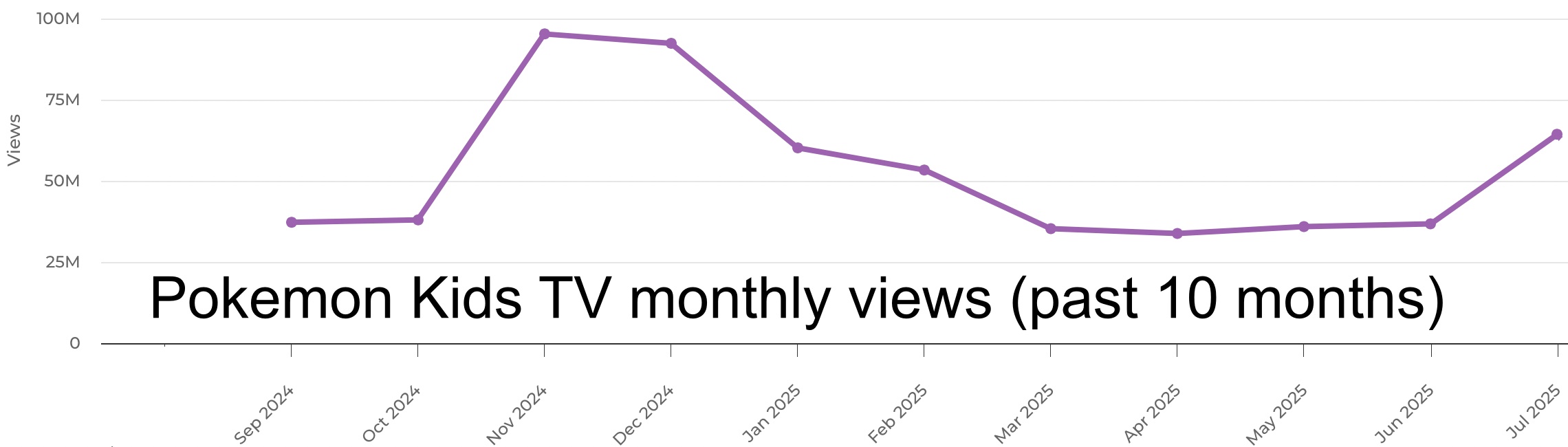
The official YouTube home of the pocket monsters is benefiting from the renewed surge of interest in the trading card game. Pokemon Kids TVis an all-ages hub where viewers can follow the fauna from their favorite game as they embark on adventures with one another. That channel had a huge month in July; it got 1.6 million new subscribers to reach 25th place in the Global Top 100.
Data via Gospel Stats
Pokemon Kids TV has had big months on YouTube in the past, so it may be that the arcade channels are flourishing because they feature Pokemon cards, not the other way around. But no matter which direction that relationship flows, there’s a clear trend emerging here: Old-school gaming is in.
Trading cards and claw games may not offer the immersive experience of the latest AAA video game, but they’re fun, colorful, and accessible. In the era of YouTube Shorts, those factors often lead to a big-time viewership jackpot.
Channel Distribution
Here’s a breakdown of the Top 100 Most Subscribed channels this month in terms of their countries of origin:
India: 31
United States: 21
Bangladesh and Hong Kong: 6
Mexico: 4
Brazil, South Korea, and Spain: 3
Australia, Indonesia, Japan, Russia, and Vietnam: 2
Argentina, Belarus, Belgium, China, Germany, Jordan, Peru, Singapore, Slovenia, Taiwan, Tanzania, United Kingdom, and Uzbekistan: 1
This month, 71 channels in the Top 100 are primarily active on YouTube Shorts.
As always, keep up to speed with the latest Tubefilter Charts and all our news by subscribing to our newsletter. You’re going to love it. 👉 Newsletter.Tubefilter.com.
YouTube‘s TV dominion has put it in closer competition than ever with traditional television networks and streaming services like Netflix. It’s been winning for sheer weight of watch time, holding top spot as the #1 most-viewed video destination in the U.S., largely for one core reason: no one else can touch the amount of content it has or drive the amount of traffic it does.
But just because no one else can catch it, doesn’t mean YouTube can’t make tweaks to bring it closer in aesthetics to its competitors.
We recently noticed some YouTube channels looking a little different: fresh new UX that looks more like browsing through Netflix than YouTube, episode descriptions and a “Watch Now” button to jump right in, and shelves of scheduled content that would be right at home on DirecTV.
When you click on a ‘normal’ YouTube channel, it brings you to the channel’s homepage, where the creator can pin one featured video, followed by shelves of playlists. You can see videos’ titles and thumbnails, but no descriptions. To see more of the creator’s recent or popular content, you have to manually navigate over to the Videos tab and pick a sorting method.
But while the default YouTube UX is serviceable, it’s also…samey. That one featured video aside, everything is the same size. Videos don’t stand out–and many creators make uniform thumbnails that are designed to catch viewers’ attention on the homepage or in recommended and let them know Hey! That creator you like has a new video! The default UX can turn that practice from effective to eye-straining, and gives an impression of the creator’s content being samey, too.
This new UX, which YouTube refers to as “early […] experimentation of YouTube’s Shows feature,” flips all that on its head.
Take Law&Crime, for example. The true crime network was founded in 2016 by longtime TV host Dan Abrams, and sold to Jellysmack for a reported $125 million in 2023. It has over 7 million subscribers and generates around ~100 million views per month with half-hour-long, evening news-style episodes about current criminal cases in the U.S.
If you navigate to those videos, they look like normal YouTube videos. Head over to Law&Crime’s channel, though, and the differences are stark.
Law&Crime’s home tab greets viewers with a nearly edge-to-edge shelf of recent videos. Supersized thumbnails are overlaid with view counts and video length info, and a new button prompts, “Start Watching.” Each video gets a few seconds of spotlight, then cycles on to the next, Netflix homepage style.
Scroll down, and directly beneath that display is a shelf of upcoming content. Law&Crime debuts a new episode every half hour, and viewers can see the next slate of programming up to 12 hours in advance.
Below that are shelves of Law&Crime’s various productions, with descriptions of each show and a playlist of uploads organized by most recent.
This UX, as we mentioned, is part of YouTube’s in-development Shows feature. Channels like Law&Crime are invited to upgrade to the UX, which is then shown to 10% of YouTube users “in select countries,” the platform tells participants in an invite message shared with Tubefilter.
The overall goal of this glow-up is to “elevate the UX and discovery of Shows (i.e. playlists with a clear connection across episodes),” YouTube adds.
Basically, it wants to give creators who make strongly connected content and curate good playlists of that content a way to look more like a TV network producing TV programming. After all, TV is where most people are watching their YouTube content these days (at least, in the U.S.).
Along with the new channel UX, Shows get spotlight in the “Recommended Shows” and “Continue Watching” shelves on the YouTube homepage, “and be eligible for continued watching treatment in Watch Next,” it says.
Shows enrolling now will also get early access to the YouTube Studio launch a Shows toolkit, including features like season organization, “TV optimized Show artwork,” genre tags, and more that’ll become available “later this year.”
This is a new frontier for YouTube, which occasionally makes tweaks to things like channel bios and tabs, but hasn’t moved away from the standard rolodex-of-one-inch-thumbnails in…well…ever. This UX rewards the creators and their teams who have essentially become full-fledged, digital-first creative studios. It lets them promote content with attention-grabbing, clearly organized shelves that are new-viewer friendly. And, we’ll be honest, this UX just plain looks good. It’s a fresh change–and one we’re keen to see more of as YouTube debuts Shows later this year.
Filed under: Creator, Homepage Feature, YouTube by James Hale Comments Off on YouTube is giving some channels a Netflix makeover