Archive for 2025:

Netflix’s CEO thinks YouTube is just a place to “kill time.” And yet it keeps tapping creators for deals.

In the United States, YouTube has been generating more watch time per month than Netflix (and every other streaming service) for the past two years straight. That’s just a fact.

And it’s a fact that Netflix CEO Ted Sarandos doesn’t seem to like. He’s been talking a lot about YouTube recently, and the crux of his messaging is, Hey, creators and viewers, you may think you’ve got it good on YouTube, but trust me, you could have it better on Netflix. Just a couple weeks ago, at a Paley Media Council event, he said Netflix is the “spending time” business, while YouTube is the “killing time” business.

Eesh. It is true that Netflix has access to massive production power, but it’s pretty adept at killing things, too. Creators want control over what they make, and when and how they make it, which is what keeps them on YouTube.

All that being said, Netflix is obviously combing YouTube for budding talent. And some creators are willing to make deals with it. Like Tony Hinchcliffe, the comedian host of live-filmed conservative humor podcast Kill Tony.

Here at Tubefilter, we track the performance of every sponsored video published on YouTube each week, and we’ve seen Kill Tony pop up in the top 5 most-watched on multiple weeks. The podcast (which features Hinchcliffe and a rotating cast of other comedians) used to generate around 10 million views per month, but in the leadup to the presidential election, it surged to nearly 40 million VPM.

That jump was likely due to Hinchcliffe and guests’ overall pro-Trump stance–a stance that got Hinchcliffe a spot onstage at a Trump rally, where he bombed with both sides of the aisle after calling Puerto Rico “a floating island of garbage.”

But the wave of backlash didn’t dissuade Netflix from tapping Hinchcliffe for a three-episode + one special deal, part of its continuing focus on stand-up comedy originals.

The three episodes are Kill Tony installments, where newbie (and sometimes established) comedians do 60-seconds of stand-up, then get roast-style feedback from Hinchcliffe and other career wisecrackers. The first episode (notably featuring guest Joe Rogan, who also built his podcast on YouTube and then cashed out with a lucrative Spotify deal) was filmed live at the Comedy Mothership in Austin, Tx., and went live on Netflix April 7.

If these episodes aired on YouTube, they’d probably snag Hinchcliffe 5+ million views’ worth of ad revenue plus a decent chunk of sponsor change. We’ll probably never know what Netflix paid him, but the platform might release viewership information in the future.

As for ad revenue, though…Hinchcliffe might still be pulling some in for this episode, because to advertise it, he posted a two-hour-and-six-minute video on the Kill Tony YouTube channel when the episode would normally go live. But instead of actual content, the video flashes a message:

“For the first time in 12 years, this Monday’s brand new episode of Kill Tony will not be posted on YouTube. But fear not, because there is a brand new episode for you to experience…and it’s one of the greatest episodes ever.”

It then fades into the Netflix logo, then repeats the message, then the logo, then repeat…We doubt anyone is tuning in for the video’s full duration, but a whole lot of people have clicked on it, giving him ~330,000 potential views’ worth of ad dollars.

Netflix says premiere dates for the next two episodes are forthcoming. Episodes that aren’t part of the Netflix deal will continue posting on YouTube as usual. Hinchcliffe’s special will be a solo 60-minute stand-up premiering sometime in the coming months.

Kill Tony isn’t the only creator news coming out of Netflix. The platform today released Bad Influence: The Dark Side of Kidfluencing, a documentary about Piper Rockelle, her momager Tiffany Smith, and the large group of tweens and teens recruited for Rockelle’s YouTube “Squad.” In 2022, 11 of those squad members sued Smith, accusing her of abuse, exploitation, and failure to compensate them for their appearances. Smith settled the case for $1.85 million in October 2024.

Netflix’s documentary follows former squad members, cataloguing their experiences through their years working with Smith and Rockelle, and what their lives have been like since.

RHEI sends its AI agents into the music industry

Just two weeks ago, RHEI–the media-tech AI company formerly known as BBTV—unveiled Made, a content production and community management platform it says uses “emotionally intelligent AI to provide creators with a virtual dream team” of support.

Now, it’s revealing bigger plans for Made–plans that involve deploying the platform (and its AI agents) as a solution for the music industry. This is the Enterprise half of Made, which RHEI says is already working with major labels as well as independent labels and artists like MNRK, Symphonic, and Lyrical Lemonade.

RHEI describes Made for Enterprise as “a fully managed AI offering, where RHEI provides its full agentic solutions for content creation, ideation, audience growth, fan engagement, and rights management.”

“For too long, music companies have been forced to react to shifting digital landscapes rather than define them,” Shahrzad Rafati, RHEI’s CEO, said in a statement. “AI is fundamentally rewriting that equation. With RHEI’s solutions, labels and artists can transcend the limitations of traditional content strategies which are confined only to official channels and direct fan engagement, unlocking a level of scale, personalization, and growth that was previously unimaginable.”

She added, “We’re not distributing content, we’re building highly engaged and pinpoint-targeted communities that are fully catered to what fans really want and what trends are shifting the landscape, enabling music companies to harness the full potential of their vast libraries.”

As Rafati told Tubefilter last month, RHEI believes the way forward in the development of AI involves using this agentic approach to “close the gap between these large foundational models and the human brain and human creativity.”

RHEI Chief Strategy Officer Lewis Ball explains the goal with introducing Made to the music industry is to “scale content creation and optimization while preserving creative integrity.”

“Specifically when it comes to music, labels and artists can harness AI to produce high-quality content, optimize metadata, and curate predictive playlists–without sacrificing authenticity,” Ball said. “By combining rapid video production, AI-driven audience targeting, and intelligent community management, we ensure that music reaches the right fans, engagement is maximized, and revenue potential is fully realized.”

RHEI says Made for Enterprise’s partners in the music business have seen results like a 291% growth in monthly revenue, 3.7x more views per viewer (indicating “superfans” returning to watch more content), and “tens of billions of views generated.” RHEI says Made has “dramatically expanded reach for labels and artists across multiple genres.”

Jorge Brea, CEO of RHEI partner Symphonic, chimed in with his company’s experience.

“At Symphonic, we are continuously evolving to meet and exceed the needs of artists and labels, and expanding further into media and entertainment is a key part of that journey,” he said. “RHEI’s solutions are helping us scale in new ways, enhancing how we connect music with audiences across digital platforms. By pairing their tech, solutions and deep industry expertise with our own, we’re seeing more and more opportunities for discovery, engagement, and growth in key areas of our business.”

MNRK Music Group SVP and General Manager Brandon Squar also addressed their recent signing with the company. “MNRK is focused on giving our artists every advantage when it comes to visibility, engagement, and growth. We signed on with RHEI because of their extensive expertise and tech solutions to drive the best content performance, and reach fans effectively and authentically wherever they consume. This partnership will further enable us to keep pushing boundaries while making sure our artists’ music connects with fans in the most impactful way possible.”

Ultimately, RHEI launched Made to the music industry because it believes content creation is entering the new “Augmented Creativity Era” where AI “is now the connective tissue between artists and fans,” Rafati says. “The future of music belongs to those who harness its intelligence and scale.”

Instagram’s latest attempt to copy TikTok will bring improvements to its “content search”

If there’s going to be a TikTok ban in the United States, Instagram is hellbent on becoming the go-to platform for displaced users. It has already rolled out TikTok-like features and dangled financial incentives in front of creators. Now, it’s turning its attention to the search industry, where it will apply some of the same ideas that have worked wonders for TikTok.

Instagram Head Adam Mosseri commented on the platform’s potential as a search engine during an appearance on the Build Your Tribe podcast. He admitted that Instagram has a lot of room for growth among users who search for videos to learn about local businesses, global trends, and cultural happenings. To accelerate development in that area, Instagram is expanding the team that works on search products.

“We’re … starting to invest more in search on Instagram because there’s so much amazing content,” Mosseri said. “And quite frankly, what we call content search — as opposed to searching for an account, actually searching for some type of content — it’s not very good on Instagram.”

The concept Mosseri called “content search” is related to a broader shift in consumer behavior. Traditionally, Google search users employed the engine to locate specific information related to a query. These days, many people — and many members of Gen Z in particular — think about search differently. Through platforms like TikTok, search becomes a form of discovery, in which users are less interested in locating a specific webpage and more interested in a broader view of the content and recommendations that are available across the World Wide Web.

That paradigm shift has allowed TikTok to eat away at Google Search’s market share, though the ByteDance-owned app seems to have recently lost some of its momentum in that sector. Even if discovery-style, content-based search isn’t as hot as it was a few years ago, it still has plenty of potential for Instagram. TikTok has added a new form of monetization through search ads and has turned its user queries into creativity aids.

Mosseri noted that Instagram creators would benefit from an increased investment in search because it would lengthen the shelf life of their content. “It should allow content to resurface so that you don’t get all the value in those first 24 or 48 hours,” he said.

Meet the new TikTok, same as the old TikTok

Mosseri’s comments on Instagram search come amidst an onslaught of updates that have added new features and incentives to the Meta-owned app. The takeaway from all those changes is clear: Instagram wants to be the new TikTok.

To absorb so-called “TikTok refugees” in the event of a U.S. ban, Instagram has dusted off one of its favorite tactics: Copying popular features from other apps. The new Edits app offers a direct answer to CapCut, the app that is oft used to edit TikToks.

In other cases, Instagram has made direct overtures to creators. It has offered cash bonuses as big a $50,000 for TikTokers who port their videos over to Reels, and it has promoted new features by turning them into viewership drivers.

According to The Information, Mosseri recently told his staff that Instagram is willing to assume more “risk” in order to capitalize on a potential TikTok ban. A standalone version of Reels, for example, would divide Instagram’s user base while also making the new app an appealing haven in a post-TikTok world.

For all that to happen, TikTok will need to actually be banned. It just received another reprieve, and it’s looking more likely that the beleaguered app will outlast regulatory threats in the U.S. Even if that happens, Instagram users will surely appreciate the updates Mosseri is advertising — even if those developments don’t accomplish their original purpose.

X isn’t as ad-hungry as it was before Trump’s re-election, so it’s playing nice with Twitch

X and Twitch are making nice.

Last November, the platform formerly known as Twitter added Twitch to the list of defendants in a lawsuit that accuses advertisers of engaging in anticompetitive practices. Five months later, a lot has changed for X, and Twitch is being struck from the case. A court filing from Elon Musk‘s social media company revealed that “X and Twitch have entered into a memorandum of understanding resolving the action as to Twitch.” Translation: Twitch is off the defendant list.

The initial lawsuit — and the subsequent inclusion of additional defendants — came during an extended period of advertising turmoil at X. The chaotic and uncertain early months of Musk’s reign caused many agencies and brands to shift budgets away from the platform then called Twitter. X’s lawsuit argued that global entities like World Federation of Advertisers behaved in an anticompetitive manner by enforcing the so-called boycott.

In recent months, X has culled the targets of its lawsuit. Reuters notes that X previously came to terms with consumer goods giant Unilever. Now, it’s entering into an agreement with Twitch that requires the streaming hub to fulfill certain unspecified conditions in exchange for the cessation of legal action against it.

If you’re wondering why X seems less concerned about advertiser boycotts than it did last year, the answer has everything to do with Donald Trump. Musk’s alliance with the newly-reelected President has increased X’s value while also giving the platform an advantageous cultural position. X’s influence on the outcome of the 2024 election has made it harder for advertisers to ignore, even if they have to accept Musk’s volatility.

X has used its White House ties to turn the tables on the ad industry. Instead of facing pressure from fleeing buyers, Musk’s ad team is strongarming agencies by reportedly threatening consequences for those who choose not to spend on X.

That strategy will be effective for as long as Trump and Musk remain in cahoots, but there’s evidence to suggest the partnership could be fraying. Musk reportedly asked the president to soften his sweeping tariffs, a proposal Trump brushed off.

As Truth Social also takes off, and some of Musk’s other companies see flagging returns, could the Chief Twit be falling out of favor in the capitol? If so, X might have to dust off one of its other tactics: Direct appeals to some of the biggest agencies in the ad world.

Twitch was making money off subscriptions to permabanned channels. Thanks to streamers getting loud about it, refunds are on the way.

Twitch‘s ban system can be baffling. ‘Ban’ is a heavy word, and on other platforms often means creators permanently lose access to their accounts. But in Twitch’s case, bans are usually only temporary, can be reversed or lessened based on public feedback, and have no long-term consequences. Twitch only recently annnounced that it’s finally cracking down a little bit by limiting monetization for temp-banned streamers who violated TOS around things like sexual content, gambling, and violence.

But sometimes, Twitch actually does ban streamers forever.

And then, according to an investigation by Dexerto, it might keep paying them, and itself–with money from former subscribers’ wallets.

On April 3, Dexerto published findings that some permabanned streamers were still receiving monthly subscription payouts, despite that being explicitly against Twitch’s TOS. According to the TOS, a permabanned streamer loses access to monetization tools, and all recurring viewer subscriptions will cease autorenewing at the end of that month. The way it’s supposed to work, they’ll receive one final payout for revenue generated before their ban, and then will be cut off.

Dexerto found this has been an ongoing problem since at least 2022. In September that year, permabanned streamer Tempest tweeted that his fans should manually cancel their subscriptions, because he’d noticed they were still being charged after his channel was no longer active.

“idk how it’s even possible twitch can ban me and still take 50% of revenue on a channel that they won’t unban but it’s quite literally robbing people,” he said.

Another banned streamer, Incoxicated, tweeted earlier this year that he’d been paid $60 CAD one month, all from subscription revenue, after his channel was terminated. “You are still charging my recurring subs their monthly fee and paying me out despite incorrectly indefinitely banning me after 6 years with only 2 infractions,” he tweeted. “What the hell is going on over there?”

Dexerto found numerous other instances of banned streamers continuing to receive payouts from recurring subscriptions–in some cases for months, with one subscriber who’d prepaid for six months not receiving a refund despite the streamer being banned during that period. It also found that streamers had regularly been trying to inform Twitch about this issue on its User Voice page.

What’s worth noting here is that this issue isn’t just about banned streamers still earning money, despite in some cases being banned for heinous behavior. Twitch by default gets 50% of subscription revenue (sometimes 30%, depending on its deals with individual streamers). So it too was profiting off these dead channel subscriptions.

When Dexerto contacted Twitch about this issue, some streamers who were mentioned in the article had their formerly indefinite bans mysteriously lifted.

“In line with Twitch policy, when a channel is deleted or is indefinitely suspended, subscriptions to that channel are not renewed. The examples shared appear to be edge cases, and we’re working to quickly resolve those issues,” the platform said in a statement. It added that in “certain cases” where viewers are charged subscriptions for dead channels, they’re supposed to get a refund.

Now, after the investigation and threat of a potential class action lawsuit, Twitch is issuing those refunds. Based on what we’ve seen on X, Twitch isn’t reaching into banned streamers’ pockets to take money back; instead, it’s eating the full refund cost to subscribers. The platform hasn’t issued another statement, but emails are going out to notifying people that their subscriptions have been cancelled and they can expect refunds.

As for that class action lawsuit, it might still be on. Tom Kherkher, who’s both an attorney and a YouTuber who specializes in suing megacorporations, has been tweeting about how this issue “is bigger than I thought,” and is actively asking people to reach out to him if they want to be part of a class action suit.

He later said during a podcast episode that “a lot of victims” had approached him, plus streamers who’d been receiving wrongful payouts.

He believes what’s been happening is “between negligence on the low end and affirmative fraud on the other,” he said. “I believe it’s some form of deceptive trade practice. You can’t be willfully ignorant and collect that much money.”

Kherkher said Twitch can expect a lawsuit will be filed “very shortly.”

CoryxKenshin’s manga just sold 200,000 physical copies in a week

The first volume of CoryxKenshin‘s manga Monsters We Make has sold a whopping 200,000 physical copies in its first week of release, according to publisher New Edyn Press.

To put that in perspective, One Piece–one of the most popular Japanese manga of all time–sold 1.9 million copies in the United States through all of 2023. My Hero Academia, another top Japanese title, sold 900,000 over the year. Those series have been running since 1997 and 2014, respectively, so have the oomph of legacy in the manga world. They also have the biggest publishers in the industry behind them.

CoryxKenshin’s manga is all indie, and his oomph is coming from his audience of nearly 22 million YouTube subscribers. There are also more sales not accounted for by this number: New Edyn Press is offering digital copies of the volume as well, but didn’t say how many have sold.

Even without counting digital copies, though, he’s pulling some insane sales numbers, and has set a high bar for number of debut copies sold by a content creator-turned-mangaka.

In case you missed the backstory to all this, CoryxKenshin (aka Cory DeVante Williams) has been a YouTuber since 2009, and is a prominent voice for gamers and anime enthusiasts. He gained more prominence in 2022, after he challenged YouTube’s moderation team for allegedly playing favorites, and gained support from Markiplier. Then, in 2023, he vanished. No notice. No explanation. His subscribers were baffled. Was he retired? Was he okay?

Turned out that no, he wasn’t retired, and yes, he was more than okay. He reappeared in December 2024 and announced that he’d spent the past 18 months writing Monsters We Make. The series follows main character Jabari Booker, a musician who (in true manga style) just wants to go to school, but instead finds himself battling a corrupt tech corporation and its mutated creations.

Now, on the heels of its 200K debut, Monsters We Make is confirmed to get a second volume.

“Monsters We Make is a playground for me to exercise all the ideas and life experiences I’ve collected from the decades of being a spectator. Creating a story that scrutinizes humanity and what makes us tick, injecting some of the Black representation I’ve been longing to see in this space, and finally adding in some sprinkles of my faith in God, were the driving forces behind this project,” Williams said in a statement.

He added, “It meant a lot to me to see a character like The Raikage from Naruto in a space where you don’t typically see Black characters, let alone powerful ones. My hope is that my main character, Jabari, can be to people what Goku was to me growing up. This experience, while a ton of work, has been incredibly fun and fulfilling.”

Like most other mangaka, Williams hopes his story will catch on enough to get an anime adaptation. If it does, that adaptation would likely also be produced stateside, putting him on Rooster Teeth‘s path to making a fully American anime. (RT was responsible for RWBY and gen:LOCK, two of the most prominent American anime to date.)

While Williams’ sales number is pretty staggering set against Japanese series sales, we’re not surprised it’s getting this much attention from his fans. We’ve seen more and more American creators with established audiences build their fannish enthusiasm for manga and anime into businesses: Valkyrae recently launched her own anime-focused production company, Hihi Studios; and Tony Weaver Jr. and Brandon Chen founded manga production studios Weird Enough Productions and Inspired Productions, respectively.

It’s also worth noting that Williams is following the same model as many filmmaker YouTubers. Just like Inoxtag and Sam and Colby self-distributing their original films in theaters (to record ticket sales), he didn’t wait for a major studio to pick up his manga. He put it out there himself.

What we’re curious about is whether New Edyn Press–which is named after the core city in Monsters We Make and we’re guessing is owned by Williams–will now start publishing stories by other anime-enthusiast content creators. Clearly there’s a market for them.

Vimeo’s new product lets creators build and monetize their own streaming services

Vimeo is enhancing its SVOD business with a new solution that aims to address common creator frustrations. The name of that product is Vimeo Streaming, and it’s designed for creators who are looking to launch and monetize dedicated subscription services for their content.

A visit to the Vimeo Streaming homepage reveals that the platform’s app-building tools have already been used to launch more than 5,400 apps, which have collectively attracted over 13 million subscribers while hauling in $429 million in annual revenue. Notable Vimeo Streaming entries include Dropout, The Try Guys’ 2nd Try, and Sidemen XIX.

Vimeo’s history as a monetization solution for creators dates back more than a decade. The pay-per-view hub known as Vimeo On Demand was once used to distribute Oscar-worthy fare and indie favorites, as well as plenty of creator-led productions. After acquiring digital distribution platform VHX, Vimeo made a more concerted move toward the streaming world with a hub called Vimeo OTT.

The new Vimeo Streaming product brings the platform’s distribution technology in line with contemporary trends. Creators are now building their own subscription services and producing their own premium shows, and many of them can find uses for an intuitive, no-code solution packed with coveted features like piracy protection, analytics, and AI translations. Vimeo Streaming users can add multiple subscription tiers to their hubs, allowing them to put live events, merchandise, and special videos behind paywalls.

These days, Vimeo’s struggles make the news as often as its successes. Over the years, the platform has struggled to square its status as an artist-friendly hub with the monetization needs of creators. Vimeo Streaming looks to add a new chapter to that story by providing creators with a multifaceted monetization suite while still affording them control over their work.

“Vimeo is proud to serve the professional creator. With our new Vimeo Streaming release, we are giving creators more ways to connect with and gain a deeper understanding of their audiences, more ways to monetize their content, and higher grade security,” said Vimeo CEO Philip Moyer. “We believe creators should be in control of their work and how they are paid; so we’re taking the technologies that are usually only afforded by the biggest platforms and putting it in the hands of our customers, at a fraction of the cost.”

In a statement of his own, Dropout CEO Sam Reich said that his team has used Vimeo Streaming to power a product that is “far and away our biggest revenue driver.” Like YouTube, Vimeo understands the financial potential of subscription services, but as per usual, the indie darling of the online video world is approaching that trend with artists in mind. Creator content can finally keep up with the big-budget offerings of traditional media — does that mean it’s time for a Vimeo resurgence? Moyer and co. are hoping that their new streaming product will be part of that renaissance.

Top 5 Branded Videos of the Week: 1 bunnygirl, 3 Shorts, 20 anti-vaxxers

Welcome to our rundown of the most-watched branded YouTube videos of the week.

We’re publishing this snippet of a larger Gospel Stats Weekly Brand Report in order to analyze sponsorship trends in the creator economy. Any video launched in tandem with an official brand partner is eligible for the ranking.

And – as the name up above would imply – all the data comes from Gospel Stats. If you’re interested in learning more about Gospel – and which brands are sponsoring what creators on YouTube – click here.


Welcome back to our Gospel Stats Weekly Brand Report, where it’s the week of Shorts. We have not one, not two, but three Shorts in our top slots, two of which are from MrBeast and one of which is a curious case. Then we go much longer with Jubilee‘s latest episode of Surrounded, and cap things off with some VTuber face time.

Check it all out below:

#1 Could You Win This Obstacle Course?
Channel: MrBeast
Brand: .store
Views: 51,329,588

We just wrote in our Tubefilter newsletter (hey! you should subscribe!) about how Shorts have become a source of revenue for creator sporting events. And one of those upcoming sporting events will be cohosted by MrBeast. The video that put him in our #1 spot this week is also a sporting event video, but it’s not creators, and it’s not basketball or football. Instead, it’s more Ninja Warrior-style, with two women booking it through an obstacle course while MrBeast gives a lightning-quick ad read for .store, a digital marketplace for people to buy (as you may suspect) .store domains instead of .com or .biz.

#2 Baseball Tic Tac Toe vs MLB Pro
Channel: MrBeast
Brand: T-Mobile
Views: 36,139,012

And that’s not the only micro mini ad read MrBeast is teeing up this week. Spot #2 goes to him again, and this time it’s a tee-ball competition where he himself squares up against New York Yankees outfielder Aaron Judge. The 26-second video is sponsored by T-Mobile, a company we here at Tubefilter have had our eyes on for a few months, because it’s been quietly sponsoring Saturday Night Live‘s YouTube livestreams. It also paid for one other video this week: an episode of sports podcast JM Baseball.

#3 “I Don’t Care What My Husband’s Dreams and Aspirations Are”
Channel: The Ramsey Show Highlights
Brand: Zander Insurance
Views: 11,211,896

With spot #3, the Week of Shorts continues. This video is a whopping 17 seconds long. Seventeen! And unlike MrBeast’s rapid-fire videos, it doesn’t have a whole lot of content–just a guest telling The Ramsey Show hosts that she doesn’t care what her husband wants, she wants him to get a better job. The hosts have a small second or two of reaction, and then the video cuts. So why is it at spot #3? We’re guessing the viewer conversation. It has nearly 4,000 comments, with people on both the wife’s and husband’s sides sharing their stories. That’s a lot of eyeballs on Zander Insurance, a company Dave Ramsey has officially endorsed.

#4 Doctor Mike vs 20 Anti-Vaxxers | Surrounded
Channel: Jubilee
Brand: Straight Arrow News
Views:  5,841,766

Jubilee made quite a name for itself during the presidential election and now during the first few months of the Trump administration. This video puts family physician and YouTuber Doctor Mike on the hot seat, answering questions from 20 anti-vaxxers. In a complete 180 from our first three videos this week, this one is an hour and a half long–but the debate is worth watching all the way through. Doctor Mike has made his content career combating misinformation, and this video might be his magnum opus.

BONUS #1,709 Mixed My Friends’ Fav Drinks & Got Absolutely Wrecked
Channel: CottontailVA
Brand: Gamer Supps
Views: 53,043

For most VTubers, their whole thing is that they don’t show ever show themselves IRL. Many keep their faces, bodies, locations, and even voices concealed, for personal privacy and/or for immersion’s sake, so viewers see them as their models. But CottontailVA is one of a few outliers: she went on camera this week for a Gamer Supps-sponsored stream where she made her friends’ favorite boozy sips. According to one bona fide bartender in the comments, the whole thing was “like a hilarious train wreck, except instead of an actual derailment it was a bunny girl trying to drink a Tokyo Tea without filling the glass with Sprite.” We really dig the VTuber IRL mystique, but it’s also interesting to see a creator take a different approach.


…and there’s a lot more data where that came from. If you’re interested in learning more about Gospel – and which brands are sponsoring what creators on YouTube – click here.

Trump gave TikTok 75 more days to find a buyer in the U.S. Here’s a rundown of the suitors.

Thanks to a newly signed executive order from the desk of President Donald Trump, the reprieve protecting TikTok‘s U.S. operations has received a 75-day extension. The app’s parent company, ByteDance, now has nearly three more months to find a business partner that can take control of a divested TikTok. In theory, if a deal doesn’t arrive in time, TikTok will become unavailable on U.S. app stores.

Since reclaiming the Oval Office, Trump has been adamant that he will get a deal done to “save TikTok,” but dispatches from the negotiations make the outcome seem cloudier than Trump claims it to be. Amidst broader trade disputes, China has not made clear that it has any intention of letting a U.S.-backed firm control TikTok.

That hardline response hasn’t stopped potential TikTok buyers from lining up at the White House doors in hopes of snagging ownership of the culturally resonant app. The Independent describes the feeding frenzy as a “six-horse race,” but the total number of bids is even higher than that. Here, in no particular order, are the details on some of the most interesting offers:

  • Amazon shook up the TikTok race by submitting a late bid for the app just before Trump ordered the latest deal extension. Jeff Bezos certainly has enough cash on hand to pay TikTok’s massive price tag, but there would be concerns about social media monopolies if Amazon controlled TikTok and Twitch in addition to its own powerful affiliate marketing platform.
  • OnlyFans founder Tim Stokley has joined forces with a crypto firm to target a TikTok acquisition. Can the man who helped build a revolutionary monetization hub for creators find similar answers for TikTok’s current conundrum?
  • AppLovin is another media company behind a prominent TikTok bid.
  • Perplexity‘s TikTok bid is different from the others. The AI company has “a vision for rebuilding TikTok in America,” and that mission would involve an open-source version of the TikTok algorithm. Is a more democratized form of TikTok a potential future for the platform?
  • Reid Rasner, a Wyoming billionaire, has assembled a “people’s bid” for TikTok that includes a $47.5 billion offer. Numbers-wise, that’s one of the highest proposals, and like the Perplexity bid, Rasner’s take on TikTok would include a more community-oriented spirit.
  • Blackstone is part of one bid that includes multiple investors. The VC firm already has a foothold in the social media world thanks to its backing of the deep-pocketed company Candle Media.
  • MrBeast has also seen his name come up among the TikTok suitors, though the bid he’s a part of looks like a long shot at this point.
  • Oracle is the last name to consider. The tech company that has long been floated as a potential TikTok steward seems to be gaining momentum in the ongoing negotiations. With Andreessen Horowitz reportedly looking to enter the Oracle bid, it’s time to ask an important question: Are we just going to end up with Project Texas again? That was the name of the original plan to safeguard U.S. TikTok data, and even after multiple years of negotiations, we seem to be headed back in the direction of that initial proposal. It’s beginning to feel like this whole saga is just going in circles, and I for one can’t wait until it is finally resolved.

Nas Daily’s Dubai hotel has maker spaces for creators–and lets some share in its revenue

Back in early YouTube days, the concept of becoming a full-time content creator seemed ludicrous–and because of that, there was little logistical and operations support for people who wanted to make content their careers. We’ve come a long way since then; now, there’s an entire industry dedicated to supporting creators and their video-making processes, from editors-for-hire to community managers to talent agents, lawyers, tax preparers, and more.

One thing we largely still lack, though, is dedicated coworking spaces. We had it for a while with YouTube Spaces, the initiative where YouTube offered brick-and-mortar production and post-production rooms, video equipment rental, networking events, and educational workshops to content creators around the world. But those closed in 2021, and since then, it’s been up to a handful of companies and individual content creators to build a network of places for creators to both work and socialize.

There are some programs, like Whalar‘s Lighthouse, where creators pay a membership fee to access a coworking space and biz dev + educational programming, plus networking and social events. Other hubs have been opened by successful creators like American Alan Chikin Chow and Australian EYstreem, using their money to offer professional production studios to fellow creators. Dude Perfect is similarly planning creator maker spaces in its new Dallas headquarters, if and when that ends up being built.

But Nas Daily is taking a different approach. The Israeli-Palestinian Facebook travel vlogger-turned-YouTuber is opening hotels that offer regular guest stays, but also push social interaction and creative collaboration.

Called Nas House, the business is centered in Dubai–which makes sense, considering Nas Daily (aka Nuseir Yassin) has lived in the city for several years, and was involved in 1 Billion Followers Summit, an annual biz dev convention that, in part, is aimed at getting more creators to move to and make content in Dubai. The convention and associated initiatives are backed by a whopping $40.8 billion grant from the United Arab Emirates government, which appears to see content creation as a potential source of revenue and growth–plus free advertisement of Dubai as a tourist destination.

Yassin said in a recent Instagram video that Nas House’s first location, which is “in the middle of Dubai,” took two years to build, and offers six villas and 30 hotel rooms. In the hotel’s center is an outdoor gathering space with an olive tree “to signify peace,” he added. Renting a whole villa will run you around $1,200 USD per night; a regular hotel room is about $100/night.


View this post on Instagram


A post shared by Nas Daily (@nasdaily)

“I lived in hotels for three years and the problem with hotels is they’re not designed for community,” he said. “No common spaces, no soul, and all rooms are separate. Nas House is the exact opposite of that. It is designed to get you to meet people.”

The gathering space, pools, gym, and cat-petting room are all intended for regular guests. Creators who stay at Nas House will get access to a filming/production studio and coworking space.

Also worth noting is that, for around $10,000 USD/year, up to 50 people can become “founding members” of Nas House. Those 50 people will share in Nas House’s future earnings (10% of the hotel’s profit is split between them), attend quarterly board meetings, and get permanent discounts on stays. If Nas House does become a center for creators in Dubai, presumably some of them will become founding members, which could lead to a model where creators are able to profit from a digital content coworking space in one of the most complicated and contentious real estate markets in the world.

Yassin emphasizes that Nas House isn’t just for creators; he also wants entrepreneurs to stay–and become founding members.

He hasn’t said yet whether, where, or when another Nas House location will open. For now, it’s Dubai-only, so maybe the sort of creators who can afford to flock to the city for a chocolate bar will catch a night’s sleep there.

@naraazizasmith this was interesting😭 #fypシ #dubaichocolate #tastetest #marriage #momtok #dessert #treat ♬ original sound – Nara Smith

Top 50 Most Viewed U.S. YouTube Channels • Week Of 04/06/2025

[Editor’s Note: Tubefilter Charts is a weekly rankings column from Tubefilter with data provided by GospelStats. It’s exactly what it sounds like; a top number ranking of YouTube channels based on statistics collected within a given time frame. Check out all of our Tubefilter Charts with new installments every week right here.]

Scroll down for this week’s Tubefilter Chart. 👇


Just like in our Global Top 50 chart, the U.S. Top 50 was greatly affected by the changes YouTube made to its view counting methodologies. The decision to bring more liberal accounting to Shorts has allowed many channels to double or even triple their YouTube viewership week-over-week.

There’s one key difference between the new policy’s effect on the worldwide charts and its impact on the U.S. ranking. Unlike in the Global Top 50, the U.S. chart doesn’t have a new leader. MrBeast is still the #1 creator in his home nation and the only member of the U.S. Top 50 to get at least one billion weekly views at the start of April.

Tales from the Shorts boom

The U.S. Top 50 is currently dominated by Shorts channels, with 45 of the 50 chart entrants operating primary on YouTube’s answer to TikTok. Like in the Global Top 50, many of the fastest-rising U.S. Shorts hubs cater to kids; big gainers included FuFu Squishy (#2 in the U.S. Top 50), A happy family (#3), and J house jr. (#5).

But there was a more niche category that caught my attention as I perused the channels in the U.S. Top 50. True to form, survival-themed channels are hanging onto their chart placements by using whatever methods they have at their disposal. For the always popular hub known as Knot Master, a steady stream on Shorts — many of which have been added over the past few days — have brought 218.8 million weekly views to a channel that is knotty by nature.

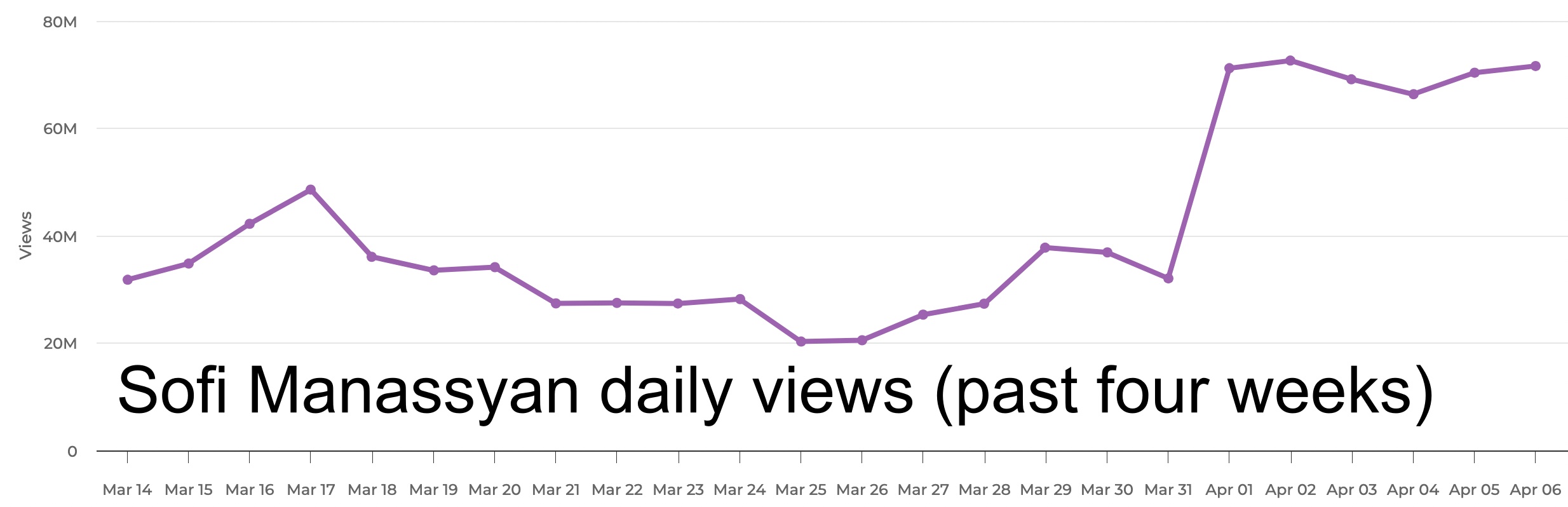
The other survivalist who is retaining her high-ranking chart position is Sofi Manassyan. The personable outdoors expert has delivered some polished long-form videos that have wowed her 7.7 million subscribers. But no matter how much work she puts into her longs, her daily viewership graph shows that she too is powered by Shorts. Her traffic at the start of April looks like the sort of eccentric landscape she would traverse in one of her videos.

Data via Gospel Stats

There’s a lesson here for any content creator who operates in a niche category: If your area of expertise can’t be easily digested in a 60-second Short, it might start to fall behind in the current era of YouTube accounting. With its recent update, YouTube is forcing enthusiasts within niche categories to figure out their Shorts strategies if they want to stay afloat in the U.S. Top 50. Translation: Now seems like a pretty good time to learn how to tie nautical knots.

Channel Distribution

This week, there are 45 YouTube Shorts channels in the U.S. Top 50.

As always, keep up to speed with the latest Tubefilter Charts and all our news by subscribing to our newsletter. You’re going to love it. 👉  Newsletter.Tubefilter.com.

Top 50 Most Viewed YouTube Channels Worldwide • Week Of 04/06/2025

[Editor’s Note: Tubefilter Charts is a weekly rankings column from Tubefilter with data provided by GospelStats. It’s exactly what it sounds like; a top number ranking of YouTube channels based on statistics collected within a given time frame. Check out all of our Tubefilter Charts with new installments every week right here.]

Scroll down for this week’s Tubefilter Chart. 👇


For the first time ever, a YouTube channel has gotten more than two billion views in a single week. Here’s the extra special part: Two different channels managed to surpass that milestone over the same seven-day period.

That might seem like an astonishing accomplishment, but given what’s been happening on YouTube this week, the record-setting results are nothing more than expected formalities. Here’s a brief overview of what’s happening:

The Shorts numbers are going brrr

On March 26, YouTube announced changes to the rubric it uses to determine what counts as a “view.” Previously, the platform required viewers to watch for a few seconds before registering a hit. That type of impression is now known as an “engaged view,” and videos now add to their top-level view counts every time they start playing for any amount of time.

That change has had a profound impact on our viewership charts. Unsurprisingly, channels that get most of their viewership on YouTube Shorts gained ground, pushing long-form hubs out of the ranking. The new #1 channel in the Global Top is Canada’s Sierra and Rhia FAM, which got 2.6 million official weekly views — more than four times its previous seven-day output — by delivering its typical array of kid-friendly fare.\

Like Sierra and Rhia FAM, many more of the YouTube channels that improved their chart position during the first week of April cater to the platform’s youngest viewers. Family-friendly standouts like Anaya Kandhal (#4 in the ranking), Diary of 4 (#6), and ToRung (#9) all got more than one billion weekly views.

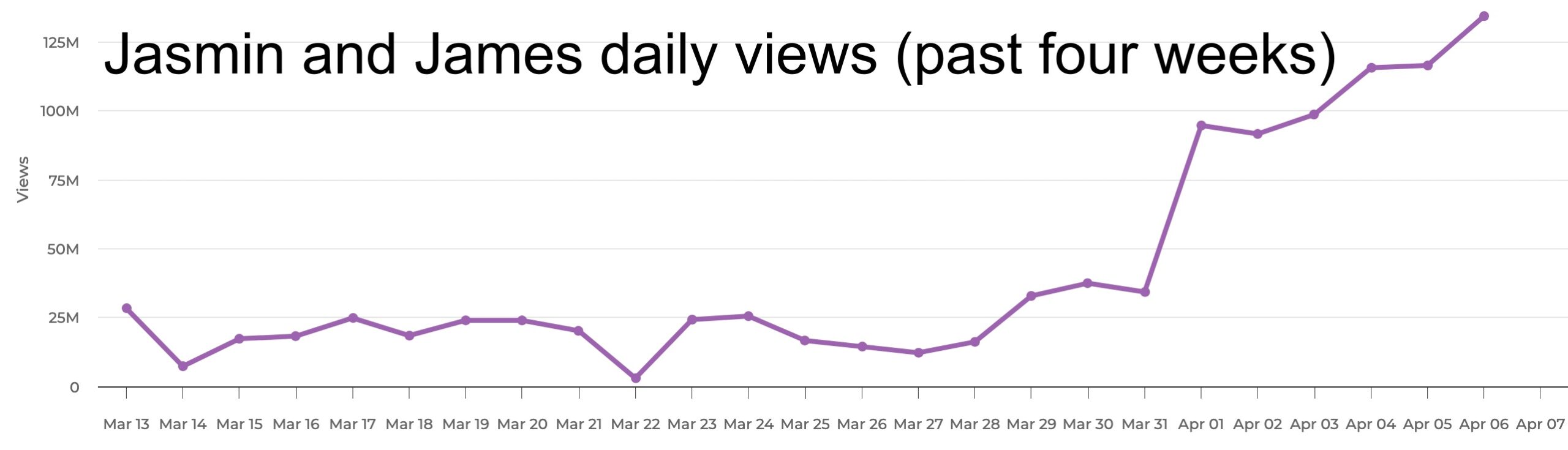
Since children’s content has universal appeal, it is likely to benefit from the changes to YouTube’s view counts. But to be clear, any channel that thrives on Shorts will see its numbers go up in the coming weeks. The Gospel Stats data for one of those channels, Jasmin and James, shows that the bump in question occurred on the first day of April.

Data via Gospel Stats

The evidence there is as clear as can be: If you want your channel to rank among the world’s most-watched YouTube hubs, a presence on Shorts is more necessary than ever. To keep pace with TikTok and Reels, YouTube is going to make sure its numbers are as big as possible, and parents of young children will be some of the biggest beneficiaries of that shift.

Channel Distribution

Here’s a breakdown of the Top 50 Most Viewed channels this week in terms of their countries of origin:

  • India: 16
  • United States: 10
  • Vietnam: 4
  • Canada, Indonesia, and South Korea: 2
  • Australia, Bangladesh, Belarus, Belgium, China, El Salvador, Germany, Hong Kong, Japan, Kazakhstan, Puerto Rico, Russia, Spain, and Taiwan: 1

This week, 46 channels in the Top 50 are primarily active on YouTube Shorts.

As always, keep up to speed with the latest Tubefilter Charts and all our news by subscribing to our newsletter. You’re going to love it. 👉  Newsletter.Tubefilter.com.