Archive for 2025:

Top 5 Branded Videos of the Week: South Korea, Nintendo Switch,

Welcome to our rundown of the most-watched branded YouTube videos of the week.

We’re publishing this snippet of a larger Gospel Stats Weekly Brand Report in order to analyze sponsorship trends in the creator economy. Any video launched in tandem with an official brand partner is eligible for the ranking.

And – as the name up above would imply – all the data comes from Gospel Stats. If you’re interested in learning more about Gospel – and which brands are sponsoring what creators on YouTube – click here.


Welcome back to our Gospel Stats Weekly Brand Report, where we go from South Korea to math to tech to Disney cruises, all sponsored by some of the biggest brands paying YouTubers to do what they love. Every week, we see one-off, big-money sponsors who pay for just a single video (like last week, with T-Mobile sponsoring MrBeast) as well as smaller sponsors who pay creators making content related to their retail niches. But the biggest force in sponsorship remains broad-appeal companies like Ground News, which sponsored 65 videos this week from a variety of creators, and Squarespace, which sponsored 54.

Check it all out below:

#1 SOUTH KOREA IS OVER
Channel: Kurzgesagt – In a Nutshell
Brand: Ground News
Views: 9,946,046

Starting things off on a somewhat dire note is Kurzgesagt, consistently one of YouTube‘s top-performing science/life curiosity channels. In this video, like many others, he introduces a big and clickbaity concept, only to break it down into digestible factual information. SOUTH KOREA IS OVER is an eye-popping title, but the actual video, sponsored by unbiased news org Ground News, talks about the country’s ongoing fertility crisis, global warming, cultural erosion, and disenchantment with the military. And many of these issues aren’t relegated to just South Korea, which makes this 14-minute video a potential peek at what countries all around the world may face as our world gets hotter–in more ways than one.

#2 The Man Who Almost Broke Math (And Himself…)
Channel: Veritasium
Brand: Brilliant
Views: 7,422,849

German logician and mathematician Ernst Zermelo had one heck of a life, but he’s perhaps most known for formulating the axiom of choice in 1904. Bear with us here, because we’re very much not math experts, so we’re not going to explain what that axiom means. We’re going to leave that to Veritasium–who, like Kurzgesagt, is a curiosity creator who consistently makes top 5 in our Weekly Brand Reports, proving there’s viewer hunger for education. But we will say this 33-minute deep dive follows mathematical innovation to its dark side. Which means we should just stop looking at numbers altogether, right? Right.

#3 Nintendo Switch 2 Impressions: One Big Asterisk!
Channel: Marques Brownlee
Brand: dbrand
Views:  5,858,011

The second iteration of Nintendo‘s Switch console has been one of the most anticipated releases in video gaming pretty much since the OG Switch came out in 2017. But now that it’s finally here, was it worth the wait? For tech reviewer Marques Brownlee, it’s a case of wait and see–not because he thinks the console won’t perform well (he’s impressed by the specs) or because the unit itself is overly expensive ($449 compared the original’s $300), but because Nintendo is taking this opportunity to hike its game prices to $80 base for a digital copy. Eesh. Luckily, after people shell out all those dolla dolla bills, they might be able to snag a case for their new console from Brownlee’s sponsor dbrand, which also paid for videos from Linus Tech Tips and Phil DeFranco this week.

#4 I Spent 24 Hours With Real Criminals
Channel: Law by Mike
Brand: PDS Debt
Views: 4,948,612

On YouTube, outlets like Insider and WIRED have become known for interviewing criminal experts, getting them to break down movie scenes to show how realistic they are (or not), and talking about the nitty-gritty of how common crimes are committed. Sometimes those experts are lawyers or investigators–and sometimes, they’re former criminals. That’s the tack attorney Michael Mandell took in his most recent video, where he interviewed a pickpocket, a burglar, a hacker, a credit card skimmer, and even a former FBI’s Most Wanted lister. His hard time is sponsored by debt relief company PDS Debt–we guess with the goal of steering indebted potential criminals away from skimming and toward more legal solutions?

BONUS #975 We Try all the Food on Disney’s BRAND NEW CRUISE SHIP!
Channel: Cruise With Ben and David
Brand: Squarespace
Views: 92,625

Disney has a massive presence on YouTube. There are thousands of channels that cover the House of Mouse’s every new update, from future attractions to ride refurbishings, pinboard notices (did you know you can trade employees for Disney pins at locations within each park?), ticket price shifts, and menu changes. Some of these channels focus exclusively on Disney Cruise Line–channels like Cruise with Ben and David, which recently got to check out the newest lady in Disney’s fleet, the Treasure. Like most things Disney, time on the Treasure can cost an eye-watering amount of cash. But what culinary bang for their buck will seafarers get? Ben and David are here to investigat–backed by website builder Squarespace.


…and there’s a lot more data where that came from. If you’re interested in learning more about Gospel – and which brands are sponsoring what creators on YouTube – click here.
Top 50 Most Viewed YouTube Channels Worldwide • Week Of 04/13/2025

[Editor’s Note: Tubefilter Charts is a weekly rankings column from Tubefilter with data provided by GospelStats. It’s exactly what it sounds like; a top number ranking of YouTube channels based on statistics collected within a given time frame. Check out all of our Tubefilter Charts with new installments every week right here.]

Scroll down for this week’s Tubefilter Chart. 👇


YouTube’s new rules for counting Shorts views continues to have a profound impact on our Top 50 rankings. Before the change, it was rare for a single channel to get more than one billion views in a single week. During our most recent seven-day measurement period, however, 11 different channels cleared that benchmark.

KIMPRO kept itself at the front of the pack. The Korean Shorts hub finished #1 in the Global Top 50 for the second straight week after collecting 1.92 billion weekly views.

You better work, Shorts

Last week, as the reality of YouTube’s new Shorts landscape set it, we discussed how the update would boost channels in specific categories. Channels that dispense outdoor survival tips, for example, have become a hot commodity on Shorts.

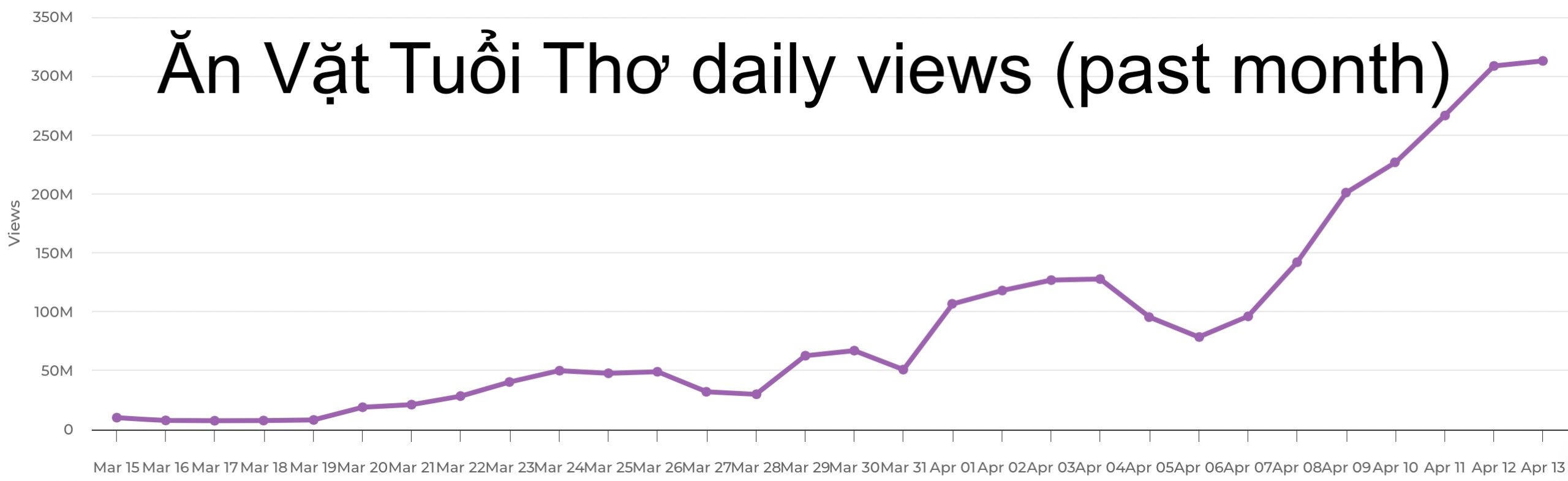
It seems as if the survivalists are still thriving via YouTube’s TikTok competitor. A look at the viewership received by Ăn Vặt Tuổi Thơ supports that hypothesis. Though the channel’s Vietnamese-language name translates to “childhood snacks,” its most-watched Shorts clips are predominantly survival-themed.

That tendency has led to shocking growth for Vietnam’s sole Global Top 50 representative. After getting fewer than ten million daily views a month ago, Ăn Vặt Tuổi Thơ has pushed its average daily tally above 300 million.

Data via Gospel Stats

With that trend in mind, let’s shift our focus to the content category I alluded to with this section’s header: Videos of people working. Channels like MaviGadget helped popularize that genre on Shorts, and it is now benefitting from the view counting change.

One of the biggest success stories in the YouTube Shorts work world is Worker Vision, which just moved into the top 25 of our Global Top 50 after ranking outside the top 300 a week ago. Worker Vision has soared up the charts with the ease of two loggers taking down a big tree.

Though the Shorts counting change is undeniably a good deal for these types of channels, will it promote stagnancy within the format as a whole? It’s hard to say — though at this point, the dust is still settling.

Channel Distribution

Here’s a breakdown of the Top 50 Most Viewed channels this week in terms of their countries of origin:

  • India: 16
  • United States: 11
  • South Korea: 3
  • Canada, Germany, and Japan: 2
  • Australia, Bangladesh, Belgium, China, El Salvador, Hong Kong, Indonesia, Kazakhstan, Nepal, Puerto Rico, Russia, Slovakia, Spain, and Vietnam: 1

This week, 44 channels in the Top 50 are primarily active on YouTube Shorts.

As always, keep up to speed with the latest Tubefilter Charts and all our news by subscribing to our newsletter. You’re going to love it. 👉  Newsletter.Tubefilter.com.

TikTok made $39 billion outside of China last year. How’s that ban looking?

As TikTok‘s ban loomed (and then was yet again delayed), it talked up the economic impact of its U.S. operations: 7.5 million American businesses use its tools, and those 7.5 million businesses employ 28 million people.

But what about the economic impact TikTok’s stateside ops have on owner ByteDance‘s wallet?

A person familiar with ByteDance’s financials told The Information that the Beijing-based giant’s international revenue, most of which is earned from TikTok U.S., jumped 63% to $39 billion in 2024. It ended up accounting for a quarter of ByteDance’s total revenue for the year ($155 billion), its highest proportion yet.

The person also said growth in ByteDance’s Chinese operations, like Douyin, has slowed, and that it’s now depending more on what TikTok earns from American users.

That leaves it in a rough spot. If it doesn’t divest and TikTok is banned, it’ll lose that revenue completely. If it does divest in time and TikTok is able to continue U.S. operations, ByteDance will get a lump sum chunk of change, but will miss out on the app’s future American earnings. Neither option is very savory for ByteDance, for obvious reasons, but since divestment is mandatory, it’s got to make a choice.

Luckily for it, that choice involves some major players. TikTok’s list of potential suitors continues to grow, and some estimates have put its value at over $100 billion. Will ByteDance actually get that? Who knows. But if it did, that’s over three 2024s of earnings to keep its fires going while it figures out its next move.

To put TikTok’s earnings and profit in context, it’s earning more than YouTube and less than Instagram, and likely profiting less than both. YouTube earned just over $36 billion in ad revenue last year (but also brought in unspecified Premium, YouTube Music, YouTube TV, movie/TV rental, etc income on top of that). Instagram was estimated to have brought around $71 billion. We don’t know what percentage of YouTube’s earnings are profit, but we know Instagram owner Meta’s annual profit jumped up 59.5% year-over-year to end 2024 with $62.4 billion in profit out of $164.5 billion in revenue.

ByteDance, on the other hand, saw profits increase only 6% in 2024 (for a total of $33 billion in profit out of $155 billion in revenue)—in large part due to its heavy investments in AI development and data infrastructure.

It also invested in ecommerce, which seemed to be paying off with TikTok Shop raking in impressive Black Friday sales. But considering TikTok just laid off a portion of its U.S.-based ecommerce team and is restructuring due to missed targets, maybe the payoff hasn’t hit quite as hard as expected.

Snap’s new ad format asks brands to pay for creators’ education

Platforms roll out new ad formats pretty consistently, and in most cases, they’re nothing groundbreaking. Pre-rolls, mid-rolls, in-feed ads, takeovers, pause ads…We’ve seen it all before. So when Snap announced it was launching a new ad product, we expected nothing special.

Instead, we found something unique: Snapchat is now allowing brands to sponsor Snap Schools, its series of IRL creator education/biz dev events.

Snap launched the workshop program in 2022, and to date has hosted over 50 installments in the U.S., Mexico, Europe, MENA, and India. Topics include the nuts and bolts of content creation, engagement strategies and audience-building, and monetization. Before this year, the workshops were put on solely by Snap. But this past February, it partnered with cosmetics brand Clinique as Snap Schools’ first sponsor.

“In February, over 75 creators participated in a Clinique-branded game show where they learned about Clinique’s dermatologist-guided approach to skincare, in addition to activities like candle making and (of course) networking,” Snap said in a company blog post. “Clinique was organically integrated throughout the event, including through augmented reality (AR) Clinique Lenses in our Snapchat AR mirrors, the Clinique gameshow, and logo placement throughout the venue.”

The partnership also paid off for attending creators: After Clinique’s Snap School, it went on to sign brand deals with Snapchatters Joseph Arujo, Zaina, The Odditty, Shannon Baker, and Ydelays.

Snap is opening another 22 sponsorship slots over the rest of 2025, and calls them a “premium offering” that “offers advertisers a unique opportunity to engage directly with aspiring and established Snap Stars, helping build brand visibility and foster meaningful relationships and partnerships with creators.”

We’re guessing, based on “premium,” that these sponsorships are pricey–but so far, they seem like an effective way for a brand to ingratiate itself with Snap’s trove of creators. And based on the number of deals Clinique signed after its Snap School installment, this program could end up providing more for creators than just a day in the classroom.

Have you heard? ‘Ask a Ninja’ revived, scambaiters in the spotlight, and Twitch staff says Adin Ross unban big L

Each week, we handpick a selection of stories to give you a snapshot of trends, updates, business moves, and more from around the creator industry. This week, a beloved web series returns to YouTube, Nintendo says no to a VTuber, Best Buy wants in on cash from creator recommendations, and Balatro gets a blessing.

Creator commotion

One of YouTube’s oldest web series is back in action. Ask a Ninja first spun its shuriken on YouTube way back in 2005, had its heyday in 2010-2011, but vanished into the mist in 2015. Never fear, though: This week, after years of radio silence, it’s offiically returned. The cult beloved series features, of course, a ninja (played by host/channel co-creator Douglas Sarine) who answers the world’s queries with a dash of sage advice. His new episode is eight minutes long and has inspired nearly 2,000 comments from fans excited about his grand return. Next in line for hokage?

Dude Perfect’s going steady with BODYARMOR. The five-man creator group has been cozy with bev brand BODYARMOR for a year now–part of its ongoing effort to secure long-term sponsorships that go beyond just paying for videos. Now it’s following up custom flavor Perfect Pop with a sour punch. Expect to find Sour Apple on Walmart shelves for a buck apiece now through June.

MrBeast is suing a former employee, and it’s not DogPack404. Instead, it’s a former IT contractor, Leroy Nabors, who MrBeast says committed misappropriation of trade secrets, breach of NDA/contract, and unauthorized surveillance within Beast HQ. That resulted in Nabors allegedly having access to “thousands of Beast’s most confidential files.” Yikes. In other MrBeast news, he’s partnered with a Ghana nonprofit to build a free surgical center in West Africa.

Dobrik’s cashing in his health kick. After his fitness-focused return to vlogging, David Dobrik is launching his own potato chip brand, with bags ringing in at just 60 calories. And, to get the health-conscious crowd interested, he’s handing out 1,000 bags at Coachella this weekend.

Pop culture minute

Nintendo is at it again. The Japanese gamemaker behind cultural icons like Pokémon, The Legend of Zelda, Mario, and more is known for its antagonistic attitude toward content creators. Its latest target? Hololive VTuber Pekora, who streamed herself trying to catch a Shiny Mew in the 2004 game Pokémon Emerald. The problem is that Shiny Mews are exceedingly rare, so Pekora bought a bunch of used game cartridges, looking for one that contained the rare item needed to encounter Mew. She apparently ended up streaming herself using a cartridge that was hacked, and Nintendo was not happy about it. Hololive apologized profusely, which isn’t surprising, since it’s the biggest VTuber agency in Japan and probably wants to stay on Nintendo’s slim good side.

Scambaiters in the spotlight. Scamming has reached new heights. We here at Tubefilter get texts almost every day from people claiming they found our profiles on LinkedIn and really truly honestly have a fantastic job offer for us. We just have to fork over $5K for “startup supplies.” But as scamming gets more prolific, costing Americans an estimated $12.5 billion last year, so do scambaiters. And lots of them are making their livings by sharing their best baits on YouTube.

Mariah Carey may be one of the world’s most famous celebrities, but she’s also a mom–which means when she got the chance to embarrass her kid while he was livestreaming on Twitch, she took it. 13-year-old Moroccan invited Carey and his sister Monroe to make a quick appearance while he was broadcasting, but Carey’s renown ended up distracting the chat, and despite Moroccan’s efforts to urge her offscreen, Carey stuck around to give him a hard time. Ah, motherhood.

The biz

Hitting the beach with a brand. Tanning lotion brand Jergens Natural Glow just ferried a group of influencers from the U.S. to the sunny shores of Tulum, a sunny resort town on Mexico’s Caribbean coast. Attending creators included Halley Kate, Bonnie Wyrick, Jaz Smith, Soo Youn Lee, and Bran Flakezz. The adventure was part getaway, part biz dev: influencers all got professional photographs posing with Jergens products, along with luxury accomodations and peer networking.

Tariffs at NAB. The National Association of Broadcasters‘ annual trade show had a lot to do with artificial intelligence this year, but though that was the big-ticket item for many presenters and attendees, there was something else on everyone’s minds: The Trump tariffs, and how they’ll affect American industries–and thus American brands’ advertising budgets–in the coming months…or years. (Another NAB Show tidbit worth noting: Webtoon made an appearance this year, hyping up its growing presence in Hollywood.)

Face cream, home decor…groceries? We know lots of products do well in ecommerce and digital ads. Brands like e.l.f. cosmetics have managed to reach Gen Z’ers on TikTok, and TikTok Shop is selling the same users millions of dollars in trendy products. But what about home basics like groceries? Well, thanks to a new investigation from Grocery Dive, we can see exactly how companies like Kroger, Whole Foods, and Aldi are performing with The Youths Online–and why it recommends influencers team up with these brands. The tl;dr? Groceries may not be the sexiest product on paper, but everyone needs them.

Best Buy gets busy with creator storefronts. Speaking of legacy brick-and-mortar stores pairing with influencers, Best Buy‘s new program is giving creators like Linus Tech Tips their own storefronts. It’s basically the same as Amazon‘s creator program, where they can make public lists of recommended products and get a kickback every time someone buys. Not a bad gig for YouTube‘s bevy of tech-savvy creators.

Platform headlines

TikTok Shop restructure. As we said above, TikTok Shop is raking in millions. But its numbers aren’t satisfying the company, because it just laid off a portion of its U.S.-based Ecommerce Governance and Experience team. Employees told Business Insider this is part of an overall restructuring of the team. The layoffs follow February cuts to TikTok’s Global Trust and Safety Team, as well as some executive exits.

Twitch staff says Adin Ross unban big L. Twitch’s CEO Dan Clancy has spent the past two years establishing himself as a cool guy who listens to creators’ needs. He’s put in a lot more face time than previous CEO Emmett Shear, and has spearheaded some significant changes to things like monetization, multistreaming, and bans. But he’s also walked back some decisions from before his time–one of which is Adin Ross‘s ban. Ross, an Andrew Tate devotee, was banned for hateful conduct. Clancy allegedly told Twitch staffers who were unhappy with his decision that unbanning Ross was about giving him a “second chance.” Who knew you could be banned eight separate times and still qualify for a second chance?

YouTube has to keep up with the times. The internet’s latest favorite neurodivergent catnip game is Balatro, a randomized dungeon-crawler in card deck form. Players advance through rounds by playing poker hands and collecting special ability cards. Developed by one person, LocalThunk, it costs around 15 bucks on Steam, but you don’t put any additional money into it. It’s not real poker. This was apparently difficult for YouTube to understand, because it started age-restricting videos of gameplay, saying they were showing gambling. After complaints, YouTube reversed the decision and said it’s “conducting a platform-wide review” of what happened, but sheesh! Keep up with the culture, YT!

TikTok tells creators to stick around for bonus monetization

You may have noticed TikTok‘s gotten kinda quiet on the development side while the whole will-it-won’t-it ban–and executive exodus–has been happening. But with an ever-growing list of potential U.S. suitors lining up and the Trump administration apparently keen to keep the app operating (unless tariffs screw that up…), its potential future in the States is starting to look brighter.

And it wants to make sure top-performing (and top-revenue-generating) creators stick around for that future instead of moving somewhere like Reels.

To accomplish this, it’s offering a new, invite-only reward program that pays creators to make content in high-traffic niches.

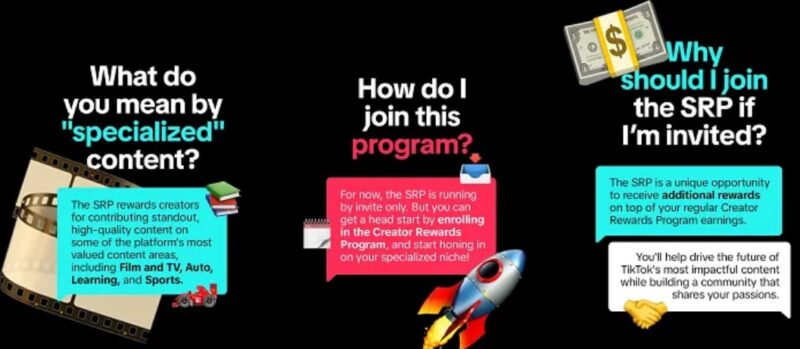
The “Specialized Rewards Program“–not to be confused with TikTok’s Creator Rewards Program, the name for its default monetization system–will give creators bonus earnings for “standout, high-quality content,” TikTok said in an Instagram post (ironic, we know).

At launch, it’s looking for creators to make content around film & TV, automotive, education, and sports.

“You’ll help drive the future of TikTok’s most impactful content while building a community that shares your passions,” according to an infographic about the program.

from TikTok

As we mentioned above, the program is invite-only (“for now,” TikTok says), but TikTok appears to be pulling candidates from the pool of people enrolled in the Creator Rewards Program. How it judges who deserves an invite and what counts as “standout, high-quality content” isn’t yet clear.

To us, this sounds like a mix of Snapchat‘s Spotlight program, which used to shell out $1 million a day to top-performing videos, and things like Twitch‘s bounties, where creators can accept specific brand deals for bonus cash. Obviously TikTok’s program doesn’t involve creators directly making content for specific brands (at least, for now?), but it is a way for TikTok to manually generate more content about certain subjects, which it could use to woo advertisers in those niches. Maybe it wants to work with more luxury car brands, so it taps someone like Supercar Blondie and pays her bonuses for her videos. Or it could tap a smaller creator whose whole brand isn’t built around cars, but makes car-adjacent content, and encourage them to make more of what it’s looking for.

That’s all hypothetical. What’s certain is that this program gives TikTok a way to almost commission creators for the content it wants.

As for what it’ll pay and whether creators will think the bonuses are worth it…that remains to be seen. The debut of this program does indicate, though, that TikTok expects to stick around in the U.S.–and it clearly wants creators to know that if they don’t jump ship in anticipation of a ban, they could get some extra cash.

BeReal thinks it can capitalize on TikTok’s uncertainty with ads. Are they even competitors?

We’ve come a long way since Facebook was the only social network on the web. Now we have a sizable handful of major platforms–and an even bigger handful of up-and-coming platforms, some of which, like Kick, have become adept at taking advantage of bigger fishes’ falterings.

BeReal is aiming to do just that. Launched in 2020, the French photo app pitched itself as a hub of candid authenticity, where users would post one unfiltered, unedited picture (of themselves, their surroundings, their loved ones, etc) every day in response to a timed prompt. Basically, it idealized itself as an escape from the uberglitz luxe lifestyle world of Instagram, and advertised to potential users with taglines like, “BeReal won’t make you famous.”

In its early days, BeReal was also pretty anti-ad. Operations over the past five years have been powered by $90 million in funding from investors including Andreessen Horowitz. When Digiday asked BeReal in 2022 what it planned to do when that cash ran out, it didn’t answer.

Now, we know: It’s going to, like Instagram, start relying on ads.

To be clear, BeReal has been running ads outside the U.S. from over 200 brands for a while now, hitting regions like France, the U.K., Italy, and Germany. (It’s also worth noting that the usual digital-savvy brands, like Chipotle and e.l.f. cosmetics, have already been meeting U.S. consumers on BeReal, without the involvement of a formal ad program. Both brands jumped into TikTok ads early, too.) But this is the first time it’s targeting stateside users with marketing. Why choose this moment to debut American ads?

There are two reasons. Ben Moore, who is joining BeReal as Managing Director of U.S. and will be leading its U.S. ad push, told Digiday that (1) he sees marketing budgets growing tighter, and (2) the uncertainty around TikTok could have advertisers looking for somewhere else to run less polished, Gen Z-targeted marketing.

“From what I’ve heard from my contacts on the agency and brand side in the U.S., there’s a need for an alternative to the polished, less authentic content that users are consuming and they are seeing a rebalance of ecosystems,” he said about ad budgets. “Agencies are definitely reevaluating where they show up and that’s where we come in.”

About TikTok, he said that amidst the ongoing will-it-won’t-it ban talk, “we feel like friends and agencies are ready to pull the trigger and shift some of those budgets to BeReal.”

BeReal has been building its U.S. ad side for six months, testing with an undisclosed number of Fortune 500 companies and hiring an internal team of around 10 people. Digiday reports that advertisers who want to put their stuff on BeReal have to commit a minimum spend of $10,000. Once they do, they’ll get access to two ad formats–targeted in-feed ads and 24-hour, high-placement takeovers (the same vibe as YouTube’s masthead).

Moore advises brands start with in-feed ads, which are “one of our best-selling ad units because it’s the most seamless and non-intrusive format that has worked on other platforms in the past.” Both Instagram and TikTok–which BeReal appears to view as a competitor–run in-feed ads.

BeReal doesn’t intend to stop with in-feed and takeovers. Moore said it’s developing boosted posts, where brands will be able to pay to boost UGC from the app’s 40 million users.

The question is whether BeReal can actually sieve away some ad dollars from TikTok. The ByteDance-owned platform is technically on a tightrope, but it has a veritable smorgasbord of potential suitors, and seems confident about its ability to continue operations in the U.S.

BeReal and TikTok’s audiences were probably similar in 2020–Gen Z and young millennials looking for a rawer approach to social media–but TikTok has come far from its post-straight-from-your-phone roots. Sure, a fair share of candid, memeable videos go viral, but many top creators are putting high-quality production resources into their TikTok content. And if BeReal still thinks it can be a platform that doesn’t make people famous–aka a platform without creators–we’re not sure how far it’ll get.

Creators are redefining food discourse. Now they’re getting their own version of ‘MasterChef’.

A strong performance on MasterChef can help launch a YouTube career — just ask Nick DiGiovanni — but can careers built on YouTube translate to MasterChef? That’s the question Banijay Entertainment is asking with MasterChef Creators, a spinoff of the Brazilian version of MasterChef that will air exclusively on YouTube.

Banijay has turned to YouTube stars to find new audiences for some of its formats, and it’s now applying that strategy to MasterChef. The cooking competition comes from Endemol Shine, a Banijay subsidiary, and Endemol teamed up with YouTube to bring a creator-led version of the show to life.

“The partnership between YouTube and Endemol Shine Brasil stems from our Brand Solutions division’s ongoing mission to translate trends, and create relevant initiatives for brands and audiences,” said Google Head of Content Projects Esly Paiva in a statement. “By featuring creators as both hosts and contestants in MasterChef Creators, we strengthen their connection with fan communities and the show’s followers. Additionally, we celebrate the growing trend of YouTube content consumption on connected TVs, by leveraging a classic television format.”

On MasterChef Creators, judges Helena Rizzo, Henrique Fogaça, and Erick Jacquin (pictured above) will be joined by hosts Fih and Edu, who reach more than three million subcribers on their Diva Depressão channel. The proceedings will be broadcast on another hub that has benefitted from the rise of digital cooking content: The official MasterChef Brasil YouTube channel.

Like in many content categories, cooking shows are reaching out to younger generations by including creators as participants and judges. A notable example of that trend is the Korean Netflix original Culinary Class Wars, which featured a challenge that turned famous influencers into restaurant patrons.

In the food world, there is also an interesting effect happening in the other direction: Creators are making their fans more interested in the sort of haute cuisine one finds on MasterChef. Through in-person gatherings and videos from accomplished chefs (including DiGiovanni and high-end steak master Guga), YouTube and TikTok viewers are evolving their taste buds and pushing restaurants to adopt feed-friendly dishes.

MasterChef Creators will give reality TV fans a chance to see how far the internet’s culinary community has come. The first of three weekly episodes will drop on May 6.

Rebecca Zamolo’s new venture supports mothers at all stages of the fertility journey

Rebecca Zamolo is using her influential position to advocate for expecting mothers. The family-oriented creator, who reaches more than 18 million subscribers on her namesake YouTube channel, has announced a new lifestyle brand called MOLO.

MOLO, which stands for “mother’s love,” is designed to serve as a resource for women who are embarking on the path to motherhood, no matter which stage of the process they’re at. The venture includes a platform where users will be able to share their personal stories, a space where women can research topics like reproductive biology and fertility, and information provided by fertility experts, OB-GYNs, and nutritionists.

Beyond its community-oriented hub, the MOLO brand also extends to a line of fertility wellness powders that will be available through Walmart. “MOLO is all about helping women prioritize their health and feel hopeful, whether they’re starting their fertility journey or preparing for motherhood,” Zamolo told Tubefilter. “I know firsthand how overwhelming it can be, and these supplements are meant to give women the support they need to feel confident and take control of their fertility.”

Zamolo’s personal history will be woven into MOLO. Though she also uploads content in categories like gaming and comedy, her channel has shifted toward family content since her marriage to Matt Slays in 2014 and the birth of her daughter Zadie eight years later. Earlier this year, Zamolo and her family announced that they are expecting a second child; the reveal video for that announcement has picked up more than five million YouTube views to date.

For Zamolo, motherhood hasn’t always come easily. She has been open about her fertility struggles, which have included a miscarriage she revealed in 2021. As she explained to Tubefilter, part of her goal with MOLO is to help women “feel supported and empowered” as they prepare for pregnancy.

“As a mom to Zadie, I know how important it is to feel confident in your health during such a transformative time,” Zamolo said. “MOLO gives women the tools to take control of their journey, whether they’re starting their fertility path or preparing for motherhood.”

The makeup of the MOLO supplement is also related to Zamolo’s desire to ease the path to motherhood. She described the supplements as an alternative to the “horse pills” she had to take during her own fertility journey. Expecting individuals who want to put that claim to the test can check out the MOLO supplements now — they’re officially available on Walmart shelves.

YouTube wants “No Fakes,” so it’s endorsing a Congressional bill that addresses AI concerns

A Congressional effort to address the rise of deepfaked images and videos has the support of several major tech companies, including YouTube. As the Google-affiliated platform expands its own suite of AI-combatting tools, it is throwing its weight behind the No Fakes Act, which was reintroduced in Congress this week.

The No Fakes Act is a bipartisan proposal that gives individuals the right to control digital replications of their likeness. That ownership can be transferred to an estate in the event of the affected individual’s death, and digital likeness rights would not expire until 70 years postmortem.

The bill is sponsored by Senators Marsha Blackburn (R-TN), Chris Coons (D-DE), Thom Tillis (R-NC), and Amy Klobuchar (D-MN). It failed to gain traction upon its initial introduction last year, with organizations like the Motion Picture Association (MPA) questioning whether the statute would violate First Amendment free speech protections.

Blackburn and co. have now reintroduced the No Fakes Act with support from more than a dozen prominent media companies, including YouTube, Disney, OpenAI, and the Creative Artists Agency (CAA). “For nearly two decades, YouTube has been at the forefront of handling rights management at scale, and we understand the importance of collaborating with partners to tackle these issues proactively,” reads a statement from YouTube VP of Public Policy Leslie Miller. “Now, we’re applying that expertise and dedication to partnership to ensure the responsible deployment of innovative AI tools.”

YouTube’s stable of deepfake hunters includes MrBeast, Marques Brownlee, and Mark Rober

The blog post that contains Miller’s statement also runs through the steps YouTube has taken to stamp out illicit AI-generated content on its platform. Those efforts include a system that lets creators request takedowns of unauthorized deepfakes, new tools that offer “likeness management,” and support for proposals like the No Fakes Act.

YouTube added a new safeguard against generative AI last year, when it announced a partnership with CAA to develop and test a toolkit that lets high-profile users find and moderate AI-generated uploads that feature their likeness. Several high-profile creators, including MrBeast, Mark Rober, and Marques Brownlee, have signed on to use the likeness matching system during the next phase of testing.

Brownlee is one of the creators who has called for more sophisticated solutions to combat the “evolving problem” of AI misuse. YouTube has complied with that demand through a mix of technological and policy-based solutions, but misleading generative content and other forms of AI slop continue to run rampant.

YouTube believes that a mix of internal advances and government regulations can provide a path for a more sustainable AI future. Now it’s Congress’ turn to decide whether they agree with that roadmap.

Through funding platform GigaStar, a gambler raised a $1.3 million investment from his fans

As direct investments in creator channels heat up, some digital stars are going directly to their fans to fund the next phases of their operations. That’s what Jason Boelhke did via GigaStar Market. On the crowdsourced investing marketplace operated by GigaStar, Boelhke set a new individual record by raising a $1.3 million round from more than 1,200 backers.

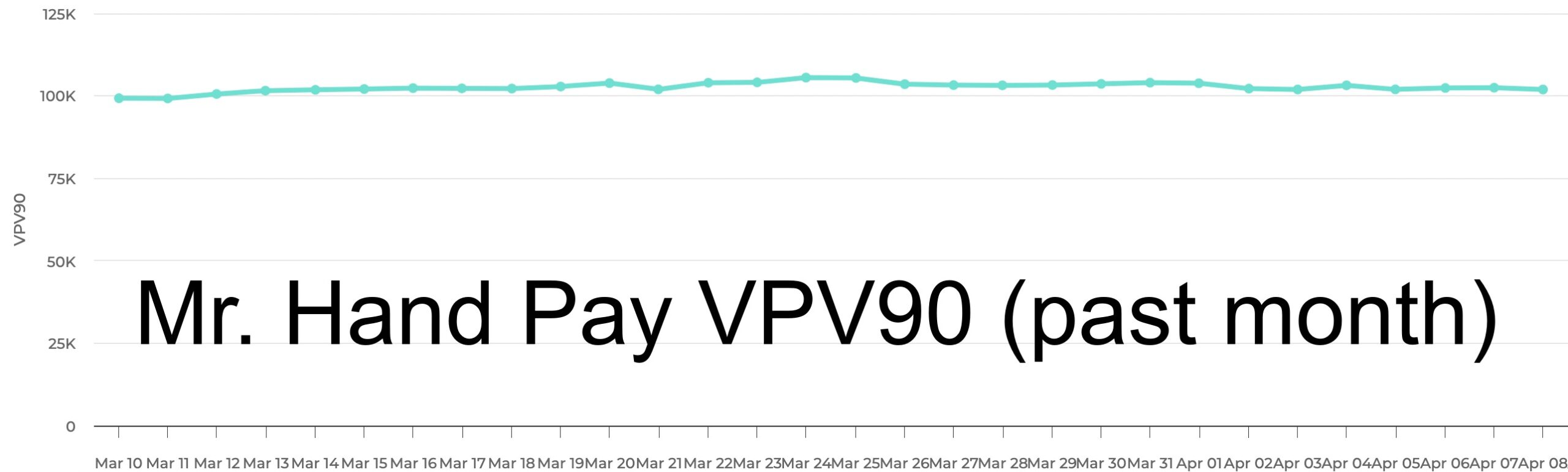
Boelhke has become a familiar face in the world of gambling content thanks to his Mr. Hand Pay channel, on which he shares his most extravagant bets and biggest hits. Thanks in part to his increased presence on Shorts, Boehlke has built Mr. Hand Pay into a thriving hub that reaches 735,000 subscribers.

Emboldened by his successes on the casino floor and on YouTube, Boehlke turned to GigaStar to raise a round that, in his own words, will “take this channel to new heights.” In exchange for capital, Boehlke offered up a 10% slice of Mr. Hand Pay’s future YouTube revenue, which will be divvied up among GigaStar users who hold the appropriate tokens.

There’s a good reason why more than 1,200 people jumped at that opportunity. According to Gospel Stats data, Boehlke’s VPV90 — the average viewership on his videos over a 90-day period — has hovered around 100,000 over the past month. That converts to a significant chunk of ad revenue, some of which will go into the backers’ pockets.

Data via Gospel Stats

Since kicking off in 2023, GigaStar has hosted two seven-digit funding rounds on its eponymous marketplace. In addition to Boehlke’s $1.3 million windfall, Brian Kim of the ClearValue Tax channel also cleared the million mark last June.

“This raise proves that creators like me can build something bigger by inviting our communities to join us as partners in our journey,” Boehlke said in a statement. “GigaStar gave me the innovative platform to engage my audience.”

GigaStar CEO Hazem Dawani applauded Boehlke’s round as a “new benchmark” for creator investments and invited the Mr. Hand Pay host to join GigaStar’s DropStars Program, an advisory board that also includes Kim among its members.

Between its creator consortiums, massive funding rounds, and other payout programs, GigaStar is establishing itself as a serious player in the creator economy. Boehlke is one channel owner whose investing gamble has paid off, and his success may inspire others like him to seek support from their closest fans.

IAB releases full schedule for 2025 NewFronts

The NewFronts is ready for its 2025 return. The annual pitch series put on by the Interactive Advertising Bureau (IAB) will return to New York from May 5-8, with more than 30 companies slated to present across four days of action.

For nearly two decades, the NewFronts has served as the digital media industry’s answer to TV’s upfronts, offering presenters the chance to show off the ad-buying opportunities that are available across their respective platforms. “The 2025 IAB NewFronts is where you can really get a sense of where the video world is heading,” said IAB CEO David Cohen in a statement. “The presentations here reflect and shape what’s coming next. From what people will be watching to how brands show up in those spaces, this is where the next year in digital video starts.”

As per usual, IAB NewFronts Principal Partner Google will kick off the proceedings with an event on Monday morning. The tech giant will return to send off the NewFronts on its fourth and final day, when YouTube will host an event beginning at 4:30 PM ET.

In between, there will be a diverse array of presentations that will include pitches from social media platforms, streaming services, FAST channels, and ad networks. The greatest concentration of spiels will occur during the IAB Mainstage event, which will run for most of the day on May 7.

The NewFronts has gone through numerous changes since the gathering’s initial conception by the agency Digitas. An event series that once ran for two weeks has been reduced to four days, notable presentations like YouTube’s Brandcast have left the schedule, spinoffs like the IAB PlayFronts have debuted, and COVID necessitated a switch to digital meetings that has mostly caught on. The majority of 2025 NewFronts sessions will be available to stream online; one notable exception is the TikTok pitch on May 6, which is sure to draw plenty of interest from potential attendees.

At the end of the day, despite all the changes to its format, NewFronts is what it always has been. As Cohen stated, the pitches offer a look at the future of advertising, giving brands and agencies the chance to buy in on the next big thing. To stay abreast of any changes to the schedule, and to see the full docket for the Mainstage event, head over to the IAB website.