Archive for 2025:

Advertisers hoping to reach under-18 viewers on YouTube can keep PACE with a new tool

Precise TV has unveiled a first-of-its-kind solution to help advertisers reach consumers under the age of 18. At the IAB PlayFronts, the contextual video ad tech platform unveiled PACE, a tool that helps users target young viewers in an efficient and legally compliant manner.

PACE, which stands for Precise Audience Content Evaluator, draws from its namesake company’s proprietary data to serve as “the first comprehensive video advertising solution for audience targeting and measurement for under-18 demographics,” according to a press release from Precise TV. By applying machine learning to that data, PACE aims to reduce wasted spend among advertisers seeking to reach the relevant cohort.

In an email to Tubefilter, a Precise TV rep demonstrated how PACE can be used to break down audience segments, even within the nebulous “under-18” category. For example:

  • Educational creator Ms. Rachel gets 85% of her traffic from viewers aged five and under.
  • Ryan’s World viewership is split fairly evenly between the 2-5 and 6-9 age brackets. The toy channel has a majority of male viewers (65%) compared to Ms. Rachel’s majority-female audience (55%).
  • Most of MrBeast‘s audience (75%) is male, and the most common age demographic among his fans is teens between the ages of 13 and 17. They account for 39% of his viewers. Check out the image up top for the full breakdown.

Precise TV is building PACE on top of its existing work in the children’s entertainment ecosystem. It previously used its database to inform brands about the ways that viewership trends influence purchasing decisions among kids and parents.

“Brands seeking the attention of kids and teens have long struggled with a lack of visibility into their campaign performance,” said Precise TV Co-Founder and Co-CEO Christian Dankl in a statement. “With PACE, we’re providing a level of precision and transparency never seen before.”

PACE arrives at a time when U.S. regulators are thoroughly investigating digital ads that target underage viewers. Precise TV is answering any safety concerns by ensuring that PACE operates in a COPPA-compliant manner. The data used to train PACE’s models is anonymized and aggregated, and parents are present when their kids fill out viewership surveys.

As brands, creators, and agencies get used to working within the confines of rulebooks like COPPA, we’re seeing a lot more products designed to fine-tune campaigns that are linked to children’s entertainment. Common Sense Networks, for example, has brought child-safe partnerships to Roblox, and media company Moonbug recently announced its first-ever brand campaign for smash hit nursery school series CoComelon.

PACE may be the most sophisticated targeting and measurement tool introduced into that ecosystem thus far. Working alongside brands in its beta testing phase, PACE has achieved 76% campaign delivery in core demographics, such as boys between the ages of 7 and 12. Precise TV describes that result as “a massive improvement over industry benchmarks” — so there are plenty of reasons for advertisers to get excited.

OpenAI wants more training data. So it’s building the next X.

When people said they wanted an alternative to Twitter now that it’s been X-ified, this probably isn’t what they meant: ChatGPT, DALL-E, and Sora owner OpenAI is apparently building its own social network to compete with Elon Musk‘s site.

The Verge reports that OpenAI co-founder/CEO Sam Altman has been privately asking for feedback about the project. But he’s also not so privately floated the idea; back in February, when news surfaced that Meta might be looking to make its own ChatGPT competitor, he sniped, “ok fine maybe we’ll do a social app.”

It seemed like a sarcastic comeback at the time, but now–not so much. A person familiar with the matter (but who works at another AI lab, not OpenAI) told The Verge that X integrating Grok into its feed “has made everyone jealous.”

“Especially how people create viral tweets by getting it to say something stupid,” they added.

Like many of X’s updates post-Musk buy, the Grok integration was widely disparaged and caused yet another mass exodus of creatives from the platform, since they didn’t want their art, writing, photos, and videos to be scraped for training or stolen and “remixed” with the click of a button.

And that’s the crux of what’s happening here. Yes, Altman’s beef with Musk and Meta might be some of the inspiration for it to build its own social network. But also, OpenAI is clearly taking stock of its biggest competitors and realizing they have something it doesn’t: vast, constantly updating troves of user-generated content, platforms whose terms of service make everything posted on them takable for training.

Since ChatGPT first appeared on the net, OpenAI and other AI developers have faced scrutiny over where they source the data used to train their large language models, and it’s become more difficult for them to simply take what they want, citing “publicly available” as permission. With platforms like Facebook and X, though, scraping permission can be baked in to basic TOS–so if people want to use those platforms, they are required to consent to pouring a neverending well of fresh meat into the AI grinder.

Now, it’s possible for developers like OpenAI to broker deals with entire platforms–or, in some cases, individual creators–and pay to scrape their data. However, since Meta and X (which Musk recently merged with his AI startup, the creatively named xAI) are competing with OpenAI on artificial intelligence development, they’re obviously not going to give it their training data, leaving OpenAI high and dry for new material.

Unless it can make its own platform.

As The Verge writes, it’s not clear yet whether OpenAI’s envisioned site would be separate from ChatGPT, or if it would be similar to the X/Grok integration. Considering ChatGPT was the most downloaded app on Earth last month, that might be the move OpenAI goes with.

Whether people will actually adopt it as the next big social platform…We’ll see.

Despite ban threats, TikTok has never been more popular among U.S. teens

TikTok‘s regulatory status may be in jeopardy, but its status as a teen cultural touchstone is not in doubt. The Spring 2025 edition of Piper Sandler‘s Taking Stock With Teens report found that TikTok is still the most common response Gen Z Americans give when asked, “what’s your favorite social media platform?”

Piper Sandler (formerly known as Piper Jaffray) has been conducting biannual surveys of American teenagers ever since Millennials, not Gen Z, were the teens in question. Over the years, the preferences of the surveyed youths have shifted, but U.S. under-20s have shown a general preference for mobile-first social apps like Snapchat.

In recent years, that preference has turned TikTok into the most common “favorite social platform” in the Taking Stock With Teens report. In the Spring 2025 edition of Piper Sandler’s research, the TikTok love shone even brighter: 47% of respondents dubbed TikTok their favorite social platform. That percentage is up 12% year-over-year.

It’s worth noting that Piper Sandler doesn’t include YouTube in its survey of social media preferences, preferring to characterize the Google-affiliated platform as a streaming hub. Within that category, YouTube and Netflix tend to take turns as the top destination listed in the Taking Stock With Teens report. In the Spring 2025 publication, it’s Netflix’s turn to lead. The surveyed teens indicated that 31% of their video consumption comes on Netflix, compared to 26% for YouTube.

Even if TikTok isn’t competing against YouTube in this particular arena, its saturation among American Gen Z consumers is notable. It’s a sign that vertical video aficionados in the U.S. aren’t pressed about a potential ban, even though Congress has aggressively targeted TikTok with a sweeping law passed last year.

Depending on who you ask, TikTok’s popularity among American teens may be the reason why it has been targeted for a divestiture or ban. Senator Mark Warner of Virginia, one of the original authors of the law that looks to rein in TikTok, argued that the statute was dead in the water until TikTok started radicalizing young people on topics like Palestine.

Congress may be able to limit TikTok’s operations (especially if the Trump Administration fails to get a divestiture deal done), but regulators can’t stop the app from receiving enthusiastic support from Gen Z. To learn more about the proclivities of American teenagers, check out this infographic provided by Piper Sandler.

The creator industry NEEDS your POV–and you can get $250 by giving it

Our content creation industry is powerful but can be disparate. We’re worth $250 billion as a whole, but there’s no business-wide standard for what individual content creators should make from things like brand deals, leaving new creators vulnerable to bad contracts. Similarly, there are hundreds of tools–both hardware and software–available to creators, so newbies (and experienced folks looking to upgrade) can be overwhelmed by their options. How can they know what’s most reliable?

For some creators, the solution is simple: Ask peers what tools they’re using. But others, like the aforementioned newbies, don’t have access to that resource.

So MIDiA Research is building its own.

The content creator-focused analytics company regularly puts out reports about various facets of the creator economy, and we here at Tubefilter have covered them numerous times. Now we’re working directly with MIDiA, seeking creators to fill out the survey that will power its next report.

The report will lay out what tools–software, hardware, artificial intelligence, and distribution–creators today are most commonly using. It’ll be a resource for all creators, from hobbyists to longtime pros, whether their niche is short-form, long-form, or livestream.

But to put that resource together, MIDiA needs creators (like you!) to fill out its 10-minute survey, which you can find right here.

The survey is open through May 22, 2025, and it has a $1,000 prize pool. After it closes, two respondents will receive $250 apiece; another four will win $50 each, as a thank-you for participating.

All respondents can earn $50 if they agree to sit for a 30-minute video interview after filling out the survey.

What’s the fine print? Participants must be 16+ years old and are permitted to submit only one entry per person. Winners will be selected at random, after which prizes will be distributed via bank transfer using PayPal. Every respondent will receive a short summary of the survey’s results, giving them a peek at the valuable information the full report will contain.

Look: This is an opportunity for creators to come together and establish an industry-standard guide on video production tools. If you’ve ever been jazzed about finally getting your hands on that model of camera, or upgrading to this editing software, or at last switching from iPhone to lav mic, this is the chance for you to help fellow creators level up right alongside you.

–> Fill out MIDiA’s survey here. <–

MIDiA Research is a Tubefilter Partner.

After Gawr Gura’s split with Hololive, what’s next for one of the world’s top VTubers?

“It’s been an honor and a dream come true to be your shark.”

That’s how Gawr Gura informed her fans that her character will be retired in a “graduation” ceremony that will take place on May 1. The VTuber, who is partnered with the Japanese agency hololive, is one of the biggest stars of her ilk to graduate.

On her official YouTube channel, which reaches more than 4.5 million subscribers, Gawr Gura posted a video explaining her decision. She cited “disagreements with management and company direction” as the main reasons why she chose to break from her parent agency. “This has been a very long time coming,” she said, “but today I’m here to announce that I will be graduating from hololive.”

Gawr Gura was a big part of a global push hololive made with help from its stable of English-language VTubers. Though other members of cohort have graduated due to disputes with management, none of those departures are as notable as the sunsetting of hololive’s shark-toothed favorite. Gawr Gura serenaded fans as part of the hololive concert series, and she even performed a Jumbotron rendition of “Take Me Out To The Ballgame” at a Los Angeles Dodgers game.

Along the way, Gawr Gura has taken occasional breaks for health reasons. This time, however, the VTuber will discontinue her signature avatar for good.

Given her stardom, one might think that Gawr Gura would try to “go solo” after her break from hololive, but the Cover Corp-owned agency will still have control over the character it crafted. A Gawr Gura solo act would likely necessitate a new name and a new look. In that case, would fans follow their favorite shark or stick with the familiar faces incubated by hololive?

The situation is somewhat similar to what happened at BuzzFeed in the 2010s, when personalities who became famous due to the company’s formats chose to strike out on their own. The growth of VTuber industry — which is starting to bleed into mainstream pop culture — suggests that a big name like Gawr Gura might have a devoted enough fanbase to make hay as an independent.

Alternatively, maybe the creator behind Gawr Gura just wants to take their career in a new direction. That would be perfectly understandable, even if her fans would be left to reminisce about bygone days of selachian fun.

Patreon’s latest fan engagement tool comes in the form of live video

For creators who want to forge deeper fan connections and establish stronger revenue streams, Patreon has a plan: Go live. The monetization platform has started testing a Live Video product that will give users a way to launch broadcasts without leaving the Patreon app.

Patreon users could already integrate live streams from other platforms, but the new product will make that process seamless while opening up new opportunities along the way. Features embedded into Patreon streams will help convert “free” patrons (who subscribe to a creator without financially supporting them) into paying customers.

In its recent State of Create report, Patreon argued that having authentic interactions with fans is more valuable to creators than reaching arbitrary viewership benchmarks. 81% of creators surveyed for that report said they desire a channel for direct communications with fans.

On platforms like TikTok and Instagram, live video offers that kind of channel. TikTok Live has proved to be a dependable moneymaker for creators; it is projected to haul in $77 billion of annual sales by 2027. Instagram has updated its own live video product to facilitate direct communications between creators and their core supporters.

Patreon introduced native video in 2022. In the years since, the company led by CEO Jack Conte has introduced a number of features that make the video experience on Patreon look more like Twitch. Gifted subscriptions arrived in 2024, and a sitewide Explore tab dropped later that year. Long-form creators — especially podcasters — have benefitted from those perks to the tune of hundreds of millions of dollars.

Native live video on Patreon will continue to draw influence from Twitch. There will be a chat window where fans can offer input, and a robust suite of monetization tools will moderate those discussions. Integrations will third-party products like OBS and Streamlabs will be available. There’s one key part of Patreon Live Video that is distinct from Twitch: It will be an ad-free experience.

A Patreon spokesperson told The Verge that “thousands of creators” are currently testing Live Video ahead of a wider rollout planned for the summer. The spokesperson said that feedback from the trial group of creators will be incorporated into the product moving forward.

Companies are increasing their influencer marketing budgets. Here’s what they’re looking for.

Influencer marketing has blown up, with brands projected to spend $10.52 billion on creator partnerships in 2025. According to eMarketer and Spotter, 77% of companies have increased their influencer marketing spend this year.

With so much money being devoted to influencer marketing, its important for creators to know what brands expect out of those partnerships. That’s where eMarketer and Spotter’s latest report comes in. The two firms teamed up to produce new research that shows where advertisers’ priorities lie when they wade into the influencer marketing waters.

eMarketer and Spotter presented their findings days after the latter company put on a star-studded upfront presentation featuring pitches from several prominent creators. The event showed that YouTube’s biggest stars are ready to take their operations to the next level, and the new report provides some guidelines to help ensure copacetic relations between influencers and their marketing partners.

Most notably, advertisers are looking for the right fit. Among the 139 marketers who were surveyed for the report, 43.9% said that “finding the right creators” is the biggest challenge they face amidst their influencer campaigns. “Creator discovery has largely been solved, but identifying the right partners remains a top challenge,” said eMarketer principal analyst Jasmine Enberg in a statement. “In an era of algorithmic social feeds and where ROI matters more than ever, relying on gut feeling or vanity metrics like follower counts just doesn’t cut it.”

Instead of adhering to those “vanity metrics,” advertisers are keeping up with recent findings by prioritizing creators who are adept at fan engagement. When analyzing the performance of influencer partnerships, the number of conversions that can be directly attributed to the campaigns are the most prized number. 27.1% of eMarketer and Spotter’s respondents described those conversions as the “most valuable” influencer marketing metric, with no other stat earning even half as high of a percentage.

Seeking out long-term partnerships with creators (37.4% of respondents) and working with microinfluencers (33.1%) are two “emerging creator marketing tactics” advertisers are using to strengthen relationships with the voices who can best convert for their brands. And nearly a third (31.7%) of eMarketer and Spotter’s cohort cited more effective ROI management tools among the “priorities for your creator marketing program this year.”

The bottom line is clear: Influencer marketing is changing. Partnerships that were once plug-and-play are now being fine-tuned to ensure that creator partners can send authentic and trustworthy messages to their respective fanbases. Engagement is everything — and advertisers are keen to work with creators who can provide it.

Fan wikis are encyclopedias of unpaid passion. BloxBase is taking “pro” approach with Roblox.

Over the past few years, major platforms like YouTube have openly recognized the power of fandom. All around the world, millions upon millions of people are fans of everything from huge contemporary properties like Star Trek, Apex Legends, and House of the Dragon to long-cancelled TV shows, indie book series, niche two-volume manga series, and single-author webcomics tucked away on decades-old Tumblr accounts.

Out of these fans’ passion comes wikis: sprawling, community-made and -maintained indexes that catalog all the details about their beloved IPs, most on the Fandom hosting service. There, you can find a wiki for pretty much any TV show, movie, book, and comic out there. (Some content creators have their own, too!) And, again, they’re all made and maintained nonprofit, purely out of fan passion.

But BloxBase is doing something different. It’s putting together a Roblox wiki made by a unified editorial team that “consists exclusively of well-versed content creators,” all of whom are experienced and currently active Roblox players, The Escapist reports.

BloxBase considers itself a professional wiki where, instead of anyone on the net being able to add and modify articles, it’ll send all text content through the editorial team to be “triple-checked” for accuracy.

The site is a bit bare-bones for now, but the articles that are available show BloxBase’s overall content plan: It has individual wiki entries for games (well-known/top-performing ones for now, but maybe that’ll change in the future?) that give an in-depth description of their genres, what players can expect and what sort of game-unique items they’ll get by playing. Each entry also has some interesting stats, like player count.

BloxBase also offers game walkthrough guides and shares news about recent game updates.

The latter two are more standard journalistic fare–and certainly there’s a fair share of games journalism websites out there–but the core wiki itself is a unique approach. As far as we know, this is the first time an organized, journalist-style editorial board has tried managing this kind of wiki.

BloxBase hasn’t said yet who the content creators responsible for it are, so we don’t know if they’re content creators in the sense we’re used to discussing–e.g. YouTubers, TikTokers, Twitch streamers, etc–or trade writers. (It also hasn’t said whether or how much contributing writers will be compensated.)

Either way, this is one of those interesting internet projects worth paying attention to. If it takes off, could it change the way fan wikis are maintained? As The Escapist points out, though fan passion is available in spades, unpaid people with jobs and families don’t always have the free time to maintain wikis thoroughly; as a result, some sites are seasons or books behind on episode descriptions, and have pages filled with the dreaded, This article needs more information. Click here to contribute. And, since there’s no immediate fact-checking when edits are made, if one person is wrong about something, that misinformation could remain on the wiki until someone else more knowledgeable stumbles across it and fixes it.

It also indicates just how much of a force Roblox has become. We’ve written before about how it’s possibly the only platform still successfully riding the metaverse wave, and it’s paying out hundreds of millions of dollars to content creators and developers making virtual items and games on its site.

Now what remains to be seen is whether any of those games can become cultural zeitgeists with the kind of engrossing narrative that’ll put them alongside classics whose wikis have been run on fan energy for decades.

Kick sets new high-water mark with 317 million hours of watch time in March 2025

Kick just had its best month ever, and it’s putting the pieces in place to ensure its growth continues into the future. After reporting 317 million hours of watch time during March 2025, Kick is increasing its investments in fields like monetization and moderation, according to Co-Founder Ed Craven.

Craven co-founded Kick backer Stake.com alongside Bijan Tehrani. Since taking over as the CEO of Kick, Craven has invested heavily in streamer infrastructure to make the platform a legitimate rival for established industry leader Twitch.

The latest data coming out of Kick HQ shows how that effort is going. A spokesperson for the platform told Digiday that Kick now has more than 57 million total users. In addition to the unprecedented watch time figure, Kick also bested its average watch time record in March with 443,559 concurrent viewers.

To compare those numbers against Twitch’s returns, we can turn to StreamElements and its data partner Rainmaker.gg. During the shorter month of February, Twitch earned more than 1.5 billion hours of watch time, according to StreamElements’ latest State of the Streams report.

Though initially known for splashy signings, Kick has encouraged long-term growth by supporting the middle class of streamers. Initiatives like the Kick Road campaign, which offers a $50,000 prize pool to creators with low viewership rates, are part of Kick’s plan to carry out that vision.

Supporting small creators is nice, but Kick also faces high-profile roadblocks related to controversial behaviors within its community. The Stake.com venture has platformed controversial figures like Adin Ross, giving it a reputation as a breeding ground for conservative politics.

To address the potential issues that could be caused by contentious streamers, Kick is ratcheting up its moderation. “Kick has invested at least tenfold, compared to what we used to, in moderation,” Craven told Digiday. “It’s become one of our frontrunners, in terms of where we put resourcing. Trust and Safety, especially, has become one of our larger departments internally. So, it’s continuously growing.”

The give-and-take between viewership and moderation will be an important balancing act for Kick moving forward. Adding to its traffic numbers can potentially put it in the same stratosphere as Twitch, but as its community grows, scaling moderation becomes a difficult question to answer — just ask YouTube.

Fans have more ways than ever to give creators direct financial support. But what if a recession hits?

When COVID lockdowns first clamped down in 2020, people stuck at home ended up watching record-setting amounts of digital content–and, as a result, ended up financially supporting creators to a degree our industry had never seen.

The bulk of creators’ income has always come from ad revenue and brand deals, and when both those things were predicted to slope down in early pandemic days, fans stepped up, purchasing channel subscriptions and otherwise contributing money directly to creators through platforms like Twitch, Patreon, and OnlyFans, where sales jumped 615%. These platforms, plus YouTube, Facebook, and more, responded to the increased fan traffic by expanding ways for them to connect with creators, both in financial support and community. And there were new platforms that launched, places like Fanfix and FanHouse, that were solely dedicated to getting creators paid.

All of this means fans now have more ways than ever to directly financially support content creators. It’s also become more culturally acceptable for creators to toss out an ask for subs to their channels or extra content platforms, with fans receptive and overall more willing to support the content they enjoy.

But what happens if those fans suddenly stop having as much disposable income? With a potential recession looming, plus the uncertain tariffs, that just might happen–and, like they did when we all thought digital ads and brand deals would go down five years ago, wary creators are already bracing for impact.

Twitch streamer Swearin, who has 56,000 followers, told Digiday his revenue is currently split 50/50 between Twitch channel subscriptions, paid for by fans, and brand deals. He said he wants to tilt that ratio more toward 60/40, favoring brand deals.

“I don’t like to put the onus on my [Twitch viewer] chat to give me money,” he said.

Meanwhile, Instagrammer/TikToker Max Schneider, who has ~360K followers on Instagram and 1.6M on TikTok, said he’s pivoting to creating more long-form content on YouTube to take advantage of the Google-owned platform’s AdSense program, since it’s more robust than TikTok’s and Instagram’s.

Gaylen Malone, SVP of Talent at gaming-focused management agency Loaded, added that this–putting more emphasis on YouTube content–is an overall trend among prepping creators.

“Creators are putting more priority on YouTube and long-form content, where there has been a very long history of a great monetization model,” she said. “So creators are responding and diversifying their content in a way that they can continue to make some of this passive income, versus relying solely on subs and donors, and even sponsorships.”

The tl;dr here is that creators who worry their audiences will be impacted by a recession are trying to find ways to increase revenue, without asking their fans to continue the same level of financial support.

Digiday also found that these same creators, in addition to lessening their asks to fans and increasing their long-form output on YouTube, are trying to bulk their revenue with brand deals, too. But not just any brand deals–the kind of brand deals we here at Tubefilter have been writing about since Spotter‘s creator-focused upfront presentation.

During that presentation, Dude Perfect and other creators talked about how they’re no longer seeking one-off brand deals. Instead, they’re seeking long-term partner brands that will pay for more than videos. Dude Perfect, for example, has an ongoing deal with bev brand BODYARMOR, one that’s resulted in two collab flavor releases. It’s currently seeking six more sponsors–and hoping at least some of them will chip in on its upcoming global tour.

Whether things will go this way and fan financial support actually will drop–not because fans are less dedicated, but because there is simply less money to go around–remains to be seen. But in an industry where income is variable, it’s always smart for creators to protect themselves, even if the hit never lands.

Creator content has upended U.S. politics. Now it’s influencing Canada’s elections to the tune of millions of views.

In 2023, the Canadian government passed a law that aimed to protect news providers on social media. Instead, the statute has granted more power to the nation’s creator community.

Two weeks out from Canada’s 2025 federal election, creator content related to the vote is receiving millions of views. Like in the United States, Canadian influencers have become a potent political force, and local laws are feeding that paradigm shift.

The 2023 law, known as the Online News Act, stipulates that social media platforms must compensate news outlets if they wish to disseminate content from those organizations. Perhaps the intention was to give journalists a better deal, but Meta went for the nuclear option instead: It banned news posts on the Canadian versions of Facebook and Instagram after the Online News Act went into effect.

The lost visibility for traditional news outlets has led to commensurate increases for Canada’s political creators. According to The Globe and Mail, those digital-native pundits are getting “millions of views” via platforms like TikTok.

Emily Laidlaw, the Canada Research Chair in cybersecurity at the University of Calgary, told The Globe In Mail that Meta’s ban on news posts has sent political junkies rushing to TikTok. “We are seeing influencers filling the space and conversations moving elsewhere,” she said. She added that political news seekers are “not drawing a distinction between news from traditional media and influencers on social media.”

The Online News Act is not just concerning because of its impact on news literacy. It also potentially plays into the hands of the right wing. During the 2024 U.S. presidential election, conservatives were best able to translate online viewership into desired results. Upon President Trump’s reelection, he immediately indicated that creators would be welcome to apply for press credentials at the White House.

There is evidence to suggest that a similar phenomenon is occurring in Canada. The Globe and Mail noted that right-leaning organizations like Fox News and the Daily Mail are seeing some of the strongest gains on the Canadian version of TikTok. In the United States, Fox News’ social media success sparked a wave of young, influential conservative pundits. If conservative candidate Pierre Poilievre enjoys a similar boost in Canada’s 2025 election, north-of-the-border officials may be forced to admit that social media restrictions play into the hands of right-wing parties.

In general, Canada seems to be slow to catch up with the changes creators have brought to the political landscape. Canadian campaigns typically operate on a tighter schedule than their American counterparts, but TikTokers can advocate for their favorite candidates and policies year-round. The only way to slow them down may be a wholesale TikTok ban, which Canada seems to have considered. But even that won’t stem the tide — political influencers are already ascendant, and it may be too late to curb their rising influence.

Top 50 Most Subscribed U.S. YouTube Channels • Week Of 04/13/2025

[Editor’s Note: Tubefilter Charts is a weekly rankings column from Tubefilter with data provided by GospelStats. It’s exactly what it sounds like; a top number ranking of YouTube channels based on statistics collected within a given time frame. Check out all of our Tubefilter Charts with new installments every week right here.]

Scroll down for this week’s Tubefilter Chart. 👇


Back in the day, it was rare to see any YouTube channels with one million subscribers. During the second week of April 2025, however, there were four different U.S.-based channels that needed only seven days to add one million new subs.

MrBeast, who runs YouTube’s most-subscribed channel, put himself at the top of that group. He added three million new subscribers to bring his platform-topping total up to 385 million.

‘A Minecraft Movie’ made Technoblade a posthumous chart-topper

It’s hard to believe it’s already been nearly three years since Technoblade passed away due to cancer. Many individuals within the Minecraft scene have struggled to come to terms with the loss of a young, vivacious member of their community.

The recent blockbuster A Minecraft Movie gave Technoblade fans another chance to reminisce about the departed creator. One scene in the film showed a blocky pig wearing a crown — a clear homage to Technoblade’s signature Minecraft avatar. Moviegoers have applauded the allusion to a “legend” of the sandbox game’s world.

The decision to bring Technoblade back into the spotlight has also revived interest in his YouTube channel. He got 600,000 new subscribers during the second week of April, even though he (obviously) hasn’t uploaded new content and he never had much time to try out YouTube Shorts. Instead, existing Minecraft gameplay snippets on his channel are drawing fresh sets of eyes.

Technoblade’s posthumous success is not just a stirring tribute to a creator who meant so much to his 19.1 million fans. It’s also a refreshing reminder that humble, narrative content can still get attention amidst a sea of brainrot.

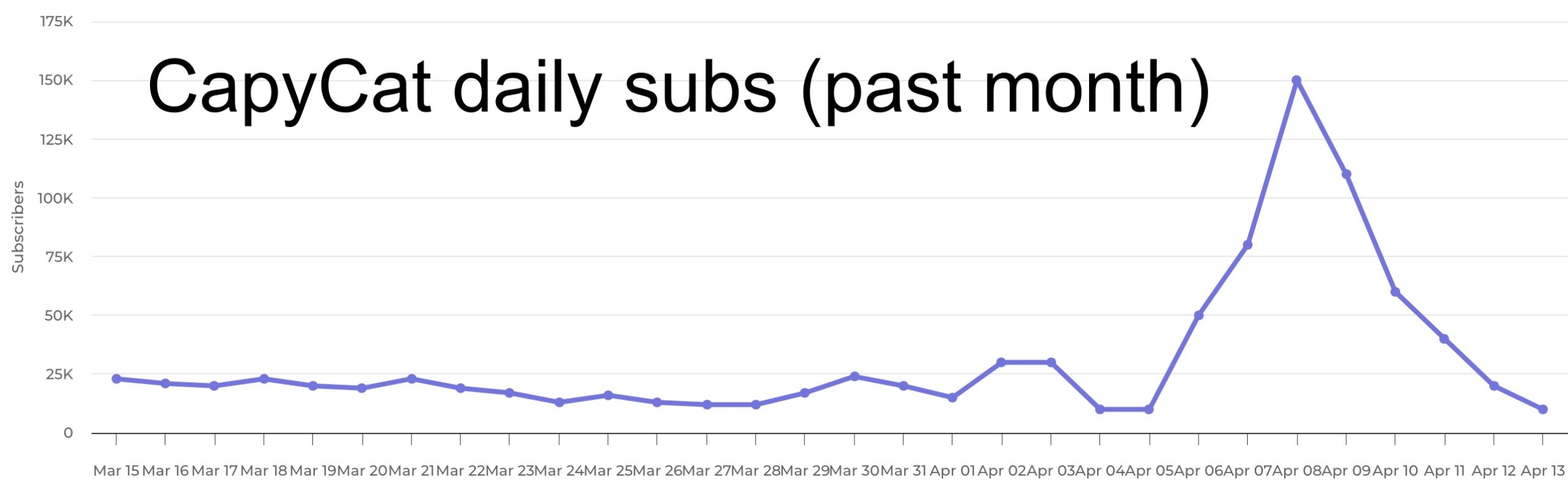
In the U.S. Top 50, Technoblade finished one spot ahead of CapyCat, a truly bizarre channel filled to the brim with AI slop. But the low quality of the channel’s uploads hasn’t stopped it from bringing in 510,000 new subscribers in a single week. As the below graph shows, much of that volume came during an early-week spike.

Data via Gospel Stats

The Minecraft community likes to say that “Technoblade never dies,” and I really hope that’s true. For as long as the porcine king reigns, he can defend his kingdom against the strange brainrot characters rapping at the castle doors.

Channel Distribution

This week, there are 39 YouTube Shorts channels in the U.S. Top 50.

As always, keep up to speed with the latest Tubefilter Charts and all our news by subscribing to our newsletter. You’re going to love it. 👉  Newsletter.Tubefilter.com.