Archive for 2025:

Top 50 Most Viewed YouTube Channels Worldwide • Week Of 05/25/2025

[Editor’s Note: Tubefilter Charts is a weekly rankings column from Tubefilter with data provided by GospelStats. It’s exactly what it sounds like; a top number ranking of YouTube channels based on statistics collected within a given time frame. Check out all of our Tubefilter Charts with new installments every week right here.]

Scroll down for this week’s Tubefilter Chart. 👇


As Double Date rides high at the top of the Global Top 50, we’re seeing other channels follow the Australian hub’s lead. Couple content is in, short-form challenges even more so, and if you can work both of those trends into a single video, that’s even better.

Beyond the top spot, Asian creators are dominating the Global Top 50. Channels from China, South Korea, and Vietnam are rising higher than ever before, and the average short-form creator can learn a thing or two from those hubs’ continued success.

Not all superheroes run to the rescue. Some of them hop.

Viewers who spend a lot of time on YouTube Shorts may have noticed that superheroes are one of the format’s tried-and-true topics. The weird Spiderman/Elsa videos of yesteryear have been replaced by strange AI slop that doesn’t feel much more wholesome. Just because Spiderman can be put into all sorts of odd videos doesn’t mean he should be.

If you’d prefer to watch superhero-tinted YouTube content without all the bizarre AI tech, the 50th and final channel in this week’s Global Top 50 offers an interesting alternative. Its Mandarin title translates to “Officer Rabbit,” and that’s also an accurate description of the character who shows up in the channel’s most-watched Shorts clips.

Officer Rabbit isn’t exactly Judy Hopps, but she does have speed to burn. Apparently, the law enforcer is capable of moving so quickly that she can beat a bucket of water to the ground floor of the building. If wearing bunny ears can allow me to defy gravity, I’m willing to give it a shot.

Officer Rabbit’s 518.9 million weekly views pushed the channel’s lifetime viewership close to nine billion, and its subscriber base is growing as well — it now reaches more than ten million fans. Its success is a reminder that popular YouTube Shorts characters don’t require fancy costumes or advanced technology. If you have a pair of bunny ears, a creative approach to Shorts, and an understanding of how popular moralistic content is on YouTube, then you have everything you need.

That’s not to say that YouTube is devoid of more typical heroic content. Like Officer Rabbit, Vietnam-based creator Ben Eagle chooses to use his powers for good. With his martial arts prowess, he assists the downtrodden and beats up anyone who stands on rocky moral footing. Eagle has been a regular in our Tubefilter charts throughout much of 2025, and his viewership has surged in recent months, pushing him up to 20th place in the Global Top 50.

Data via Gospel Stats

So, to recap: If you want to become the greatest hero YouTube has ever seen, the best thing you can do is take notes on Asia’s biggest short-form superstars. Always remember to use your powers to help others; if you do that, you’ll find yourself strong enough to win a race against gravity. If you really must cross over to the dark side, well, some neat editing tricks should get the job done just fine.

Channel Distribution

Here’s a breakdown of the Top 50 Most Viewed channels this week in terms of their countries of origin:

  • India: 18
  • United States: 8
  • Canada and Vietnam: 3
  • Australia, Brazil, China, and Hong Kong: 2
  • Belgium, France, Germany, Japan, Kazakhstan, Slovakia, South Korea, Spain, Taiwan, and Turkey: 1

This week, 41 channels in the Top 50 are primarily active on YouTube Shorts.

As always, keep up to speed with the latest Tubefilter Charts and all our news by subscribing to our newsletter. You’re going to love it. 👉  Newsletter.Tubefilter.com.
Have you heard? Kai Cenat takes streamers to school, Joe Rogan gets knocked, and TED has its own TikTok

Each week, we handpick a selection of stories to give you a snapshot of trends, updates, business moves, and more from around the creator industry. This week, one creator retires while another takes his colleagues to school, YouTube puts stock in Shopping, Joe Rogan faces being #2, and Mamrie Hart is back with a mouthful.

Creator commotion

The Outdoor Boys are over. Or are they? Longtime hiking/camping/hunting/etc creator Luke Nichols is retiring from his YouTube channel Outdoor Boys after a decade, saying he’s worried about the effect fame will have on his three sons. “My wife and I, we both have real concerns about what this will do to our family if I keep growing my YouTube channel at this pace. And the time to stop is before this problem gets so out of hand that my family and I can’t live normal lives,” he said in an upload to his 15 million subscribers. But his future plans seem to contradict that statement: He closed the video by telling people he’s going to help his young son Thomas grow his own YouTube channel, which currently has 888,000 subscribers. Hmmm.

Clock in for Cenat school. The first class of Kai Cenat’s Streamer University is officially in session–but it may also be the last. Streamer University is a free-to-attend boot camp for any creator with internet access; ~150 of those creators, though, were hand-selected by Cenat to congregate (again, for free) at the University of Akron for some in-person gnoshing and networking. Backlash against some of the streamers Cenat selected led to a rough moment on stream where Cenat said he’s splashed out big to pay for this event, and probably won’t do it again because “no matter which way I try to make sure things is good, I always get the bad end of the stick.”

Movers and shakers

Todd Sherman hops from YouTube Shorts to YouTube Shopping. We all know TikTok Shop is big biz. Does YouTube want to reach those ecommerce heights? Maybe–and if so, it’s shifting resources from Shorts in the attempt. Sherman, who was a product lead for YouTube’s short-form division, will now do the same job for Shopping. “People spend so much time researching and discovering new products on YouTube and it should be easy for them to purchase them as well,” he said in a LinkedIn post.

TikTok’s creative solution. The ByteDance-owned app has brought in San Francisco-based agency Pereira O’Dell to lead its global creative efforts after “a competitive review.” That includes competitive efforts in the U.S., where TikTok is still on the banhammer chopping block…and layoffs are looming.

The biz

LATAM gets a leg up. Twitch just made it easier for streamers in Latin America to reach revenue-share status. They now need 50 points down from 100 to hit 60/40 revenue split, and 200 points down from 300 for 70/30 split. (Deets on how points work here.) “The data we have tells us that cultural nuances and economic realities in LATAM have made it difficult for creators of similar size to meet Plus program requirements compared to those in other regions,” Twitch said. So, it’s making this move to level the playing field.

Goodbye, Joe Rogan. Okay, we’re being a little hyperbolic. He didn’t go anywhere, his podcast just got knocked out of the #1 spot on YouTube’s brand-new podcast charts. They only dropped last week, and The Joe Rogan Experience being top dog wasn’t surprising. What was surprising was the instant knock-down this week. He was taken to #2 by true crime ‘cast Rotten Mango.

Platform headlines

Wait, bro, it was just a prank. After a five-year hiatus, streamer SoLLUMINATI returned to Twitch, and maanged to get banned twice. Once for allegedly saying a transphobic slur, and again right after talking sh*t at fellow streamer Zoe Spencer. Off the back of that second time-out, SoLLUMINATI promptly–and publicly–appealed to Kick for a streaming deal…and just like that, his Twitch ban was lifted. Coincidence?

Thanks for coming to my TED Talk. The nonprofit responsible for our favorite meme is entering the short-form game with its own TikTok-style feed. Its app, which hadn’t received a significant update since 2010, now boasts a swipeable section of clips from past TED Talks and other original content. Like everything else these days, it’s being promoted as “powered by AI.” Don’t get us wrong, TED Talks are cool, but the constant AI shmarketing? Yawn.

Pop culture minute

Just like the ancient era, sensei. Aniplex is going back to the old-school days of waking up at 4 a.m. to catch InuYasha on Cartoon Network. Not that anyone here did that. Ahem. Anyway, the Japanese entertainment company is streaming an episode of popular anime Demon Slayer on its YouTube channel every day at 6 p.m. EST. The episodes won’t be archived, so if you’re not there to watch it when it’s on, you’re SOL–just like old times.

We wanted hot robots, but not like this. Tesla’s newest unholy creation will apparently be able to DIY by watching YouTube videos. Elon Musk said that right now, Optimus is learning by watching humans wearing motion-capture gear, but it’s on the horizon for the thing to learn from YouTube just like a person. Supposedly.

A Sidemen success. The six-man supergroup’s Netflix reality show Inside is the first content creator production to be nominated for the U.K.’s National Television Award. “Among I’m a Celeb, Love Island and Traitors, the flagship shows from ITV, BBC and Channel 4 etc…There’s Inside,” Sidemen manager  Jordan Schwarzenberger wrote on LinkedIn. Congrats, guys. Emmy next?

Mamrie Hart is back, baby. This double Streamy Award winner has been offline for a while, but she’s making a dramatic re-entrance with a “sexy” vegetarian cookbook. Dig in.

Creators accuse Twitch of “double-taxing” their income with supposed community-centered feature

We know, we know: Twitch makes an announcement and streamers hate it. What else is new?

But hang with us here. This one’s a doozy.

As you may know, Twitch has historically been pretty abysmal at discoverability. Up-and-coming streamers have to advertise their channels on other sites like YouTube and TikTok, because–despite some recent introductions like a short-form video feed and homepage tweaks–they are simply not going to be organically discovered on their home platform.

This situation has fostered a unique reach-down-the-ladder attitude on Twitch, where streamers who’ve managed to ‘make it’ frequently turn back and help newbies, often by promoting their channels and giving donations/subs/Bits, and sometimes by offering direct mentorship, management/brand intros, or collaborations.

Twitch seems to know this, because its latest feature is one that allows successful streamers to support others with gift subs and Bits.

Except…it does that by effectively “double-taxing” their income, and giving itself more money.

We’ll explain.

The feature’s whole deal is that it allows streamers to buy those gift subs and Bits with their banked income–meaning they don’t have to pay with a credit card etc, they can just tap their current earnings before they cash out at the end of the month.

But streamers are still buying the subs/Bits at full price, directly from Twitch. There’s no real advantage here except that it removes a little bit of payment friction, and some streamers may be willing to spend more since the cash is coming out of future earnings instead of their bank account.

There is, however, a potential disadvantage. As streamer Sir Hans Vader laid out, if a streamer’s chat donates 100 subs, a streamer would (typically) get 50% of the revenue from that transaction, with Twitch keeping the other 50% for itself. If the streamer then turns around and gifts 50 subs using that money, Twitch would take another 50% from the receiving creator.

As Vader put it, “So 75 to Twitch, 25 to creators & community? Are you high?”

“So people gift subs to support creators and you take 50%, then creators use their cut to buy bits or gift subs to support others and then Twitch takes ANOTHER 50%? That’s basically double taxing lmao,” fellow streamer ABYSS chimed in.

Now, to be clear, streamers don’t have to use this feature. And a streamer who chooses to buy gift subs with the feature vs with a credit card won’t face any additional charges; it’ll be the same price, and they won’t lose any money.

Streamers’ complaints here aren’t about their own money. They’re criticizing Twitch for introducing a supposedly charitable, community-minded feature that ends up acting as a funnel to give itself more money. Twitch could have chosen not to take a 50% cut of gift subs and Bits bought through this feature. It could’ve chosen to take a smaller cut.

But it didn’t.

As usual, Kick was waiting in the wings to pounce on Twitch’s every last moment of weakness. After Twitch announced the feature on X, Kick co-founder/owner Trainwreck was quick to respond, tweeting, “twitch has its streamers in a perpetual stockholm syndrome, they won’t even realize [they’re being double-taxed]. Instead they’ll cheer on thinking it’s a QOL update.”

We don’t think he’s correct. The Twitch creator community as a whole is neither complacent nor ignorant, and while there are some streamers arguing that this isn’t a big deal, the vast majority of responses to Twitch’s announcement are smart dissections of what’s actually happening with this feature.

Whether those dissections will lead anywhere remains to be seen. Twitch is usually quick to bow to backlash, but in this case it’s been quiet, with the feature rolling out to U.S. streamers as planned.

Disney’s suing YouTube to keep it from poaching a key exec. Will that actually work?

Yesterday, YouTube revealed it had successfully poached longtime Disney exec Justin Connolly, and has set him up to manage its relationships with major media companies and run its burgeoning live sports division.

Then, just hours later, Disney filed a lawsuit against YouTube, asking the Los Angeles Superior Court for an injunction to stop Connolly’s appointment. Its reasoning? Connolly–which has been with Disney since 2003, mostly as part of sports-focused ESPN–signed a new, three-year employment contract last November. That contract comes with a one-time right to terminate in March 2027. And, since it’s not March 2027, Connolly is legally obligated to continue working for Disney for almost two more years, the Mouse House claims.

But there’s more to this story. Connolly, who most recently was President of Disney Platform Distribution, has been leading negotiations for Disney to renew its content distribution deal with YouTube.

Disney’s suit accuses YouTube of tortious interference with contractual relations, saying it induced Connolly to break his employment agreement, as well as unfair competition. It alleges Connolly could leak trade secrets and confidential information to YouTube that could affect the still-in-progress renewal negotiations.

“Connolly has intimate knowledge of Disney’s other distribution deals, the financial details concerning Disney’s content being licensed to YouTube, and Disney’s negotiation strategies, both in general and in particular with respect to YouTube,” the suit claims. “It would be extremely prejudicial to Disney for Connolly to breach the contract which he negotiated just a few months ago and switch teams when Disney is working on a new licensing deal with the company that is trying to poach him.”

Connolly apparently notified Disney of his resignation last week, and did not respond when asked if he planned to work for YouTube. He’s exiting as Disney is in the midst of rolling out its new ESPN streaming service.

We can’t know how Connolly’s hiring will affect the Disney x YouTube negotiations, but one thing’s clear from this suit: Disney considers YouTube a serious competitor. Yes, they’re working together for content distribution, but YouTube is the #1 streaming service in the U.S., far outstripping Disney+, and it’s also shaping up to be a force in live sports after clinching the NFL Sunday Ticket rights. Considering Disney owns ESPN and is also pursuing live sports deals for Disney+ (it just signed a five-year deal with the Women’s Champions League), Disney likely views veteran Connolly as an invaluable asset it really doesn’t want a big competitor to get hold of.

Will this pan out for Disney? Maybe. Fox filed a similar suit against Netflix in 2016, and the court ruled in Fox’s favor.

Google’s Veo 3 AI model is scary good at generating videos. Creators and viewers should be prepared.

If you get a good chuckle out of unrealistic videos generated by contemporary AI models, you might want to get your laughs in now while you still can. The debut of Google DeepMind‘s Veo 3 showed the world that generative AI programs can now make videos that are difficult to distinguish from human content. Brace yourselves: The internet is about to get more confusing than it already is.

Google introduced Veo 3 on May 20 during its annual I/O developer conference. The new model improves on its predecessor by adding sound effects, background noise, dialogue, and other forms of audio to the videos it generates.

“For the first time, we’re emerging from the silent era of video generation,” said DeepMind CEO Demis Hassabis during a press briefing. Hassabis noted that users can provide “a prompt describing characters and an environment, and suggest dialogue with a description of how you want it to sound.”

The audio enhancements Veo 3 offers for generative AI are potentially powerful, but the improvements it brings to video quality are arguably its most stunning features. A post by X user Min Choi showed a snippet of a man-on-the-street interview generated by Veo 3. If you didn’t know ahead of time that this was made by AI, would you be able to suss it out?

The examples Choi provides show that AI-generated video has come a long way since OpenAI’s Sora arrived in February 2024 — and that model was already a revelation at the time of its release. Veo 2 was powerful enough to be integrated into YouTube features like Dream Screen, and as we can see, its successor is far more advanced.

The rapid progression of generative AI technology validates individuals who claim that we’re heading toward a “dead internet” populated solely by AI-generated videos and comments. If unrealistic genAI videos are already popular enough to rank among YouTube’s most-watched fare, how many views will realistic genAI videos get?

To make matters worse for (human) creators, there’s a good chance Veo 3’s training material includes a significant number of YouTube videos — though Google has been cagey about that subject. If a large language model knows more about viral YouTube content than the creators of those videos, how will humans keep up with the AI revolution?

The answer to that question will involve a lot of vigilance from platforms, creators, and viewers. YouTube has taken strides to ensure that generative AI videos are properly labeled, and all content made with Veo 3 will be stamped with Google’s SynthID watermarks.

Even if information about AI-generated videos is available, it doesn’t mean that viewers will use it. There has been a lot of talk lately regarding media literacy, and with advanced generative AI tools staring us in the face, it’s more important than ever to teach kids and teens how to spot fakery on the internet.

Veo 3 can’t be written off as a passing tech fad. Hollywood directors are already incorporating DeepMind products into their productions, with auteur filmmaker Darren Aronofsky serving as one of the latest examples. Internet users who ignore the potential of the latest models will have a harder time identifying the work of those programs in the wild.

If you want to see for yourself what Veo 3 is capable of, you’ll need a Google AI Ultra subscription, which will run you $249.99 per month. Alternatively, the new model is available on Google’s Vertex AI enterprise platform.

Creator-investor Caspar Lee levels up his venture capital firm with $45 million fund

An influential YouTube star from the mid-2010s has become a prominent figure in the creator economy. Caspar Lee and his cousin Sasha Kaletsky have raised $45 million to launch a new fund for Creator Ventures, the early-stage venture capital firm they launched in 2022.

In a LinkedIn post, Lee described the $45 million war chest as Creator Ventures’ “Fund II.” It adds fresh capital on top of the firm’s previous Funds: Between a $1 million “Fund 0” and an ensuing Fund I, Creator Ventures has grown the total assets under its management to $65 million, according to What’s Trending.

On X, Kaletsky wrote that Fund II will connect Creator Ventures to “the next great consumer internet founders.” Across previous investments in creator economy and consumer tech spaces, Lee and Kaletsky’s firm has taken stake in several buzzy companies, including the newsletter platform beehiiv and the generative AI startup ElevenLabs. The size of those investments has ranged from $200,000 to $2.5 million.

Embolded by the ongoing trend of creator-investors — the Sidemen-led firm Upside is a recent example of that phenomenon — Creator Ventures has cultivated strong ties in the financial community. Lee’s LinkedIn post cited the Limited Partners who have contributed to Creator Ventures’ new fund, including “Level Ventures, Cendana Capital, Vintage Investment Partners, Sequoia Capital, Isomer Capital, and existing LPs from Fund I.”

Lee, who grew up in South Africa, made his name as one of YouTube’s premier vloggers during the 10s. As his career wore on, it became clear that he had aspirations in the business world. He teamed up with fellow creator Joe Sugg to launch a talent firm called Margravine, and his role at marketing startup Influencer helped him become one of the first prominent creators to gain experience as an investor.

More than a decade after his initial YouTube breakout, Lee has now positioned himself at the forefront of the creator economy. His pivot from vlogging to investing now seems like a savvy, forward-thinking decision, and at just 31 years old, he’s still a rising star who figures to do big things with his deep-pocketed Fund II.

For the first time, brands are spending the biggest chunk of their budgets on YouTube’s connected TV ads

At YouTube‘s Brandcast presentation earlier this month, it reminded the world yet again that it wants to dominate TV screens. And, well, it is dominating. According to Nielsen, it’s been the #1 streaming service in the U.S. for two years straight, and new data presented at Brandcast showed YouTube now generates more watch time than any linear or broadcast TV network. It’s also the device U.S. viewers use the most, having recently beaten out mobile phones.

All that TV watch time means lots of slots for marketers to run TV-specific ads. We knew that, and also knew YouTube has been introducing new ad formats like pause-vertising and longer unskippables, both of which are exclusively for TVs.

What we didn‘t know is how readily brands were spending on TV ads.

Turns out, pretty readily. According to data from marketing firm Tinuiti, which manages ~$4 billion in annual digital ad spend, brands are–for the very first time–now spending more on YouTube’s connected TV ads than ads on mobile.

The margin is very slim: Tinuiti found that during Q1 2025, brands spent 43% of their YouTube ad campaign dollars on TV screens. Mobile? 42%.

One percent difference might not be a lot, but it’s the overall trend this figure indicates that’s the real interesting part. Tinuiti’s data shows that TV viewers and marketers are aligned on both sides of the screen; as people’s watch habits shift more toward TV, advertisers are spending accordingly to reach them.

Another interesting data point: In Q1 2024, brands were spending 24% of their campaign dollars on YouTube’s TV ads. This means their spending has nearly doubled in just a year.

Is that hard evidence that brands are spending more on YouTube overall? Not necessarily. Some brands, at least, are almost certainly reallocating their spend from one type of YouTube ad to another. TV ads’ rise over the last year was counterbalanced by a drop in mobile phone ads. This time last year, brands were spending 51% of their YouTube campaign dollars to reach people watching content on mobile phones. Now it’s down to the aforementioned 42%.

Other formats are also dropping. Desktop ad spend dropped year-over-year from 19% to 10%, and tablet-specific spend dwindled from 7% to 5%.

Obviously TV and mobile are the big dogs here overall. In terms of the 42% of campaign dollars brands are spending on mobile ads, one-fifth of that is going straight to Shorts. We don’t have data on that year-over-year, so can’t see how much Shorts spending has grown, but we do know YouTube is pushing Shorts ads hard.

We here at Tubefilter suspect brands will continue upping their spend on YouTube’s TV ads–especially if the marketers at Brandcast were impressed.

Dubai wants more creators. So it’s offering to get them Golden Visas.

Creators HQ, the $40.8 million United Arab Emirates-based government initiative to bring 10,000 content creators to Dubai, is promising a range of benefits to creators who join its program. They’ll get access to its coworking spaces and creative studios in the Emirates Towers, a pass to its annual convention, the 1 Billion Followers Summit, and entry into a whopping 300+ biz dev events throughout the year.

But there’s another major perk Creators HQ is offering creators: It says it’ll help members get the coveted UAE Golden Visa.

As the UAE’s official website puts it, “The Golden visa is a long-term residence visa which enables foreign talents to live, work or study in the UAE while enjoying exclusive benefits. Investors, entrepreneurs, scientists, outstanding students and graduates, humanitarian pioneers and frontline heroes are among those eligible for the Golden visa.”

Dubai has increasingly become a center of content creation, thanks in no small part to government outreach. One of its biggest moneymakers is tourism, so it wants content creators to live there and share footage of its enormous high-rises, luxury experiences, and gourmet cuisine on social media, where people might see it and book their own trips to the city.

A UAE Golden Visa can be difficult to obtain without assistance. For people like real estate investors and entrepreneurs, they have to invest specific amounts of money, or prove their businesses’ worth. But for content creators, who are considered people with “outstanding specialized talents,” the procedure involves getting an approval letter from Dubai’s department of culture and arts.

Just like applying for U.S. O-1B Visa, applying for a UAE Golden Visa involves creators proving the influence of their social media channels. If they can show traction as a professional creator, they may get an approval letter, and may get a visa.

Creators who are approved for a Golden Visa can live and work in Dubai for 10 years. This specific type of visa comes with perks including:

  • not needing a sponsor
  • being able to stay outside the UAE for more than six months while still keeping their visa valid
  • the ability to sponsor spouses and children, so creators’ families can come live with them in Dubai
  • and the ability to sponsor employees, so creators can bring folks like their assistants, crew, and editors

Creators HQ says it will walk creators through every step of acquiring a Golden Visa. And, since content makers have to pass muster to join Creators HQ, it’s likely their credentials will already be evaluated and they’ll be fast-tracked to get a letter of approval.

Once they’re approved, Creators HQ will assist them with the normally lengthy and expensive process of relocating to Dubai, it says.

Creators HQ recently accepted its first 100 members–the Founding Members. Applications are open for creators around the world who want to join the initiative and move to Dubai. You can find more information here.

Want recipes from one of the internet’s favorite chefs? Step into Nick DiGiovanni’s kitchen.

Nick DiGiovanni has already become one of the most prominent video creators in the internet’s cooking community, but he’s not stopping there. The 29-year-old former MasterChef contestant, who has attracted more than 26 million subscribers on his namesake YouTube channel, is stepping into the world of written recipes. On a new website called Nick’s Kitchen, DiGiovanni blends text, images, and video to appeal to both novice chefs and adept gourmands.

At launch, Nick’s Kitchen offers more than 30 recipes, ranging from kitchen basics (hard-boiled eggs) to comfort foods (lasagna) to takeout classics (orange chicken). The header on the Nick’s Kitchen website quotes Ratatouille‘s Chef Gusteau by reminding culinary amateurs that “anyone can cook.” As long as no rats are hiding in DiGiovanni’s toque, the reference is a welcome reminder of the creator’s inclusive approach to food content.

Each Nick’s Kitchen recipe is accompanied by a video tutorial. Rather than uploading those clips to his main YouTube channel, DiGiovanni has launched a secondary hub to support his new venture.

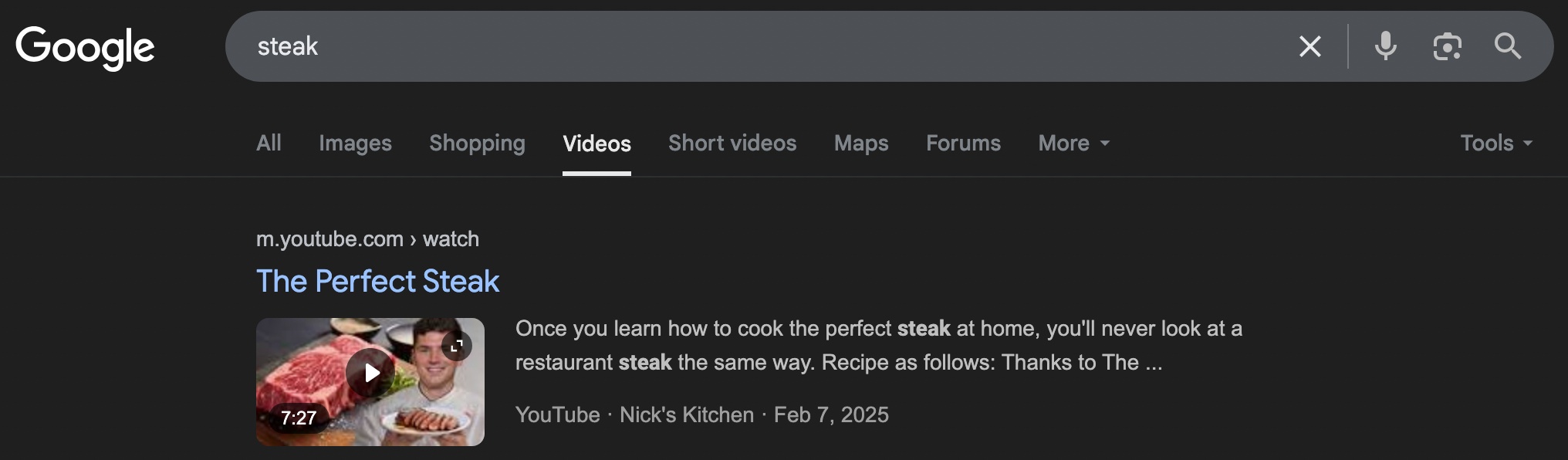
DiGiovanni’s ability to share his gastronomic skills in a welcoming tone has keyed his growth on platforms like YouTube. His star status among internet foodies has led to celebrity collabs, agency representation, and brand deals with partners like Dunkin’. When you look up food-related terms in Google’s video search tab, DiGiovanni’s recent Nick’s Kitchen uploads often rise to the top.

Nick DiGiovanni’s tutorial is the first result when searching for steak videos on YouTube.

In an email to Tubefilter, Nick’s brother Peter DiGiovanni said that the Nick’s Kitchen website aims to promote the chef’s recipes on standard search pages. For many food-related terms, Google’s results are dominated by recipe websites that use a familiar, frustrating formula: They preempt the recipes with pages and pages of context, where readers will find specific terms that boost the host site’s search ranking.

With Nick’s Kitchen, the DiGiovannis are trying to move up in the search rankings without relying on tiresome SEO growth hacks. Most of Nick’s recipes feature a few lines of context before getting straight to the point.

The result, if all goes according to plan, is to build a trove of simple, fundamental recipes that can easily be searched up through engines like Google. And if you’re a visual learned who would prefer to skip the written recipes, the Nick’s Kitchen channel has you covered.

Top streaming platforms premiered 116 fewer original shows in 2024 compared to 2022

Have we reached the end of Peak TV? That’s the question Digital i is answering with its latest report, and the answer seems to be a resounding yes.

The streaming media measurement company tracked the volume of original shows over a two-year period to produce a study it dubbed Trend Report: Are You Still Watching? According to the report, four prominent subscription-based streaming services – Netflix, Disney+, Max, and Amazon Prime Video – launched 116 fewer original shows in 2024 than they did in 2022.

Those four hubs launched 395 original shows in 2022. In 2024, that number dropped to 279. Among that group, only Netflix can say that the majority of its top 25 shows of 2024 came from original concepts rather than recycled IP.

The decline points to a tangible result of the 2023 WGA and SAG-AFTRA strikes, which shut down Hollywood productions for months as industry professionals sought better deals with streamers and increased protections against generative AI disruption. Many outlets have described the strikes as the end point of the Peak TV era, and Digital i’s findings support that hypothesis.

There are also signs, however, that the streaming industry may be able to rebound. For some hit shows, like Prime Video’s Fallout and Netflix’s The Gentlemen, more than 60% of viewers watched the complete series. Shows with shorter runs fared better than those with longer seasons; originals in the first group averaged a 48% completion rate, while that figure dipped to 26% for the second group.

Licensed content also held on as a reliable choice for streaming viewers. As subscribers favored older shows over splashy new originals, familiar hits rolled up massive viewership tallies. Grey’s Anatomy, for example, generated two billion hours of global watch time in 2024, according to the Digital i data.

Despite some positives for streaming hubs, the Trend Report serves as a grim reminder of the current state of an industry that once redefined television. The WGA and SAG-AFTRA strikes shifted power to creator platforms like YouTube and TikTok, which Gen Z and Gen Alpha consumers increasingly prefer compared to Netflix et al. That effect has been so strong that SVOD services are cutting deals with creators to convert YouTube subscribers into streaming subscribers.

Some of those deals are reminders that creators see streaming services as vehicles for increased reach. The Sidemen, for example, took their show Inside to Netflix because they felt that they had maximized their potential on YouTube. So while the era of Peak TV may be over, the new entertainment paradigm will still have a place for the Netflixes of the world.

Publicis Groupe entered the creator space with a $500M Influential acquisition. Now it’s picking up Captiv8 too.

Last July, multinational ad agency Publicis Groupe joined the growing number of companies acquiring a stake in the creator industry. It paid $500 million to pick up influencer marketing business Influential, and described creator-led advertising as “a ubiquitous growth driver for brands due to the channel’s unique ability to meaningfully connect with their customers.”

Now Publicis is committing even more resources to our industry with the acquisition of Captiv8, a company that says it “unifies creators, commerce, and campaign performance” by using a data-central approach to hooking up creators and brands for campaigns.

Captiv8 was founded in 2015 on a $2 million seed round, and by 2016 had done deals with creators like Zach King, Casey Neistat, and iJustine, and brands like Amazon and Johnson & Johnson. These days its data platform processes 2.5 billion posts across social media sites each year, collecting data from 95% of content creators who have over 5,000 followers, it says. That data allows it to sift through over 15 million creators in 120 regions around the world, selecting the ones that might fit its brand clients’ next ad pushes.

Financial details of Captiv8’s acquisition are not being released, but Publicis said the company (like Influential) will continue operating independently, but under the close umbrella of its Connected Media unit. Captiv8 CEO Krishna Subramanian will remain in charge.

Influential CEO Ryan Detert, who similarly remained in charge of his company under Publicis’s wing, said Captiv8 joining will “supercharge our offering for clients.”

“Creators [will] get access to more insights and even more deal flow across Fortune 1000 brands to further fund their passions,” he added in a LinkedIn post. And, in a separate statement, he noted that, “As two leaders in the influencer marketing space, together, we bring unrivaled expertise, innovation, and transformation for our clients. We’re excited to collaborate with Krishna and Sunil to co-author the future of global influencer marketing at Publicis.”

As part of their acquisitions, both Influential and Captiv8’s platforms were plugged in to COREid, a consumer identity verification system made by fellow Publicis subsidiary Epsilon. The system lets Publicis Groupe check names and addresses to be sure ad campaigns are being seen by real people.

“This platform is a one-stop-shop for our clients’ influencer marketing initiatives. They can uniquely unite, plan, and optimize creator strategies that are brand fit, brand safe, with fully transparent measurement,” Arthur Sadoun, Publicis Groupe’s CEO, said in a statement.

Publicis Groupe also plans to implement Captiv8’s ecommerce capabilities–it offers things like digital storefronts, affiliate marketing integrations, and ROI tracking–in its creator x brand deals.

Like we said when Publicis acquired Influential, this move shows that more ‘mainstream’ companies are looking at the hundreds of billions of dollars our industry is commanding and (finally!) seeing the legitimacy of creators and their power. Publicis, which made $14.2 billion in 2023, is one of the largest companies yet to take a stake here–and we think its acquisitions might open the floodgates for more businesses to get in on this space.

Visional Pop is the newest firm turning kid-friendly animated YouTube channels into franchises

A newly launched company has its eyes trained on the world of animated YouTube content, and it is announcing its intentions with a major transaction. Former YouTube exec Ben Grubbs is the Director of Visional Pop, which has kicked off with an acquisition of the Indian family media company YoBoHo.

According to a press release shared by Visional Pop, the new entertainment company will work with top YouTube content creators to turn animated shows into multimedia franchises, unlocking fresh monetization opportunities along the way. 

That business model makes Visional Pop sound a lot like Moonbug and pocket.watch, two firms that have helped some of YouTube’s biggest kid-friendly channels expand into new territory. Those companies have brought their partner channels to movie theaters, big-box retailers, and holiday parades, among many other initiatives.

Visional Pop’s foray into that industry will begin with YoBoHo, a Mumbai-based company that reaches 200 million monthly viewers across more than 150 owned and operated YouTube channels. One of the crown jewels in the YoBoHo catalog is HooplaKidz, which has amassed nearly six billion lifetime YouTube views through a broad selection of nursery rhyme content.

“We’re thrilled to introduce Visional Pop to the world and to welcome YoBoHo into the fold,” Grubbs said in a statement. “Our vision is to build animated franchises that start with creators and grow into beloved global brands. With YoBoHo’s reach and capabilities, we are uniquely positioned to accelerate this mission from day one.”

Grubbs is an experienced YouTube operative who spent two-and-a-half years as the platform’s Global Head of Top Creator Partnerships. His previous role at YouTube – Head of YouTube Kids & Learning Content Partnerships for Asia Pacific – will be highly relevant to his work at Visional Pop.

After departing YouTube, Grubbs invested in the creator economy through firms like Next 10 Ventures and Creator Plus. In one recent move, Grubbs teamed up with notables like Peyton Manning to back the YouTube golf hub Good Good with a $45 million investment.With his latest venture, Grubbs will bring his acumen, resources, and industry connections to the world of animated family content. Visional Pop is a bold new play in a booming business, but I still have one question about YoBoHo: Is the accent on the yo?