Archive for 2025:

20 years of YouTube: In 2009, a ‘New Moon’ ushered in the next phase of movie marketing

In February 2025, YouTube turned 20. The video site has gone through a lot over the past two decades, including an acquisition, an earnings glow-up, and multiple generations of star creators. In our 20 Years of YouTube series, we’ll examine the uploads, trends, and influencers that have defined the world’s favorite video site — one year at a time. Click here for a full archive of the series.


In 2008, the internet chose between Barack Obama and John McCain. A year later, a different dichotomy divided the web: You were either on Team Edward or Team Jacob.

I’m talking, of course, about Twilight. Bella Swan’s two love interests represented two different sides of the male ethos. Edward was dapper, broody, and mysterious (and a vampire). Jacob was protective, righteous, and gallant (and a werewolf). When Twilight: New Moon — the sequel that greatly expanded Jacob’s character — was at its cultural zenith, the Edward vs. Jacob debate proved inescapable. The conservation became so big that New Moon managed to change movie marketing forever.

OK, that’s a bit of an exaggeration. Movie marketing was bound to change even without the sexy, sparkly vampires, but New Moon provided the push that set the industry on its way. The main trailer for the Twilight sequel’s film adaptation became one of the first previews to go mega-viral on YouTube, and it demonstrated the potency of the pop culture tentpole — a concept that has inspired media strategists for decades.

To understand what makes this particular trailer so notable, we have to take a step back to 2007, when Viacom filed a billion-dollar lawsuit against YouTube. The owner of channels like Comedy Central and Nickelodeon argued that YouTube was facilitating a “brazen” form of copyright infringement by hosting numerous pirated clips from films and TV shows.

YouTube eventually fended off the lawsuit, but the incident showed the need for more stringent safeguards that could protect studios’ intellectual property at scale. The Content ID digital fingerprinting system rolled out in 2007, and 2009 saw the arrival of two official sources for pop culture content: Major record labels backed Vevo to create a home for music videos, and Movieclips emerged to consolidate trailers for the latest blockbusters.

Those moves cemented YouTube as the place to go for pop culture conversation, especially for younger viewers. Stan Ruszkowski, the President of film clip distributor The Boxoffice Network, told Tubefilter that trailers have become “conversation starters, cultural references, and entry points” for movie lovers and newcomers to the art form alike.

“For younger viewers, YouTube is often their first touchpoint with cinema,” Ruszkowski said. “A short three-minute clip can go viral as a meme. A trailer reaction can bring a global fandom together overnight. A well-crafted edit can introduce a 12-year-old to Hitchcock, Tarantino, or Greta Gerwig for the first time.”

New Moon was one of the first movies to epitomize that phenomenon. Major YouTube channels of that era caught “Team Edward or Team Jacob” fever. The film got the How It Should Have Ended treatment, and Ryan Higa expertly skewered the melodramatic trailer for an episode of his “Movies in Minutes” series.

The fanfare that followed New Moon through its production cycle was all-encompassing. Back then, YouTube was still one big family, rather than a network of niches connected by a shared distribution vehicle. When the trailer for a blockbuster dropped, or when a hotly-anticipated release date approached, it was nigh impossible to engage with YouTube’s creator community without coming across movie-related content.

“YouTube is a natural home for movie content because movie lovers are core to its audience,” Ruszkowski told Tubefilter. “Whether it’s trailers, iconic scenes, fan edits, or cast interviews, pop culture thrives on YouTube, not as a niche, but as a central part of the platform’s daily engagement.”

In 2025, it’s much harder to cut through the YouTube clutter than it was in 2009. Even so, Ruszkowski’s claim holds true. Clip distributors have harnessed YouTube Shorts to rank among the platform’s most-watched channels, and entities like The Boxoffice Network have made inroads on TikTok as well.

Want proof that shared pop culture celebrations are still a big deal? Look no further than the recently concluded NewFronts. At the 2025 edition of the annual presentation series, tentpole-based marketing was a recurring theme. Companies like Meta, TikTok, and YouTube announced AI-powered ad products that identify the biggest cultural moments and bring brands closer to them.

Back in 2009, the New Moon trailer drop ranked among YouTube’s biggest cultural moments, one that united 19-year-old sketch comedians, fledgling media companies, and animation channels. New Moon‘s reception adds an amusing wrinkle to the story.

The film was panned by contemporary critics and has been thoroughly derided by its two co-stars in the decade-and-a-half since. These days, recollections of Edward Cullen trend toward his creepy characteristics, while conversations about Jacob remind us of Hollywood’s attempt to make Taylor Lautner happen.

That’s the power of the tentpole. It can make any movie into a cultural touchstone through the sheer force of community engagement. In the face of “Team Edward or Team Jacob,” the negative reviews hardly meant a thing. The memes, forum arguments, and YouTube caricatures were the elements that made the saga sparkle.
Airrack offers up $100,000 position through “YouTube’s greatest editor competition”

One of YouTube’s biggest stars is looking to hire a new editor, and he’s launching an expansive contest to find the right candidate for the job. Eric Decker, the vlogger and challenge creator known online as Airrack, will pay up to $100,000 in salary to the winner of what he called “YouTube’s greatest editor competition.”

Decker used that language in a video posted on the contest’s official homepage. Roster, a creator economy job board founded by vlogger Sherry Wong, is hosting the sweepstakes on its platform.

Entrants will be given footage from an unreleased Airrack video and will be asked to craft a video to the best of their ability. Submissions will open on May 22 and will be accepted through June 2. The winner will get a $2,000 prize and will be considered for an editing role at Decker’s company. That position potentially includes a $100,000 annual salary for applicants who are willing to relocate to Los Angeles.

Zack Honarvar, who represents Decker, told Tubefilter that the evaluation of the entries will be purely “qualitative” and focused on each editor’s ability to tell a story. “Over the past few months, our channel has grown like crazy. We’ve been pushing toward weekly uploads, our videos have been performing incredibly well, and the demand for great storytelling keeps rising,” Honarvar said. “But we realized: to keep this momentum going without burning out our team, we need more all-star editors. Not just talented, but mission-aligned. So we thought, let’s turn this into an opportunity for editors around the world to test their skills, get on our radar, and maybe even join the Airrack team. It’s part recruitment, part celebration of the craft.”

Honarvar added that it’s “wild” how difficult it is to find quality editing help. The demand for creator-related jobs has skyrocketed, with companies like Creator Economy Jobs identifying thousands of open positions across the globe. But the dearth of quality applicants for those roles has led creators like MrBeast to launch academic partnerships that will train more editors, strategists, thumbnail designers, and other related professionals.

Decker’s contest is not just a recruitment tactic — it’s also an opportunity to showcase just how powerful a good edit can be. Honarvar told Tubefilter that entries won’t be broadcast publicly, but the Airrack team will be “making noise” to ensure the opportunity reaches as many editors as possible.

If you think you’re qualified to answer Decker’s call, you’ll have about ten days to enter his contest. You can get started on your application by signing up for a Roster account.

RHEI partners with the Professional Fighters League

In February, RHEI–the media-tech AI company formerly known as BBTV–released Made, a platform with “emotionally intelligent” AI agents it said are designed to “unlock creativity” by assisting creators with day-to-day content creation and community management.

Then, in April, RHEI expanded Made to the music industry with Made for Enterprise, which used the same agentic AI tools to assist everyone from major record labels to individual artists.

Now, it’s teaming up with the Professional Fighters League (PFL), which will use Made as “a creative dream team for scalable content creation and fan engagement with the cultural momentum of the sport through unique access to PFL’s IP, events, and a range of other value adds,” RHEI says.

“Our partnership with the PFL marks a new model for how leagues and creators can combine to power fandoms,” Shahrzad Rafati, CEO of RHEI, said in a statement. “For the first time, creators are being given real access, not just to IP, but to the heartbeat of the sport, combined with AI agents that turn that access into timely, high-impact content at scale. What sets this apart is the ability to scale creativity without diluting authenticity, and to do so with intelligence that understands cultural context in real time. It’s more content, more relevance, more resonance, and more scale than anything the industry has seen to date.”

Through the partnership, RHEI and the PFL will work with a range of creators in the combat sports fandom (which, like most other live sports, has found a growing audience on social media over the past couple of years). Those creators will get access to PFL IP like official match footage, event entry, interactions with fighters, and other “exclusive creator-first opportunities designed to elevate their voices and content among the combat sports audience,” RHEI says.

RHEI says Made will “be central to how creators and the PFL will create, engage, and grow their audiences at scale.”

“This partnership is about unlocking the full potential for creator storytelling in sports,” Reggie Yan, Chief Global Partnerships Officer at RHEI, said. “We’re engaging a wide diversity of creators who are deeply aligned with the culture and energy of MMA, and empowering them with unmatched access, from coveted PFL IP to live events and fighter interactions. Fuelling this new era of creativity, Made is supercharging what these creators can do with a team of personalized and proactive agents to not only seamlessly incorporate this unique access into their content and fan interactions, but also drive their success as key voices in the MMA fan community.”

“Our partnership with RHEI is about building the future of combat sports fandom,” Mike Chioditti, SVP of New Business at PFL, added. “Made gives us the ability to collaborate with creators at a scale that has never been done before in combat sports. We’re not just growing our fan footprint; we’re building a movement where fighters, fans, and creators come together to shape the next era of MMA entertainment.”

This partnership marks a shift for the PFL, which wants to engage its digital-first fandom and move from “a traditional media model to a creator-powered ecosystem,” RHEI says.


RHEI is a Tubefilter partner.

Althea Lim wants Gushcloud to be an all-in-one income growth ecosystem for creators

Althea Lim was in biomedical school when she became the most successful party promoter in Singapore. She hadn’t planned to make a serious job of it; she only wanted to bring in some extra cash, and promoting seemed easy to pick up. She paid clubs $6 per entry ticket, then turned around and sold them to Singapore’s thriving crowd of young partygoers for $25 apiece, netting a neat $19 profit for every person she got through the door.

But that was just it. She had to get people through the door. And doing that meant figuring out how to network. How to sell. How to find people who wanted what she had to offer, and were willing to pay for it. Well, Lim learned, and by the time she graduated with a biomedical degree, she was bringing in up to $40,000 a month from promoting.

“Not a lot of people know that,” Lim laughs after telling us this story.

It makes sense, though. Today, she is the co-founder and CEO of Gushcloud, Asia’s largest talent representation, content distribution, and creator monetization company. Her company reps hundreds of creators globally, recently expanded to Abu Dhabi, and just launched a $20 million venture capital program specifically for creators seeking growth investment.

The social media, sales, and community-building skills she learned as a party promoter, plus the network of people she gathered along the way, became foundational for the next step in her career. “I was called in to help politicians understand the world of social media,” she explains. “Politicians and very wealthy businessmen were very intrigued by the space. I started introducing them to all these cool kids who were helping sell my party tickets, and I started seeing that young people in Singapore were becoming interested in the topics these people were talking about.

“That’s when I realized I could make this a career,” she says.

Becoming Singapore’s first digital talent agency

She launched Gushcloud in 2011, and in the company’s infancy planned to disrupt the magazine industry. She would go to major mags’ established advertising clients and ask if the magazines were giving them specific statistics to prove what ROIs they were seeing from placements.

“At that point in time, they weren’t,” she says. “So I said, ‘Well, if you give me half of that budget, or even one-tenth of that budget, we could spend it on bloggers and I can tell you exactly what the viewer analytics are.’ And that was how it started.”

It worked. Clients who shifted some of their budget to Gushcloud would start “increasing and increasing” upon seeing viewership statistics from the bloggers whose content ran alongside their ads, Lim says.

At the same time, she was interested in doing more with the bloggers–and other types of content creators springing up thanks to the success of platforms like YouTube and Instagram.

“In Singapore there were zero digital talent agencies,” she says. “So I went to America and had meetings with WME and UTA for the first time. And they would say, ‘We represent Brad Pitt exclusively.’ So I’d say, ‘Oh, you manage Brad Pitt?’ And they go, ‘No, no, no, we just represent him.’ I thought, What’s the difference? And they were able to explain that when you represent talent, you represent their business needs. You don’t necessarily have to manage them and develop their career. I liked that model.”

It’s the model she adopted for Gushcloud, which she sees as providing four areas of service to the content creators it represents.

First is representation, where Gushcloud sources brand deals, product endorsements, and NIL rights. Then content publishing and distribution, including content licensing, multiplatform optimization and distribution, and OTT and FAST channel development. Third is direct-to-consumer fan monetization, like subscriptions and merch. And fourth, Gushcloud gives creators capital injections. All of this is built on Gushcloud’s technology and data platform.

“We can study the data of the services that we provide to creators, and we can tell them that by doing this, you’ll be able to earn more income, because this is what you’re going to do for your fans, this is what you’re going to do for your content,” Lim says. Without Gushcloud’s tech/data side, she adds, “We wouldn’t have the confidence to be able to tell them, ‘Last year you made half a million dollars, this year you’re going to make $700,000. This is what we’re going to do for you.’ The data platform guides our decision-making when it comes to increasing creators’ income.”

Using those guiding projections, Gushcloud deploys capital to its creators in a royalty/advance model “similar to the music industry,” Lim says.

Gushcloud’s “obsession” with acquiring the tools creators need

Gushcloud currently has offices covering 13 territories throughout Southeast Asia, China, Australia, and its latest, Abu Dhabi. Lim’s goal is to next break into the American market, then South America. She plans to do this while also kicking off a spate of acquisitions that will build Gushcloud’s stable of creator services.

“We’re obsessed with acquiring any company that has tools when it comes to content licensing or content distribution,” she says. “For example, if you have a tool that helps to distribute content faster in a more intelligent manner, that’s what we like. Or you might have a tool that edits faster than anyone else, and be able to understand different markets. We like that as well.”

Gushcloud’s actively seeking companies in the OTT/FAST spaces, direct-to-consumer subscription companies, merch companies, and brand incubators, she adds.

Ultimately, Lim says, “What we really want to be is our own ecosystem. We want to be able to represent 0.5% of our addressable market, which is $200 billion on an annual basis. We want to keep $1 billion annual revenue of creators we work with, and we want to keep their income sustainable. Our golden vision is to see if we can represent $1 billion of annual income for creators.”


Gushcloud is a Tubefilter partner.

Critical Role is the latest creator act filling movie theaters

Movie theater chains are looking to rebound by bringing in more creator events, and the latest group capitalizing on that trend is Critical Role. The streaming show — in which a cast of professional voice actors plays role-playing games — is hitting movie theaters in the U.S. and Canada thanks to a deal with Fathom Entertainment.

The theatrical event will feature rebroadcasts of four Critical Role live shows. The group is currently on tour to celebrate the tenth anniversary of its show, which was initially inspired by the voice actors’ Dungeons & Dragons sessions. A show in Chicago has already occurred, but upcoming dates in Sydney (June 19), Melbourne (June 25), Indianapolis (Aug. 2), and New York (Oct. 7) will all get the movie theater treatment.

Fathom will host its screenings shortly after the corresponding live shows conclude. According to Variety, the run will reach 800 theaters in total.

“We’re incredibly excited to partner with Fathom to bring the rest of Critical Role’s 2025 live shows to big screens across the U.S. and Canada,” said Critical Role SVP of Business and Content Development Ben Van Der Fluit. “These events are some of our most ambitious live productions to date, and now even more of our audience can experience the genuine energy, emotion, and camaraderie that plays out at the table.”

Critical Role has plenty of experience with live events, but this deal is described as the show’s largest theatrical run to date. The group’s live-streamed D&D sessions have already hit it big on Twitch, where Critical Role has a lifetime follower count of 1.41 million and a peak of 210,000 concurrent viewers, according to Streams Charts. Fathom will be looking to bring in that audience to put butts in seats at its 800 partner locations.

The success of a Critical Role Kickstarter campaign in 2019 suggests that those viewers will indeed show up. When given the chance to support an animated special inspired by the show, Critical Role viewers pledged so much money that the special expanded from a short to a feature one day after the campaign launched. The Kickstarter push ultimately raised $7.7 million.

As social media hubs ignite Gen Z’s interest in the cinema, creators are finding their way to big screens in greater numbers. A notable example of that trend occurs each year during spooky season, when haunted house explorers Sam and Colby partner with Cinemark to bring their latest adventures to movie theaters. In 2024, that run reached 350 theaters thanks to high fan demand.

Will the Critical Role event series prove popular enough to earn an extension of its own? If that happens, Fathom might be in for another strong year to build on its record-breaking 2024.

‘Fortnite’ used AI to make Darth Vader’s voice. SAG-AFTRA is mad it didn’t call first.

Back when the SAG-AFTRA strikes started in July 2023, we got a brief glimpse of a future where generative artificial intelligence wasn’t a thing. Many actors were unwilling to comply with studios’ far-reaching requests to sign their likenesses away for AI training/replication, and for a while, it looked like SAG-AFTRA might blanket disavow companies that used AI to replace actors.

But that stance later softened. Over the last two years, SAG-AFTRA has been negotiating agreements that allow companies to use AI–including AI trained to replace actors. The union’s main sticking point is that these companies need “informed consent” from all affected parties.

Basically, an actor in the next Avatar film could give James Cameron‘s production permission to train an AI off their voice and movements, and inject a digital fake of them in the film, so they’d have a role without actually doing anything creatively significant. But if Cameron’s company recorded an actor’s likeness and dropped them in the film without a written contract allowing it to do so, that would get SAG-AFTRA upset.

And that’s kind of what Fortnite did, according to a new SAG-AFTRA complaint.

The union has filed an unfair labor practice complaint against Fortnite developer Epic Games for using an AI voice made to replicate James Earl Jones‘. In its newest update, Fortnite introduced an interactive Darth Vader that can respond to questions players ask through their mics. (It could also be tempted to say certain four-letter words, an ability Epic swiftly patched out.)

SAG-AFTRA’s complaint isn’t about Fortnite using AI. It’s also not about Jones’ estate giving permission for his likeness to be used in training the dark side chatbot. Instead, it’s about the actors who, over the years, have been hired to play Darth Vader in video games, the union said.

“We celebrate the right of our members and their estates to control the use of their digital replicas and welcome the use of new technologies to allow new generations to share in the enjoyment of those legacies and renowned roles,” it said in a statement. “However, we must protect our right to bargain terms and conditions around uses of voice that replace the work of our members, including those who previously did the work of matching Darth Vader’s iconic rhythm and tone in video games.”

What SAG-AFTRA is saying is that Epic Games didn’t do enough when it got the Jones estate’s permission to use his voice. Sure, Jones’ descendants agreed. That was fine. But SAG-AFTRA says Epic needed to clear things with it, and with the other actors who’ve played Vader, too. Without that clearance–and potential compensation–SAG-AFTRA says Fortnite‘s Vader is a no-go.

“Fortnite’s signatory company, Llama Productions, chose to replace the work of human performers with AI technology,” SAG-AFTRA said. “Unfortunately, they did so without providing any notice of their intent to do this and without bargaining with us over appropriate terms.”

Where will this go? Complaints like this from SAG-AFTRA can have different outcomes, from the union mandating that a company undo violative actions (like unjustly firing employees, etc) to requiring internal investigations with findings posted publicly. The complaint itself doesn’t say exactly what SAG-AFTRA wants Epic Games to do. It could ask Epic to remove Vader from the game until an agreement is reached, or it might ask the developer to pay a certain amount to it and affected actors. Either way, this case shows that SAG-AFTRA is still keeping a sharp eye on AI–especially if companies are using AI for profit without SAG-AFTRA getting its cut.

On the new streaming hub Shibuya, fans decide which stories continue on

Shibuya is launching a namesake streaming service that puts viewers in control of the renewal decisions. The self-proclaimed “crowdfunding storytelling platform” has premiered with six original programs, including a proof-of-concept film from Shibuya Co-Founder Emily “pplpleasr” Yang and five new shorts directed by digital content creators.

The five projects that have joined Yang and Maciej Kuciara‘s White Rabbit on Shibuya make up the platform’s “Season One” lineup. The 30-minute shorts effectively function as pilots; if Shibuya viewers like what they see, they can put their financial support behind the creator-led projects to fund more episodes or full-length films. In the simplest terms, Shibuya is Kickstarter with a distribution platform built in.

With White Rabbit, Yang provided a proof-of-concept to show that her platform’s innovative crowdfunding model had legs. The initial short raised $1.2 million in just 20 minutes, Shibuya stated in a press release.

Shibuya takes its name from an area in Tokyo where many footpaths and roads converge at a famous crossing. The company’s geometric logo alludes to that intersection, and for good reason — the Shibuya crossing is an apt metaphor for a streaming hub whose stories can follow many different branching paths. The viewers who backed White Rabbit received some say in the plot of the ensuing film.

“We built Shibuya to disrupt the traditional studio system and put power back into the hands of creators and fans,” Yang said in a statement. “With the launch of Season One, we’re spotlighting bold, original work and inviting fans to decide what comes next.”

The Season One lineup includes Don’t Forget About Me, a coming-of-age story from one-time YouTube star Elle Mills. With a tale about two teens and their favorite TV character, Mills is harkening back to her vlogging career.

Mills knows first-hand that the omnipresent production cycle can take its toll on creators. She believes Shibuya offers an alternative to platforms that frustrate viewers and showrunners alike with befuddling cancellations. “What’s been so cool about working with them is how much they care about creative integrity,” Mills told Variety. “They actually want artists to take risks and stay independent, which feels super aligned with where media is heading.”

Shibuya is supported by the $6.9 million seed round it raised in 2022. a16z and Variant Fund led the investment, with participation from firms like Kevin Durant’s Thirty Five Ventures and Paris Hilton’s 11:11 Media. Those backers have given Shibuya the resources it needs to set up shop. The next step will be in the hands of the fans.

VRChat is loading into the creator economy with an avatar store

More than a decade after its initial launch, VRChat is looking to improve its bottom line through the sale of virtual goods. The tech company known for operating a namesake virtual reality platform has announced an Avatar Marketplace where users can buy and sell custom-made avatars as well as other digital cosmetics.

Vendors who wish to sell on the new Avatar Marketplace must first enter VRChat’s Creator Economy program. Once approved, sellers upload their designs to the Marketplace and set a price. Buyers pay via the on-platform currency known as “VRChat Credits.” Though the exact revenue split from those purchases hasn’t been made public, a VRChat blog post notes that creators pocket “the largest cut” of the earnings.

VRChat’s path forward will center creators

Though it has been active on some headsets since 2014, VRChat was one of the apps that enjoyed a breakout during the COVID-19 pandemic, when its virtual hangouts functioned as replacements for postponed IRL gatherings. Many companies that thrived during peak COVID ran into financial hardships once the world began to open up again, and VRChat was no exception. In June 2024, the Bay Area-based tech firm laid off 30% of its workforce.

One year after those layoffs, as the mood surrounding metaverse experiences shifts, VRChat has positioned itself as a virtual reality alternative to Roblox. Its on-platform experiences serve as a hotbed for meme culture, with some of YouTube’s most-watched channels dispensing the latest VRChat jokes.

VRChat has recently added some Roblox-style branded experiences as well, with McDonald’s Japan serving as one of the first takers. On Roblox, an abundance of interconnected worlds creates a plethora of opportunities to sell digital goods. With its Avatar Marketplace, VRChat is testing how lucrative its world-building mechanics can be for users.

VRChat sells, but who’s buying?

The platform set a personal record earlier this year by getting 66,284 concurrent players on Steam. An expanding player base has led to increasing demand for virtual wares, but until the launch of the Avatar Marketplace, users had to rely on third-party vendors like Hikky to sell via VRChat.

The new hub streamlines that process. “For creators, getting avatars in front of the VRChat audience has been a roundabout process,” reads the introductory blog post. “We wanted to streamline that process, enabling creators to sell their avatars directly to other users — with far less friction. Likewise, we wanted users to have a far better opportunity to find an avatar that fits them.”

The community making those purchases will likely include a lot of furries. That fandom is not only big on VRChat, but also regarded as having a high number of big spenders within it. Will buyers from “the one furr cent” send the Avatar Marketplace soaring sky high?

For that to happen, the Avatar Marketplace will have to get big enough to reach a significant portion of the VRChat user base. The platform notes that it is being “selective” about the sellers it admits to the new Marketplace, with “talented, experienced artists and developers” getting priority. The relevant seller application can be found here.

The Avatar Marketplace has potential among VRChat’s loyal base, but it also functions as an entry point for those who may not have experience with immersive digital experiences. Despite its name, VRChat is not just for people with virtual reality headsets. It’s also available on PCs and Android devices, with an iOS launch coming soon. Could a haven for furries become the next big competitor for Roblox? At the very least, VRChat is going to sell a lot of sharp-looking skins.

Artistic AI startup Promise goes full speed ahead, lands Google investment and partnership

As Promise pulls back the curtain to reveal some of its first projects, it is deepening its pockets by securing a strategic investment. The generative AI-powered studio founded by a trio of innovators — AI artist Dave Clark, longtime digital video operative George Strompolos, and former YouTube Senior Director of Creator Partnerships Jamie Byrne — has announced a capital injection that includes participation from Google’s AI Future Fund.

The size of the investment has not been publicly revealed, but Promise is forging a multi-pronged alliance with Google as it begins previewing its first AI-assisted productions. In addition to the support the startup is getting from the AI Future Fund, it is also integrating some of Google’s AI products into a proprietary workflow platform called MUSE.

Promise’s leadership team includes a pair of ex-Googlers. Byrne spent nearly 16 years at YouTube, while Strompolos got six years of experience at the same company before moving on to lead the influential multi-channel network Fullscreen.

Now, those two execs are leveraging their connections and using Promise to demonstrate the potential of Google’s AI tools within the world of Hollywood. “Promise is one of the most forward-thinking studios we’ve encountered — operating on the leading edge of what’s creatively possible with generative AI,” said Google AI Futures Fund Co-Founder and Director Jonathan Silber in a statement. “Their work with models like Gemini and Veo is helping demonstrate how this technology can enhance cinematic storytelling and unlock new creative frontiers — making this partnership a powerful example of what’s possible.”

Beyond Google, other firms contributing to Promise’s investment include Crossbeam Venture Partners, Kivu Ventures, and Saga Ventures. They’re joined by angel investors like Emery Wells and Aaron Levie, as well as original Promise investors The North Road Company (Peter Chernin’s company) Offline Ventures.

Promise has been busy since announcing its launch and initial funding last November. In February, the startup revealed the first wave of AI artists who will work with it on a splashy slate of shows, movies, and other “innovative formats.” Clark, who has strong ties in the world of AI art, took the lead on those collabs.

Then, shortly before announcing its latest investment, Promise shared a sneak peek at NinjaPunk. That’s the name of an upcoming film, helmed by Clark, that will combine multiple production techniques to tell a futuristic story. Traditional cinematography will be combined with technologies like motion capture, VFX, and “generative AI material” to bring NinjaPunk to life in a novel way.

Promise has big plans for the future. Amid widespread tensions regarding the use of generative AI in Hollywood productions, the big-minded startup is out to show that genAI tools can enhance creativity rather than replacing it. Thanks to support from Google and others, Promise has an extended runway as it brings that vision to life.

‘Amazing Digital Circus’ maker Glitch gets another big–and non-exclusive–streaming deal

Glitch Productions, the animation studio behind YouTube hit The Amazing Digital Circus, has scooped up another licensing deal.

Last September, Glitch–opened in 2017 by brothers Kevin and Luke Lerdwichagul—signed a deal with Netflix, giving the streamer permission to air new episodes of TADC. The unique thing about their deal? Glitch didn’t have to pull TADC off YouTube to make it a Netflix exclusive. In fact, new episodes would debut on YouTube and Netflix on the same day. Basically, Netflix serves as an extra distribution channel for the show, while getting to pad out its adult animation collection.

And now, Glitch has signed a similar deal with Amazon–not for The Amazing Digital Circus (as far as we know), but for several titles including Murder Drones, an eight-episode series Glitch published on YouTube from 2021 to 2024.

Similar in tone to TADC, Murder Drones follows Uzi Doorman, an angsty teenage worker robot whose existence is threatened when big bad extermination bots arrive on her planet. It was created, written, and directed by Liam Vickers, and produced by Glitch.

Just like with the Netflix x TADC deal, Glitch will keep Murder Drones on YouTube in full. It’s just that all eight episodes of the show are now also live on Prime Video.

The deal with Amazon is multi-title, but the duo haven’t announced which titles aside from Murder Drones are included.

In a statement, the Lerdwichagul brothers said this deal allows them to keep “full creative control” over all their shows. Those shows, they added, will “always continue to be released” on YouTube–so it’s safe to bet that whatever future deals they manage to secure will similarly require streaming partners have non-exclusive rights.

“What this means is, we keep operating independently, doing what we’re doing, and Prime Video will give us the support necessary to do more for indie animation and creators than we could have previously,” the brothers said.

It’s interesting that Glitch has scooped up two of these non-exclusive deals. Netflix and Amazon don’t typically play in non-exclusive licensing (remember the Friends rights throwdown in 2018?), but it looks like they’re more lenient when the people they’re buying from have massive established presences on YouTube. Netflix has a non-exclusive licensing deal with CoComelon, too (at least for CoComelon‘s main program; Netflix has made some exclusive spinoffs), and while Amazon’s deal with MrBeast for his Beast Games show is exclusive, it’s an overall indicator that streamers consider content creators a pool of impressive talent worth poaching…no matter what Ted Sarandos says.

Top 50 Most Subscribed YouTube Channels • Week Of 05/18/2025

[Editor’s Note: Tubefilter Charts is a weekly rankings column from Tubefilter with data provided by GospelStats. It’s exactly what it sounds like; a top number ranking of YouTube channels based on statistics collected within a given time frame. Check out all of our Tubefilter Charts with new installments every week right here.]

Scroll down for this week’s Tubefilter Chart. 👇


MrBeast topped our Global Subscriber Top 50 chart after adding three million new subscribers during the second full week of May. Only two other channels in the world managed to add half as many subscribers (1.5 million) over our most recent seven-day measurement period.

If MrBeast keeps up his current pace, he will hit yet another unprecedented milestone before the end of the month. He is closing in on 400 million subscribers, which would make MrBeast the first channel to ever reach that mark.

Eurovision’s 12 points go to…YouTube!

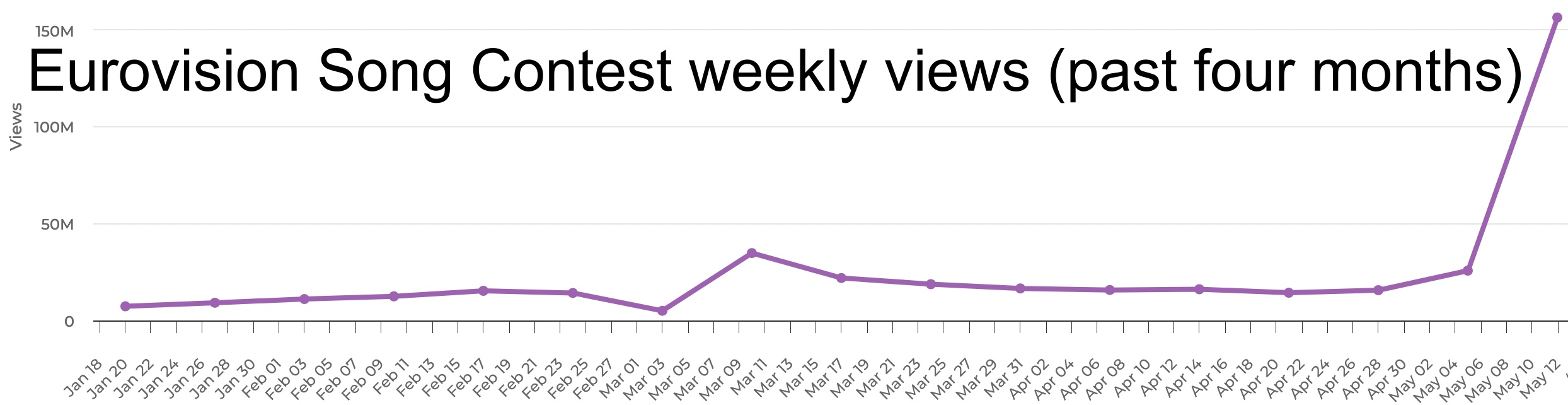
In the United States, the Eurovision Song Contest is little more than an overseas curiosity. On its home continent, however, the annual competition of national musicians is still a big deal. It has become an undeniable political force, a celebration of queer culture, and a big hit on YouTube.

The ESC has long chosen YouTube as a distribution channel for each year’s music videos, performances, and contestant interviews. (Some YouTubers have had roles in the contest as well.) Thanks in part to that long-term partnership, the ESC typically receives a viewership bump when its grand final rolls around each May.

This year, Eurovision took place in Switzerland, the country that operates the contest’s official YouTube channel. Perhaps aided by that coincidence, the competition’s YouTube channel enjoyed an extra-strength uptick. By getting 360,000 new subscribers, the official Eurovision hub brought its total sub count above seven million. Its lifetime YouTube view count, which is upwards of 8.6 billion, is nothing to sniff at either.

Data via Gospel Stats

Music videos have historically thrived on YouTube, and Eurovision has recently courted global viewership by admitting countries like Australia and landing a U.S. distribution deal via Peacock. Those strategies have worked wonders, but Eurovision isn’t the only intervallic competition with a presence in this week’s Global Sub Top 50.

I’m talking, in this case, about a classic YouTube channel that has showed up in our Top 50 charts for years. The WWE knows how to put together a powerful programming slate on social media, and it recently brought its signature moves to the Global Sub Top 50. With stars like Seth Rollins and Roman Reigns drawing big numbers, the official WWE YouTube hub added one million new subscribers, bringing its total up to 109 million.

An upcoming NBA Playoffs showdown between the New York Knicks and the Indiana Pacers could bring more shine to the WWE’s YouTube operation. The stars of those teams have faced off in the squared circle before, and the VOD from that event is bound to be revisited by many in the coming weeks.

For companies that stage events, YouTube offers a powerful distribution option. The most important thing is to say “c’est la vie” and seize the moment — just like some of Eurovision’s stars would tell you.

Channel Distribution

Here’s a breakdown of the Top 50 Most Viewed channels this week in terms of their countries of origin:

  • United States: 13
  • India: 12
  • Spain: 3
  • Indonesia, Saudi Arabia, and South Korea 2
  • Argentina, Australia, Bangladesh, Brazil, Canada, China, Hong Kong, Ireland, Japan, Mexico, Pakistan, Switzerland, Turkey, Ukraine, Uzbekistan, and Vietnam: 1

This week, 38 channels in the Top 50 are primarily active on YouTube Shorts.

As always, keep up to speed with the latest Tubefilter Charts and all our news by subscribing to our newsletter. You’re going to love it. 👉  Newsletter.Tubefilter.com.

Top 5 Branded Videos of the Week: MrBeast in Mexico, the Sidemen in streaming, and also the Met Gala

Welcome to our rundown of the most-watched branded YouTube videos of the week.

We’re publishing this snippet of a larger Gospel Stats Weekly Brand Report in order to analyze sponsorship trends in the creator economy. Any video launched in tandem with an official brand partner is eligible for the ranking.

And – as the name up above would imply – all the data comes from Gospel Stats. If you’re interested in learning more about Gospel – and which brands are sponsoring what creators on YouTube – click here.


For the third week running, MrBeast is #1 on our Gospel Stats Weekly Brand Report–but the video that put him there isn’t doing so hot. He’s closely followed by the latest Met Gala and the recently-turned-venture-capitalists Sidemen. As for this week’s bonus video? We suggest getting a snack first.

Check ’em all out here:

#1 I Explored 2000 Year Old Ancient Temples

Channel: MrBeast
Brand: Jack Link’s, Feastables
Views: 69,882,427

Welp, this isn’t a good look. The latest installation of MrBeast‘s ongoing sponsorship with Jack Link’s has landed him in hot water with the Mexican government (and Mexican citizens). In I Explored 2000 Year Old Ancient Temples, MrBeast and co. headed to Mexico to explore Mayan heritage sites like the ruins of Chichén Itzá. According to a lawsuit filed by Mexico’s National Institute of Anthropology and History, MrBeast and his crew got permission to film at the sites, but that permission did not include any commercial promotion/moneymaking attempts. Since MrBeast pushed Jack Link’s and his own chocolate company Feastables while filming–going so far as to call Feastables’ peanut butter bar a “special Mayan dessert” that is “the only Mayan-approved snack on the planet”–the government is suing him for breach of permit.

Backlash about the video didn’t seem to slow it down views-wise, though. At 69 million, it’s right around what MrBeast’s videos usually bring.

#2 Find This Key, Win $10,000
Channel: MrBeast
Brand: DoorDash
Views: 26,956,527

#1 wasn’t MrBeast‘s only top 5 video of the week. He also snatched second place with a Short sponsored by DoorDash (which also sponsored his #1 video from MrBeast Gaming last week). His Short is one of only around ~180 sponsored Shorts this week, commpared to over 2,300 sponsored long-form videos. Brands like DoorDash and Google seem willing to toss money at established creators for Shorts sponsorships, but it seems like Shorts deals haven’t really caught on yet. Maybe brands who want to do short-form sponsors are still looking primarily at TikTok?

#3 Live at Met Gala 2025 With Vogue
Channel: Vogue
Brand: eBay, 1800 Tequila
Views: 15,220,214

In third place we have Vogue‘s official three-hour livestream showing all the luxe looks at this year’s event. The theme for 2025 was “Superfine: Tailoring Black Style,” which focused on the intersection of fashion and Black identities. Just like every year, major celebs showed up wrapped in styles from the world’s most well-known designers–and a lot of people at home were digging it. Vogue‘s stream got 15 million views, which is plenty of eyeballs for its sponsors 1800 Tequila and eBay. (Think any of those gowns will pop up for auction after the red carpet? We’re not sure Anna Wintour would approve…)

#4 SIDEMEN LAST TO FALL ASLEEP CHALLENGE
Channel: Sidemen
Brand: Side+
Views: 8,891,806

Sleep deprivation is real torture. But what isn’t torture is how The Sidemen‘s career is going. These six U.K. lads make up one of YouTube’s most-watched content groups, and while they keep plenty busy with their own individual businesses and now their new VC firm, they’re also still absolutely pumping out content–including this MrBeast-style challenge that puts sleep deprivation readiness to the test. It’s sponsored by the guys’ own streaming service, Side+, which is also another page out of the MrBeast book. Is it cool to sponsor your own videos? Who knows, but the business ouroboros seems to be paying off for them.

BONUS #1,528 Where Would You Time-Travel (For the FOOD)? ft. Max Miller
Channel: Mythical Kitchen
Brand: Rosetta Stone, Factor
Views: 54,267

This week’s bonus vid is a YouTuber mashup, with Tasting History host Max Miller visiting the Mythical Kitchen for a tastebud’s trip through bygone eras. Miller is an expert in ancient food, and has made everything from ancient Roman cuisine to biscuits and gravy from the California Gold Rush. Taking all that into consideration, the culinary dervishes at Mythical have just one question for him: If he could time-travel to any point in human history to taste any food he wanted, where would he go? This Q&A is appropriately sponsored by meal kit company Factor and language-learning brand Rosetta Stone, which might help if you need to order a big honkin’ cup of wine in Latin.


…and there’s a lot more data where that came from. If you’re interested in learning more about Gospel – and which brands are sponsoring what creators on YouTube – click here.