Dating back to the days of VHS and Betamax, there is a long-held (and contested) link between pornography and the widespread adoption of new entertainment formats. If that belief is still relevant more than 30 years later, then proponents of short-form video just got a big win, because an infinitely-scrolling vertical feed is coming to Pornhub.
Pornhub’s take on TikTok-style video is called Shorties (though Mashable joked that Quickies might have been a more apropos title). The typical Shorty is exactly what you’d expect: A fast-paced, vertically-oriented video that delivers a quick jolt of adult entertainment.
The world’s most-visited porn site (according to Similarweb data) rolled out a beta version of Shorties more than a year ago, and the feed is now rolling out to more users — though an official release still has not been announced. The Shorties feed can be found on the main Pornhub menu, and this article provides a direct link to the NSFW hub.
Pornhub has often taken cues from platforms like YouTube, and its reasons for adopting a TikTok-style feed make it sound like any other copycat. It wants draw in users between the ages of 18 and 24, who have accounted for the biggest chunk of Shorties viewership thus far. There are opportunities for creators as well, since an infinitely scrolling vertical feed can lead to increased reach and discoverability.
“Our new vertical platform, Shorties, is currently in beta, but early feedback from both users and creators has been very positive,” a Pornhub spokesperson told Mashable. “We are excited about the creativity and engagement it is already generating, and we look forward to sharing more information when it officially launches later this year.”
The rise of funding platforms like OnlyFans has led to stronger connections between the worlds of pornography and creator content. The latest news suggests that OnlyFans is on its way to a massive sale, and brands have been flocking to the platform in greater numbers. Pornhub could theoretically carve out more ad space via Shorties once the feed officially launches.
The burning question, in my mind, is what YouTube will think about the name of Pornhub’s new format. Shorties sounds a lot like YouTube Shorts, so that might rankle some of the folks at YouTube HQ. Then again, the original name of YouTube Premium was very similar to RedTube, another site owned by Pornhub parent company Mindgeek. So I guess you could think of the Shorties name as a little bit of tit-for-tat.
Instagram isn’t exactly known for its library of web series, but the Meta-owned platform is looking to cash in on a recent phenomenon by upgrading the Reels format. A new feature lets Instagram users link together related Reels to create sequences that facilitate long-form storytelling.
Reels can be linked together during the editing process, either on the captions page or through the menu that shows previously shared Reels. A new button will connect linked Reels, allowing viewers to seamlessly transition from episode to episode.
Previously, Instagram creators had to rely on clunky segues (i.e. “come back for part two”) if they wanted viewers to follow the thread of a multi-Reel tale. According to TechCrunch, Instagram is introducing linked Reels — which was a highly requested feature — to make it easier for viewers to discover videos that are directly related to uploads they’ve previously watched. Collections, such as a compendium of seasonal recipes or a list of restaurant reviews, can also be compiled via the new feature.
Though there are many potential uses for linked Reels, the feature is, at its heart, the latest example of a time-honored Instagram tradition: Copying something that works on TikTok. Earlier this year, TikTok viewers became enraptured by The Group Chat, a series spread out across dozens of short videos. 80 million views later, The Group Chat has catalyzed a revival of the long-dormant web series format.
Once common on YouTube, web series have now found new audiences by appealing to the Gen Z denizens of TikTok. Minidrama studios have cashed in on that revival, especially in China, where the minidrama industry approached $7 billion in revenue in 2024.
The rise of the minidrama gives Instagram about seven billion reasons to roll out linked Reels. When you add in the marketing potential of sequential short-form clips, the new feature becomes a no-brainer — even if we’re starting to get tired of Instagram copying TikTok all the time.
After splashing out $14 billion dollars for exclusive streaming rights to NFL Sunday Ticket and seeing success with its first season, YouTubepaid to pick up a 2025-2026 Week 1 matchup that pits the Los Angeles Chargers against the Kansas City Chiefs in São Paulo, Brazil. Unlike Sunday Ticket, the Chargers v Chiefs game (Sept. 5) will be free to watch for anyone with access to YouTube.
But that doesn’t mean YouTube will walk away without benefiting. As you probably know, the vast majority of YouTube’s revenue comes from selling ads–and a new report from TV data and analytics firm EDO asserts that digital ads should be more attractive to the NFL (and, of course, to the brands that run them) than ads on traditional TV.
That’s not to say the NFL isn’t doing well on TV. EDO’s data showed that during the 2024 season, TV ads run on regular-season NFL games were 19% more effective than ads on TV in general. That effectiveness shoots up to 63% during playoffs, and 243% more during the annual ad bonanza that is Super Bowl Sunday.
To put that in perspective, an advertiser would have to run 23 ads on non-NFL television to have the same impact as a single NFL TV ad, EDO found.
But ads on streaming-exclusive games are so effective they beat the NFL’s own numbers, it added. Data showed that digital ads run during NFL streaming-exclusive games are, on average, 66% more effective than TV ads run during broadcast/linear games.
That figure goes up during special events. The 2024 Black Friday game Amazon Prime Video picked up had ads 51% more effective than those shown during the NFL’s TV-broadcast Thanksgiving games. Ads shown during Netflix‘s Christmas Day games were 84% more effective for entertainment brands and 70% more for pharmaceuticals than the average 2024 season TV broadcast. Then there was Peacock‘s exclusive Green Bay Packers vs Philadelphia Eagles game, which had ads 116% more effective for brands than average TV ads, with engagement specifically benefiting Applebee’s, Little Caesars, and Subway.
“The NFL is so important to the TV ecosystem overall that it is, on average, more effective than all other types of advertising on TV,” Kevin Krim, EDO’s President and CEO, said in a statement. “The big push for the NFL has been to add streaming exclusives as a way to keep up with the evolution of where the audiences are going, which is to a streaming-first ecosystem.”
What makes digital ads more effective? Targeting is the big one, and scarcity is the other. On TV, the NFL has a limited number of ad slots, and it can only sell those slots to one brand at a time. The ~20 million people who watch NFL games each Sunday are shown the same ads, regardless of their demographic or consumer preferences. This spray-and-pray method means lots of people seeing ads that aren’t relevant to them.
On digital, there are many more slots, and those slots can be filled by brands using ad tools to target specific sects of the population. With digital ads, brands can reach people who’ve shown interest in products like theirs, or live in an area where they want to drive more awareness, or have certain conditions. That way, if ~20 million people watch one game, they could all be seeing unique combinations of ads, with dozens of companies having paid for slots on the same game with different audiences in mind.
Krim notes pharmaceutical companies in particular have traditionally shown “a lot of hesitance to pay higher rates to advertise a specific drug compound, because, in almost any case, you’re going to get a small fraction of the total population for whom that’s applicable.”
With streaming, though, there is “the opportunity for these big pharma companies, who have multiple compounds that can be targeted at different conditions, to buy a slot and target different folks,” he added.
This is all promising news for YouTube. Sure, Sunday Ticket earns money through pricey subscriptions, but as live sports continue to dominate in online content, it’s sure to want more exclusive games–and judging by EDO’s data, could make big bucks by punting top-performing ads alongside those streaming steals.
Filed under: Homepage Feature, Uncategorized by James Hale Comments Off on The NFL’s biggest ad touchdown? Streaming.
Like most people, Markiplier got his first inkling of the generative “AI” gold rush with OpenAI‘s DALL-E. The concept of AI had been around for decades–Turing, after all, created his famous test back in 1950, and digital-native Millennials will remember growing up with chatbots like SmarterChild back in the early 2000s. DALL-E, though, was the first publicly accessible product that linked text input with image output.
And all that output was “garbage,” Markiplier (aka Mark Fischbach) says.
He made a YouTube video shortly after DALL-E released in 2022, poking fun at the generator’s surreal, nightmarish, and thoroughly memeable productions. It couldn’t nail faces. It gave people 15 fingers and 500 teeth. Backgrounds were fuzzy at best; objects were conglomerate blobs. The video premise was a joke, seeing how bad DALL-E’s “art” could be. But even as he uploaded the video, something about it nagged at him. Eventually he realized: DALL-E scared him–and not because its generations looked like something out of a low-budget found-footage horror movie.
It scared him because it was just the beginning.
“I grew up around computers. From the age of five, I was around computers with my dad,” he says. “I knew the pace would increase. A lot of companies are very interested in the next big thing, the next big technological push. When you have that much money going into it, it will start to iterate.”
He was right. Big tech and startups alike were fresh off the web3/metaverse/crypto/NFT bandwagons, which had been profitable for only a select few, and were looking for trendy new places to put their money, hoping to strike it rich this time. The late 2022 debut of OpenAI’s ChatGPT took interest to a fever pitch, and billions of dollars began pouring into gen AI development, flowing from companies like Google, Microsoft, and Meta. In just a couple years, their backing took gen AI from 15 fingers and 500 teeth to outputting video that’s troublingly indistinguishable from reality.
Fast-forward to 2025, and “AI” is an omnipresent buzzterm. Companies have burned cash bending their entire business models around incorporating large language models and releasing generative products. We are swarmed with marketing that tells us to accept that gen AI is the future. There are tools that give YouTubers their next video idea, writers their next book chapter, entrepreneurs their next startup concept. After all, don’t we want to be more productive? Don’t we want to think less?
Fischbach has kept a close eye on AI’s development.
To get a better understanding of how generative technology is being applied in the real world, he did an internship with production/VFX studio Corridor Digital and consulted with Dr. Amanda Muyskens, an accomplished data scientist with a PhD in statistics (who happens to be married to his longtime friend and fellow creator Bob Muyskens).
The technology, he says, is fascinating. (He’s also quick to point out that ChatGPT and other popular products aren’t actually AI; they’re large language models. “They don’t think,” he says. “They just don’t. That’s not how the technology works.”) The problem is that many companies utilizing it are taking advantage of the fact that AI input and output is not just “a legal grey area, but a legal dark abyss area,” he says.
“It can’t be a secret that Google, owner of YouTube, used all YouTube videos,” he says. “Put ‘Let’s Play’ into Veo 3, and it recreates it. It even recreates Fortnite accurately. Oftentimes these companies will change their TOS to add in language to put them in a less indefensible position.”
Laws and regulations, he adds, cannot keep up with the speed at which AI companies are moving, especially when it comes to copyright: “You put up a wall, and they’re already ten paces past the wall.”
In 2024, frustrated by how AI could be used to better humanity and how the companies using it aren’t doing that, he went to the Muyskens.
Together, they founded Real Good AI, a 501c3 nonprofit researching how AI can be used for positive, humanitarian impacts.
“Where we are now with AI, there are some serious concerns about how it will or will not work going forward, from where the technology stands,” Bob says. “Mark and Mandy share an interest in AI, and it went from casual conversations to Mark feeling like something needs to be done.”
Dr. Muyskens “has the expertise and knowledge and connections to other scientists to do something about it, in terms of research and developing new tools and techniques,” he adds. Prior to founding Real Good AI, she worked for five years as a scientific researcher and principal investigator, with areas of specialty including Gaussian processes, uncertainty quantification, scaling machine learning algorithms, and communicating science.
Real Good AI is “focused on trying to ethically pursue ways to improve and new methods to make these tools work for humanity,” Bob says. (It’s also staunchly against “AI art.”)
Some of its initial projects include:
Using data analysis to help nonprofits learn from other nonprofits in their area, examining best practices and funding histories to project what sort of running budget they can expect
Using data analysis to understand the impacts of public policy on homelessness in elder members of the population, in an effort to reinforce policies that aren’t seeing the results they were supposed to, and to find policies that are especially effective
Figuring out how to identify when LLMs are lying, and getting those LLMs to communicate to users if and when the factual accuracy of output is in question
“This is a lofty idea,” Bob explains, about the lying project. “One of the problems with LLMs currently is they have no way to credit their source. Something gets generated, but there’s no, ‘I pulled from this artist, this animation.’ They don’t know. The way these models work, they can’t tell where things come from. It’s not trying to obscure that information, it just can’t tell you.”
Real Good AI’s thought process is to make an overlay, something on top of the model where a user would still get output, but then the LLM would say, “This is a pretty good answer, I’m pretty confident, this is being pulled from X source,” Bob says. “Or it could say, ‘I’m making this from thin air, I’m extrapolating, you should not be confident or comfortable this is coming from factual sources.'”
Current LLMs “give you the appearance of ‘Oh, let me think about that, let me look at some sources,’ but that’s not really what they’re doing,” he says. “If you want to be responsible, you have to understand every answer is going to sound equally confident. Answers can look very credible, but might be a complete hallucination.”
Dr. Muyskens is leading these projects, with the help of summer research fellows. Fischbach stepped up and has been fully funding Real Good AI himself. Dr. Muyskens isn’t taking a paycheck yet, but Real Good AI has brought in other team members, including the aforementioned fellows, plus more data scientists and an outreach director. Fischbach, Bob, Bob’s mother Diane Muyskens, and veteran music teacher David Bell all sit on the board.
Staffing is tough, Fischbach says.
“Setting up a charity is a very difficult thing. We cannot beat the big giants who are pumping a million billion dollars into this,” he explains. “You have Google paying tens of millions of dollars, offering compensation packages for AI. That’s what we’re fighting against. I often make jokes about being Mr. Big Dick Moneybags over here, but I can’t fight that. You have to find people willing to say no to those big paydays, and this is the hottest employment field right now.”
The people who have joined Real Good AI “have taken a hellacious pay cut to be part of this team, because they believe in it,” he says. “It’s a funny thing, being this tiny speck of a nonprofit versus the mountains of these other companies. But I’m happy to fund it myself, because I believe they’re right. I 100% believe they’re on the right track and that the mission is strong.”
That mission is now getting more support, thanks to recent controversy. After Fischbach mentioned using ChatGPT in an episode of Distractible, his podcast with Bob and their mutual friend/creative collaborator Wade Barnes, viewers were quick to pounce, accusing him of promoting generative LLMs. Fischbach held a livestream afterward to clarify that he was criticizing modern dependence on LLMs.
“What was good about people raising a stink is that it gave me an opportunity to talk about [Real Good AI], to draw some attention and get some donations,” he says.
The attention, Bob adds, has been “overwhelming,” with people wanting to volunteer and organizations reaching out for partnership–and, crucially, to supply funding. Right now, Real Good AI is trying to communicate more about its mission (some people reaching out are asking what kind of chatbot the org is building, a fundamental misunderstanding of what’s going on here) and continue to bring in more researchers.
“We’re at a point in the broader climate of science and research where science is kind of losing the fight. Science is being broadly defunded,” Bob says. “We’re just trying to keep that fire alive and be a beacon of good research, good moral practices, good ethical practices, and try to fight the fight.”
Filed under: Creator, Homepage Feature by James Hale Comments Off on Markiplier is paying expert researchers to figure out if AI can be Real Good for humanity
The topic of conversation is deceptively simple: “Favorite home-cooked meal, boys?”
“I heard your mom makes a mean pizza.” That’s Peyton, talking to Jackson. They’re both 13.
“Yeah, she does make a mean pizza,” Jackson concedes.
“And she makes a good ramen,” Ryan, who’s 14, chimes in. He’s the one who proposed this topic. When quizzed about what makes Jackson’s mom’s ramen so good, he gets a little bashful. “It’s the–It’s, she cuts it up so it’s like, it’s–”
His fellows are quick to pounce. “Aww,” Jackson coos, egged on by Peyton and the fourth member of the group, 14-year-old Emmett. “Little Ryan needs his ramen cut up!”
It’s the kind of camaradic conversation that would be at home in any middle school. You almost expect to hear silverware tinking, the clack of plastic trays, and a distant school bell signaling class switch. But these are the MD Foodie Boyz, and this is their podcast–which, despite none of them, nor any of their family members, having prior social media experience, is well-produced in a slick-looking soundproof space and uploaded every other week or so to YouTube.
It all started in November 2024, Ryan’s older brother tells us. The boys, who are from Maryland (hence the “MD” in their name) and met as classmates, “thought it would be a fun idea to get together and film a podcast just for jokes,” he says. “Just ’cause that was what seemed interesting to them at the time.”
Their podcast aspirations aren’t very surprising in this day and age. Neither is their decision to post that episode on YouTube. Ryan’s brother says it got around 50 to 100 views–pretty typical of something that doesn’t take off.
“It sat there for a couple months,” he says. By December, the boys were still smitten with the idea of doing a podcast, so Ryan’s brother got together with another of the squad’s older brothers and launched TikTok and Instagram accounts. To fill them, they cut up the previously filmed episode into short-form segments. They weren’t expecting much, but one segment, a heated debate about celery, got 5 million views.
“We just kept posting every day since then,” Ryan’s brother says. The boys’ virality made them a household name among those savvy in the digital video space, and they nabbed interviews with people like Taylor Lorenz and outlets like The Cut. They also caught the eye of Dave Portnoy, who flew out for a collab, and Lil Yachty, who guest-starred on episode 9 of their podcast.
Like we said, no one involved had any experience with social media beyond running their own personal accounts. So they’ve all had to learn fast. For Ryan’s brother, that’s meant figuring out how to film biweekly around the boys’ school schedules, then turn that footage into both long-form episodes and more short segments to be posted across YouTube Shorts, TikTok, and Instagram Reels.
For the segments, he ended up using OpusClip, whose flagship product is a video editor that uses artificial intelligence to take creators’ long-form content and cut it down into short-form videos.
Ryan’s brother says they originally found OpusClip because he was looking for a tool that could give them “cool captions” for their short vids. “I wasn’t in the video editing space, so I just Googled, I did some research on the best captions, and they had a free program,” he says. “We continue to use them for our captions currently.”
Why? Because OpusClip’s captions offer “barely any mistakes,” he says. “Every clip, there’s like, maybe one or two mistakes that I have to go in and manually fix. But outside of that, it’s good. It’s customizable, I can make it animate the way I want, and the placement and size I want. It’s super user-friendly and very good at what it does.”
He adds that after the OpusClip team saw the Foodie Boyz using its tools, it reached out to Ryan’s brother asking for any feedback. Were there any fixes he wanted? Any new features he thought could be helpful? Any workflow issues he runs into?
“They notify their team to make any updates they need to,” he says.
OpusClip has told us before that consistent conversation with creators of all sizes is a key part of its development process.
This is that philosophy in action: The MD Foodie Boyz are up-and-coming, make no mistake, and they have caught viral attention. But they’re not MrBeast, and they don’t have an entire professional team backing them. They have their brothers–and, with OpusClip’s tech, that’s enough.
For the foreseeable future, the boys’ production is somewhat limited by school and sports schedules. Ryan’s brother, who’s currently in college for economics, says he probably doesn’t want to do content creation as a career, but he’ll continue managing their socials, and will carry this experience forward into whatever he does end up doing. The boys may end up following in his footsteps, having made a little cash from AdSense and Cameo clips. Or they may end up becoming the next Keith Lees. They’re not sure–and that’s okay. We’re all just taking things one bite at a time.
OpusClip is a Tubefilter partner.
Filed under: Homepage Feature, OpusClip by James Hale Comments Off on Four middle schoolers wanted to make a podcast for fun. Now, the MD Foodie Boyz are making content with Dave Portnoy and Lil Yachty.
2025 is YouTube‘s 20th anniversary, but that’s not the only milestone the platform is celebrating. Its audio streaming hub, YouTube Music, is now ten years old, and it is continuing to improve thanks to a partnership with digital concert database Bandsintown.
YouTube Music initially launched in 2015 at the end of a long and arduous developmental process. Along with the service now known as YouTube Premium, the music hub served as YouTube’s entry into the world of paid subscriptions. These days, a YouTube Music subscription costs $10.99 per month, with discounts available for students and families.
Ten years on, YouTube Music has become the vehicle through which YouTube is embarking into Spotify’s territory. Through features like a music video remixer and support for podcasters, YouTube Music has attracted enough users to give the titular platform more than 100 million paying customers.
The latest addition to the YouTube Music platform will continue to add utility for popheads. The Bandsintown integration is described as an “exclusive partnership” that will bring upcoming concert dates to music videos, Shorts, and official artist pages.
To show what that feature looks like, YouTube has teamed up with a diva who knows a thing or two when it comes to modeling social media products: Sabrina Carpenter. Ahead of the release of her seventh studio album Man’s Best Friend, Carpenter is hitting the road — and YouTube Music users will have easy access to her imminent slate of shows.
“We’re also adding new notifications to let you know when upcoming releases from your favorite artists are announced, new merch is dropping, or event dates are added,” reads a YouTube blog post, “so fans never miss a beat.”
Like TikTok, YouTube has positioned itself as a pop culture tastemaker by making popular hits available as the soundtrack for millions of short-form videos. YouTube Music is the epicenter of that effort, and when you add in the power of Google technology, YouTube’s audio hub becomes a killer app — hence its recent integration into TikTok’s “Add to Music App” feature.
Long story short: After ten years, YouTube’s presence has gotten a lot bigger than mere Coachella streams. The platform is transforming into an all-around locus of pop culture, and Bandsintown is getting in on the fun.
Filed under: Articles, Featured, Homepage Feature, News, YouTube by Sam Gutelle Comments Off on YouTube Music celebrates 10th anniversary by showing you which bands are in town
If you’re in the market for some spiffy secondhand finds, Pinterest has just the hub for you. The virtual pin board has introduced a new ecommerce experience called Thrift Shop, which features pre-owned items from sellers across the platform.
The “Thrift Shop” name is a bit of a misnomer, since the new hub doesn’t include a single, centralized point of sale. Instead, Pinterest has aggregated vintage and secondhand items from its community by working with “top vintage and thrift retailers from around the globe,” according to an introductory post.
That effort has revealed the throwback trends that are currently percolating among Pinterest’s core audience. Y2K-inspired looks are still hot, boho chic seems to have never gone out of style, and Pinterest was right to predict that dill pickles would inspire 2025 fashions.
The launch of Thrift Shop underscores a demographic shift that has seen Gen Z replace Millennials as Pinterest’s primary audience. Previous attempts to connect with that cohort included a June 2025 partnership with iconic Gen Z creator Emma Chamberlain. Now, Pinterest is paying attention to Zoomers’ tendency to shop for sustainable goods. Today’s twentysomethings have stressed the importance of environmental conservation, leading to changes in the advertising and retail markets.
“Gen Z Pinterest users are curating unique spaces and personalizing their styles with pre-loved treasures, proving that sustainability and creativity go hand in hand,” reads the introductory post. “From 2000s preppy style to Art Deco decor, the Pinterest 2025 Fall Trend Report shows that this new wave of style is less about following the crowd and more about finding one-of-a-kind pieces that tell personal stories—while keeping planet and budget in mind.”
But the launch of Thrift Shop is not just about conservation. Pinterest is also acknowledging the widespread cultural impact of spaces like Facebook Marketplace. Meta’s secondhand store has become so beloved that it’s even getting its own IRL pop-up in Los Angeles.
And then there is the matter of cost. Despite Gen Z’s preference for sustainable goods, many creators and social media users within that group have turned to fast fashion brands like Temu and Shein. Though those overseas retailers have faced significant criticism, they also offer low prices that matter to a cost-conscious generation.
Thrift Shop gives consumers a more ethical source for screaming deals on in-demand fashion items. Pinterest plans to work with “industry tastemakers for weekly closet drops,” so resourceful buyers should periodically check in with Thrift Shop while the experience remains active. It is slated to run from August 20 to September 26.
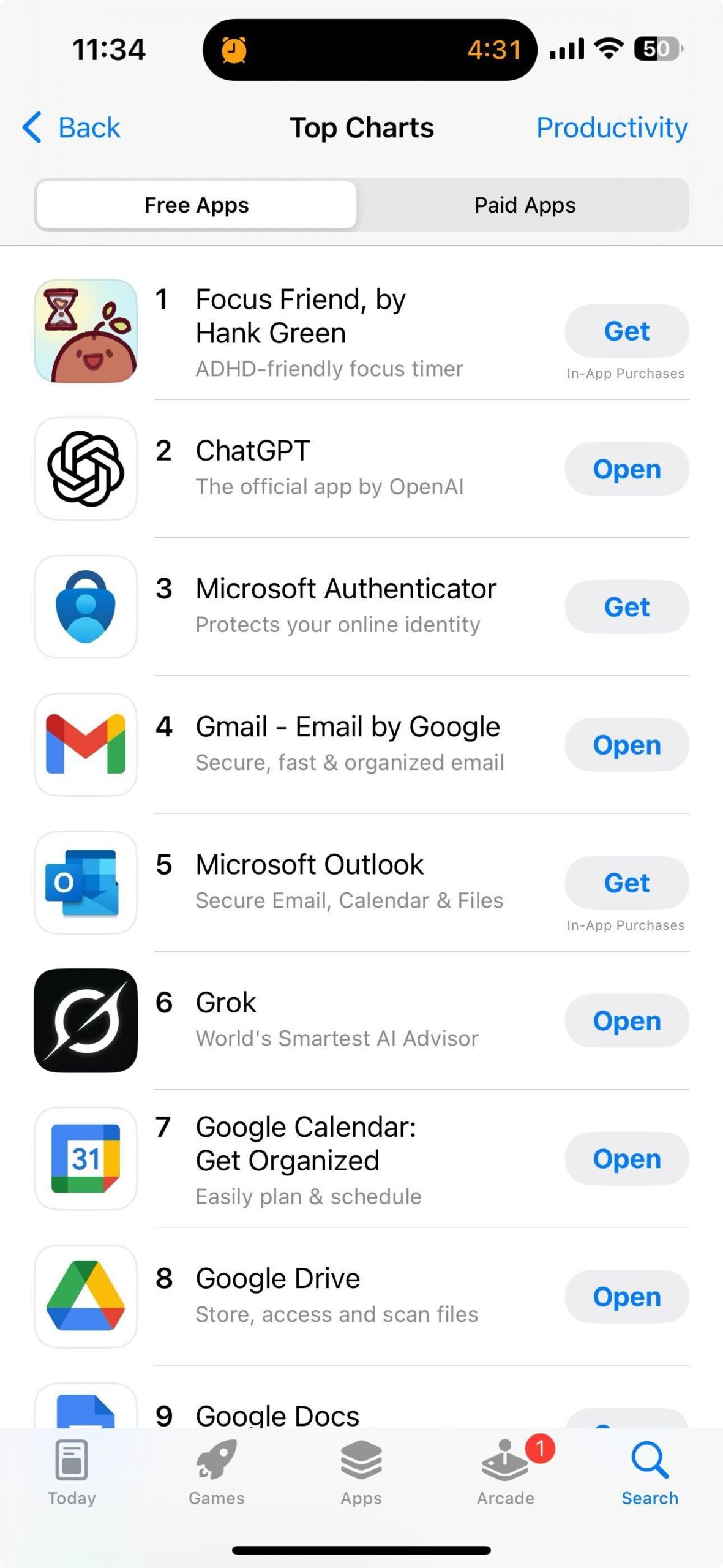
Hank Green has concocted another clever creation, and this time, he’s claiming the top spot on the App Store charts. Focus Friend, a productivity aid that features an adorable, bean-shaped character, became the most-downloaded app in the U.S. shortly after its August 17 launch.
Focus Friend, published by Honey B Games, invites players to put their beans to work whenever they need to focus. When they start a timer, their bean starts focusing on the decor of its virtual room. Players who leave their phone alone for long enough unlock cosmetic items that can be used to trick out their bean’s room. The app offers a similar concept to the Pomodoro Technique, a little bit of body doubling, and a whole lot of cuteness.
Though the app is far from Green’s first creation — his other credits include Vlogbrothers, VidCon, Crash Course, and multiple books — Focus Friend has emerged as one of his most successful projects. One positive review came from Hank’s brother John Green, who addressed the app in a Vlogbrothers upload. John loves his little bean friend, even if he has complaints about the white-haired “John Bean” character who can be unlocked as an in-app purchase.
18 years after the launch of Vlogbrothers, the Greens are reminding the world that they possess one of the most devoted fanbases in the creator business. The same “Nerdfighters” who support annual Project 4 Awesome charity drives have helped Focus Friend earn its perch atop the App Store charts.
If, somehow, an adorable beany sidekick isn’t enough to keep you occupied for days, don’t worry. Hank Green, who always stays busy, is devoting himself to several other developments. In a recent Bluesky post, he claimed to have 19 different projects in the works. Thanks to Focus Friend, we’ll be able to experience all those creations as efficiently as possible.
Thanks to a new feature, “fantastical scenes” are coming to YouTube Shorts.
That’s how a video on the Creator Insider channel describes the output of Effect Maker, a tool that lets users design and share augmented reality (AR) overlays for short-form YouTube videos. Completed effects will be available to all logged-in users who have access to YouTube Shorts, and creators can set up a separate channel tab to show off the effects they’ve built and distributed.
According to the relevant Creator Insider video, YouTube has been honing Effect Maker “over the past year” and “slowly expanding” access to the feature. The latest update makes Effect Maker “widely available to users with access to advanced features on YouTube,” but there’s a catch: The tool is only available on desktop devices for now, and YouTube doesn’t have any information to share about a potential mobile rollout.
Even with that limitation, YouTube sees Effect Maker as an asset that will make “Shorts creation more fun and effective.” A tutorial published on the YouTube Creators channel explains how the effects creation process works.
Fun tools for creators are nice, but YouTube also stands to benefit from the launch of Effect Maker. Similar features are already available on Snap (Lens Studio) and TikTok (Effect House), and effects built through those hubs have started to show up on YouTube Shorts.
Rather than forcing its users to go elsewhere to craft effect-driven formats (or limiting them to crude imitations), YouTube is doing what it can to provide the same tools and experiences that already exist on TikTok, Instagram, and Snapchat. The decision to change the counting formula for Shorts, for example, made YouTube’s short-form viewership look more like TikTok’s.
The Effect Maker rollout could also spawn a new revenue stream. Both Snapchat and TikTok have built monetization into their effect creation tools, and YouTube now has the opportunity to do the same (though it has not indicated that effect monetization is imminent).
While the benefits of Effect Maker are limited to reach and engagement for now, YouTube does plan to bring in some upgrades in the near future. Some AI-powered effects, for example, are on the way. To get more details and check eligibility for your channel, click here.
Filed under: Articles, Featured, Homepage Feature, News by Sam Gutelle Comments Off on YouTube’s new Effect Maker puts it in competition with TikTok and Snapchat
Gushcloud is continuing its expansion push in a partnership with the Abu Dhabi Investment Office (aka ADIO) that will see it establish headquarters in the MENA region and team up with local governments, universities, and creators.
Gushcloud says it’s the largest talent representation, content distribution, and creator monetization business in Asia, and it currently has offices covering 13 territories, including Australia, Greater China, Indonesia, Japan, Korea, Malaysia, the Philippines, Singapore, Thailand, Vietnam, and the U.S. It recently acquired a 500-creator multichannel network from Paris-based agency Wizdeo, giving it its first European stake.
The Wizdeo acquisition and this ADIO partnership follow Gushcloud’s plans to expand globally over the next couple of years. CEO Althea Lim, who founded Gushcloud in Singapore in 2011, told us the company wants stakes in North and South America, too, and that its ultimate goal is to “represent $1 billion of annual income for creators” around the world.
ADIO, meanwhile, is the UAE’s government office for economic health. It handles tourism and retail development, and works with local and foreign entities who want to invest money and/or business into the region.
We’ve written multiple times about the United Arab Emirates’ creator economy aspirations. It wants to turn Dubai into the creator center of the future, and is shelling out tens of millions of dollars in an effort to make that happen. But while Dubai is often mentioned at the crux of those aspirations, Abu Dhabi, the UAE’s capital city, also wants the economic boost that comes from creator engagement.
Gushcloud will set up in Abu Dhabi and, as we mentioned above, work with local governments and organizations to establish opportunities for creators, it tells Tubefilter. It also plans to “identify and invest in top local creators within MENA to turn them into global creators via Gushcloud’s Creator Venture Program.”
If successful, those creators will be encouraged to “establish sustainable businesses and secure funding in the UAE,” Gushcloud adds.
Other plans include:
“Developing and providing solutions for brands and agencies to expand their reach into MENA and India through influencers and content creators”
“Developing new experiences including offline and online events and masterclasses that highlight the influence of local and global creators in the region”
“Abu Dhabi offers a thriving ecosystem for digital content creators. This strategic expansion led by this partnership will allow us to offer more services to our clients (being creators and brands) in the MENA region,” Andrew Lim, Group CFO of Gushcloud International, said in a statement. “The city’s strategic location and business-friendly environment make it an ideal hub for our operations in MENA and India. We look forward to deepening our connections with the local community and contributing to its vibrant digital media ecosystem.”
Badr Al-Olama, ADIO’s General Director, added, “We are pleased to have Gushcloud expand its presence in Abu Dhabi. This advances our shared ambition to grow a world-class creator economy in our nation. The appointment of senior leadership in the emirate reflects real momentum and underlines Abu Dhabi’s role as a magnet for talent, innovation and global opportunity in the digital media space.”
Filed under: Gushcloud, Homepage Feature by Tubefilter Staff Comments Off on Gushcloud expands into Abu Dhabi, hoping to help MENA’s top creators go global
After paying lip service to the TikTok generation since his re-election, President Donald Trump has established an official executive account on the app. The new White House TikTok account, established earlier this week, has already reached more than 150,000 followers through a smattering of soundbites shared directly from the President’s desk.
The first video on the new account featured a montage of Trump footage. “I am your voice,” Trump says in the 27-second clip, which has already received more than 1.2 million views.
Other uploads have repurposed Trump statements as TikTok audio snippets that can be repurposed by the President’s supporters. Those clips are appended to one another back-to-back, with no narrative through-line. The message is clear: If you’re looking for a repository of Trumpisms to use in your videos, the White House TikTok account is the place to go.
@whitehouse‘I was the hunted, and now I’m the hunter.’
Arguably, some of Trump’s detractors could find uses for that audio as well. Those critics will find it harder to use the new account’s other videos, which regurgitate executive talking points on subjects like urban violence.
To be clear, this is not Trump’s first rodeo on TikTok. The leader of the MAGA movement employed the ByteDance-owned app on the campaign trail as he solidified his alliance with young people and creators. That account has been dormant since his reelection, but the new White House hub is not much different from Trump’s previous TikTok home base.
The Trump administration’s ideas about TikTok seem to be similar to the views held by the preceding presidency. Joe Biden made his way onto TikTok during his ill-fated reelection campaign, and many of the videos he shared there were linked to the “Dark Brandon” memes that became popular during his stint in the Oval Office.
Biden’s TikTok use took a backseat when he moved to limit Americans’ access to the app. Trump may soon find himself facing a similar conundrum. After attempting to curb the app’s influence during his first term, Trump reversed course during his reelection campaign, promising to overturn the Biden-era “divest-or-ban” law.
Keeping that promise has been easier said than done. Trump has granted multiple reprieves to prevent the TikTok ban from taking effect, but even with more time to negotiate, ByteDance and Washington legislators have been unable to agree on a deal that would give the U.S. a measure of control over TikTok’s operations. Trump has looked to put pressure on ByteDance by claiming (through his deputies) that the latest deal extension will be the last one, but it’s unclear if China is even willing to play ball with potential TikTok buyers.
If the dealmaking effort turns sour, what will happen to the new White House account? Will it stay active, or will Trump’s animosity cause him to swear off TikTok once again? The future is quite cloudy, so purveyors of MAGA memes should get to work now while they still can.
In February 2025, YouTube turned 20. The video site has gone through a lot over the past two decades, including an acquisition, an earnings glow-up, and multiple generations of star creators. In our 20 Years of YouTube series, we’ll examine the uploads, trends, and influencers that have defined the world’s favorite video site — one year at a time. Click here for a full archive of the series.
By the time 2020 rolled around, YouTube was 15 years old. The teenagers who had grown up with the platform’s first wave of homegrown stars — the Ryan Higas, iJustines, and Smoshes of the world — had become full-grown adults. Compared to their younger years, they had less time to spend watching videos. A younger generation had emerged as the drivers of digital culture, and the merger of Musical.ly and TikTok had created a new force to rival YouTube’s dominance of the creator industry.
The business side of the creator world was evolving, too. The old order of multi-channel networks was crumbling, creator revenue was ballooning, and major stars like Logan Paul were realizing that they could dictate the course of their careers rather than deferring to their handlers.
That’s a lot of change, and we haven’t even gotten to the 2020 of it all. A chaotic year opened up new doors for many creators, but it also showed the door to old favorites who were forced to reckon with the insensitive jokes they had made in the past.
I’m talking, chiefly, about Jenna Marbles and Shane Dawson. In 2020, they each had more than a decade of YouTube experience and tens of millions of subscribers hanging onto every upload. But as a racial reckoning swept across the United States as part of the George Floyd protests, Marbles’ and Dawson’s old videos came under the microscope — and the resulting backlash accelerated the upheaval of creator culture.
In the cases of both Marbles and Dawson, much of the controversy centered around old videos performed in blackface. Marbles came under fire for an inappropriate Nicki Minaj costume, as well as jokes that offended women and Asians. Dawson’s transgressions included his own blackface characters and numerous videos featuring the n-word.
These two linked public trials had related outcomes. Both creators posted remorseful apology videos in which they held themselves accountable for regrettable past actions. Marbles chose to put her channel on indefinite hiatus, whereas Dawson faced sanctions from YouTube that affected his ability to monetize his video. Five years later, Marbles’ channel is still inactive, while Dawson has added new uploads occasionally on his primary hub.
On one hand, there’s not much to say about the creator reckoning of 2020. It had been known for a while — if not said out loud — that many of YouTube’s biggest stars relied on tired and offensive jokes. Criticism of Dawson dates as far back as 2014, when Franchesca Ramsey called out the racist tropes that underpinned much of his comedy. Ramsey authored her take amidst the release of Not Cool, a Dawson-piloted film that was savaged by critics for its crass sense of humor.
It is easy enough to see Dawson’s “cancellation” as an overdue punishment for a creator who made millions by pushing the boundaries of taste until they couldn’t contain him anymore. The case of Jenna Marbles, however, makes this story more complicated. Despite her flaws, she wasn’t Shane Dawson. Her decision to go on indefinite hiatus felt like an acknowledgement that her time in the YouTube spotlight had passed, and she was willing to quietly pass the mic to the generation of creators she helped inspire.
“I’m just a person trying to navigate the world the same way that you are, so I don’t always know what’s right, what’s wrong, or what the truth is,” she said in her apology video. “As someone clearly with their own past that they’re not proud of, I do just try to see people for who they are right now — today.”
Some fans who had admired Marbles during her heyday backed up the assertion that she had been caught up a in fast-moving cultural shift. “By today’s standards, [Marbles’ first viral video] is undeniably offensive,” reads a 2021 op-ed in The Berkeley Beacon. “But in 2010, when controversial creators like Shane Dawson and Onision ruled the platform, Marbles joking about wearing ‘whore’ makeup and wasting her master’s degree by working as a go-go dancer was hilarious.”
That paragraph gets to the heart of this phenomenon. The cultural crusades of 2020 demanded accountability from creators who had thrived on the edgy side of YouTube, and in the case of Jenna Marbles, the critics got what they wanted. What was really going on, however, was a generational changing of the guard. Marbes and Dawson’s respective rises were aided by the tastes of a Millennial cohort that was hungry for something a lot edgier than what was available on traditional TV. But as Gen Z became the internet’s most dominant cultural force, the window slammed shut for that brand of outspoken, offensive rhetoric — at least temporarily.
While Marbles and Dawson were shown the door, active creators benefited from an influencer marketing boom driven in part by the at-home culture the COVID-19 pandemic ushered in. The term “creator economy” came into common use, and YouTube became an instrumental part of an industry that now accounts for nearly 20% of the U.S. GDP.
As the TikTok generation enjoys its moment in the sun, Jenna Marbles is living a quiet life in L.A. with her husband Julien Solomita and their pet dogs. Perhaps, had the George Floyd protests never come, she’d still be plugging away on YouTube alongside the other icons of the platform’s first decade. Personally, I prefer to think that she saw the writing on the wall. The cultural context that had thrust her to stardom had expired, and she moved on gracefully. YouTube since 2020 has been distinctly different from the preceding 15 years, and for many of the platform’s earliest celebrities, there’s no going back.