Archive for 2025:

Is this the start of Roblox’s own Adpocalypse?

Roblox is facing increased scrutiny over its child safety practices.

Earlier this month, in two entirely separate cases, two families filed suit against the platform, alleging their 10– and 13-year-old daughters were found, groomed, and then kidnapped by adult predators who used Roblox to connect with them. (Both girls were found.)

Shortly after those cases were filed, Roblox took action…to ban YouTuber Schlep, who’d been conducting child predator hunts on its platform–hunts he says resulted in six men being arrested and charged. Schlep and fellow creator/hunting partner JiDion say they reported the men they found to Roblox, including sending chat logs showing nefarious intent, plus police reports and arrest records, but Roblox never banned offending accounts. Instead, it told Schlep he was “simulating” child endangerment, and threatened to sue him if he made another Roblox account, whether it was for personal use or to continue what it called “vigilante” behavior.

After that is when things kicked into high gear. Schlep’s video about the situation amassed 4 million views and brought him nearly 500,000 new subscribers, making his channel one of the fastest-growing on YouTube.

Roblox wouldn’t specify what it’s doing to catch potential predators like the ones Schlep and JiDion forwarded to police; to explain Schlep’s ban, it simply said it has “robust” Community Standards in place that “prohibit content or behavior that may be inappropriate or harmful,” that it maintains “comprehensive on-platform abuse reporting tools,” and that it seeks the advice of law enforcement officials.

But now, hearing Schlep’s story, law enforcement officials are concerned.

Louisiana Attorney General Liz Murrill filed suit against Roblox Friday, calling the platform a place where predators “thrive, unite, hunt and victimize kids.”

“Due to Roblox’s lack of safety protocols, it endangers the safety of the children of Louisiana,” Murrill said in a statement. “Roblox is overrun with harmful content and child predators because it prioritizes user growth, revenue, and profits over child safety.”

Responding to the AG’s lawsuit, Roblox said the assertion that it would intentionally put its users at risk of exploitation “is categorically untrue.”

“While no system is perfect, Roblox has implemented rigorous safeguards–such as restrictions on sharing personal information, links, and user-to-user image sharing–to help protect our community,” it added. “Unfortunately, bad actors will try to circumvent our systems to try to direct users off the platform, where safety standards and moderation practices may differ. We continuously work to block those efforts and to enhance our moderation approaches to promote a safe and enjoyable environment for all users.”

Also in response to the suit, Roblox issued updated guidelines on romantic and sexual content. It already prohibited explicit romantic and sexual content, but the new policy also prohibits “content, settings, or behavior that implies sexual activity,” it said.

Roblox is making a few additional changes to moderate user-generated content:

  • Unrated games/experiences are restricted to developer access only.
  • “Social hangout” experiences that have “private spaces” like bedrooms and bathrooms are restricted to users who have proven to Roblox (through its newly introduced age verification system, where teens are required to send in videos of their faces and sometimes government IDs) that they’re age 17 or older
  • Virtual bars and clubs will also only admit users proven to be 17 or older

And it’s introducing new tech it says can detect “violative user behavior in otherwise policy-compliant experiences,” meaning it will comb through all-ages experiences for potential issues, too. This follows the rollout of another, AI-based system that is supposed to detect early signs of possible endangerment and flag the users involved to Roblox.

That system was introduced earlier this year, and Roblox says so far, it’s caught around 1,200 incidents of potential attempts at child exploitation. Roblox reported those incidents to the National Center for Missing and Exploited Children.

As all this happened, To Catch a Predator‘s Chris Hansen chimed in to say he and his team are “all over the Roblox story,” and Roblox’s stock dropped sharply (though most analysts still class it as a “strong buy” and say the dip is temporary).

So where does this leave Roblox? We have a prior example of what can happen if a platform faces scrutiny over child safety and doesn’t meet regulators’ expectations: YouTube’s failure to protect child privacy on its platform resulted in a hefty FTC fine and a swath of policy changes impacting kids’ content and accounts. But the fine and changes came after something else: the Adpocalypse, where nearly all YouTube’s advertising clients pulled their spend while it was getting things figured out. And, since Roblox just began running programmatic ads, it could face a similar fate.

The bulk of Roblox’s money doesn’t come from running ads…yet. It has, however, struggled to get brands on board with buying marketing space across its platform–so a situation like this, where companies might shy away from controversial partnerships, could kneecap its efforts.

ESPN is hiring creators. It will feature them on an in-app, TikTok-style feed.

Stop me if you’ve heard this one before: A media company is reimagining its mobile to put its take on the For You Page front and center.

On April 21, ESPN will launch an as-of-yet unnamed feed that will serve vertical videos in an endlessly scrolling feed, according to a report from Sportico. Through a mix of user-generated clips and content from shows like SportsCenter, ESPN will reimagine its on-the-go presence to support a creator-led push.

“We want this to be a fresh feed that you can get lost in whenever you open the app,” said ESPN SVP of Digital, Social, and Streaming Content Kaitee Daley. “Vertical, scrollable video is how so many fans get their information today. I’m just thrilled to be at that moment where we can deliver that.”

On the surface, ESPN’s plan to introduce a TikTok-style feed is derivative as can be. The Worldwide Leader in Sports isn’t just copying TikTok — it’s copying all the other apps that have already copied TikTok.

In this case, however, the bottomless vertical feed is carving out real estate where ESPN’s growing stable of in-house influencers will be able to do their thing. Katie Feeney, a sports broadcaster known for her TikTok videos, was officially hired at ESPN earlier this month. She is joining House of Highlights founder Omar Raja and all of the other creators who are translating the network’s sports coverage for Gen Z and Gen Alpha.

To reach those generations, ESPN is harnessing IP that has long connected it to young consumers. SportsCenter, the irreverent news show that became a cultural touchstone in the 90s thanks to anchors like Stuart Scott and Dan Patrick, will be featured on the new vertical feed. Daley also alluded to the bygone hub Page 2, which helped launch the careers of pop-conscious commentators like Bill Simmons.

If ESPN is going to make SportsCenter great again, the time is now. The new pro football season is about to begin, and thanks to a blockbuster deal with the NFL, ESPN is ready to provide more gridiron coverage than ever before. Like we saw ahead of last season‘s kickoff, media companies are using the preseason window to announce broad football activations — many of which involve creators.

Though the NFL’s opening week provides a potent platform on which ESPN can promote its redesigned app, the network’s efforts will not stop there. Daley described the current moment as the “first inning” of ESPN’s digital push, so much more is still to come.

TikTok’s college-centric update is a nod to OG Facebook

TikTok wants you to stay true to your school.

The ByteDance-owned app has introduced a new feature that invites users to connect their accounts to the colleges and universities they have attended. After inputting that information, users will be able to see a list of other TikTok accounts that are affiliated with the same schools.

The feature is available for both current students and alumni. Users who connect to schools will have their alma mater and graduation year listed on their accounts. At launch, more than 6,000 colleges and universities are available to choose from. TikTok compiled that list in partnership with UNiDAYS, a company that verifies students’ scholastic affiliations.

If this all sounds familiar to you, congratulations, you’re old. Facebook famously launched in 2004 as a haven where university students (initially just at Harvard) could connect with one another. TikTok’s take on that design is less strict — you don’t need a .edu email address to sign up — but the new feature is a reminder that the experience now known as “OG Facebook” is trending up more than 20 years after its initial rollout.

Meta itself is part of that revival. Mark Zuckerberg has spoken publicly about the importance of bringing back the exciting, communal feeling that defined Facebook in its early days. A retooling of the Friends feed is part of that effort, as are some test features on Meta-owned Instagram.

TikTok has its own reasons to serve college students. The app has been associated with youth culture since its mid-2010s breakout. As those users have grown up, they have brought TikTok to college with them. That demographic shift has produced a number of platform-wide trends, including public sharing of college admissions decisions and Greek life vlogs that are grouped together on the #RushTok hashtag.

As the latest “season” of #RushTok shows, college life is still a big topic on TikTok. The new university identifiers will keep that discussion alive even after the currently-enrolled TikTokers graduate.

Does that cultural connector come with security flaws? TechCrunch speculated that the new feature could make it easier to track users, thus raising safety concerns. But if you think back to 2004, Facebook’s original requirement of a .edu address created another layer of security by making it harder to register fraudulent accounts. So perhaps TikTok can reframe its campus-centered feature as a nod to user safety — it could certainly use the PR boost.

Netflix’s continued creator push brings Mark Rober on board

Netflix has made its programming strategy clear: It wants more shows, films, and live events led by star creators from YouTube and TikTok. To that end, the streamer has announced an agreement with Mark Rober that will bring a new competition show to subscribers starting in 2026.

Rober ranks among YouTube’s biggest stars, with more than 70 million subscribers and over 13.7 billion lifetime views on his primary channel. His prestige caught Netflix’s eye earlier this year; a month before the deal was announced, Deadline reported that Netflix was negotiating with Rober amidst a flurry of creator outreach.

The completed deal also involves one of Rober’s celebrity friends: Jimmy Kimmel. The late-night host let Rober guest host his show in 2022, and he teamed with YouTube’s favorite engineer on a pair of TV shows that hit Discovery in 2023.

For their next team-up, Rober and Kimmel are bringing a “Kids and Family competition series” to Netflix, according to a Tudum post. Their respective companies — Rober’s CrunchLabs and Kimmel’s Kimmelot — will co-produce the series. Scott Lewers, who has supercharged CrunchLabs’ content output since joining the brand earlier this year, is listed as an executive producer on the upcoming project.

As for the viewers? Kimmel can provide at least a few of those. “My kids love Mark Rober, and so do their parents,” he said in a statement. “Mark’s videos are so clever and inventive, it’s easy to forget that they’re educational, too. We can’t wait to introduce one of the best and brightest creators to Netflix.”

As far as Netflix is concerned, Rober’s all-ages approach is a big part of his appeal. The streamer’s more grown-up creator partnerships, like the Paul-Tyson boxing match, have grabbed many recent headlines; however, the popular appeal of kid-friendly creator has started to inform Netflix’s programming decisions. That’s why its subscribers are getting videos from Ms. Rachel as well as Rober’s upcoming contributions to the slate.

Before he drops his competition series, Rober will bring “some of his most beloved experiments” to the Netflix library, according to a post on X. Those clips will hit the streamer later this year.

Nearly 15 years into his YouTube career, Rober is arguably more popular than he’s ever been. Through #TeamWater, his latest collab with MrBeast, he is raising $40 million to provide clean drinking water to communities around the world. The Netflix deal will ensure that Rober’s star continues to shine well into 2026 and beyond.

Top 5 Branded Videos of the Week: MrBeast, Dave Ramsey, a battery, and an otamatone walk into a bar

Welcome to our rundown of the most-watched branded YouTube videos of the week.

We’re publishing this snippet of a larger Gospel Stats Weekly Brand Report in order to analyze sponsorship trends in the creator economy. Any video launched in tandem with an official brand partner is eligible for the ranking.

And – as the name up above would imply – all the data comes from Gospel Stats. If you’re interested in learning more about Gospel – and which brands are sponsoring what creators on YouTube – click here.


Tell us if you’ve heard this one before…

We won’t spoil any more–just trust us and check out this week’s Gospel Stats Brand Report below.

#1 $1,000 Every Minute You Survive
Channel: MrBeast Gaming
Brand: Shopify
Views: 9,989,083

MrBeast is on top yet again, but this time, the video isn’t coming from his main channel. It’s from secondary outlet MrBeast Gaming, where he focuses on (you guessed it) video games. Don’t get us wrong, though: This video, like all MrBeast Games uploads, isn’t the sort of Let’s Play you’d find on other channels. It has a MrBeast twist…in this case, giving out $1,000 in cold, hard cash for every minute players can survive a deadly Roblox map. What we find interesting is that this video’s sponsor, Shopify, also pays for vids on MrBeast’s main channel. We’re not surprised. Bigger, broader creator/brand partnerships are the name of the game right now.

#2 $1.8 Million In Debt… Good Lord
Channel: The Ramsey Show Highlights
Brand: Zander Insurance
Views: 6,725,999

Dave Ramsey may not have made our top 5 in a few weeks, but he’s still got some serious dough in the oven. He uploaded ~30 sponsored videos to YouTube this week across his channels. And, like many media publishers and creators, his “Shorts” are getting longer, flexing to fill out YouTube’s longer time limit (and run more ads). This two-minute Short follows a caller who works as a nurse in Montreal and has $1.8 million in debt thanks to buying two homes, two new cars, and more. As usual, Ramsey has some tough words–and it’s all paid for by his sponsor Zander Insurance, which in turn promotes Ramsey pretty heavily on its website.

#3 The billion dollar race for the perfect battery
Channel: Veritasium
Brand: CodeRabbit
Views: 6,179,315

In video #2, Dave Ramsey’s caller mentions buying two brand-new Hondas because charging up electric batteries will cost them less than paying for gas. That’s true–but what if the world could come up with not just a good battery, but the perfect battery? That’s what Veritasium wants us to consider…with caution. Lithium batteries are what power our phones, laptops, and the aforementioned electric cars. They work–most of the time. When they fail? Things become catastrophic, and quickly. Veritasium breaks down how lithium batteries are made, why they work, and why they fail–and whether science could improve on them for future, safer power. His video is the only one this week sponsored by CodeRabbit, an AI program that claims it can cut computer code review time and launch bugs in half.

#4 Who is this new girl in my house?!😨 #shorts #couple #comedy #onskin
Channel: NickandCarrie
Brand: OnSkin
Views: 5,770,661

K-beauty skincare got a major pop on YouTube during the COVID pandemic, and now K-dramas and K-pop have taken over, especially with the newly released K-pop Demon Hunters. That show gets a little cameo in this week’s video #4, as one half of YouTuber couple Nick and Carrie sashays out of the bathroom, singing its hit track “Golden.” He segues into skincare (and the Short’s sponsor OnSkin) by pretending to mimic Carrie getting out of the shower and undergoing her multi-step beauty routine. Get it, girl!

BONUS #2,106 LIZARD LIZARD (Otamatone Version)
Channel: moshibass
Brand: PCBWay
Views: 40,038

Look, it’s only Monday and it’s already been a hard week. Here’s 19 seconds of ridiculousness to give you a brain break, featuring the incredible otamatone. (Oh, and this clip is sponsored by manufacturing/assembly services company PCBWay, which was also the principal sponsor of recent creator STEM convention Open Sauce.)


…and there’s a lot more data where that came from. If you’re interested in learning more about Gospel – and which brands are sponsoring what creators on YouTube – click here.

Top 50 Most Subscribed YouTube Channels Worldwide • Week Of 08/17/2025

[Editor’s Note: Tubefilter Charts is a weekly rankings column from Tubefilter with data provided by GospelStats. It’s exactly what it sounds like; a top number ranking of YouTube channels based on statistics collected within a given time frame. Check out all of our Tubefilter Charts with new installments every week right here.]

Scroll down for this week’s Tubefilter Chart. 👇


The gap between MrBeast and his closest competition continues to widen. Jimmy Donaldson‘s primary YouTube channel added two million new subscribers during the second full week of August. That brought his platform-leading total up to 423 million, giving him a 120 million subscriber cushion over his closest competition.

Only four channels added at least one million new subscribers this week, so there are no obvious candidates to challenge MrBeast at the top of the charts. Instead, channels are crawling into the Top 50 with slow, steady progress that harnesses the average Shorts viewer’s interests and preferences.

Cricket videos are bowling over the competition

In case you haven’t noticed, this summer has been a massive moment for sports content on YouTube Shorts. Jesser continued to hit nothing but net with his basketball videos, iShowSpeed raced across the world to collect millions of new subscribers, and some of the world’s top football clubs — like Italy’s Juventus FC — got in on the fun themselves.

Those are all achievements that deserve trophies, but the summer’s not over yet, and there’s a hot new sport rising up the short-form ranks: Cricket. The bat-and-ball game is popular in India, where 16 of the channels in the Global Sub Top 50 are based, and that regional popularity is starting to pay dividends.

If you thought that the cricket content in the Top 50 would be highlights or match recaps, well, you clearly haven’t been paying attention to this column lately. The hot topics on Shorts right now are AI slop and similarly indecipherable kids’ videos made by humans, and the cricket channel in this week’s Global Sub Top 50 falls into the second category. Introducing Cricketer Animation Story.

Rather than providing specific insights into its titular game (and as a confused American, I could use them), Cricketer Animation Story places the world’s top batsmen and bowlers into unusual situations influenced by pop culture. I don’t know much about Virat Kohli, but I’m pretty sure he has never appeared in Squid Game — at least not in real life.

But the accuracy of these videos doesn’t matter too much, because they’re getting tons of views regardless. Bolstered by its viral content, Cricketer Animation Story added 412,000 new subscribers during our latest seven-day measurement period. That allowed the brand new channel to more than triple its previous subscriber total.

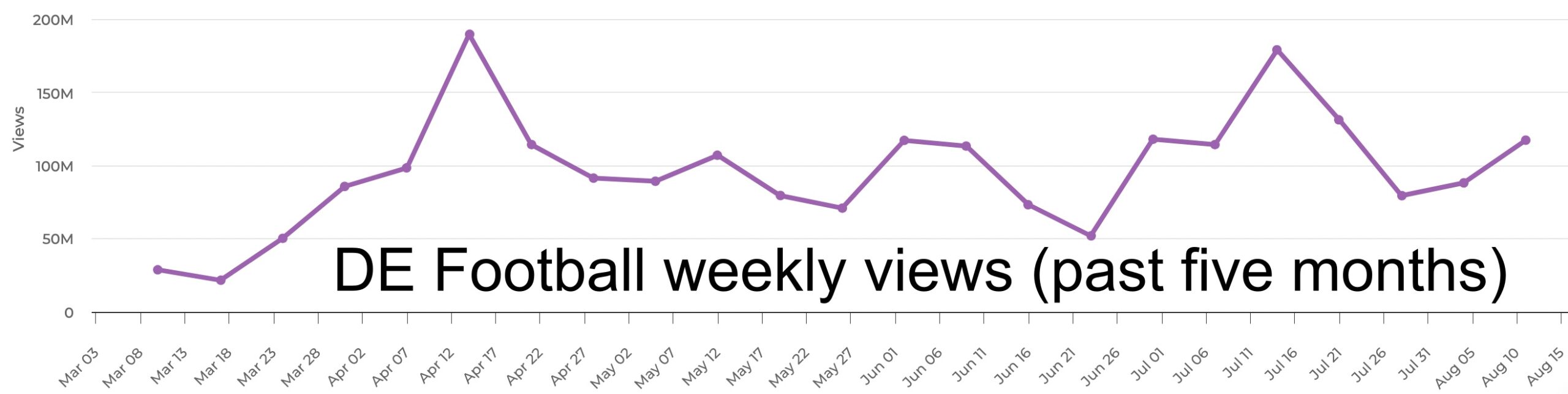
The combination of short-form trends and real-life sports figures is not just a cricket thing. It’s also showing up in the world of soccer thanks to channels like DE Football. Again, to the best of my knowledge, rivals Cristiano Ronaldo and Lionel Messi have never played the red light, green light game from Squid Game, but DE Football puts them in that scenario, and it gets a lot of views and subscribers as a result.

Data via Gospel Stats

With another school year set to start, will these summertime sports trends carry on? It’s hard to imagine that such a bizarre interpretation of real-life sports stories has legs, but stranger things have happened.

At the very least, cricket’s rise as a short-form force is a good bet to have staying power. South Asia is a crucial region for channels that want to break into the Top 50, so even if you’ve never thrown a wicked googly in your life, it might be time to learn the rules of cricket.

Channel Distribution

Here’s a breakdown of the Top 50 Most Viewed channels this week in terms of their countries of origin:

  • India: 16
  • United States: 10
  • Hong Kong: 4
  • Australia: 3
  • Argentina, Mexico, and Spain: 2
  • Bangladesh, Belarus, Brazil, Canada, China, Germany, Italy, Peru, Saudi Arabia, Taiwan, and Vietnam: 1

This week, 34 channels in the Top 50 are primarily active on YouTube Shorts.

As always, keep up to speed with the latest Tubefilter Charts and all our news by subscribing to our newsletter. You’re going to love it. 👉  Newsletter.Tubefilter.com.

Top 50 Most Viewed YouTube Channels Worldwide • Week Of 08/17/2025

[Editor’s Note: Tubefilter Charts is a weekly rankings column from Tubefilter with data provided by GospelStats. It’s exactly what it sounds like; a top number ranking of YouTube channels based on statistics collected within a given time frame. Check out all of our Tubefilter Charts with new installments every week right here.]

Scroll down for this week’s Tubefilter Chart. 👇


Double Date is still #1 in the Global Top 50. The Australian channel, let by a pair of popular couples (more on that in a second) collected 1.74 billion weekly views during the second full week of August. While that was 18% less traffic compared to the previous week, it was still enough to rank first in the world.

Couple channels have occupied spots near the top of our charts ever since YouTube Shorts became a thing. Even within that category, however, Double Date’s success is extraordinary. How does this fearsome foursome pull it off?

Drilling down with a deep dive into Double Date

Australia’s premier couple channel has been at or near the top of our global charts since April, when YouTube became more liberal with the methodology it uses to track short-form viewership. In many cases, Double Date has had more than 1.5 billion weekly views, as is the case this week. It has even moved past the two-billion mark on multiple occasions.

The secret to Double Date’s success involved its four starring cast members. Its videos feature two couples — Cadel and Mia and Jasmin and James — each of which can be found on a popular, self-titled channel. As a matter of fact, this week’s global top five includes Double Date at #1 as well as Cadel and Mia at #2 and Jasmin and James at #4.

That is pure dominance right there, and it shows that YouTube Shorts might be nothing more than a numbers game. In an era when frequent uploads are a must for channels that want to break into the Top 50, having two stars instead of one makes everything a lot easier. That’s one reason why couple channels continue to show up in the Global Top 50.

If two creators on one channel is a productivity hack, then four creators on one channel can be even more prosperous. Maybe that’s why Cadel and Mia seem so eager to have a baby — it would add another number to their ongoing operation.

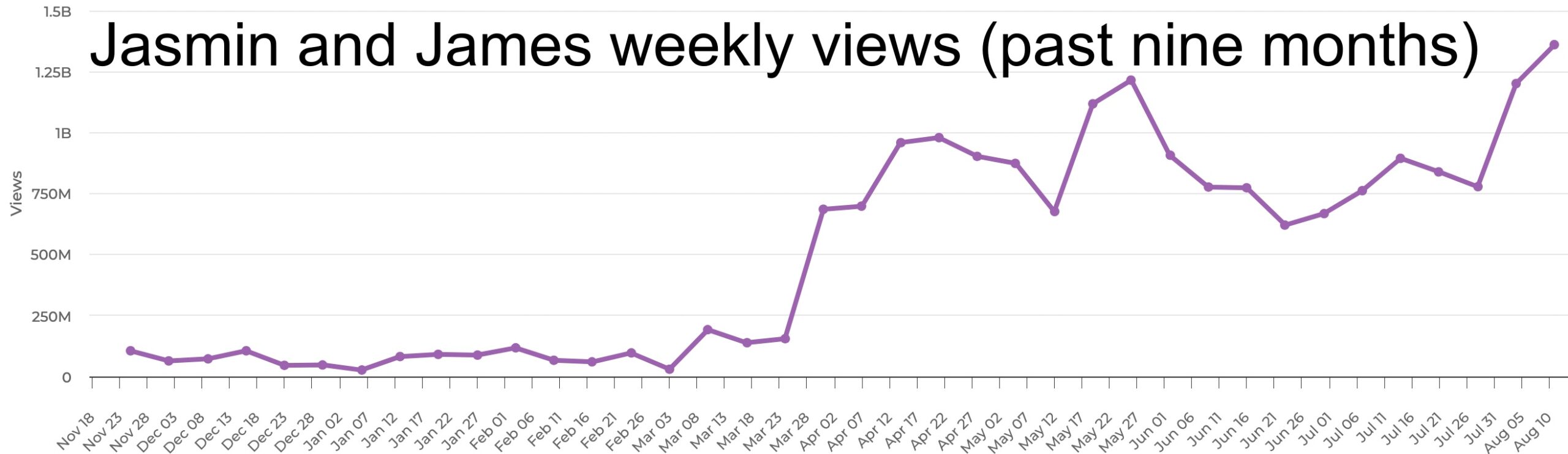
That may be a callous way of looking at things, but when else can you do when couple channels rule YouTube Shorts? When you combine the viewership on Double Date, Cadel and Mia, and Jasmin and James, the paired couples earned more than 4.6 billion YouTube views during the second full week of August. That’s enough traffic to add a unique wrinkle to these relationships.

YouTube’s policies encourage couple creators to crank out videos as quickly as possible. Before the Shorts view-counting change took effect, Jasmin and James hovered around 200 million weekly views on their primary YouTube channel. Then, faster than you can say “abracadabra,” their viewership exploded.

Data via Gospel Stats

As you may have noticed in the video I linked in the previous paragraph, Jasmin and James refer to their subscribers as members of their family. Thanks to their success on YouTube, their chosen family keeps growing — and that bodes well for the continued upward trajectory of their joint venture with Cadel and Mia.

Channel Distribution

Here’s a breakdown of the Top 50 Most Viewed channels this week in terms of their countries of origin:

  • India: 17
  • United States: 10
  • Hong Kong: 4
  • Australia, Canada, China, South Korea, Spain, and Taiwan: 2
  • Bangladesh, Brazil, Egypt, Germany, Indonesia, Japan, and Ukraine: 1

This week, 42 channels in the Top 50 are primarily active on YouTube Shorts.

As always, keep up to speed with the latest Tubefilter Charts and all our news by subscribing to our newsletter. You’re going to love it. 👉  Newsletter.Tubefilter.com.

Webtoon is turning top webcomics into bite-sized anime, hoping to appeal to TikTok audiences

Things are happening in vertical video. Just last week, we wrote about MicroCo, a new startup that thinks it can succeed where Quibi failed if it uses AI to keep production costs low. Then there’s MrBeast, whose plan to sell more of his Moose Toys figures involves an animated series, posted on YouTube in bite-size vertical segments.

Webtoon‘s recently revealed video ambitions are a sort of half-and-half between those two cases, minus any AI involvement. It told Business Insider that to drive more traffic to its top titles, it’s producing short-form adaptations it hopes will appeal to Gen Z.

Webtoon and its sister platform Wattpad have around 150 million users, and between the two of them, they’ve cornered the market on user-uploaded digital novels and comics. Their business plan involves turning those webnovels and comics into official adaptations. But up until now, adaptations have been mostly focused on developing webnovels into comics, and novels and comics into long-form films and TV shows. Short-form, and vertical video, are new.

For this first fleet of short videos, Webtoon picked 14 English-language comics across various genres. Adaptations involve some still images interspersed with full animations, fleshed-out voice acting, sound effects, and music.

Creator Jessica Ramsden (aka Ro-taniah) is among those whose projects were selected for vertical video. Her gay YA series Star Catcher follows closed-off main character Lucas as he finds new love–and new life–at the homey Star Valley University.

Ramsden describes Webtoon’s short-form adaptations as webcomics’ version of anime, and a way to meet people “halfway” if they’re more watchers than readers.

“I know there’s a much broader audience that might not know [Star Catcher] exists because they don’t read comics,” she said. “I love manga, but there’s people who only watch the anime version of it, and this can meet them halfway.”

Ramsden told Business Insider she worked with the Webtoon team on the character design and voice acting, making sure the vertical video version matched what she envisions for her comic.

As for the biz/rights side of this, webcomic creators keep total ownership of their IPs, but share ownership of the video adaptations with Webtoon. With webcomics, Webtoon has a 50/50 ad revenue split with creators, so it’s possible that might end up being the model for video, too.

At launch, though, video adaptations will be ad-free and free to watch, so no revenue is coming in. Webtoon told BI it plans to add advertising to videos in the future.

It’s not clear yet whether Webtoon plans to post adaptations only on its platform, or on platforms like YouTube and TikTok. Either way, vertical video is a strong bid for more engagement–especially engagement with The Youths.

As we said above, this is a sort of middle point between what MicroCo and MrBeast are doing. Webtoon is staunchly anti-AI, so antithetical to MicroCo in that way, but it’s still aiming to appeal to the modern audience with quick-hit content that can stand up to TikTok brainrot attention spans.

And, of course, the ultimate goal here is to drive more traffic, and thus more revenue. Considering how frequently Hollywood looks online for fresh ideas these days, Webtoon’s short adaptations may even garner enough attention to bait big studios into signing longer projects–something it’d no doubt be happy to see.

And the Oscars broadcast goes to…YouTube?

Having failed (for now) to get its stars into the Emmys, YouTube is opting for a different awards season strategy: It’s angling to broadcast the Oscars. According to a report from Bloomberg, Google’s video hub has had conversations with the Academy of Motion Picture Arts and Sciences regarding a deal that would see YouTube supplant Disney/ABC as the official distributor of the Oscars broadcast.

The report cites “two people familiar with the matter,” who claimed that YouTube has inquired with the Academy about the Oscars broadcast rights. The annual film industry ceremony has been broadcast on ABC since 1976, but recent developments have suggested that Disney may forfeit its Oscars rights after its current broadcast deal expires in 2028. Notably, back in March, the exclusive negotiation window between the Academy and ABC lapsed. That means it’s currently open season for Hollywood’s biggest night.

For YouTube, an Oscars broadcast would make sense. The awards show would be another crown jewel for a company that has positioned itself as a modern-day distributor of live events that were previously aired by networks. A notable example of that phenomenon is the NFL Sunday Ticket package, which has helped YouTube become the most-watched platform on U.S. TV screens.

The Oscars would present YouTube with another opportunity to employ the creator-forward marketing strategy it applied to its NFL package. A number of YouTubers, including critic Chris Stuckmann, fraternal horror duo RackaRacka, and Backrooms mastermind Kane Parsons, have directed feature films that have been picked up by notable distributors like A24 and Neon.

As much fun as it would be to see an Oscars ceremony co-hosted by Conan O’Brien and this guy, it’s important to concede that the Oscars are not quite the NFL. While cross-platform Super Bowl viewership has exploded — rising from 84.3 million in 2000 to 123.7 million this year — public interest in the Oscars is flagging. A show that topped 46 million viewers in 2000 dropped to an average of 19.69 million viewers in 2025, even though that ceremony was the first one to be simulcast on the Disney-owned streaming service Hulu.

Even with a move to YouTube, the Academy would face an uphill battle to attract younger viewers who aren’t interested in the arthouse favorites that earn the lion’s share of each year’s Oscar nominations. Or to put it another way: If Disney let its exclusive negotiation window lapse, maybe ABC isn’t as interested in the Oscars as it was between the 1970s and 2010s.

From YouTube’s point of view, a deal with the Academy could still make sense, at least from a marketing standpoint. The video platform wants its homegrown stars to level-up their entertainment careers, and putting them front-and-center on the Oscars red carpet would be one way to further that mission.

YouTube’s new Shorts ads give kudos to creators

When we talk creator/brand collaborations, most of those collaborations consist of creators making content, then posting said content to their own social channels. But what happens when creators make content that doesn’t end up posted on their channels?

This is the problem YouTube is trying to solve for. Its latest ad product is Partnership Ads, a Shorts-only format that co-brands vertical video ads with both creator and brand links.

When sponsored content is posted somewhere other than a creator’s own channel (like, for example, as an ad on YouTube), their personal branding can get lost. Forget links to their channels–viewers might not even know their names. This is an especially prominent problem with short-form content, since UI is limited and what space is available for video descriptions and outlinking URLs usually goes to the sponsoring company, not the creator.

But Partnership Ads give equal billing to creators and brands. On the brand side, YouTube wants Partnership Ads to encourage app downloads, so it offers tappable cards that direct viewers to the Apple Store. On the creator side, their tappable card includes their name, their own short video tagline/description, and a subscribe button.

“The main excitement for creators is around the co-branded format,” a YouTube spokesperson tells Tubefilter. “Before, BrandConnect offered opportunities to connect creators with advertisers, but now this co-branded format will show up, and it’s representing both the creators and advertisers. Now, you can easily connect with the creator and the brand, making it easier for a viewer to find a creator from the ad.”

Partnership Ads were designed to give creators “better visibility,” and YouTube hopes they become “another vector for organic growth,” he adds.

We think this will benefit creators–especially smaller creators who may just be starting out with their first big brand partnerships, or more niche creators who may be well known in one sect of people, but not all. If MrBeast, for example, appeared in an ad that popped up on YouTube Shorts, most people would know who he is and where to find him if they want to watch more of his content. But creators who aren’t the biggest YouTuber on Earth will struggle to capture viewers without prominent and followable attribution.

Partnership Ads are available on iOS now. Android is slated for a future release.

What if Quibi, with AI? MicroCo thinks it can be Hollywood’s minidrama king for cheap

We just said it last week: Quibi had all the components to make bite-sized premium content the next big thing in entertainment. Its elevator pitch was on point: celebrity- and creator-led narratives delivered in Hollywood-polished vertical format, designed for people to watch on the go. And even as Quibi failed, TikTok took off. It was a case of short-form ships passing in the night–except one of those ships paid $100,000/minute to produce its shows, and was waterlogged by a fatal lack of audience preferences.

MicroCo thinks it can do things better…by using AI.

A venture co-launched by Terrifier distributor Cineverse and former ABC, Yahoo, and WME exec Lloyd Braun‘s venture firm Banyan, MicroCo is going all-in on vertical short-form. It’s betting its success on a few key factors, including the aforementioned AI, which it says is essential for keeping production costs low. (“We will make entire shows for what Quibi spent on limos,” Erick Opeka, Cineverse’s President and Chief Strategy Officer, quipped on LinkedIn.)

Braun told The New York Times he and his MicroCo partners see minidramas as “an emerging global format with no clear leader here in the U.S.”

We’re not sure that’s accurate. ReelShort, operated by Sunnyvale, Calif.-based Crazy Maple Studios, has successfully amassed an audience of over 10 million viewers with its romance minidramas, which it promotes on TikTok and YouTube. In 2023, it produced one of the most popular minidramas across both platforms, The Double Life of My Billionaire Husband. There’s also My Drama, which distributes minidramas from U.S.-based studios like Second Rodeo Productions.

ReelShort’s productions are clearly inspired by Asian minidramas, which also tend to be romances, and have become multibillion-dollar businesses by appealing to viewers of long-form C-dramas and K-dramas, and by capitalizing on the short-form boom.

MicroCo’s aim is to do the same thing here, translating the vibe and appeal of American shows into minidramas. Its Chief Creative Officer is former Warner Bros. exec Susan Rovner, who oversaw development of Ted Lasso, Gossip Girl, The Flash, and more.

Opeka told the Times that MicroCo thinks its content will be “more refined” than other minidrama companies’, and that it can build a viewer experience that is “more consistent with the entertainment experiences Americans are accustomed to.”

That experience includes cliffhanger-heavy episodes, with a formula where each installment will have plot tension with 3 seconds, and a dramatic hook within 23 seconds, MicroCo CEO Jana Winograde said.

While the vast majority of genre TV adheres to certain formulaic elements, the mention of a to-the-second, formulaic timeline combined with generative artificial intelligence is likely to set some people–both creatives and viewers–on edge.

MicroCo didn’t say exactly how it plans to use AI in its production process, but Braun’s Banyan VC has also backed Intelligent Animation, which uses a so-called “AI-assisted” animation process to make videos for around $1,500 a minute.

“With today’s technology, we can tell quality stories at an exceptionally attractive cost,” Braun said.

“Everything will have a human touch, but technology is going where it’s going, and we hope to use it in the best way possible to scale our business and do great storytelling at a reasonable cost,” Winograde added.

Cineverse is currently building the MicroCo app, using the work of over 100 engineers in India.

Have you heard? Super Simple Songs throws “surprise party,” JeromeASF makes money moves, and Jake Shane gets cast.

Each week, we handpick a selection of stories to give you a snapshot of trends, updates, business moves, and more from around the creator industry.

This week, one of YouTube’s biggest kids’ media companies is doing it live, a TikToker is going to the big screen, and a one-time Minecraft star is moving into the world of investing.

Creator commotion

Super Simple Songs is turning its IRL tour into a “surprise party.” With more than 57 billion views on its main YouTube channel, Super Simple Songs is a favorite of young kids (and their overtaxed parents). With a six-city swing through Southern Ontario, Super Simple Songs will host a “surprise party” that will feature the musical stylings of primary star Caitie Classens. The tour kicks off in September.

Not all creator fast food promos are created equal. That’s what Popeye’s found out when it invited streamers to use its foodstuffs to design their ideal plates. Cinna and FaZe Lacy both endured confusing moments after learning that these combos aren’t being listed as actual menu options. Lacy was even spurned when he went to Popeye’s and tried to order his meal for himself. Can I get a side of omegalul with that?

Barber-turned-influencer VicBlends battles recidivism with prison hairstyling school. After getting millions of social media followers, VicBlends is providing a way forward for incarcerated inmates. His barber school is now opening its doors at the Valley State Prison in California. Now there’s a good guy who’s a cut above the rest.

The biz

JeromeASF joins a rising creator investment firm. Once upon a time, Jerome Aceti was one of the biggest names in the Minecraft world. His YouTube channel isn’t as active as it used to be, but he’s making big moves in the investing world by joining HotStart, a VC firm whose partner roster also includes top creators Sasha Pieterse and Marina Mogilko. Members of the HotStart team have already previously helped to start notable entities like Feastables and is looking to invest in more creator-led companies.

Slow Ventures kicks off $60 million creator fund by backing Jonathan Katz-Moses. Earlier this year, early-stage firm Slow announced its plan to target “high-value verticals” through strategic investments in enterprising creators. Katz-Moses, a woodworker who publishes sharp, polished videos, is definitely the type of creator Slow is looking for — and he’s getting $2 million toward his holding company as a result.

Grocery store tourism is surging thanks to TikTok. If you’re the kind of person who likes to live vicariously through the konbini snack hunters of TikTok, good news — you’re contributing to a significant trend in the realm of food and drink.

Pop culture minute

It’s not Wishful Thinking to believe Jake Shane deserves a role in a feature film. The TikToker known for silly reenactments of historical events has been cast in a romantic comedy that is currently in production. Like his new castmates Randall Park, Amita Rao, and Kate Berlant, Shane is repped by UTA.

GSTV is bringing creators to a gas station near you. A campaign themed around road trips will turn social media notables like Tank Sinatra and Paul Virzi into pump-side entertainment. Can you fill it up with premium content, please?

Crunchyroll’s Demon Slayer marathon will make a popular anime free on YouTube. By streaming one episode of the shonen series at a time, Crunchyroll will prepare viewers for an upcoming Demon Slayer movie while taking advantage of YouTube’s promotional potency. If you miss the initial marathon, you can catch VOD versions of the episodes on YouTube for a week.

The ad world

YouTube is going all-in on its exclusive NFL broadcast. Colombian pop star Karol G has been announced as the halftime entertainment for the Brazil-set, season-opening tilt between the Los Angeles Chargers and the Kansas City Chiefs. Here’s hoping this broadcast has fewer technical glitches than Travis Kelce’s previous big moment on YouTube.

Viewture onboards Jellysmack vet to deepen creator partnerships. The firm known for investing in top YouTube talent has brought in Jason Kingston-Brown as its Head of Sales and Creative Strategy. In a LinkedIn post, Kingston-Brown said his new role “will focus on accelerating commercial partnerships, growing our creator pipeline, and supporting more talent to scale on their own terms.”

Members of the beehiiv Media Collective are reaching thousands of subscribers. Newsletter platform beehiiv has provided an update on its effort to support independent journalists. Ryan Broderick’s creator-focused periodical Garbage Day is one of the biggest winners, with more than 100,000 subscribers on board.

The internet is a strange place

“Musical festival” is the new protest code word. If the federal government is going to monitor social media to punish protestors, than those dissidents need to use coded language to talk about their plans. So if you think that Washington, D.C. is suddenly full of live music events, you may be misreading the latest posts.

Miniature Ikea stores are opening up inside of Best Buy locations. I call this one the “blue-and-yellow logo alliance.” Is there room in that team-up for Goodyear, Pokemon, WD-40, or West Virginia University? Inquiring minds want to know.

Anthropic is giving credence to people who think that AI company logos look like buttholes. The evidence is mounting. I mean, just look at this post. It’s very Greendale Community College of them.