Archive for 2025:

Top 50 Most Viewed U.S. YouTube Channels • Week Of 02/09/2025

[Editor’s Note: Tubefilter Charts is a weekly rankings column from Tubefilter with data provided by GospelStats. It’s exactly what it sounds like; a top number ranking of YouTube channels based on statistics collected within a given time frame. Check out all of our Tubefilter Charts with new installments every week right here.]

Scroll down for this week’s Tubefilter Chart. 👇


The past seven days were a busy time for U.S. culture, with the 2025 Grammy Awards and Super Bowl LIX thrusting popular musicians like Kendrick Lamar into the limelight. The result was a week in which channels needed more than 100 million weekly views to crack the U.S. Top 50.

But the channels at the top of the chart are invested in a different form of pop culture: YouTube Shorts trends. Content aggregator Zack D. Films took the top spot in the chart with 549.2 million weekly views, while Toys and Colors rode its library of technicolor kids videos to a second-place finish.

Want to see a magic trick? Lady Gaga just used one to re-enter the U.S. Top 50.

During the Grammys, Lady Gaga premiered a new music video for the song “Abracadabra“. The visuals are vintage Gaga: There are extravagant costumes, backup dancers in suggestive poses, and an overall vibe that mixes high art with high camp.

On YouTube, “Abracadabra” was an instant hit. The track’s official music video has already picked up more than 28 million views only one week after its initial upload date. In total, Gaga got 199.2 million weekly views on her primary YouTube channel. That was enough traffic to bump her up to 18th place in the U.S. Top 50.

“Abracadabra” offers plenty of allusions to the world of illusions, and I wouldn’t be surprised if the video’s themes helped its growth on YouTube. After all, magicians like Justin Flom rank among the biggest draws of YouTube Shorts. In general, magic content seems to do well because kids like magic, and there are a lot of young viewers consuming vertical videos these days.

Case in point: Beyond Lady Gaga, the other musical channels in this week’s U.S. Top 50 compose sing-songy tunes that are meant to be enjoyed as part of an early childhood education. One channel offering nursery rhymes set to music is 123 Andrés, which has been a past riser in our charts of late. Five months ago, its weekly viewership was far below the chart minimum, but that’s hardly the case anymore.
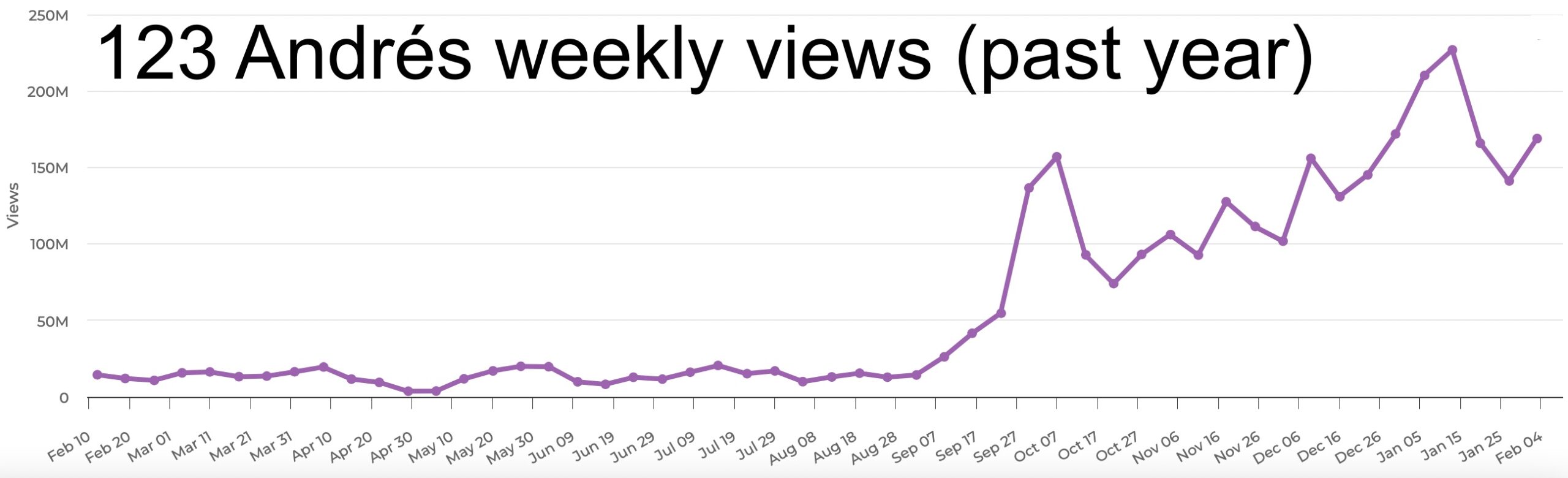
Data via Gospel Stats

Both 123 Andrés and Lady Gaga deserve kudos for their fast starts to the year on YouTube. Gaga’s ascension shows why the Grammys was so eager to feature her new single during its ceremony: Music video premieres are a big deal, and when Gaga-approved costumes are involved, viewers will tune in to see how she shocks them next.

Channel Distribution

This week, there are 39 YouTube Shorts channels in the U.S. Top 50.

As always, keep up to speed with the latest Tubefilter Charts and all our news by subscribing to our newsletter. You’re going to love it. 👉  Newsletter.Tubefilter.com.

Top 50 Most Viewed YouTube Channels Worldwide • Week Of 02/09/2025

[Editor’s Note: Tubefilter Charts is a weekly rankings column from Tubefilter with data provided by GospelStats. It’s exactly what it sounds like; a top number ranking of YouTube channels based on statistics collected within a given time frame. Check out all of our Tubefilter Charts with new installments every week right here.]

Scroll down for this week’s Tubefilter Chart. 👇


This week, T-Series improved its YouTube viewership by 34% week-over-week. The Indian record label collected 927.5 million weekly views in all.

During most weeks, that much traffic is more than enough for YouTube’s all-time most-watched channel to lead our Global Top 50. During the first full week of February, the running order went a bit different, with South Korea’s KIMPRO collecting 1.09 billion weekly views to cruise into the top spot.

KIMPRO isn’t the only Korean channel in the Global Top 50

There are four creators from the East Asian peninsula represented in this week’s ranking, and one of them is part of a minority group in his home country. Hassyl Joon is proud of his identity as a Korean Muslim, and on YouTube, he has found affinity among other followers of Allah.

Compared to other top Korean creators, Joon’s content can be a bit quaint. He doesn’t offer the relationship drama of the typical KIMPRO short, and it’s hard to call his content “comedy” either. His typical YouTube Shorts upload sees him choosing between two options, often as a means of signifying where his religious beliefs fall on the axes of taste and morality.

As Arabic-language content and Indonesian creators bring awareness of Muslim life to viewers around the world, Joon is sharing his Korean perspective on current events. Many of his most-watched Shorts touch upon the conflict between Israel and Palestine, with Joon typically showing solidarity with the area’s Islamic inhabitants.

Videos like these pushed Hassyl Joon’s primary YouTube channel into the Global Top 50 during the first full week of February. His 250.2 million weekly views earned him a 48th-place finish in the worldwide ranking.

Meanwhile, other creators from Muslim countries, such as nurrayni25, are continuing to trend up. Adaptable YouTube formats like the ones used on Joon’s channel have brought those Indonesian channels to the masses. As a side effect of that trend, viewers are getting more experience with Muslim creators.

Data via Gospel Stats

Like in his home country, Joon is still in the minority in the Global Top 50, but he’s part of a growing movement. It’s good to see that Muslim YouTube content is a little more straightforward than some of the Christian stuff we’ve seen on the platform.

Channel Distribution

Here’s a breakdown of the Top 50 Most Viewed channels this week in terms of their countries of origin:

  • India: 16
  • United States: 8
  • South Korea: 4
  • Indonesia: 3
  • Canada, Japan, and Vietnam: 2
  • Argentina, Australia, Belgium, Brazil, China, El Salvador, Hong Kong, Kazakhstan, Mexico, Norway, Pakistan, Russia, and Spain: 1

This week, 34 channels in the Top 50 are primarily active on YouTube Shorts.

As always, keep up to speed with the latest Tubefilter Charts and all our news by subscribing to our newsletter. You’re going to love it. 👉  Newsletter.Tubefilter.com.

On the Podcast: YouTube had a fantastic 2024, 2025 will be good, and 2026 is going to be great

FYI, Tubefilter has a podcast.

It’s hosted by our very own Joshua Cohen (that’s me) and Lauren Schnipper. Subscribe to Creator Upload on Apple Podcasts, Spotify, or wherever you listen.

This week’s episode is sponsored by creator membership software Memberful.


Alphabet recently reported YouTube’s Q4 2024 advertising revenue topped out at $10.473 billion. It’s the first time the world’s largest video sharing site’s ad figures have hit eight figures in a single quarter. Political spending in an election year along with changing consumer behaviors – plus being in the market for 20 years now – all contributed to the number.  YouTube also hit its highest ever annual revenues of $36.147 billion. Let’s just bullet point all these revenues out since 2017 (which was the earliest year for which Alphabet broke out YouTube revenues into their own line item) so that we can all put that changing-consumer-behaviors and 20-years-in-the-market into perspective.

Here are the YouTube advertising revenues by year along with their annual percent increases. All dollar figures in billions:

  • 2017: $8.15 billion
  • 2018: $11.16 billion //+36.93%
  • 2019: $15.15 billion // +35.75%
  • 2020: $19.722 billion // +30.21%
  • 2021: $28.845 billion // +46.24%
  • 2022: $29.243 billion // +1.38%
  • 2023: $31.510 billion // +7.75%
  • 2024: $36.147 billion // +14.72%

In eight years, YouTube advertising revenues have increased 343.52%. If you want to break that down annually it comes out to +23.71% per year. Whether or not it can maintain that kind of growth moving forward is uncertain, but what’s perfectly clear is that number will continue to rise in 2025. I think it’s going to really take off in 2026. Here’s the rationale:

  • 2024 – This was the year everyone with an advertising budget became familiar with the term “creator” and started asking questions like, “WTF are we doing with them?” Whether or not you previously invested in creators or platforms with creators on them, this once-newfangled kind of celebrity you could shrug off or pretend to not understand suddenly became a cultural staple almost two decades in the making. There are innumerable examples of how this manifested. Two of my favorites are CMO mecca Cannes Lion adopting a creator track (of which Tubefilter is an official media partner) and Kai Cenat inking a deal with Nike.
  • 2025 – This will be the year when those brands without a creator strategy will implement one and those brands with a creator strategy will invest more into it. At the same time, all those brands will see they’re getting positive results from these strategies while the reach and cultural relevancy of marketing on traditional media outlets  will continue to decline (outside of live sports, which are playing a whole other ball game).
  • 2026 – This is when things are really going to start to 🚀. In 2024 everyone found out about creators. In 2025 everyone either invested for the first time or invested more into creators. In 2026 they’re going to dramatically increase those investments due to positive results and the continued change in consumer behavior away from traditional entertainment outlets. All social platforms will benefit – and so will creators and those around them because of increased interest and output in aligning with creators via influencer marketing campaigns, products, and more – but the big overall winner is going to be YouTube as it continues its path towards living room, cultural, and entertainment industry domination.

What do you think? Pretty logical reasoning, right? Thank you, I know. I get into all this and more with my co-host Lauren Schnipper in the latest installment of Creator Upload. She agrees with me, too. Hear it for yourself on Apple Podcasts, Spotify, or whenever you listen. You’re gonna dig it.


Memberful is a best-in-class membership software that empowers creators to build customized membership businesses. Creators can generate reliable recurring revenue, all while fostering meaningful connections with their audiences. Get started for free, no credit card required.

Top 5 Branded Videos of the Week: Podcasts, super glue, and NASA’s big plans

Welcome to our rundown of the most-watched branded YouTube videos of the week.

We’re publishing this snippet of a larger Gospel Stats Weekly Brand Report in order to analyze sponsorship trends in the creator economy. Any video launched in tandem with an official brand partner is eligible for the ranking.

And – as the name up above would imply – all the data comes from Gospel Stats. If you’re interested in learning more about Gospel – and which brands are sponsoring what creators on YouTube – click here.


Podcasters are having a moment in the White House right now–and over on YouTube, too. Around this time last year, we saw a spike in podcast viewership right before the Super Bowl, with the Kelce brothers‘ podcast New Heights regularly hitting the top 5 in our Gospel Stats Weekly Brand Report. This year, instead of sportsball podcasts, it’s entertainment and political shows, with a dash of our usual science suspects.

Check ’em all out right here:

#1 Katt Williams | This Past Weekend w/ Theo Von #558
Channel: Theo Von
Brand: Celsius, PrizePicks, Moonpay, Tecovas, Blinds, Manscaped
Views: 9,034,435

Theo Von is among the contingent of podcasters who were tapped for Trump‘s pre-election press run–and since Trump was elected, he’s enjoyed a somewhat privileged place in the right-wing community. His viewership on YouTube has steadily increased since November, and with this latest episode–guest-starring stand-up comedian and actor Katt Williams–he’s officially at spot #1 for the week. The video has so far brought over 9 million views for sponsors Celsius, PrizePicks, Moonpay, Tecovas, Blinds, and Manscaped, all of which frequently pay for space on podcasts.

#2 Why Super Glue Is Perfect For Gluing Skin
Channel: Veritasium
Brand: Brilliant
Views: 8,202,365

We’ve all been warned at some point in our lives: Don’t get super glue on your skin. But are there circumstances where you may actually want to use it? Veritasium dives in this week, and (without spoiling too much) it turns out that, yes–super glue can be a viable medical tool. If you’re in a pinch with no bandages, a wound that’s not too deep, and a bottle of super glue, it might be worth a shot. As for why, that’s where we’ll let Veritasium steps in. His explanation is sponsored by frequent partner Brilliant and is all science-based, breaking down the chemical properties of super glue, how it works, and why it could save a life.

#3 KT#702 – SHANE GILLIS + MARK NORMAND + ARI SHAFFIR
Channel: Kill Tony
Brand: Shopify
Views: 4,080,153

Kill Tony is our second podcast to make the top 5 this week. This live-filmed show puts together a smorgasbord of stand-up comedians each week, and this week’s lineup–sponsored by Shopify–includes two hours of riffing from Shane Gillis, Mark Normand, Ari Shaffir, Kam Patterson, William Montgomery, Ari Matti, Hans Kim, D Madness, Michael A. Gonzales, Jon Deas, Matthew Muehling, Joe White, Kristie Nova, Yoni, Troy Conrad, Tony Hinchcliffe, and Brian Redban. Shopify also sponsored eight other videos this week, including an episode of the podcast Bad Friends.

#4 What’s the Hardest Year of College?
Channel: Gohar Khan
Brand: Notion
Views: 4,006,041

Something pretty rare in spot #4: a Short. Gohar Khan‘s video is essentially a 35-second ad for workspace app Notion, where he walks through how the service’s tools can help college students at different stages. Freshmen need help tracking their busy schedules, sophomores need to organize more notes for harder classes, juniors are trying to track internship applications, and seniors are tying up loose ends while applying for jobs. Khan’s not wrong about any of it, but the video isn’t super in-depth; most of the chatter about it is driven by people sharing their college experiences in the comments. We’d be curious to see what Notion’s click-through rate was here…

BONUS #492 NASA’s Plan to Build Cloud City On Venus (and other questions)
Channel: Joe Scott
Brand: Nebula
Views: 215,277

Creator-owned streaming service Nebula continues to grow and continues to be a one of the biggest sponsors of edutainment content on YouTube. This week it sponsored nearly 20 videos–including this one from Joe Scott, who describes himself as a “curator of interestingness” and a “purveyor of fine science.” It’s a 31-minute rundown of top-asked questions from Scott’s science-minded community, including whether NASA could actually build a “cloud city” on Venus, how terraforming alien planets would work, whether an EMP would knock out home electronics, and the mysteries of the Mayan calendar.


…and there’s a lot more data where that came from. If you’re interested in learning more about Gospel – and which brands are sponsoring what creators on YouTube – click here.

MrBeast’s Moose Toys line is already a bestseller. Now it’s getting its own animated shorts.

This fall, MrBeast‘s toys are getting a lore drop.

Thanks to a partnership with Moose Toys and production house Stoopid Buddy Stoodios, the MrBeast Labs toy line will expand through a series of animated shorts. The videos, which are due to arrive later this year, will build a narrative around the characters that began to arrive on retail shelves ahead of the 2024 holiday season.

The color-changing Mutators were among the first toys to come out of MrBeast Labs, the venture that got a boost from the partnership between MrBeast and Moose Toys. Upon their debut, the Mutators and other MrBeast Labs toys promptly became bestsellers. Last holiday season, Moose Toys announced that the MrBeast Labs Mutators were the top-selling toy line in the Action Figure supercategory in both September and October, per data from Circana.

Beyond the Mutators, another piece of the MrBeast Labs line is the micro-collectibles known as Swarms. The forthcoming Shorts will introduce new toys called Hybrid Beasts, pitting MrBeast items against an enemy known as the “Shroud.”

“This is the perfect moment to take the MrBeast Lab world to the next level with animation,” said MrBeast Industries CEO Jeffrey Housenbold in a statement. “It’s an exciting new way for fans to dive deeper into the adventure and experience the world like never before.”

MrBeast is not the first creator to harness the popularity of animated storytelling on platforms like YouTube Shorts. Bonkers Toys, which has produced retail items based on the viral Skibidi Toilet universe, used fan-made content to tell stories that put its toys front-and-center.

Given his week-to-week dominance of our charts, MrBeast clearly knows a thing or two when it comes to short-form production. For this particular project, Jimmy Donaldson is getting assists from two firms that have plenty of digital media experience. Moose Toys has entered into partnerships with several high-profile creators, while Stoopid Buddy Stoodios — the company co-founded by Seth Green and responsible for his Adult Swim classic Robot Chicken — has teamed up with a wide range of media companies, including Vimeo, EA Sports, and Crackle.

Thanks to Donaldson’s massive following of more than 360 million YouTube subscribers, his animated toy videos will get a leg up once they’re cooked up in the MrBeast Lab. According to a press release, “explosive storylines” are on the way. We’ll just have to wait until the fall to see them.

Are minidrama studios using TikTok to do what Quibi couldn’t?

We’re in a new age of soap opera–one where all the drama, romance, and secret twin and/or baby reveals are packed into just 60 or 90 seconds of content posted on platforms like TikTok, YouTube Shorts, and Instagram.

Much akin to livestreamed shopping, which has become a dominant ecommerce force in China but is just catching on in the West, minidramas have been around on Chinese social media since 2018. These series have historically been produced by Chinese studios, and have classic, tropey plotlines like fake marriages and falling for the bad boy.

Per Bloomberg, early drivers were companies like Tencent and Kuaishou Technology. Their business model? Produce bite-size episodes for smallish five-figure budgets (eat your heart out, Quibi), distribute a few of them on social media sites like TikTok’s sister app Douyin, then redirect viewers to their own apps to watch their full slates of programming.

These minidrama series (which can be single-episode one-shots that tell a complete story in a minute or a half, or can span dozens of episodes like TV soaps) have become wildly popular in China. Studios now produce between 5,000 and 8,000 new minidrama series a year, and Bloomberg reports that thanks to viewer spend and ad revenue, minidrama revenue jumped 35% from 2023 to 2024.

In 2024, the minidrama industry collectively made just shy of $7 billion in China, surpassing the country’s box office earnings.

Some of this revenue growth might also be thanks to Western enthusiasm for the shows. Minidramas found a new audience with American TikTok users over teh past few years, and now have attracted enough attention on the platform that both established Chinese studios and newer U.S.-based studios are eyeballing them as the potential next big thing in digital content.

Established Chinese studios are forming headquarters in the U.S., hiring American production teams and working with local studios to develop shows aimed at engaging U.S. viewers and give series a more Hollywood feel, Bloomberg reports. Dramas from these studios tend to involve actors who are bilingual and speak both English and Chinese, allowing for shows to be filmed in both languages.

Other short-form serialized content companies, like ReelShort, launched in the U.S. and are producing minidramas in English for an American audience. ReelShort is operated by Sunnyvale, Calif.-based Crazy Maple Studios, and says it has more than 10 million users watching in the U.S. It’s currently expanding into Latin America, Europe, and the Asia-Pacific region, and is building a library of shows in 16 languages.

It produced one of the most popular minidramas on TikTok and YouTube in 2023, The Double Life of My Billionaire Husband. The first part of the series has over 22 million views on YouTube.

“I see mini dramas becoming a dominant form of entertainment, potentially even outpacing the traditional film market in a few years,” Joey Jia, ReelShort’s CEO, told Bloomberg.

Is ReelShort what Quibi aspired to be? Can minidramas truly take off with U.S. viewers? That remains to be seen—but both Eastern and Western studios are betting big money on it.

Roblox paid creators almost $1 billion in 2024

Despite Meta pouring billions of dollars into an attempt to become the world’s #1 metaverse hub, Roblox and Fortnite continue to outclass it. Both games rely on a steady stream of new digital items from content creators–and are willing to pay those creators for what they make (and sell).

Fortnite just reported that it paid creators $352 million over the course of 2024. Now here comes Roblox to dwarf that amount: During its latest earnings call, it revealed that it paid creators $280 million in Q4 alone, bringing it to a total of nearly $930 million paid out in 2024.

“We are continuously investing in growing our economy to further expand opportunities for creators, from professional studios to individual content creators, digital clothing designers and brands–already estimated at nearly 18,000 full-time job equivalents just in the U.S. between 2017 and 2023,” Matt Curtis, Roblox‘s VP of Developer Relations, said on the call.

Higher creator earnings from Roblox can be at least partially attributed to the one key difference between it and Fortnite: Fortnite started as a battle royale game (a competitor for something like Apex Legends) where all assets were developed by owner Epic Games. It only later graduated to having independent game developers make their own content on its sandbox mode Fortnite Creative.

Roblox, on the other hand, does not have a core in-house-developed game. It’s always been a platform for developers to create their own games and digital assets. That business model set it up for a pursuit of the metaverse–and to be a major contributor to the $250 billion creator economy.

Roblox takes a 30% cut of developers’ sales through its platform, so increasing creator earnings means increasing earnings for it, too.

Its Q4 revenue was $988.2 million, up 32% year-over-year. It also saw a 19% year-over-year increase in monthly active players, and now sits at 18.9 million.

As for how much time players are spending within creators’ Roblox games, the company said in Q4, it saw 18.7 billion “engaged” hours, up 21% year-over-year.

“Roblox had a strong 2024, driven by our commitment to innovation and community. We’re building a platform that goes beyond technology—it’s about fostering genuine connections. As we aim to support 10% of the global gaming content market, we’ll continue investing in our virtual economy, app performance, and AI-powered discovery and safety, empowering creators and enhancing the user experience,” founder/CEO David Baszucki said in a statement.

Roblox said it expects revenue to increase slightly to between $990 million and just over $1 billion for Q1 2025. We’ll be keeping a close eye on things to see if and how revenue upticks for creators–and whether Roblox really will be the future for creators in the metaverse.

Have you heard? Lilly Singh returns, Emma Chamberlain opens a cafe, and Ikea does the Harlem Shake

Each week, we handpick a selection of stories to give you a snapshot of trends, updates, business moves, and more from around the creator industry. This week, a YouTube legend is back in action, another icon is celebrating her favorite drink, and a brand is testing the limits of the phrase “better late than never.”

Creator commotion

Lilly Singh returns to YouTube. A fresh 41-minute vlog catches in the midst of a deep clean. As she discards costumes and other relics of the Superwoman era, the former YouTube comedy queen promised viewers that she will continue to keep in touch, even if it won’t be with the skits her 14 million subscribers are used to.

Alex Cooper wants to throw the best Spring Break party ever. The podcast’s media company Unwell is throwing a spring break bash that will take over Miami from March 20-23. I’d imagine that some live Call Her Daddy recordings with enthusiastic crowds wooing in the background could be on the way.

Captain Sparklez is the hottest thing in California real estate. The Minecraft star made headlines when he moved from one Pasadena home to another. The man born Jordan Maron paid $4.5 million for his new digs, so his block-breaking profession must still be going swimmingly.

The biz

Come get your Emma Chamberlain coffee at the vlogger’s cafe. The Chamberlain Coffee location at the Century City Mall is the first IRL foray for Chamberlain’s namesake beverage brand. Don’t worry — a visit to Chamberlain Coffee does not require you to drink as much coffee as what Emma consumes on a daily basis.

YouTubers take over the Pacsun catalog. Speaking of Emma Chamberlain, the retailer that once worked with her is going back into business with creators. Ruby Lyn and Elah Lorde helped Pacsun style its spring 2025 items, which are part of a collection that celebrates digital culture.

Ikea does the Harlem Shake (in 2025). The Swedish retailer says it’s “better late than never” to participate in the hottest trend of 2013. Is this decade-long delay an attempt to concoct rage bait? Is it an earnest piece of nostalgia? Or did it just take 12 years for Ikea to assemble the Harlem Shake at home?

Pop culture minute

Valkyrae was on Pop Culture Jeopardy. There was only one problem. The streamer noted that Jeopardy provided an inaccurate origin story for her screen name. No, Valky’s mom did not come up with her handle, no matter how convincingly Colin Jost claims it.

Avani Gregg goes Hollywood. The short-form star has landed a role in Breathe Deep, a thriller that is expected to begin shooting this summer. Like other creators before her, Gregg is acting in a movie that uses social media as a plot point.

RDCWorld’s response to the Luka Doncic trade was worth the wait. After a deal some have described as the most shocking transaction in NBA history, the basketball world waited to see how Mark Phillips and co. would skewer the one-sided deal. RDCWorld did not disappoint, weaving a multi-scene arc that feels more like a drama than a parody of professional athletes.

The latest tech

The NHL is the latest sports league to get animated. Like tennis’ Australian Open, the world’s top hockey league realized that animated recaps of recent games provide cover for all sorts of licensing issues. I for one can’t wait until all athletes look like Miis.

Google Gemini can now watch videos for you. The generative AI bot will scan through videos, summarize them, and answer any follow-up questions you may have. So, to recap: AI is making videos, watching videos, and responding to videos. Why are us humans even here?

LinkedIn video gets an update. The professional platform is adding analytics, advanced search, and more to its in-house video product. Everyone wants to be the next TikTok — even the place you go to get your skills endorsed.

The internet is a strange place

The stars of Microsoft Excel deserve NIL deals. How quickly can you write a formula or set up a pivot table? If your answer is ‘huh?’ then you’re definitely not ready for the Microsoft Excel world championships. I hear one of the competitors was disqualified for using a performance-enhancing Clippy.

You can still buy makeup even if you’re sad. Beauty brand elf Cosemtics believes that fears about TikTok’s future have affected its bottom line in recent months. Americans may be bummed about the turmoil surrounding the app, but if you want to get your deals on TikTok Shop, now’s the time.

Leave 14-year-old Zendaya alone. The movie star’s first YouTube video goes viral once every few years. I too appreciate the precociousness of Zendaya’s teenage years, but Challengers this ain’t.

Tubi or Not Tubi: Fox offers a choice with $500,000 Super Bowl ads

For Super Bowl LIX broadcaster Fox, a stream airing on Tubi provides a link to new audiences — and an intriguing new opportunity for advertisers.

The 2025 Big Game will be the first one broadcast on a free, ad-supported TV (FAST) platform. Fox’s ownership of Tubi allows it to achieve that milestone while also opening a fresh batch of ad inventory that can meet the demand for Super Bowl commercials.

To dole out that ad space, Fox is offering a discount to potential buyers. As the cost of a linear Super Bowl spot soars as high as $8 million a pop, FAST ads are going for a fraction of the price. Digiday reported that Fox offered up 15-second Tubi spots for as little as $500,000 apiece, with some agencies receiving that offer as late as January 31.

Advertisers have reportedly been eager to accept Fox’s FAST money, so much so that the broadcaster has carved out additional “floater” units to sell. The popularity of the Tubi spots could have benefits for Fox beyond mere revenue. Sports viewers on streaming are typically served the same ads over and over, so the sellout of the Tubi inventory will add some much-needed variety to the platform’s commercial breaks.

The previous two Super Bowls both achieved streaming viewership records, with CBS’ Paramount+ and NBC’s Peacock benefitting from the growing popularity of digital sports broadcasts. Tubi, which launched in 2014 and was acquired by Fox in 2020, is working with its parent company to make sure the good times keep rolling.

“Fox has been doing live sports forever, and they’ve been streaming them on other properties,” Tubi CMO Nicole Parlapiano told Vulture in an interview. “So, a lot of what we have gone through on the tech side has been leveraging that expertise of the Fox Sports tech team. This is what they do all day, every day, and we’ve been working closely to make sure that all that is in place for the Tubi infrastructure.”

But Tubi is more than just Fox’s counterpart to Paramount+ and Peacock. It has cultivated an audience of 97 million monthly active users who are willing to experience commercial interruptions in exchange for free access to popular content. Even before kickoff, the first Super Bowl broadcast in the FAST lane is already showing the potential of ad-supported streaming services. No wonder major players like Netflix are keen to get in on the action.

Australia’s attempt to protect teens blurs the line between social media and entertainment

Last November, the Australian government broke new ground when it passed a law that bans kids under 16 from accessing major social media apps. TikTok, Snapchat, X, and Meta‘s Facebook and Instagram are all targeted by the statute, which threatens offenders with fines if they fail to keep underage users off their respective platforms.

As the law begins to take shape, some Australians are asking a simple question: What about YouTube?

According to a report from Reuters, YouTube was initially included in the social media ban, but the government backed off after protests from executives and creators. YouTube’s proponents argued that it should be exempt because of the educational value it provides. A spokesperson for Communications Minister Michelle Rowland said that the decision to remove YouTube from the ban “matched broad sentiment in the Australian community that YouTube is not a core social media application.”

Academics interviewed by Reuters argued that YouTube poses plenty of danger to Australia’s youth, owing to the prepondrence of extreme and hateful content that, despite YouTube’s efforts, continues to exist on the platform. YouTube has made significant strides in the fight against violative content, but is it any less harmful than contemporaries like TikTok and Instagram?

The answer to that question requires a clear understanding of what does and doesn’t qualify as a social media app. The search for the line between social media and entertainment has erupted into a fierce debate; in 2022, TikTok exec Khartoon Weiss argued that the popular app is akin to an entertainment hub, not a social media service.

The new Australian law shows why Weiss was eager to make that distinction. In a world where social media giants face extensive regulations that aren’t being applied to entertainment companies, entities like TikTok are incentivized to muddle any attempt at classification.

The Australian law won’t go into effect for a year, but it is currently in a trial phase that will determine the enforcement mechanisms that will be used. This pre-enforcement period is the perfect time to determine what actually defines the category of a social media app. It’s an overdue conversation that could pose a challenge to YouTube — especially considering the platform’s impact on youth culture.

China might nix Trump’s TikTok deal. If it does, other platforms will be ready.

At the beginning of his second term as U.S. President, Donald Trump promised to negotiate a deal to keep TikTok running for American users. Though multiple suitors are queuing up for a chance to acquire the app, recent reports indicate that ByteDance might need some more convincing before it agrees to part with its prized possession.

Trump is looking for a deal that would give a U.S.-based entity — whether that be MrBeast or Oracle — 51% ownership of TikTok. The potential TikTok buyers are clear, but ByteDance has never indicated that it would be open to a divestiture deal (even when faced with a “divest-or-ban” law like the one passed in the U.S.)

When Trump proposed his preferred solution shortly after retaking the Oval Office, the Chinese Foreign Ministry insinuated that it would let ByteDance negotiate its own terms with the U.S. government. That was a break from the Chinese Communist Party’s previous rhetoric. When the idea of a TikTok sale was first floated, Chinese leadership indicated its staunch opposition to any U.S.-led TikTok divestiture.

Even if ByteDance is free to do business with the U.S. on its own accord, the Beijing-based tech giant still seems to be deferring to national powers. According to a Washington Post report, ByteDance is looking to the CCP for approval, and the Chinese government has yet to determine whether it wants to sign off on Trump’s proposal. The report claims that authorities in Beijing are willing to let TikTok’s operations cease in the U.S. unless a “grand deal” is proposed.

The U.S.-backed divestiture deal faces a long road ahead unless public sentiment shifts in China. Intense U.S. scrutiny of TikTok CEO Shou Zi Chew turned him into a public hero in China, where he is seen as an iconoclastic figure who is resisting strongarm tactics. That sentiment is still prevalent on Chinese social media, and the national government may prefer to stand up to American bullying rather than keep the lights on at TikTok’s U.S. offices.

If TikTok does in fact go dark, the other major platforms in the social media industry are ready to pick up the scraps. Snapchat CEO Evan Spiegel recently noted that a TikTok ban would likely benefit his company, and YouTube is starting to speculate on the potential failure of the Trump divestiture deal. The Google-affiliated giant is buying TikTok ads to convince creators to jump ship, so that tells you how much faith YouTube has in its rival’s American future.

NASA is taking Twitch viewers into space–and maybe to the moon?

NASA wants more people–especially young people who could participate in future missions–to know how cool space is.

So, to connect with them, it’s hosting a series of events from the International Space Station–all of which will be broadcast live on Twitch, where chatters can talk directly with astronauts living about the station.

NASA has a Twitch channel (with 1.3 million followers!) and has streamed there before, offering real-time peeks into things like launches and maneuvers, plus educational clips. But, as it said in a press release, this new series of streams are the first NASA events “developed specifically for the agency’s Twitch platform.”

During the Feb. 12 stream, viewers will hear from NASA astronauts Don Pettit (a chemical engineer who’s currently aboard the ISS) and Matt Dominick (a U.S. Navy test pilot who recently flew on NASA’s Crew-8 mission, which landed on the ISS in March 2024 and spent 235 days in space).

NASA says Pettit and Dominick will talk about daily life aboard ISS and what sorts of microgravity experiments the astronauts are conducting. “Additionally, the event will highlight ways for Twitch users to engage with NASA, including citizen science projects and science, technology, engineering, and math programs designed to inspire the Artemis Generation,” it said.

“Artemis Generation” refers to the generation of aspiring astronauts who could be part of NASA’s Artemis missions, which are scheduled throughout the latter half of the 2020s and into the 2030s. They’re intended to further explore the moon and the potential for human life on Mars.

It sounds like the event will be part presentation and part Twitch stream, meaning viewers will be able to chat with the astronauts and ask questions, the same way they would with any content creator streaming on the platform.

Interestingly, NASA said it got the idea for these streams by talking to creators at TwitchCon.

“This Twitch event from space is the first of many,” Brittany Brown, Director of NASA’s Office of Communications Digital and Technology Division, said in a statement. “We spoke with digital creators at TwitchCon about their desire for streams designed with their communities in mind, and we listened.”

Considering science education is one of the top content genres in digital video (creators like Veritasium consistently make some of the most-watched videos on YouTube), we’re not surprised NASA is using Twitch to connect with its next generation of space explorers. We’re keen to see what events it develops for its digital audience–and whether those events will spur more interest in NASA jobs.

The stream with Pettit and Dominick will launch Feb. 12 at 11:45 a.m. on NASA’s Twitch channel.