Archive for 2025:

Despite YouTube’s investment in Shorts, viewers are gravitating toward long-form video

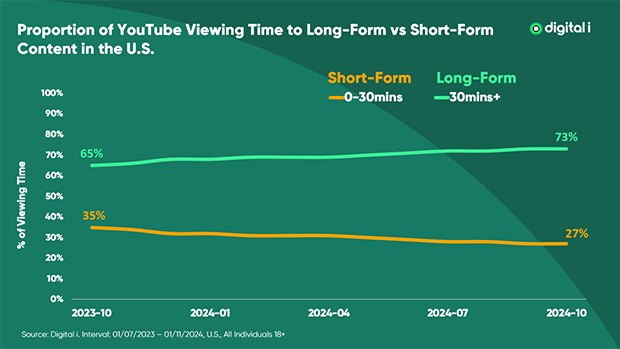
YouTube has invested considerable resources in Shorts, its vertical video format that resembles TikTok. Despite the platform’s priorities, YouTube’s long-form library is drawing more attention from its user base. Recent research found that the average U.S. YouTube viewer now spends 8% more time watching long-form videos compared to October 2023.

That data point comes from Digital i, a British software company that queried American YouTube users over the age of 18 regarding their consumption habits. The survey found that the long-form uptick was accompanied by a slight downturn in short-form viewership. Digital i’s respondents now spend 73% of their YouTube watch time enjoying videos that are more than 30 minutes long. All other videos — including Shorts — shared the other 27%.

These findings are a marked departure from previous viewership trends involving YouTube Shorts. As the platform invited more creators into its Shorts monetization program, observers speculated that the increasing emphasis on TikTok-style content could cannibalize traffic that previously went to long-form videos. Digital i’s research suggests that YouTubers can benefit from spreading themselves across multiple formats, an approach that YouTube has championed for years.

On its face, Digital i’s report makes no distinction between traditional long-form uploads and 30-minute-plus videos that are either live streams or VOD versions of those streams. YouTube has bulked up its streaming operation with a particular focus on the mobile-oriented live broadcasts that Gen Z watches in significant numbers. Over Digital i’s year-long measurement period, its 18-to-24-year-old respondents increased their consumption of long-form content on mobile devices. That figure went up 21% year-over-year.

As with so many studies related to creator content, the results of this research should be taken with a grain of salt. Digital i’s focus on watch time inherently favors long-form content, and Shorts is still growing, even if long-form videos are potentially growing faster.

The rising popularity of long-form YouTube videos may be less pronounced than Digital i makes it out to be, but even if the effect is smaller than what’s demonstrated here, the results are still noteworthy. YouTube Shorts doesn’t seem to be cannibalizing long-form traffic (at least in the U.S.), and the original YouTube format remains the platform’s bread-and-butter.

Creators HQ wants to bring 10,000 content creators to live in Dubai

Last month, 15,000 content creators, 420 speakers, and 125 executives and creator industry experts gathered at Dubai‘s Emirates Towers, the Dubai International Financial Centre, and the Museum of the Future for the third annual 1 Billion Followers Summit.

As part of that event, the organizers behind it unveiled Creators HQ, which Forbes reports is “a full-service institution designed to address every aspect of a content creator’s professional journey.”

Creators HQ is backed by the $40.8 million fund Sheikh Mohammed bin Rashid Al Maktoum, Prime Minister and Vice President of the UAE and ruler of Dubai, announced around this time last year. Dubai has been open about the fact that it wants more creators to move there and make content. Creators HQ is aimed at facilitating that, with a goal of bringing 10,000 new creators to the city.

The initiative will provide creators from outside Dubai with applications for UAE Golden Visas–a type of long-term residential visa that, unlike most, doesn’t require applicants to have a sponsor, and offers benefits like allowing family members and employees to travel and stay with the applicant for the duration of the visa.

Creators HQ also plans to provide relocation support and advice for how creators can set up and register their companies within the UAE, it told Forbes.

As for what programming creators can expect once they’re in Dubai, Creators HQ will host over 300 workshops and events per year on skills like branding, video production, storytelling, audience engagement, monetization strategies, and sponsorships. There will also be creator camps for local youth, plus funding support for up-and-coming creators.

That won’t be the first time Creators HQ has disbursed money to help creators grow; at the 1 Billion Followers Summit, it gave a first-of-its-kind $1 million award to U.K. creator Simon Squibb.

Creators HQ said it has already formed a strategic partnership with Mark Zuckerberg‘s Meta, and together they’ll launch the “Creators for Purpose” program. The program will ask creators to produce upbeat content for distribution across Instagram and Facebook.

While Creators HQ’s main focus is, of course, bringing content creators to Dubai, organizers said they intend to tap more than video-makers. Creators HQ will also look to bring in podcasters, visual artists, marketing firms, media and music producers, animation studios, and fashion and lifestyle brands.

It hopes to expand its portfolio of partnerships beyond Meta, too. Organizers said they want to partner with more tech companies, including streaming platforms, gaming and esports companies, VR and AR developers, and AI startups.


1 Billion Followers Summit is a Tubefilter partner.

February is a big month for influencer sports: Creators are balling out with NBA and NFL stars

If you tune into a major sporting event during the month of February, there’s a good chance you’ll see some creators pop up on the screen. Both the NBA All-Star Game and Super Bowl LIX are right around the corner, and they’ll both feature pregame festivities populated by big-name stars from YouTube, TikTok, Instagram, and Twitch.

The NBA All-Star Celebrity Game, which features a mix of Hollywood stars, influencers, retired athletes, and WNBA hoopers, will feature creator-heavy lineups in 2025. The participant list includes Kai Cenat, who will look to earn his place on the court despite his short stature, and Druski, who has made moves in the sports world since breaking out on Instagram Live.

Even the coaching roster includes some creator clout. One of the assistants on the sideline will be most-followed TikToker Khaby Lame. Though he might not be able to get in the game himself, he nevertheless donned his Michael Jordan jersey and posted a video that shows off his sweet shooting stroke.


View this post on Instagram


A post shared by Khabane Lame (@khaby00)

The Celebrity Game has become more creator-oriented amid a broader wave of collaborations between NBA stars and YouTube hoopers. The annual All-Star Weekend, which will be hosted in San Francisco between February 14-16, 2025, has become a hotspot where many of those collabs are filmed.

The NFL has its own February tradition involving creators. It hosts annual flag football games ahead of the Super Bowl, and the 2025 installment of that format will be headlined by Kai Cenat and iShowSpeed. The complete rosters were just announced, and they include multiple creator participants: Deestroying, Mark Phillips of RDCWorld, and Adam W will play; so too will Khaby Lame, who seems to be everywhere these days.

Creator-related promotions are currently cresting in the sports world as sports leages enter into partnerships to reach new fans online. Depending on who you ask, those deals are either the future of entertainment or a distraction from the game itself. Luckily for basketball fans, the All-Star Weekend is meant to be a distraction, so the participating creators can be as silly as they want.

Snapchat’s growing creator community was one of its biggest assets during Q4 2024

For the second quarter in a row, Snap, Inc. exceeded expectations on its topline numbers. The parent company of Snapchat enjoyed a stock market bump after sharing its Q4 2024 earnings report, which pegged its quarterly revenue at $1.56 billion — slightly higher than projections.

Snap also outpaced Wall Street estimates in terms of its daily active users. It was projected to reach 451.1 million DAUs, but it soared all the way up to 453 million DAUs, which was good for a 9% year-over-year increase.

The growth of Snapchat’s user base has been underpinned by its parent company’s continued investment in creators. The Snap Star revenue program, which pays influencers who post on the platform, is resulting in an increase in total uploads. Snap’s Q4 2024 report noted that the number of creators posting on Snapchat is up 40% year-over-year.

As TikTok has struggled to contend with U.S. regulations, Snap has used its expanding creator ecosystem as a means of attracting displaced TikTokers. It touted content from stars like Avani Gregg and Loren Gray in a campaign that ran during the lead-up to the currently-stayed TikTok ban.

In the earnings report, Snap CEO Evan Spiegel said that disruptions to TikTok’s business could bode well for his company. “I think some of the changes with TikTok, they’ve sort of been an imperfect experiment, so we’re not trying to draw too many conclusions from some of the engagement lift we saw when the app went dark for that brief period of time, I would say that the overall environment of uncertainty is benefiting our business,” he explained. “I mean, certainly advertisers are very focused on contingency planning and diversifying their spend, and I think the same goes for creators who are really thinking hard about how they can build the most diversified engagement with their fan base across various platforms, including Snapchat. So a big priority for us is really just helping make sure we support advertisers and creators during this period of uncertainty.”

Even if TikTok is able to salvage its U.S. operations, Snap will still enter 2025 in a much better place than where its 2024 began. By investing in a “simplified version of Snapchat,” the app has now produced strong results for consecutive quarters. Add it all up, and Snap expects to reach 459 million daily active users by the end of Q1 2025.

Rooster Teeth is back–with original co-founder Burnie Burns at the helm

Rooster Teeth is back.

Almost exactly a year ago, the Austin-based media company–responsible for some of the internet’s earliest and most well-known digital video brands, plus major Western animes like RWBY and gen:LOCK–announced its closure after 21 years of operation.

“Since inheriting ownership and control of Rooster Teeth from AT&T following its acquisition of TimeWarner, Warner Bros. Discovery continued its investment in our company, content and community,” Rooster Teeth’s former General Manager, Jordan Levin, said at the time. “Now however, it’s with a heavy heart I announce that Rooster Teeth is shutting down due to challenges facing digital media resulting from fundamental shifts in consumer behavior and monetization across platforms, advertising, and patronage.”

The closure laid off 150 staff plus dozens of contractors and freelancers, and put an end to a company that helped shape digital media, especially on YouTube.

But now, original co-founder Burnie Burns and his studio Box Canyon Productions have acquired the Rooster Teeth brand “and much of its remaining assets,” with plans to relaunch a new slate of programming this year.

This is the first time in over a decade that Rooster Teeth will be owned by its original creators. Prior to its closure, it underwent a tangled changing of hands: It was acquired by multichannel network Fullscreen in 2014. Fullscreen was then acquired by Otter Media–a joint venture between AT&T and The Chernin Group–in 2018. Later that same year, AT&T bought out Chernin’s stake in Otter and folded Rooster Teeth into WarnerMedia, which was spun off into its own entity in 2021 and then merged with Discovery in 2022, resulting in the creation of Rooster Teeth’s final corporate owner, Warner Bros. Discovery, Inc.

“I am excited at the challenge of bringing Rooster Teeth back to its roots,” Burns said in a press release posted to Rooster Teeth’s website (under the company’s original logo.) “The heart of this brand has always been its fans, and I look forward to writing a new chapter together.”

He gave additional details in an episode of Morning Somewhere, the podcast he runs with his wife Ashley Burns, who founded Rooster Teeth’s news division The Know. So far, they are the only staffers on board for the revival, and he is also the only original co-founder (the others were Joel Heyman, Matt Hullum, Geoff Ramsey, Jason Saldaña, and Gus Sorola) to return. In the episode, he asked that fans not question other co-founders about whether or not they’ll join the revamped venture.

The Rooster Teeth assets Burns has acquired include the brand itself, some of its owned YouTube channels, its social media accounts, and “some of [its] classic shows.”

However, he has not acquired rights to Rooster Teeth spinoffs like Achievement Hunter or FunHaus, nor to RWBY, which is owned by Viz Media. It’s not clear if Box Canyon Productions now owns gen:LOCK, or if it will revamp Rooster Teeth’s longtime annual convention, RTX.

“As an early pioneer of online video content, Rooster Teeth set the standard for how fan-first entertainment could thrive in the digital age,” Rooster Teeth said in a press release. “With Burns back at the helm, fans can anticipate a renewed dedication to Rooster Teeth’s original mission: to entertain, inspire, and connect.”

YouTube revenue shines as Alphabet earnings falter amid DeepSeek’s Big Tech upheaval

Chinese tech firms are bringing widespread turmoil to the U.S. market, and one of the world’s biggest companies is feeling the squeeze. Alphabet stocks initially dropped by 6% after the parent company of Google fell short of projections for the fourth quarter of 2024.

YouTube, however, was a bright spot for the Mountain View-based giant. The video platform maintained its momentum from the third quarter by accounting for $10.5 billion of ad revenue. It’s the first time YouTube has ever pushed that number beyond $10 billion in a single quarter.

Much of YouTube’s growth has been driven by its acceleration on TV screens, where it now gets more than 10% of all watch time to lead all platforms. During the Q4 2024 earnings call, Google Chief Business Officer Philipp Schindler identified the U.S. presidential election as another factor in YouTube’s ascendance. Political content on both sides of the aisle spiked ahead of November — perhaps that data point explains why YouTube has slackened its policy on election denialism and other forms of misinformation.

In other areas of Alphabet’s business, the picture is cloudier. U.S. tech companies are still figuring out how the rise of DeepSeek — an open-source chatbot that runs more efficiently than big-name competitors like ChatGPT — will affect American AI development.

DeepSeek’s presence has created chaos in the U.S. market, but Google CEO Sundar Pichai still sees some advantages for brand-name solutions like Google Gemini. “Our results show the power of our differentiated full-stack approach to AI innovation and the continued strength of our core businesses,” he said. “We are confident about the opportunities ahead, and to accelerate our progress, we expect to invest approximately $75 billion in capital expenditures in 2025.”

New initiatives, such as the CAA partnership that protects YouTube creators from deepfakes, show how Google can use its wealth of resources to stay competitive in AI. If TikTok is banned for U.S. users, that would likely provide an additional boost for Alphabet. But even if the social media status quo survives for another quarter, YouTube will still get opportunities to solidify its all-star status. The upcoming Super Bowl will remind viewers about YouTube’s distribution of the NFL Sunday Ticket package, and that could easily translate into more YouTube TV subscribers.

Creators are ruling Super Bowl advertising. Doritos brought back a classic contest to get in on the fun.

Super Bowl LIX is just days away, and advertisers are gearing up for one of their industry’s biggest moments of the year. One notable campaign is coming from Doritos, which brought back its Crash The Super Bowl contest to crowdsource its Big Game spot.

A decade ago, Crash The Super Bowl was an annual tradition that injected a bit of user-generated content into a Super Bowl ad landscape dominated by major agencies. At the time, platforms like YouTube were just beginning to explore their potential as Big Game commercial distributors. YouTube’s main vehicle driving that strategy is its AdBlitz hub, which has returned once again to showcase all of the paid media that’s set to air during Super Bowl LIX.

Doritos is bringing back Crash The Super Bowl during a marketing era that’s very different from 2014. Creators have become common sights among the celebrity testimonials that air during the game. That trend is only expected to become more prominent in 2025, with several advertisers lining up influencers for their multi-million dollar spots.

To keep up, Doritos parents PepsiCo and Frito-Lay are celebrating the ingenuity of football-loving Americans. The brands announced three semifinalists for the contest last month, with each submission showing off the goofy, fun tone that has become a hallmark of Doritos’ Super Bowl advertising.

“Crash the Super Bowl’s legacy has always been about Doritos being fans of its fans,” said PepsiCo North America SVP of Marketing Tina Mahal. “These three final commercials remind us that when a brand puts the fate of its biggest advertising moment of the year in the fans’ hands, incredible moments can happen.”

The winning ad, ‘Abduction‘, comes from director Dylan Bradshaw and content creator Nate Norvell. It’s a clever piece of crowdsourced art that satisfies the demands of current trends. Companies like Tongal have helped bring crowdsourcing into major Hollywood productions, and the masses are once again contributing to Super Bowl ads as well.

At this point, the attention ‘Abduction’ receives during the Super Bowl is almost beside the point. Doritos is turning to creators because it wants to ride the digital hype machine. Once upon a time, the captive TV audience was a bigger consideration for these brands, but those days seem to be long gone.

Top 100 Most Subscribed YouTube Channels Worldwide • January 2025

[Tubefilter Charts is a periodic rankings column from Tubefilter with data provided by GospelStats. It’s exactly what it sounds like: a top number ranking of YouTube channels based on statistics collected within a given time frame. We use data directly from YouTube and in terms of subscribers, YouTube rounds that data to the first three significant figures. Check out all of our Tubefilter Charts with new installments every week right here.] 

Scroll down for analysis and then this week’s Tubefilter Chart. 👇


MrBeast started 2025 with an absolutely titanic month, at least from the statistical perspective. The rich got richer as the most-subscribed creator on YouTube added 13 million new subscribers at the start of the year.

The other success stories populating the Global Top 100 are not quite as prodigious as MrBeast, but they are scoring strong viewership, sometimes within niches that have not traditionally thrived on YouTube. In particular, holy men are starting to find their way to the top of the charts.

YouTube Shorts viewers are keeping the faith

Jesus Christ has shown up in our worldwide rankings in the past, but those videos had more in common with Gen Alpha memes than they did with common worship. For the latest religious stars of YouTube Shorts, however, the doctrine is the message, and the internet is the hot new megaphone.

The first of those YouTube-based leaders is Bispo Bruno Leonardo, who has become a star in his native Brazil thanks to the passionate sermons he delivers through his São Paulo-based World Revival Baptist Church. On YouTube Shorts, Leonardo has uploaded snippets of his speeches, delivering an internet-based version of televangelism.

That strategy led Leonardo to a fifth-place finish in the Global Top 100 for January 2025. He got 4.7 million new subscribers during the month, bringing his lifetime total up to 44.5 million on his primary channel. That’s a lot of congregation members who are hanging onto every word Leonardo uploads.

Then there’s Bapuji Dashrathbhai Patel, a spiritual leader from India who also cracked this month’s Global Top 100. Patel is broadcasting his message of peace across the world, and his 3.7 million subscribers are praising him and his beliefs. After getting only a few thousand subscribers per week throughout much of 2024, Patel exploded at the end of the year to reach his current high point (57th place in the Global Top 100).

Data via Gospel Stats

An odd channel called Camina con Jesus is also in the Top 100, so there’s still room for religious content that is tuned to the desires of the YouTube audience. The creators taking a more traditional approach are hoping to reach young, faithful people through social media — and so far, it’s working.

Channel Distribution

Here’s a breakdown of the Top 100 Most Subscribed channels this month in terms of their countries of origin:

  • India: 20
  • United States: 19
  • Hong Kong: 8
  • Mexico: 7
  • Brazil: 5
  • Indonesia, Spain, South Korea, and Vietnam: 4
  • Argentina and Japan: 3
  • China and Thailand: 2
  • Bangladesh, Belarus, Belgium, Canada, Ecuador, Egypt, El Salvador, Italy, Kazakhstan, Lativa, Norway, Pakistan, Peru, Ukraine, and United Kingdom: 1

This month, 75 channels in the Top 100 are primarily active on YouTube Shorts.

As always, keep up to speed with the latest Tubefilter Charts and all our news by subscribing to our newsletter. You’re going to love it. 👉  Newsletter.Tubefilter.com.

YouTube wants creators and fans closer than ever with its new Communities update

Sharp-eyed YouTube users might have spotted some changes to channel this week. The “Community” tab, where creators could publish text posts, has been renamed “Posts.”

But that small change is due to a much bigger one–a change that’s part of YouTube’s ongoing efforts to introduce more space for fans to interact with creators.

YouTube has put a big spotlight on fandom over the past year or so, recognizing that giving creators multiple ways to engage with fans plays a significant role in keeping audiences strong.

And it scrapped the “Community” name for text posts because it just introduced Communities–a new, dedicated hub where creators and their viewers “can start and join conversations, share updates, and build relationships,” YouTube said in an update.

For the first time, creators and fans have a single, two-way space where they can share things like fanart, posts from other social media sites, and forum-style thoughts. It gets YouTube closer to the immediate creator-fan interaction offered by livestream platforms like Twitch and microblogging platforms like X (formerly Twitter). Creators can get direct feedback from their viewers, and viewers can not only interact with one another, but maybe even get some one-on-one chat time with their favorite YouTubers.

“We’ve been testing Communities with a small group of creators and have heard positive feedback, which is why we’re excited to keep expanding access,” YouTube said.

One of those test creators is Animal Crossing YouTuber @froggycrossing, who said, “Since I started using Communities, I’ve seen heartwarming connections between my viewers that wouldn’t have been possible otherwise. It’s such an awesome space for my audience to connect with each other and me in a more personal way–all right on YouTube! My Community makes it easy to keep my audience engaged, and I love that it’s a safe and wholesome place for them to hang out and get to know me and each other. Communities have definitely helped strengthen my channel and my personal brand and I’m so excited to have a dedicated space on YouTube to build deeper connections with my audience.”

These tools could encourage creators to keep more of their interactions with fans within YouTube, instead of community-building on discussion sites/services like Reddit and Discord or using third-party platforms like Patreon or Ko-fi to set up subscriptions that offer extra content and face time.

Although, speaking of subscriptions, while we here at Tubefilter were scoping out the new Communities (which for now are only accessible on mobile), we also noticed some creators have a shelf on their channels where they can spotlight specific Channel Members. A YouTube spokesperson confirms this is also a recently introduced feature–and, again, is one which helps foster that crucial fan-creator relationship.

“We are focused on community-building features to help creators connect with their fans in more powerful ways and to foster a sense of belonging,” the spokesperson says.

Creators are paying way more at tax time than they should be. Here’s how to fix that.

April is coming up fast, which means taxes are top of mind for many content creators. But what they really should be doing is thinking about taxes all year long.

Now, we said thinking. We didn’t say stressing. Don’t get us wrong, though: taxes are stressful, especially for content creators. There are a couple reasons for that.

First, the majority of people who post videos on YouTube, TikTok, Reels, Facebook, or Snapchat don’t expect to suddenly start making hundreds of thousands of dollars from them–but that does happen, and thanks to the growth of social media and the maturation of the creator economy, it’s happening more frequently.

Second, all that money is taxable at self-employment rates, but platforms like YouTube and TikTok aren’t taking taxes out for creators. That means creators themselves have to correctly calculate how much their taxes will be and save that amount from each of their monthly content paychecks. Oh, and self-employment tax? It’s pricey: an extra 15.3% of what creators are making, on top of their usual federal and state taxes.

And those are just the basic struggles. Things get extra complicated when it comes to paying editors, hiring talent managers, paying production costs, and maybe even taking on investment.

To get a foothold on all this, creators should be planning ahead throughout the year–but even if they haven’t, there are some things they should know before filing their 2024 taxes.

Pro creators need accountants who understand our industry

Nate Coughran, a CPA with 12 years of experience and founder of tax and accounting creator services company Cookie Finance, is here to give us the lowdown.

“We are an accounting firm that was built specifically for content creators and influencers,” Coughran tells Tubefilter. “We provide the full suite of accounting and tax services, monthly bookkeeping, quarterly taxes, end-of-year taxes, and really being like a fractional CFO to our content creators.

“The whole point of the company was to provide that financial peace of mind to creators,” he adds. “This is scary stuff, and I know it can cause so much stress and anxiety. We’re here to provide that financial peace of mind to them.”

Coughran started Cookie Finance in 2023 after seeing the trouble his two sisters-in-law–both content creators–were going through while trying to get local accountants to do their creator taxes. He realized they needed specific help from someone who not only understands taxes, but the creator industry.

Now, Cookie has 16 CPAs on staff, works with hundreds of creator clients, and is expanding into Canada to help creators there, too.

Coughran’s #1 piece of tax advice for creators?

Start deducting more.

Traveling somewhere for a video? Deduct your plane tickets, rental car, hotel room, and other costs. Are you a culinary creator? Deduct all the food you buy for recipes and/or all the meals you film while eating out. Fashion vlogger? Deduct your clothes. Beauty? That’s right–your cosmetics are deductible.

Creators can also deduct their home internet costs and their cell phone bills, Coughran says, and can deduct a portion of their rent or mortgage as a home office. Basically anything creators touch in the process of making content can be deducted (but make sure you’re keeping those receipts as proof).

“There’s a ton of little things that really add up quickly to thousands of dollars of deductions,” he says. “Things you already spending money on that can actually be deducted.”

Now, that being said, there are some things creators shouldn’t deduct, like entire cars.

“Probably the biggest question we get is, ‘Can I write off my car?’ And the answer is, you can write off a portion of your vehicle, but I’d say a big mistake is to try to write off the entire car,” Coughran says. “When you do that, it’s a big, big, big, big red flag to the IRS. If you write off a portion of your car, if you write off the mileage, that’s totally fine, and it’s not going to raise any suspicion with the IRS. But we’ve had creators try to buy a $150,000 car and write it off as a marketing expense. I’m like, ‘Yeah. You’ll get audited.'”

Plastic surgery is similarly a “hard no,” Coughran says. But aside from that and cars, most things are “kind of up in the air, it’s up to the individual creator.”

What else can creators do to save themselves some cash and/or stress?

Coughran says there are some earnings thresholds to keep in mind. Once a creator is making more than $12,000 per year from content, they should think about making quarterly self-employment tax payments to the IRS over the course of the year. Otherwise, come the next April, they’re going to owe a big chunk of change. (For $12K on the nose, it’s a whopping $3,600 in taxes.)

If a creator has the self-control to save 30% of that $12,000 all year long, they may be able to skate by without quarterly payments–but in general, creators should start getting ahead on what they owe by paying early.

Once a creator starts making over $100,000 a year, they should form an S corporation, Coughran says. This will turn their content business into a private corporation the creator owns. The corporation will then receive all incoming cash and pay the creator a salary–thus saving them from self-employment tax.

“I’m shocked by how many creators are making $200,000 a year operating as just an LLC,” Coughran says. “They are overpaying thousands of dollars in taxes.”

Unlike the IRS coming after you for back taxes, you can’t go after it for overpayment–so if a creator has been paying self-employment tax, they can’t retroactively file as an S corp. But they can form an S corp moving forward, and start keeping a bigger cut of the money they make right away.

Ultimately, Coughran says, creators shouldn’t be afraid to treat this career as a business. Content creation is a profession, and creators are small (and sometimes large) business owners. They are entitled to protect themselves from overpaying taxes.

“Set up a separate bank account and keep a good financial record of your income and expenses,” he says. “Running this like a business not only helps from the tax perspective, but it helps from a mindset perspective of growth and diversification of revenue streams. Think of it as a company and not just ‘Oh, this is my YouTube channel.’ No. This is a business. Let’s figure out the systems we need to put in place to make sure it operates well. Treat it like a business, because you are.”


Cookie Finance is a Tubefilter partner.

“Influencers will pay” at the third edition of the Creator Clash

For the third time, high-profile creators are gathering in Tampa, Florida to punch one another.

On June 28, more than a dozen celebrity fighters will participate in Creator Clash 3, an influencer boxing event that will take place at Amalie Arena. The summertime tilt will continue a series that showcases the athletic prowess of creators while raising money for charitable causes.

This time around, the Creator Clash will benefit Stand Up To Cancer (SU2C). Through a series of fundraising initiatives powered by Tiltify, the event will raise donations to support cancer research and treatment.

The charity drive is also backed by the participating creators, who will bring attention to the event by injecting personality and hype into the proceedings. The Creator Clash 3 roster will include some returnees from previous fights (such as gamer Myth, Epic Meal Time icon Harley Morenstein, and master pugilist Nathan Barnatt, a.k.a. Dad). They’ll be joined by some new faces, such as artist Ali Spagnola and YouTube legend Freddie Wong. A headlining fight will see two Minecraft stars go toe-to-toe, with Tubbo taking on Sapnap.

The official Creator Clash 3 press release notes that there is “more to be announced,” but for now, one name absent from the list of combatants is iDubbbz. The internet commentator (real name Ian Jomha) was one of the driving forces behind the original Creator Clash, and he’s still involved in the event. On February 20, he will host the first the first of several charity stream tie-ins, where fans will be able to bid on auctions and giveaways — including a VIP travel package to Tampa for Creator Clash 3.

iDubbbz worked with Real Good Touring on the first two Clashes, and the YouTuber touring company is taking charge of the third chapter as well. Real Good Touring is partnering with Veeps to stream the event, and a “sustainable fundraising system” will support the charitable mission of this influencer boxing mainstay, according to Real Good Touring Head of Events Justin Tracey.

Creator Clash was due for an overhaul. After the conclusion of its second edition, iDubbbz took to YouTube to reveal that the event had lost $250,000.

Tracey told Tubefilter that changes to the Creator Clash format will address some of the longstanding issues with the series, including its popularity on pirated streams and the insufficient promotion it received ahead of its second go-round. “We’ve partnered with Veeps for Creator Clash 3 to create solutions that will implement the best live streaming experience possible for our fans, inclusive of mitigating piracy issues,” Tracey said. “In addition, we’ll have the support of Live Nation and their extensive marketing and promotional resources. We’re confident that with this updated structure, fundraising strategy, creator lineup, and a few surprises, we’re set up for success.”

Reel Good Touring is ready to put on the best Creator Clash yet; will the participating fighters hold up their end of the bargain? The first two iterations of the showdown were lauded for the spirited competition they showcased. If you want to witness that spectacle for yourself, the Creator Clash 3 presale begins on February 5. Head over to the Creator Clash website for more details.

Top 100 Most Subscribed U.S. YouTube Channels • January 2025

[Tubefilter Charts is a periodic rankings column from Tubefilter with data provided by GospelStats. It’s exactly what it sounds like: a top number ranking of YouTube channels based on statistics collected within a given time frame. We use data directly from YouTube and in terms of subscribers, YouTube rounds that data to the first three significant figures. Check out all of our Tubefilter Charts with new installments every week right here.] 

Scroll down for this week’s Tubefilter Chart.


How dominant was MrBeast during the first month of 2025? Let’s just put it this way: He got 13 million new subscribers during January. If you were to divide his new subscriber count by four, he would still rank third in the U.S. Top 100 for January.

MrBeast has virtually unlimited resources at his disposal as he maps out his high-budget videos. Other creators don’t have quite so many assets, but other entrants in the U.S. Top 100 are finding clever ways to make the most of their skills.

This creator is concocting the ultimate bad beat stories

As the old poker saying goes, no one wants to hear your bad beat story. Card players love to complain any time they lose due to a sickening stroke of bad luck, but those moments are always more cathartic for the individuals involved than they are for anyone else.

But the creator known only as ED is betting that he can write a tale of card game misfortune the whole world will want to hear. In his YouTube Shorts uploads, which routinely score millions of views, ED stacks an Uno deck to create the swingiest gameplay moment that’s possible within the rules of the game.

https://www.youtube.com/shorts/llcja52eCFw

These Uno runouts are obviously staged (unless ED really did have the worst luck of all time), but the YouTube audience doesn’t seem to mind. ED soared to 10th place in the U.S. Top 100 by adding more than 1.5 million new subscribers to his running total during January 2025. That was 76% more subs than the number he earned the previous month.

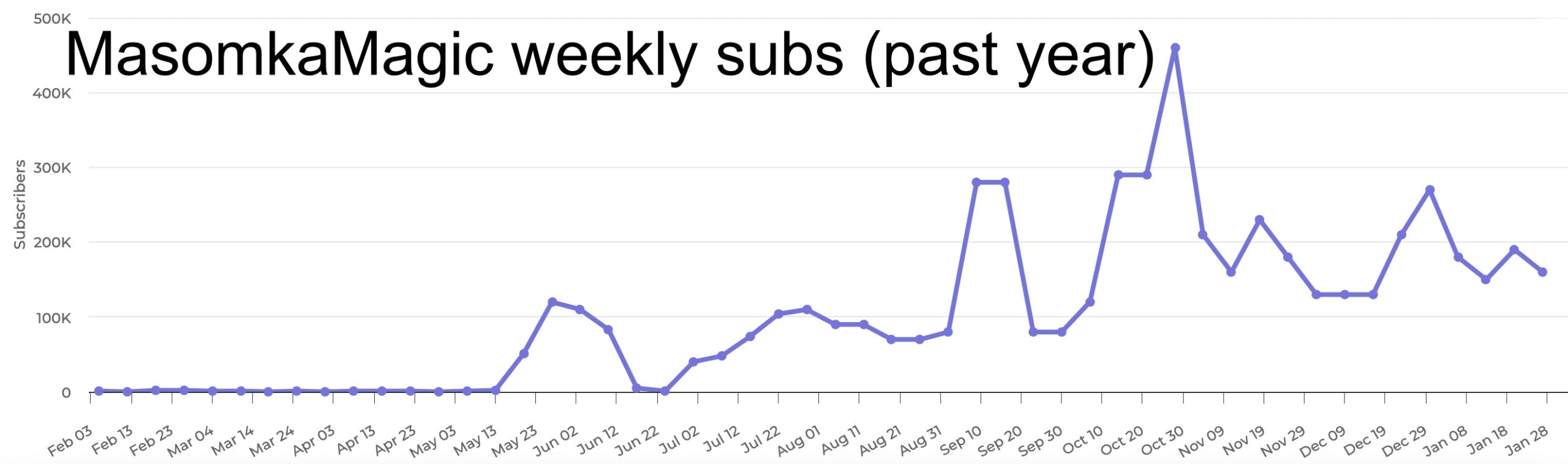
Is the most extravagant bad beat story really that exciting to the Shorts audience? One thing’s for sure: YouTube’s vertical video audience enjoys card tricks in any form. That’s one reason why Justin Flom was able to become a regular chart-topper, and there’s now another magician lurking within the ranks of the U.S. Top 100. MasomkaMagic, who was a nonfactor in these rankings six months ago, is now one of the most popular creators on YouTube. His sleight-of-hand skills are so good that I’m starting to think he was the one who stacked the deck in the ED Uno video (and he wasn’t even there).

Data via Gospel Stats

Is there a shelf life for playing card curiosities on YouTube Shorts? Flom’s longevity would say no, but ED already seems to be moving onto a new trend. The common denominator among his recent Shorts uploads is Squid Game, so his card games might be due for a violent turn.

Channel Distribution

This month, 73 channels in the Top 100 are primarily active on YouTube Shorts.

As always, keep up to speed with the latest Tubefilter Charts and all of our news at Tubefilter by following us on Twitter, becoming a fan on Facebook, and watching our videos on YouTube.