If the President of the United States is to be believed (and your mileage may vary on that one), then an executive order regarding TikTok‘s operating status will arrive any day now. Trump and his allies have indicated that they have completed a deal that will avert the looming U.S. TikTok ban by establishing American ownership of a new app that has been tentatively dubbed M2.
Based on what we know at this point, the general idea seems to be that the current version of TikTok will remain available across the world. The ownership group involved in the deal will take control of M2, which will feature technology licensed from ByteDance and data guardianship courtesy of Oracle. In theory, Americans will be able to continue interacting with the TikTok algorithm they love while benefiting from an added layer of security.
In practice, however, the proposed setup raises a lot of questions, and lawmakers in Australia have put their fingers on one of the biggest stumpers: What about the rest of the world? Will TikTokers outside the U.S. be stuck with the original app, or will they get the chance to move over to M2 as well?
Reports related to the dealings have typically characterized M2 as an app that will cater exclusively to Americans, but many U.S.-based TikTok users enjoy videos from international creators. After M2 goes live, will those viewers still be able to catch up on the latest Khaby Lame and Tibo InShape content, or will they have to go to other platforms (or use a VPN) to do that?
Some foreign politicians would love to give M2 a try for themselves. In Australia, where an upcoming law is set to restrict social media use for individuals under 18, there are concerns about the data privacy issues that have dogged TikTok parent company ByteDance for years. “It would be an unfortunate thing if there was a safe version of TikTok in the United States, but a version of TikTok in Australia which was still controlled by a foreign authoritarian government,” Australian Senator James Paterson told Sky News.
Given the rumor that the Australian Murdoch family is set to get a piece of Trump’s TikTok deal through News Corp, Down Under denizens could have a logical in for access to M2. But the situation isn’t so simple. Digital rights watchdogs have described the U.S. deal as “baffling” and have argued that M2 users will still be subjected to “constant and intrusive surveillance of the user base.”
The final terms of the deal will hopefully provide more clarity regarding foreign involvement in M2. Without its global community, TikTok wouldn’t be a cultural tour de force the way it is now. If the U.S. government isn’t considering the importance of diversity on the For You Page, then the user experience on M2 could leave a lot to be desired.
Filed under: Articles, Featured, Homepage Feature, News, TikTok by Sam Gutelle Comments Off on If the U.S. is getting a new TikTok app, which version will the world use?
YouTube is still kids’ favorite choice for watching content, and the platform’s efforts to diversify its formats are paying off. Those are two findings from the latest Precise Advertiser Report: Kids, a semiannual survey of children’s consumption habits published by the London-based ad tech provider Precise TV.
We’ve covered Precise data in the past, and the firm’s latest findings are consistent with its previous reports. As per usual, YouTube reaches more two-to-12-year-olds than any other social video platform. 78% of the U.S.-based kids in Precise’s panel said that they use Google’s video hub.
That number is similar to the figure reported in the PARK data from a year ago, but YouTube Shorts is making deep inroads among Gen Alpha. The percentage of Shorts users in the PARK survey is up 14% year-over-year, reaching 53%. Over the same period, TikTok usage dropped from 44% to 41%, so kids’ aren’t necessarily watching more short-form videos overall — they’re simply directing more of their attention to YouTube’s TikTok competitor.
The rise of comedy videos, which are popular on YouTube Shorts, informs the format’s rising cachet among Gen Alpha. For both boys and girls in the 10-to-12 age range, comedy is the most popular video category. That wasn’t the case in the PARK data a year ago, and parents are getting in on the yuks, too. 42% of the parents who responded to Precise’s survey said they co-view comedy content with their kids.
That multigenerational viewing experience is having a strong effect on ad recall. The PARK respondents were most likely to recall ads that ran on the long-form version of YouTube, but all of YouTube’s recall numbers are up year-over-year. Long-form YouTube recall rose from 53% to 76%, while Shorts recall went from 21% to 54%. That means there are more than twice as many kids remembering Shorts ads than there were 12 months ago — and that is in turn changing parents’ behavior, with 47% of them claiming that they saw the last item they purchased for their kid in a YouTube ad.
The good news doesn’t end at YouTube. In general, Precise’s Gen Alpha respondents are remembering more ads than they did a year ago. In 2024, YouTube long-form video was the only ad source that at least 50% of kids could recall. Now there are seven different platforms at or above that benchmark, so the marketers who are reshaping the creator economy seem to be doing a bang-up job.
Long-running annual TV trade show MIPCOMsays it’s unveiling an “ambitious new focus” for its 2025 event that will “[place] the creator economy at the very heart of the world’s largest market for television and streaming content.”
MIPCOM returns to the Palais des Festivals in Cannes, France, Oct. 13-16–and, for the first time, YouTube will have a major presence. Attendees will be able to check out a YouTube-branded, dedicated space, plus daily workshops and speaker sessions, along with a headliner keynote with Pedro Pina, VP of YouTube EMEA.
“The creator economy marks the biggest generational shift MIPCOM has ever seen,” Lucy Smith, MIPCOM Cannes’ director, said in a statement. “It is no longer emerging–it’s arrived, signaling a new era of storytelling, distribution, and monetization. Everything we are staging this year has the singular focus of bringing together mainstream media and the creator economy.”
YouTube’s presence isn’t the only change MIPCOM is making this year to embrace our industry and the creators driving it. Other new additions this year include:
A large expansion of the MIP Creative Hub, which will “build on its position as a beachfront destination for co-production with creators, digital studios and brands” by transforming into a four-day program with panels and matchmaking
A Brand Storytelling summit that will tap brands, creators, agencies, and producers “with the aim of nurturing new brand-led projects.” A similar summit has been held over the last decade at Sundance Film Festival; this will be the first international edition.
An AI summit with a stage, demo space, and networking space, “focused on areas at the intersection of content and technology”
An international drama co-production summit featuring Haut et Court co-CEO/Producer Caroline Benjo, Fremantle CEO Christian Vesper, and Steve Matthews, Joint Head of Scripted and Creative at Banijay.
And finally, MIPJUNIOR, to be held Oct. 11-12, a dedicated kids’ conference and network market that wants to “help companies maximize business across attention, creator and experience economies.”
On top of all this programming, MIPCOM has a stacked list of attending platforms, brands, and legacy studios, including YouTube, TikTok, Snapchat, Disney, BBC, Fox Entertainment Global, Lionsgate, Paramount, Sony, Warner Bros. Discovery, Indeed, and Mattel.
Attending creators include Dhar Mann Studios, Kevin Tran, and After Party Studios‘ co-founders, creator-focused film director RVBBERDUCK and YouTuber Callux.
“Bridging the worlds of TV, tech, and creator-led entertainment, this year’s edition of MIPCOM CANNES promises to be more vibrant, diverse, future-facing and productive than ever before,” Smith added.
Tickets for the event are currently available, starting at €1,740 for a Visitor Pass, €2,540 for a Premium Pass (Visitor perks + access to a lounge and dedicated business spaces), and €3,540 for a Prestige Pass (all previous perks + concierge, transport services, hotel booking service, and fast-track access into the event).
Check out tickets here. We hope to see you in Cannes!
MIPCOM Cannes is a Tubefilter partner.
Filed under: Homepage Feature, MIPCOM by Tubefilter Staff Comments Off on MIPCOM Cannes revamps to embrace the “generational shift” that is digital content creation
Advertising Week returns to New York Oct. 6-9, promising a “reimagined experience built for today’s changemakers across marketing, media, tech and culture.”
The industry event has been running since 2004, and has expanded from its flagship Manhattan conference to include annual meets in Mexico City and London. Each year, Advertising Week New York welcomes thousands of attendees as well as major brands like Coca-Cola, McDonald’s, Johnson & Johnson, Nike, Nintendo, Starbucks, Walmart, and Unilever, plus content platforms like TikTok, Twitch, and Meta.
This year, its four-day schedule is packed with 500+ sessions featuring more than 1,200 speakers, including beauty vlogger turned CEO Jackie Aina, Hollywood actors Kevin Bacon and Josh Peck, Smosh CEO Alessandra Catanese, YouTube’s prolific “moral philosopher” Dhar Mann, TikTok storyteller Hunter Prosper, Manscaped CEO Marcelo Kertész, and e.l.f. Beauty Chief Brand Officer Laurie Lam.
“Discover groundbreaking ideas, create new partnerships and soak up the energy of the industry’s most dynamic event,” Advertising Week organizers said. “Expect immersive content across multiple stages, premium networking spaces, fresh brand activations, and surprise guest appearances that only Advertising Week can deliver.”
Advertising Week New York says it’s expecting over 16,000 in-person attendees to show up for 2025’s 28 content tracks, which cover topics like…
AI & Innovation
Campaigns & Creativity
Content & Pop Culture
Creator Perspectives
Data & Decisions
Immersive Experiences
Industry Disruptors
Shopping & Commerce Media
Streaming
and The New Sports Economy
It’s also offering an Investors Summit, a Gaming Summit (in partnership with Super League), and a B2B marketing exchange (presented by LinkedIn), and will kick off the event by handing out the latest round of the Future Is Female Awards, which recognize “outstanding, trailblazing women and allies in our industry.”
While Advertising Week New York centralizes in-person around these few days in the city, it also offers year-round e-learning through its AWLearnplatform and year-round editorial, audio, and video content from AW360. Those who can’t make it to Manhattan this year will also be able to stream a good portion of Advertising Week New York’s schedule by signing up for a Digital Delegate pass ($100 per person during early sale, $125/person after).
As for those who can make it in person, Advertising Week New York is currently running an early bird registration with 20% off passes. During the sale, general passes start at $599.20, creator passes are $599.20, and NewGen Delegate passes, for attendees under 30, are $320. Students can get in for $125.
Advertising Week New York runs Oct. 6-9 in THE PENN DISTRICT at 100 W. 33rd St. in New York City.
Advertising Week New York is a Tubefilter partner.
Filed under: Advertising Week New York by Tubefilter Staff Comments Off on Advertising Week New York returns Oct. 6-9 with 1,200+ speakers, 28 content tracks for creators, marketers, and more
More than two decades after its initial launch, Roblox‘s player base is reaching all-time highs, so the game-building engine has brought in a new exec to serve as its figurehead for creator relations. Vlad Loktev, a seasoned operative with experience at Airbnb and Zynga, has joined Roblox as its Chief Creator Ecosystem Officer.
Loktev’s new role will take effect on September 29. That’s when he will begin improving the day-to-day experience for Roblox creators, spearheading the development of new tools and platform events. “As Roblox tracks towards its goal of 10% of all gaming content revenue flowing through the Roblox ecosystem and being distributed within our community of creators, Vlad will play a key role in supporting the community making it all possible,” reads a Roblox press release.
Though Roblox has existed since 2004, it has grown exponentially since the start of the 2020s. Annual revenue has soared to $3.6 billion, a massive increase from the $508 million annual revenue figure Roblox generated in 2019. By the end of 2024, Roblox reached 85.3 million daily active users; that number represented a 19% year-over-year increase. Oh, and Roblox content has received more than one trillion views on YouTube.
A ballooning player base has led to increased friction between Roblox’s higher-ups and its top experience builders. Complaints related to discoverability led Roblox to update its recommendation engine earlier this year, and financial anxieties preceded the launch of regional pricing.
A notable clash between Roblox and its creators occurred a few weeks ago after the platform made the contentious decision to ban predator catcher Schlep, whom it accused of “vigilantism.” The fallout from that move has sparked numerous legal actions, with notable attorney Mike Mandell working with aggrieved creators to prepare lawsuits.
As Roblox makes direct moves to make its platform safer for children, it is also shoring up its creator relationships through the Loktev hire. The Chief Creator Ecosystem Officer is starting his new gig just after the conclusion of the Roblox Developers Conference, at which the company announced new policies meant to appease creators.
With Roblox revenues continuing to rise, Loktev’s role will be critical. Other experience-building platforms, such as Fortnite and the upcoming Grand Theft Auto VI, are wooing Roblox loyalists with creator-friendly policies. In response, Roblox is making sure its own products — and its relationship with its top stars — are up to par.
Filed under: Articles, Featured, Homepage Feature, News, Roblox by Sam Gutelle Comments Off on Creators criticized Roblox for its feud with Schlep. A new exec will look to improve relations.
The Sidemen are one of the newest British empires — and they’re bringing their YouTube-born brand across the world. Arcade Media, the management company that represents the U.K.’s top creator group, is eyeing global expansion after selling a minority stake to the U.S.-based film studio and VC firm Lumina.
The size of the transaction was not disclosed, but Arcade Media Co-Founder Jordan Schwarzenberger told the Financial Times that the incoming capital will be used to fuel expansion across Europe, the Middle East, and Asia. “We’ve been at the forefront of the professionalisation of the creator economy, and trying to level it up in terms of infrastructure and operational scale,” Schwarzenberger said.
“The Sidemen now is a nine-figure business. And scales globally,” Schwarzenberger added. “They get mobbed everywhere they go. We’ve learnt first-hand what it’s like to take that step from being YouTubers with limited human infrastructure to actually having a big business.”
As part of Arcade’s roadmap for the Sidemen, the management firm has taken cues from creator culture outside of the U.K. MrBeast’s production style and creator products have inspired the London-based septet, which has exploded off of YouTube to venture into fields like retail, marketing, investing, and original streaming content. A seven-figure deal with Viewture has powered that rapid expansion, and Arcade is now joining the fun with a capital injection of its own.
Arcade’s worldwide plans will capitalize on the growing cachet of the Sidemen — and creator culture in general — across far-flung regions of the globe. The group’s annual soccer matches, for example, have recently featured more participants who hail from outside of the British Isles. And while the Sidemen may be the pioneers of influencer football, other creators have hosted star-studded matches of their own. Spain’s Kings League, backed by Twitch stars like Ibai and TheGrefg, has drawn strong fan interest as it takes the pitch at some of the world’s most storied sports venues.
The success of iShowSpeed’s world tour has shown big-name creators that they don’t have to limit themselves to their home countries. Regions like the Middle East are delivering massive YouTube traffic, and Arcade Media is making sure that its biggest stars don’t miss out on their around-the-world opportunity.
After establishing itself in fields like talent management, retail, podcasts, and investing, Night is making a move in the world of marketing. The decade-old firm’s newest division is titled Night Advisory, and it is already facilitating partnerships between major brands and members of Night’s creator roster.
At launch, Night Advisory is staffed by a team of four creative strategists, including a pair of operatives who previously worked at the influencer marketing firm BENlabs. The new business arm is looking to leverage Night’s inroads among young audiences, allowing the agency to connect brand partners to their target demographics.
Night CEO and Founder Reed Duchscher told AdAge that the Advisory division evolved out of regular requests from brands, whose reps asked Night to advise their influencer marketing activity. One company that reached out to Night was NASCAR, and Duchscher’s team capitalized on the opportunity to work with the auto racing brand. NASCAR is now one of Night Advisory’s first clients, along with the World Poker Tour and several other unannounced brands.
Duchscher explained that NASCAR sought to “understand this new world of the internet and how [the brand] could start reaching a younger audience. That’s really how Night Advisory was born.”
As you would expect, Night’s advice for brand partners involves partnerships with the creators it represents. NASCAR’s activity at this year’s Daytona 500 included deals with Night clients like The Rizzler(real name Christian Joseph). A more recent stream from Daytona International Speedway featured Din Muktar, the Twitch star known as Agent 00.
Future Night Advisory campaigns will put creators in position to cover upcoming events. At upcoming World Poker Stops, for example, activations will be designed to enable the recording and uploading of influencer commentary.
As Night has expanded, it has worked alongside creator partners to build mutually beneficial businesses that touch all corners of the creator economy. Earlier in the 2020s, many Night operations involved MrBeast, but after the YouTube star’s 2024 split from his former managers, the firm is dipping deeper into its client roster — which also includes notables like Kai Cenat and The Costco Guys — to create value for its partners. Night currently manages more than 200 creators through its flagship division.
Not all of Night’s ventures have worked out, but the company is getting into influencer marketing at the right time. Brands are paying big bucks to connect with creators who can introduce them to coveted consumers (especially in the world of sports). Within that ecosystem, Night is in the right place to play the matchmaker.
[Editor’s Note: Tubefilter Charts is a weekly rankings column from Tubefilter with data provided by GospelStats. It’s exactly what it sounds like; a top number ranking of YouTube channels based on statistics collected within a given time frame. Check out all of our Tubefilter Charts with new installments every week right here.]
Scroll down for this week’s Tubefilter Chart. 👇
MrBeast has steadily added three million new subscribers every week for the last four weeks (with the exception of two weeks ago, when he added four million). At this rate his YouTube channel is on pace to cross the unprecedented 500 million subscriber threshold in a little over 20 more weeks on approximately February 9, 2026. But something tells me he’s going to try to go for it before the end of the year. It would feel very MrBeastly if there was some type of half-a-billionth subscriber countdown to correspond with a NYE ball drop, except instead of Waterford Crystal he’d probably make the ball out of chocolate with a hazelnut center.
If that does happen, you know where we’ll be writing about. In the meantime, current events are getting people to hit that “Subscribe” button, but just on creator channels.
Another right-wing YouTube channel gets a lot of attention
Charlie Kirk – the multi-hyphenate conservative organizer, podcaster, and founder of Turning Point USA who was fatally shot on September 10 – left behind one of the most undeniably influential digital footprints in American politics. Known for campus debates that generated a seemingly perennial supply of viral long and short-form clips, Kirk helped turn right-wing media into a juggernaut online and arguably played a major role in Donald Trump’s appeal among young men in the 2024 Presidential Election.
Turning Point’s YouTube channel added 470,000 subscribers in the week following Kirk’s death. The momentum carried into this week with another 420,000. The surge was fueled by the violent and sudden nature of the original event and the heightened political sensitivities of the American public in its wake. Interviews, compilations, vigils, and the promise of a very well attended memorial service turned the online destination into a gathering place of now more than 4.25 million YouTube accounts.
The killing has created a moment of extraordinary attention. Audiences aren’t stopping at a single channel to find solace, guidance, outrage, or whatever other color of emotional support or enragement they seek. What’s surprising is on which channels that attention is landing. Or maybe it’s more surprising where it’s not landing. It’s not Fox News. It’s not any traditional media outlet. It’s not any left-leaning podcast or political pundit, either. It’s only Candace Owens.
Owens, one of the most prominent conservative commentators of the last decade, has long occupied a unique space in the digital right. A former communications director for Turning Point USA from 2017 to 2019, she resigned from the organization after members demanded it. She joined Ben Shapiro’s right-wing news network The Daily Wire two years later in 2021. She then left the company in 2024 amid escalating internal clashes over Israel and accusations of antisemitism. She has authored best-selling books, hosted podcasts, and made frequent appearances on cable news, but her core strength has always been her ability to marshal an enormous social following.
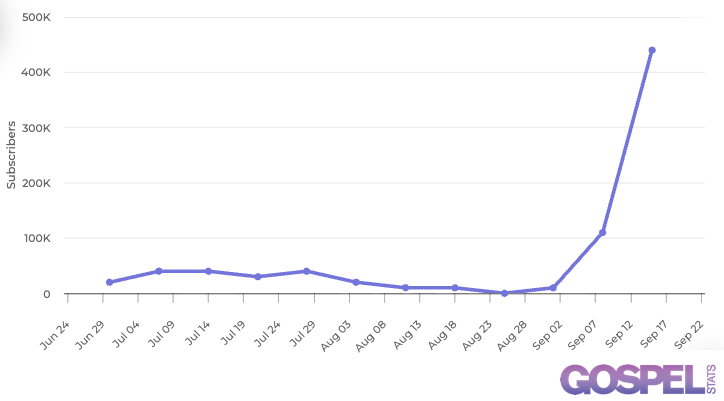
That base just got bigger. Owens’ YouTube channel gained 440,000 new subscribers this week to become the 13th most subscribed YouTube channel in the seven-day timeframe. A quick look at her YouTube hub’s Live tab shows that increased interest in the form of viewership metrics. Owen’s almost daily live-streamed commentary and news hours regularly receive high six and low seven-digit view counts. In the last week she’s averaged about 4.94 million views per installment.
Candace Owens’ YouTube Channel’s weekly subscribers. Data provided by Gospel Stats.
Channel Distribution
Here’s a breakdown of the Top 50 Most Viewed channels this week in terms of their countries of origin:
United States: 12
India: 19
Hong Kong: 5
Australia, Indonesia, and Mexico: 2
Bangladesh, Brazil, China, Chile, Japan, Pakistan, South Korea, Switzerland and United Arab Emirates: 1
This week, 36 channels in the Top 50 are primarily active on YouTube Shorts.
As always, keep up to speed with the latest Tubefilter Charts and all our news by subscribing to our newsletter. You’re going to love it. 👉 Newsletter.Tubefilter.com.
Welcome to our rundown of the most-watched branded YouTube videos of the week.
We’re publishing this snippet of a larger Gospel Stats Weekly Brand Report in order to analyze sponsorship trends in the creator economy. Any video launched in tandem with an official brand partner is eligible for the ranking.
And – as the name up above would imply – all the data comes from Gospel Stats. If you’re interested in learning more about Gospel – and which brands are sponsoring what creators on YouTube – click here.
Our latest Gospel Stats Weekly Brand Report is a check-in with the real world. It’s got exes, escalators, iPhones, and football, with the added bonus of LEGOs thanks to omnipresent sponsor RAID: Shadow Legends. Some of the usual suspects populate our top 5 in terms of creators, and their videos this week remind us that however much of an escape watching YouTube can be, savvy creators are always plugged in to what’s happening beyond cyberspace, too.
MrBeast has (predictably) been #1 for a while here on our weekly lists, with occasional double-placements in spots #2 and #3. Some of those ad spots went to outside brands like the NFL, but in most cases, Jimmy Beast has been using his tens of millions of views to promote Feastables. His candy company started with one chocolate bar, but is now a full-fledged candy brand responsible for a large portion of the Beast entertainment complex’s income. Over the last few weeks, MrBeast has tapped Feastables as the sponsor on most of his videos, using the spots to promote launches of new hazelnut cups, chocolate milk, and gummy candy. This upload focuses on the chocolate milk, which seems a lot sweeter than being chained to your ex for 30 days….Unless? 👀
MrBeast isn’t the only one using his top-clicked videos to promote his own company. Marques Brownlee is one of YouTube’s top tech reviewers, and his most-viewed videos are consistently new phone debuts–especially new iPhone debuts. Everyone wants to know if the latest model is the greatest, and Brownlee usually gets his hands on one a few weeks or even months before anyone else, making his videos hot commodities for techheads. So, he used his much-anticipated iPhone 17/Pro/Air review as an ad spot for Ridge, the wallet company where he became Chief Creative Officer in 2024–and that move paid off in nearly 14 million views. (Ridge also sponsored a video from CreepCast this week that came in at #102, so add another few hundred thousand there.)
Veritasium, as always, is out here answering the world’s most-asked questions. Why does the escalator hand rail move faster than the stairs? What seems like an innocent question is actually the gateway into exploring the physics behind how escalators work…and what can happen when the complicated machinery inside them fails. Every kid has had nightmares about escalators eating their shoelaces (no? just me?) but it turns out that fear isn’t unfounded. These commonplace conveniences are more dangerous than you think. As usual, Veritasium’s deep dive is sponsored by e-learning company Brilliant, which paid for around ~30 videos this week.
Look away if you haven’t seen it, but The Lego Movie wrapped its dramatic climax with a touching father-son scene. The centerpiece of that scene was a meticulously crafted and maintained city full of everything a LEGO-sized person (looking at you, Chris Pratt) could need. The father had built it piece by piece, and the sheer scale of it was sure to make collectors everywhere salivate. Now, to celebrate his 10-year anniversary, LEGO enthusiast TD BRICKS is undertaking a project just as massive. In a 20-minute upload, he chronicles a sprawling city build, with everything from an airport to a San Francisco-style bridge to a stadium. It’s a massive passion project–just like his channel. And, like many videos on YouTube, it’s sponsored by mobile game RAID: Shadow Legends.
We just wrote about how the NFL is becoming a king in the second-screen space. New data showed that over half of NFL viewers are engaging with NFL content on their phones while actively watching games. “NFL content” can mean player cams, behind-the-scenes footage, social media posts, and what researchers called “interactive gaming features,” which we think probably includes fantasy sports apps. It’s long been known that fantasy sports increases engagement with leagues, because you have to be engaged on a daily basis if you want to know how your lineup is faring (and whether you’re making any money). Looking at this week’s sponsored videos, it’s clear that hunger for engagement beyond games extends into YouTube content, giving creators a way to monetize their fantasy sports advice, and giving DraftKings a way to advertise its services at the start of the 2025-26 NFL season.
…and there’s a lot more data where that came from. If you’re interested in learning more about Gospel – and which brands are sponsoring what creators on YouTube – click here.
[Editor’s Note: Tubefilter Charts is a weekly rankings column from Tubefilter with data provided by GospelStats. It’s exactly what it sounds like; a top number ranking of YouTube channels based on statistics collected within a given time frame. Check out all of our Tubefilter Charts with new installments every week right here.]
Scroll down for this week’s Tubefilter Chart. 👇
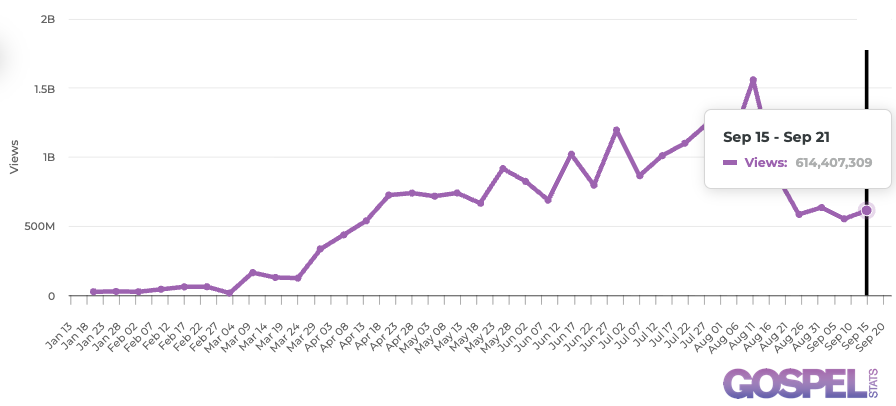
KIMPRO is on pace to close out September spending the whole entire month in the #1 spot in our Global Top 50 ranking. The Korean short-form hub that watches like a hyper-colored fever dream for children who just recently discovered object permanence amassed 1.7 billion views during the week, a 6% increase on the week prior.
That kind of viewership is the reason why the channel’s likely to not see any competition in the near future. The channel’s next closest competitor trails by 510 million views! If that viewership gap was a channel in and of itself, it’d be #28 on the rankings this week.
Couples from Australia are kinda crushing right now
Carrie Ou Yeung is a 20-something financial-analyst-turned-content-creator originally born in Hong Kong and currently residing in Australia with her husband/collaborator Nick Sharma. He’s a 20-to-30-something PR-rep-turned-content-creator originally from India. They met on Tinder in 2018 and have had a largely public relationship (consummated in a recent marriage) across the internet and on their shared YouTube channel NickAndCarrie ever since.
The content has a newlywed, domestic, and wholesome vibe, with choreographed slices of life that can sometimes even seem spontaneous and almost as if it wasn’t preplanned. It gets decent viewership, too, averaging upwards of 150 million views a week. That doesn’t make them chart-topping material. (I actually discovered the channel because I was researching AI-sponsored videos on GospelStats and they surprisingly get a lot of deal flow.) But it does perhaps make them part of a growing trend of (oftentimes multicultural) couples living in Australia who are crushing it on YouTube.
The three channels have turned collaboration into an engine of dominance, showing just how far YouTube’s oldest growth hack can go when it’s scaled across multiple personalities and YouTube outposts. For instance, Double Date has 1.08 billion views this week to occupy the #4 spot, Jasmin and James has over 631 million at #16, and Cadel and Mia got almost 608 million at #20. I don’t think there’s been this geographic localization of personality-based channels that dominate the YouTube rankings since the days of Alfie and Zoella. I guess the sun is starting to never set on the British Commonwealth’s short-form, comedic vlogish empire.
Cadel and Mia’s weekly YouTube subscribers. Data provided by Gospel Stats.
Channel Distribution
Here’s a breakdown of the Top 50 Most Viewed channels this week in terms of their countries of origin:
India and the United States: 11
Canada, Hong Kong, and Indonesia: 3
Australia, South Korea, and Spain: 2
China, Germany, Japan, Pakistan, and Turkey: 1
This week, 41 channels in the Top 50 are primarily active on YouTube Shorts.
As always, keep up to speed with the latest Tubefilter Charts and all our news by subscribing to our newsletter. You’re going to love it. 👉 Newsletter.Tubefilter.com.
If you’re online long enough, you’ll hear it whispered: The algorithm. The algorithm decides whose content is recommended to viewers. Whose content is surfaced in searches. It’s almost treated like a mercurial beast–one you have to placate, and hope you never fall afoul of.
YouTube has made some efforts to demystify the algorithm (its key piece of advice? Please the audience and the algorithm will follow), but across the web, creators are still wary of the systems that dish out their content to viewers, worrying their videos are suppressed or not shown to those who’d be interested.
On the flip side, viewers have their own rough experiences. We here at Tubefilter have seen YouTube’s Shorts algorithm recommend a fresh account pure slop irrelevant to any normal human interests. We’ve also seen it recommend right-wing content like Andrew Tate right out of the gate. Despite that, algorithms at YouTube, TikTok, Instagram, and more are in general pretty good at catching on to what viewers like and giving them more of it.
But there’s one platform having a particularly difficult time with its viewer-facing algorithm.
Now, nearly three years after Musk’s purchase, X seems to have finally put two and two together and realized some users may not like seeing this content.
To fix that problem, it’s leaning hard into another arm of Musk’s business: generative AI. According to Musk X’s recommendation algorithm will soon be “purely AI.” (What does that mean and how is it different from the machine learning systems most recommendation algorithms utilize? No explanation.) It appears that between now and then, X plans to roll out tweaks to the feed that will make it actually reflect what individual users want to see.
“The goal for your X timeline is to get out of the mainstream algo and the political crusades and find your niche,” Nikita Bier, X’s Head of Product, said in a tweet. “You should be able to post about your interests and have friendly, relevant people chime in.”
He also added a knowing nod about the violent content, saying, “If you’re seeing gas station fight videos, your account is not ramped up yet. We are working everyday [sic] to fix this.”
Musk chimed in saying X is making “significant progress along the way” to full AI-dom. “We will open source the algorithm every two weeks or so,” he said.
The bit people should be paying the most attention to, however, is his final note: “By November or certainly December, you will be able to adjust your feed dynamically just by asking Grok.”
Grok, of course, is X’s inbuilt chatbot, which like X’s algorithm has a history of being (allegedly) tweaked for Musk’s purposes. If X implements this change, it’ll be a first-of-its-kind system where users can ask a platform in plain language to change what kind of content they’re being served. 99% of major platforms offer “don’t recommend content like this/this channel/etc” buttons, but those have limited effect, and must be implemented one at a time. If X’s algorithm works the way Bier and Musk describe, users will be able to make large-scale, personalized changes.
Will this work as intended? Maybe! Musk’s various tech companies don’t have the best track records with pulling things off at first go, but this concept is sort of a natural evolution from the world’s current obsession with generative AI–and X isn’t the only platform investigating it. Social Media TodayreportsMeta‘s Threads is experimenting with something similar, a tool that would let users change their feed by tagging @threads.algo in a post. Meta hasn’t confirmed this potential change, but it is similarly on the gen AI train, so we wouldn’t be surprised if plain-language, chatbot-based algorithm changing is on its roadmap, too.
Either way, we’ll have to wait till November or certainly December to see how this tool plays out in real time. If it’s successful, will we see YouTube and other video-based sites roll it out? Would that have an impact on creators’ views? Much to wonder…
Filed under: Homepage Feature, Twitter by James Hale Comments Off on What would happen if you could talk directly to the recommendation algorithm? X is about to find out
In our industry, we talk a lot about cord-cutting and how the traditional TV entertainment giants have been going by the wayside as younger viewers (and some older ones!) increasingly prefer cheaper and more targeted video content, like streaming services and YouTube videos.
But there’s still one legacy TV giant that not only isn’t losing ground, but continuing to grow as a viewership-generating juggernaut: the NFL.
America’s football league has kept up with changing times by embracing being online. It’s sealed broadcast deals with YouTube, Netflix, and more, and just kicked off its 2025-26 season with a YouTube-exclusive Chiefs/Chargers matchup in São Paulo that drew 17.3 million viewers.
It’s not just that game getting eyeballs, though. Across the board, the NFL is doing well: Sports Illustratedreports the NFL has reported record-setting TV and digital ratings for the first two weeks of the season, with live game viewership averaging 20.7 million people. That’s up 4% from 2024 and a whopping 17% from 2023.
And, according to a new study from Horowitz Research, the NFL is also rocking at the top of second-screen charts.
The idea of second-screen viewing has been around for a while, but got into mainstream news after anonymous sources claimed Netflix is purposefully rewriting shows and movies to be dumber. The idea is that whatever’s playing on Netflix is the “second screen” behind what viewers are actually paying attention to: their phones. With dumber content that re-explains the plot over and over, viewers can dip in and out of the narrative while scrolling on TikTok and still be more or less aware of what’s going on.
Viewers are apparently doing the same thing with the NFL–but most of them, instead of browsing unrelated social media, reading, or watching another show, are looking at content related to the NFL, Horowitz found.
Researchers concluded that “[f]rom shopping in real time to engaging across multiple platforms, today’s NFL audience is blending technology and interactivity to redefine what it means to be a fan,” TV Technology reports.
Their data showed that 63% of NFL viewers engage with related social media, either by looking at posts or making their own, while they’re watching. It also showed that 39% of NFL viewers are engaging with extra/behind the scenes content like player cams and drone footage.
They engage with their dollars, too: 51% of NFL viewers shop for sports merch while actively watching live games. 43% also engage with live sports games through “interactive gaming features” or video games (the former of which we think may include daily fantasy/betting apps).
All this boils down to opportunity for leagues. Netflix (which also has a deal with the NFL, $150 million for two Christmas games per year) is banking on viewers not really paying attention to their content. But the NFL, judging by this data, can safely bank on viewers paying extra attention. They’re not using their phones as a distraction from games; they’re using their phones to access social media, merch, and interactive apps that enhance their fandom experience.
This is a major plus for the NFL, and an opportunity if it wants to roll out more ancillary content across socials and apps, directly addressing–and embracing–those second-screen viewers.
Filed under: Homepage Feature, Uncategorized by James Hale Comments Off on NFL embraces the second screen–and the engagement boost it brings