In February 2025, YouTube turned 20. The video site has gone through a lot over the past two decades, including an acquisition, an earnings glow-up, and multiple generations of star creators. In our 20 Years of YouTube series, we’ll examine the uploads, trends, and influencers that have defined the world’s favorite video site — one year at a time. Click here for a full archive of the series.
By 2023, many of YouTube’s OG Millennial stars had retired (or had been involuntarily canceled). Several Gen Z icons had gone dormant thanks to self-imposed hiatuses. As a result, the internet became Generation Alpha‘s playground — and the rest of us learned that today’s kids are into some bizarre stuff.
On YouTube, the advent of the Shorts format fueled Gen Alpha’s cultural ascent. The YouTube-branded answer to TikTok launched in 2021, and it hit its stride two years later thanks to the introduction of Shorts ads. Vertical videos became the dominant format in our Tubefilter viewership charts, and you don’t have to be a sigma to know that Gen Alpha slang became a common sight on those chart-topping channels.
Shorts gave Gen Alpha a short-form hub they could call their own. Millennials account for more than one-third of Instagram’s user base, and Gen Z’s affinity for TikTok is well known. Meanwhile, for as long as the Alphans have had cultural consciousness, they have identified YouTube as their favorite platform. Through Shorts, today’s kids have ensured that their preferred hub is sufficiently strange.
The creator who has come to exemplify that off-the-wall style is named Alexey Gerasimov, but he’s better known by his internet alias Boom. The Russian-Georgian animator appeared on our radar at the end of April 2023, when his profanely-titled DaFuq!?Boom! YouTube channel got 144.8 million weekly views and reached 33rd place in our Global Top 50 ranking.
At the time, Boom’s toilet-bodied, long-necked characters felt like yet another curiosity amidst a vast sea of Gen Alpha slop. But the animator went full speed ahead with what would eventually become known as the Skibidi Saga. By May 2023, DaFuq!?Boom! was on top of our YouTube viewership charts. Boom’s viewership tally for the month of June neared three billion hits, and at the end of 2023, YouTube chose Skibidi Toilet as its biggest trend of the year.
Skibidi’s ascension mystified all the generations that were old enough to have graduated elementary school. Even Gen Z, the contemporaneous arbiter of mainstream pop culture via platforms like TikTok, was perplexed by the youth and their absurdist tendencies.
Trying to make sense of an animated war between toilet-bodied and TV-headed races may be a fool’s errand, but Skibidi Toilet and its deliriously wacky brethren seem to encapsulate the pop culture era during which they flourished. 2023 was arguably the peak year for multiverse-set stories, especially in the world of film. Everything Everywhere All At Once was the reigning Best Picture winner, Doctor Strange had just returned from his trip to the Multiverse of Madness, and Miles Morales topped the box office by traveling Across the Spider-verse.
On the Gen Alpha playground that YouTube Shorts had become, multiversal themes could be seen amidst the chaotic collision of pop culture characters. Shorts became the place to go for bizzare mashups that featured the likes of Skibidi Toilet, MrBeast, and Cristiano Ronaldo — or, at least, animated imitations of them.
The success of Skibidi Toilet is what happens when you take the unvarnished, profane glee of a top YouTube channel (like PewDiePie a decade earlier) and reframe it through the eyes of a generation that has watched their favorite IP get smashed together in the pop culture supercollider. The fact that Boom’s storylines didn’t make sense to older cohorts seemed to be part of the appeal, though you’ll have to ask your local eight-year-old to confirm that for you.
Gen Alpha’s cultural leanings may be inscrutable to Hollywood decision makers, but that hasn’t stopped studios from coveting Skibidi IP. A toy line featuring some of Boom’s characters has brought the short-form meme into the retail universe, and Michael Bay is helming a film and TV franchise inspired by the saga.
In the current cinematic moments, those moves might just pay off. The success of A Minecraft Movie, which featured references to gaming memes like the Chicken Jockey, showed that Gen Alpha’s love of randomness (which might just be a revival of Millennials’ “lol so random” aesthetic) can have legs at the box office. All of a sudden, films inspired by creator culture are being greenlit left and right.
One of those creator-led Hollywood projects, however, reminds us that Gen Alpha’s current cultural experience is inherently transient. Kane Parsons’ The Backrooms, which is set to become an A24 horror flick, is another franchise that had its lore deepened by short-form shitposts that appeal to young YouTube viewers. The titular setting is an example of a liminal space — a transitional environment that appeals to Gen Alpha. A public restroom can be a liminal space, too, and that’s exactly where you’ll find Skibidi’s signature characters.
If Gen Alpha’s understanding of culture is constantly in flux, then Skibidi Toilet might not have as long of a shelf life as the execs betting on it would like. Gen Alpha slang evolves so quickly that parents can’t keep up, and trends can be equally mercurial. Translation: Two years after its peak, Skibidi Toilet may already be yesterday’s news.
Or I’m wrong, and Gen Alpha continues to enjoy the same wacky touchstones it brought to the top of the charts. Ten years from now, if we’re a decade into the Skibidi Cinematic Universe, don’t say I didn’t warn you.
A new platform is betting that creator investments are the new hotness in the world of influencer marketing. OWMplans to revolutionize relationships between creators and brands by offering equity partnerships to the former of those groups.
OWM functions as a matchmaker by connecting business-minded creators to entrepreneurs who are willing to exchange pieces of their companies for promotional advantages. An AI-powered proprietary data engine named Andy will identify the consumers each founder needs to reach before connecting them to the creators who are best equipped to boost their branded messaging.
That sounds a lot like the brand matchmaking platforms that are a dime a dozen in the influencer marketing world, but OWM Founder and CEO Jeff Frommer is pushing forward with a novel approach. Rather than facilitating one-off partnerships that offer only temporary gains for sponsors, OWM aims to build long-term partnerships and mutually beneficial collabs between brands and creators.
In an era when many advertisers are tightening their influencer marketing budgets, those elements of efficiency and authenticity are crucial. The central idea behind OWM is that viewers respond better when they can tell that a creator is passionate about the company they’re shilling for, and the way to ignite that passion is by giving creators some skin in the game.
“Audiences know when they’re being sold a #ad. When creators say they believed in it so much they were willing to invest and become a #owner, fans lean in and want to know more,” Frommer said in a statement. “The on-ramp to entrepreneurship for creators is investing their influence in something they believe in, either as an advisor, ambassador, or co-founder. It’s our mission to make ownership accessible to all, moving the middle class of the Creator Economy into the Ownership Economy. We believe every founder needs creators on their cap table, and OWM is the infrastructure that makes that possible.”
That setup isn’t just beneficial for founders. It’s a win-win that lets creators flex their entrepreneurial muscles while assuming less risk than they would if they launched their own product line. As creator-led brands like Prime and Feastables encounter friction, OWM is showing top influencers that they can work alongside capable founders while continuing to push the growing trend of creator investors.
At launch, OWM boasts deep partnerships on both ends of its platform. Hundreds of companies are seeking equity deals with more than 5,000 creators, with agencies like VaynerSports, Underscore Talent, Wasserman, Made by All, UnderCurrent, Select Management Group, and The Creator Society bringing their rosters to OWM.
There are also some creator investors on OWM’s own cap table, including Victoria Garrick Browne, Corp Bro, and Corp Natalie. Other backers include ACQ Ventures, Avalanche VC, Firsthand Ventures, Spacestation Investments, and HotStart VC.
YouTube‘s extensive push into the world of sports is starting to pay off. As the platform plots new content initiatives led by creators like iShowSpeed, it is launching new sports-themed ad lineups within the YouTube Select program.
YouTube Select, which succeeded Google Preferred in 2020, offers guaranteed ad space next to curated lineups of popular YouTube channels. The themes for existing packages span popular categories like makeup, cooking, and gaming, and YouTube is now deepening its Select offerings in the wide world of sports.
On its surface, the YouTube Select update caters to the growing number of advertisers who want a piece of premium sports content. The new lineups are also a logical path for YouTube given its flurry of activity in the sports world. The platform is paying $2 billion per year for the rights to the NFL Sunday Ticket package, and it has looked to recoup those costs by turning its homegrown stars into spokespeople for its football coverage.
One example of that promotion effort is an upcoming flag football game in London, for which rappers Gunna and Aitch will draft star-studded teams. For viewers who prefer on-demand programming to live spectacles, a new series called Speed Goes Pro puts streaming star iShowSpeed in contact with legendary athletes like Tom Brady.
The decision to greenlight originals like Speed Goes Pro can be linked to Sunday Ticket, but YouTube’s new ad lineups show that it is looking for multiple means of monetizing its sporting spree. NFL-loving customers can provide a substantial revenue stream — but so can NIL-loving brands.
If Mafiathon 3 truly is the final chapter of Kai Cenat‘s streaming marathon series, then the 23-year-old Twitch star went out with a bang. Over a month-long period of continuous broadcasts, Cenat achieved an unprecedented goal by attracting more than one million active subscribers on his official Twitch account.
Cenat’s first two Mafiathons were record-setting affairs that vaulted the Bronx native to the top of the Twitch leaderboard. In August, a trailer featuring Michael B. Jordan informed viewers that Mafiathon 3 would be Cenat’s biggest month-long streaming bonanza yet — and his last. By going live throughout September, Cenat hoped to become the first Twitch streamer to push his active subscriber count into seven-digit territory.
With help from a parade of special guests — including fellow streamers, traditional media stars, and other members of the creator group AMP — Cenat achieved his lofty goal and then some. He reached the million-subscriber mark with a few days to spare, and by the end of September, he counted more than 1.1 million active subs. Even Cenat’s Twitch mod benefited, as it became one of the platform’s most-used extensions during its creator’s month-long run.
Some key celebrity cameos helped Cenat make it to the uncharted territory he sought. Rapper Ray J accused celebrities of profiting from Cenat’s platform without giving back, causing Snoop Dogg to fire back with 50,000 gifted subs. A Mafiathon-concluding team-up with LeBron James, in which the Los Angeles Lakers star shaved Cenat’s locs, pushed the concurrent audience into seven digits to match the subscriber count.
Cenat’s collab with actor Kevin Hart and fellow streamer Druski revealed one direction in which his career will head during the post-Mafiathon era. The three stars are joining forces for Livestream from Hell, a horror movie that will satirize Cenat and Druski’s chosen profession. Based on the film’s trailer, Cenat might actually become the Hollywood star he was prophesied to be.
Between that project, the impending return of Streamer University, and the other irons Cenat has in the fire, he will stay busy in 2026, even if he keeps his promise to retire Mafiathon. Given the growing concerns about marathon streams (and Mafiathon’s occasional contributions to that hysteria), the decision to sunset the concept is probably correct. However, if Cenat hungers for more recognition in the Twitch record books, he could always revive Mafiathon to take a run at some of Ibai’s marks.
Filed under: Articles, Featured, Homepage Feature, News, Twitch by Sam Gutelle Comments Off on 1.1 million Twitch subs and a haircut from LeBron: Highlights from Kai Cenat’s Mafiathon 3
Its four-day schedule is packed with 500+ sessions featuring more than 1,200 speakers, including headliners like beauty vlogger turned CEO Jackie Aina, Hollywood actors Kevin Bacon and Josh Peck, Smosh CEO Alessandra Catanese, YouTube’s prolific “moral philosopher” Dhar Mann, TikTok storyteller Hunter Prosper, Manscaped CEO Marcelo Kertész, and e.l.f. Beauty Chief Brand Officer Laurie Lam.
Among those 500+ sessions is one called Beyond Spanish: the transcultural power of Top Creators. This panel features multiple Spanish-speaking creators who audiences stretch beyond viewers who share their language, including:
Chingu Amiga, a South Korean creator based in Mexico who has nearly 30 million followers on TikTok, 15 million on YouTube, and 12 million on Instagram
Paco de Miguel, whose relatable skits won him Comedian of the Year from GQ México, and who has nearly 10 million followers across platforms
and Nicolás Botero of Los Chicaneros, the Colombian family of four whose group content has brought them 16 million followers on TikTok, 7 million on Instagram, 7 million on Facebook, 6 million on YouTube
They’ll chat with Pati Giezma, CEO of LATAM management agency StayOnSocial, for a chat organizers say will be about “creating content that speaks to the heart of Latin America,” and “how their cultural authenticity, bold storytelling, and savvy content strategies are breaking borders, building loyal communities, and inspiring cross-cultural connections.”
Ahead of their panel, we sat down with Chingu Amiga (aka Sujin Kim) and Paco de Miguel to talk about their experiences as creators and what they’re looking forward to most about Advertising Week New York.
Kim, who was a teacher in South Korea before moving to Mexico, got her start making videos about South Korean culture for a Mexican audience back in 2021. She says she thinks viewers resonated with her videos because “I really love Mexican culture. This feeling, this is my heart, my love for Mexico, and I think my audience could feel that love, and maybe that’s why they love me back.”
Now that she has such a sprawling platform, she thinks she might aim for being an actress in the future, or building a business. But “I already reached a dream I didn’t think [was possible] five years ago,” she says, about creating content.
As for Advertising Week New York, “I was really surprised when I heard the news that I’m gonna be there,” she says. “I’ve worked with Advertising Week LATAM several times, and I got the news that there is a panel where we can talk about the Latin community and how important a Latin audience is, and there is a chance to go. So I was like, ‘I am gonna do everything to go there.'”
She adds that she and her fellow creators want to spur more “union” among Spanish-language creators, “in the U.S. market especially.”
Miguel, meanwhile, says his content took off because in his skits, he portrays “many characters like moms and teachers, cousins and families” that “all sorts of people can identify with,” regardless of what culture they come from. It also helps that these days, YouTube and other platforms offer auto-translation from Spanish into viewers’ languages, so his videos can be watched and understood by people all over the world.
He was inspired to make videos because “all the time, I look at people, I look at what they do. I love to do comedy because people identify with these situations and these types of characters. I knew this when I was six years old and I would imitate teachers in the classroom.”
Fast-forward a couple decades, and one of his first characters was a teacher with a jangling keychain and “big shoes,” he laughs.
“I really enjoy doing this, and it’s amazing that in social media, you can work and you can create a world,” he says.
Like Kim, he was involved with Advertising Week LATAM, and this year got an invite to join the New York iteration of the event. “I was totally very excited to be there. I want to tell people about how, being a Latin American creator, you can touch new people, and people can see you. It doesn’t matter the language, if you do relatable content, all the people around the world can identify with your content.”
Kim and Miguel will both share their stories and advice onstage at Advertising Week New York, alongside hundreds of other creators and experts.
Advertising Week New York runs Oct. 6-9 in THE PENN DISTRICT at 100 W. 33rd St. in New York City. Kim, Miguel, and Botero’s panel takes place Oct. 8 at 3:50 p.m. EST on the Insights Stage.
Advertising Week New York is a Tubefilter partner.
Filed under: Advertising Week New York, Homepage Feature by James Hale Comments Off on Top Spanish-language creators are headed to Advertising Week New York to talk about reaching cross-cultural audiences
Look up there! It’s a bird, it’s a plane, no…it’s a butterfly in the sky?
That’s right: Reading Rainbow is back. The beloved kid lit program, which ran in its original, LeVar Burton-hosted incarnation from 1983 to 2006, is getting a new host who fits the current era of children’s media. Mychal Threets, a librarian with a positive attitude and a strong social media following, will lead the rebooted Reading Rainbow to Sony Pictures Television‘s year-old Kidzuko channel.
If you watched Reading Rainbow growing up, then you’ll have a good idea of what to expect from the YouTube-set reboot. (And if you didn’t watch Reading Rainbow growing up, I’m sorry.) Threets will lead young viewers through popular children’s books while getting some help from special guests along the way. Ebon Moss-Bachrach, Adam Devine, Gabrielle Union, John Legend, and Chrissy Teigen are some of the Hollywood notables who will help kids discover the joy of reading.
“I was raised on Reading Rainbow, LeVar Burton is my hero,” Threets said. “I am a reader, I am a librarian because LeVar Burton and Reading Rainbow so powerfully made us believe we belong in books, we belong everywhere.”
After breaking out online thanks to his infectious, upbeat personality, Threets quit his job to become a resident librarian for PBS. His effort to revive one of the public broadcaster’s most famous properties will not come on the linear PBS channel, but on a Sony-owned channel that is hungry for high-quality kids’ fare. Rights holders of classic children’s TV shows are always hunting for new ways to extend their winning IP (see also: Sesame Workshop’s deal with YouTube), so the Reading Rainbow distribution agreement looks like a win-win.
A few episodes from the LeVar-hosted version of Reading Rainbow have already arrived on Kidzuko. If you’d prefer, you can also catch the show across Reading Rainbow‘s official social channels. Check back on those hubs to catch the Threets-led edition of the show once its official release date arrives.
Filed under: Articles, Featured, Homepage Feature, News by Sam Gutelle Comments Off on Take a look, it’s in a #BookTok: ‘Reading Rainbow’ is getting a reboot
Thanks to the influence and accessibility of social media content, a growing number of individuals are turning to creators to chronicle major life events. In the wedding world, for example, it’s becoming more common for couples to hire creators alongside their other vendors, ensuring a steady stream of social content during the festivities.
Amid that shifting landscape, Social Agentis making an interesting proposal: What if hiring creators to document events was as simple as ordering an Uber? The new app is a one-stop shop that offers a stable of creators-for-rent (or “agents,” as they’re known on the platform) who can complete jobs as soon as they’re hired.
Initially, Social Agent’s flagship service will be limited to the Los Angeles area. Southern Californians in need of creator assistance can purchase an agent’s services and expect a visit within 30 minutes of the initial request. Like on rideshare apps, agents are automatically paired with clients, and the available workers are described as “equally qualified.” The cost to hire an agent is a flat rate; a 30-minute session will run you $65.
Even if you don’t live in Los Angeles, you can still make use of Social Agent’s content editing services. App users can send raw videos to their agents, who will then fashion the footage into “scroll-stopping content,” as a press release puts it.
Social Agent Co-Founders Lisa Jammal and Brooke Levy revealed their new app earlier this year after raising $2 million from family and friends. Now, they’re out to provide a convenient, affordable option for individuals and businesses who may not have much experience working directly with creators.
“Social Agent wasn’t born from theory – it came from living the gap every day,” Jammal said in a statement. “There’s no real solution between DIY content creation and hiring a full-scale production crew. I’ve spent my career behind the phone, creating for brands, clients, and myself, always wondering why something faster, easier and more affordable didn’t also exist. People and businesses today need curated content with zero friction. Social Agent is that solution: on-demand creators and editors, built for the way we live, share, and consume content now.”
The creator economy has matured enough for an app like Social Agent to become a reality. Hundreds of thousands of workers support themselves by creating content, and some studies have shown that as many as half of all Americans aspire to that lifestyle. That means that if you’re in a pinch and you need someone to capture a birthday, bat mitzvah, or the birth of your child, help is never too far away.
That ubiquity will be key for Social Agent as the app looks to follow through on its 30-minute promise. If you live in the L.A. area, you can put your local agents to the test.
Filed under: Articles, Featured, Homepage Feature, News by Sam Gutelle Comments Off on Need a creator to capture your event? There’s an app for that.
Are characters generated with AI models eligible for agency representation? According to Eline Van Der Velden, the answer is a resounding yes.
Van Der Velden, the Founder and CEO of AI production studio Particle6, is launching a new venture called Xicoia. When it debuts at the Zurich Film Festival, Xicoia will look to usher in a new era of AI-generated culture by building a roster of dynamic, personable genAI creators.
The first name under the Xicoia banner is Tilly Norwood, an AI-generated “actress” who has set up shop on platforms like Instagram. Norwood’s likeness and personality were developed through Particle6 and its proprietary DeepFame engine, and Van Der Velden’s mission is to work characters like Norwood into film, TV, and digital productions.
In a sense, Xicoia resembles VTuber agencies like Nijisanji and hololive, in that it is a form of real-world representation for characters who are purely virtual (and, in many cases, carefully crafted by companies like Particle6). But while VTubers are controlled by humans, Xicoia’s characters are fully autonomous.
It’s hard to say whether a business like this presents more opportunities or philosophical quandries. On the positive side, Xicoia will be able to build diverse characters to meet the specific needs of directors, brands, and studios. There are also conversations between the new firm and “several Hollywood stars who wish to appear on screen as their younger or current selves,” according to Deadline.
The idea that AI-generated characters can and should benefit from agency backing is bound to be controversial. Skeptics will ask how Xicoia will affect the working (human) actors who are already concerned about AI’s encroachment into the entertainment industry. There’s also the question of compensation; if a character like Tilly Norwood was created using an AI model that was trained on human appearances, do those inspirational figures deserve a cut of her earnings? Since the AI industry still hasn’t figured out a definitive solution to the problem of unauthorized training, Van Der Velden might be jumping the gun a bit with her new venture.
There’s definitely no room for an AI talent wing inside the halls of traditional agencies, and Hollywood’s response to Tilly Norwood shows why: If the WMEs and CAAs of the world embraced Van Der Velden’s idea, their human clients would likely depart en masse. In a response to the Xicoia announcement, SAG-AFTRA stated that it is “opposed to the replacement of human performers by synthetics,” and actors like Emily Blunt and Whoopi Goldberg have expressed similar sentiments
To Van Der Velden, generative AI is a “new paintbrush” for the next generation of artists. “I hope we can welcome AI as part of the wider artistic family: one more way to express ourselves, alongside theatre, film, painting, music, and countless others,” Van Der Velden wrote on Instagram. “When we celebrate all forms of creativity, we open doors to new voices, new stories, and new ways of connecting with each other.”
If that philosophy of art finds widespread acceptance, Xicoia will be well positioned to build a leading roster of AI characters. The response to Van Der Velden’s new company shows that the old guard won’t be easily swayed, no matter how many gigs Tilly Norwood books.
Welcome to our rundown of the most-watched branded YouTube videos of the week.
We’re publishing this snippet of a larger Gospel Stats Weekly Brand Report in order to analyze sponsorship trends in the creator economy. Any video launched in tandem with an official brand partner is eligible for the ranking.
And – as the name up above would imply – all the data comes from Gospel Stats. If you’re interested in learning more about Gospel – and which brands are sponsoring what creators on YouTube – click here.
Feastables continues getting some serious air time in this week’s Gospel Stats Brand Report. But we also have one more repeat from last week: Marques Brownlee, who’s milking the iPhone 17 release for as much content as possible–and clearly that’s doing well with viewers. The other two videos in our top 5 this week come from businesses being sponsored by other businesses. Now that’s B2B.
If you’ve been counting, you’ll know this is the third straight week where MrBeast and Feastables are in the #1 spot on our list. Like we mentioned last week, the Feastables family has been growing rather quickly, adding new hazelnut cups and expanding into gummy candy and chocolate milk.
Unlike most other videos uploaded to MrBeast’s channel(s), though, this one doesn’t actually feature him as the frontman. Instead, it’s longtime friend/cast member Nolan Hansen, who takes viewers through the splashily edited process of making MrBeast a sweet treat with his new Feastables milk. inb4 the next FoodTok craze?
Thought we were done with MrBeast? Nope. He also scooped up a second sponsorship this week–this time for a company he doesn’t own. Tech company Lenovo sponsored his secondary channel MrBeast Gaming for the latest in a series of videos where he pits gamers against one another in (digital) feats of survival for (very real) cash prizes. In this case, four dudes have to try surviving 1,000 (in-game) days in the world of hardcore Minecraft, where everything–from the wildlife to the weather to the ground itself–is out to game-end you.
YouTube’s Creator Liaison Rene Ritchie says when it comes to Shorts, video titles don’t matter, and creators should focus on making engaging, entertaining content. As you can see in this video, the title was a bit…unusual. If it were a long-form video, people might skip over it because the title is an entire ad within itself. But it’s a Short, and therefore mostly found by vertical swiping where viewers don’t even read video titles. It’s easy to see why this video got the attention it did: clear, crisp, ASMR-style audio and video of an expert professional at work–a genre that became popular during COVID and has continued to grow.
It’s always cool seeing small businesses find YouTube success–especially when they’re being sponsored by companies that make tools essential for their careers. In this case, The Dusty Lumber Co was sponsored by toolmaker Festool. We’re betting Festool is pretty happy, because not only did this video come in #3 with a whopping 9.8 million views, but a second Dusty Lumber Co video it paid for came in #13 this week.
Marques Brownlee was in spot #2 last week with his first lengthy preview of the next iPhone. His iPhone uploads (where he gets new models before pretty much anyone in the general public) are his most popular and most watched videos, and last week, he used their attention-grabbing nature to promote Ridge, the wallet company where he is Chief Creative Officer. This week, he’s back with longtime sponsor dbrand, which (appropriately) makes device cases. dbrand sponsored around ~10 videos this week alone (to be expected during new tech announcement season), while Ridge sponsored one: #1,709, from Neebs Gaming.
Who’s hungry? Us. We’re hungry. And just in time for Halloween treat season, New York-based family-owned confection shop Hercules Candy is here to deliver. Like we mentioned above, we’re always keen to see small businesses get attention on YouTube, and we’re even keener to see that attention result in extra income from other businesses supporting them. Here, it’s prolific YouTube sponsor Surfshark VPN giving Hercules a boost, along with ~20 other videos this week.
…and there’s a lot more data where that came from. If you’re interested in learning more about Gospel – and which brands are sponsoring what creators on YouTube – click here.
Creator biz dev conference VidSummit is gearing up for its biggest year yet, with plans to welcome over 4,000 creators, their teams, and other industry professionals to Dallas for three days of panels, workshops, networking, and more.
Among the dozens of speakers who’ll take VidSummit’s stage is Dzung Lewis, who’s been a full-time YouTuber since 2017. After a few years of building a Millennial audience with cooking videos, she knew she wanted to pivot, but she found herself struggling to make new types of content that both appealed to herdb longtime viewers and attracted new ones. Navigating this shift was the most difficult thing she’s done in her video-making career, but she made it through–and now her channel Hey It’s Honeysuckle successfully blends an entertainment-forward “MrBeastification” format with the love of food that inspired her to join YouTube in the first place.
Ahead of her presentation, we sat down with her to talk about her experiences, what she learned, and what she plans to teach others.
Here we go…
Tubefilter: Pretend that I don’t know anything about you, and tell me a little bit about what you did before YouTube and how you got into YouTube, and let’s go from there.
Dzung Lewis: Sure. I had a very unique path towards YouTube. I actually was working in tech and finance. I was an analyst when I was hating my job. I’ve always grew up watching cooking shows. That was a dream to be on the Food Network, or at least do something fun like cooking for a career. I was hating my job so much, just boring, crunchy numbers. I went to this food festival with my husband. We saw Guy Fieri doing a cooking demo. It was so inspiring.
At the time, that was when– it was 2009, so it was a long time ago. That was when YouTube has just started becoming this thing where people upload their hot videos. My husband now, or boyfriend then, he was like, “Well, let’s go home.” He was also working in architecture, which he didn’t enjoy either, but we always had the creative outlet to do something fun. We went home, filmed a cooking show, essentially. I didn’t take it seriously at all. We did a few, and that was that.
Then in 2012, I actually got laid off from my job, and not really knowing what to do, I wanted to do something fun. I knew I didn’t want to go back into tech or finance. While I was searching for a job, we started uploading cooking videos. Now, at this time, people were having a whole career out of it, like Michelle Phan. All these people were making very good careers out of YouTube.
We thought, “Hey, let’s just see where this goes.” I didn’t really take it seriously. It was like, “Let’s do this in the meantime while I look for a job.” Then I ended up finding a job at Sunset Magazine. I ran their wine competition, all the while still uploading videos to YouTube, just because I felt like this is different. This was what got me hired at this job, the magazine job. We just kept it going, going, going. Then, fast forward to 2017, I had my daughter.
After three months, we moved to LA. That was when I had signed on with an influencer agency. I started working a lot with Tastemade. I was doing series with them for their– I forget what it’s called. I was doing those videos for them where you just see the hands, or you just see very fast cuts, how they used to do it on BuzzFeed and stuff, too. We did that. Then, within a few months, I quit my job. Then we went full into YouTube.
At the time, I didn’t know any better. It was just like I just wanted to put out cooking videos, and everyone wanted recipes. It was a very small subset of people that wanted recipes. I thought like, “Oh, yes, 10,000 views overnight, that’s a good video.” Then COVID happened, and the videos really took off. I did the boba series. I did the dalgona, which was something that was really trending on TikTok at the time. Then I saw my videos hit a million views within a very short amount of time.
That was an anomaly because, with COVID, everybody was staying home. After the world went back to work and had real life again, the views started slipping back down. At that point, I was just burnt out of doing recipe videos. I didn’t want to do that type of video anymore. That was during the time of the “MrBeastification” of YouTube, I would say. It was a very different YouTube than what I had been uploading to. We really wanted to pivot.
That was when I started—I think it was 2021 or 2022—our first call with Derral [Eves]. He made sure to say, “YouTube is an entertainment platform.” That’s what I will always remember he told me, is people are not coming here for education like the stuff that you’ve been doing. That pivot took a very long time to actually succeed. We kept experimenting with different types of videos. My audience, they were used to seeing me teach them how to cook. When I wasn’t really teaching them how to cook anymore…
The first breakout video was the Erewhon one, spending $100 at the most expensive grocery store. That was the first breakout one. It reached a new audience, but it really pissed off my existing audience. They were like, “Why are you cooking with such expensive ingredients? Where are the recipes?” and da, da, da. I’m like, “I just can’t do that.” I was trying to find a very good balance between appeasing the old people while also trying to transition and finding my new voice.
All the while, we started a second channel called Honeysuckle. It was an escape, where I didn’t want to do recipes, I didn’t want to do anything that had to do with food. I started playing around with gadgets, and it went super viral. I found a whole new subset of audience, much younger. We were basically filming a gadget or trying new things every single day, and really having that repetition of filming every day, listening to the audience. These videos were getting a million views overnight. Granted, they’re short, but they became multiple millions. At one point, that channel was getting 100 million views per month. It was just a really fast way for us to understand this new audience I wanted to tap into, that I really wanted to speak to, and make content for.
It just became a fun thing. I stopped uploading on the main channel for a little bit, just focusing on this second channel. Then it did well. It was last year when I finally was like, “We spent 15 years working on this channel. I can’t just let it die.” We’re like, “How do we come back? How do we make food entertaining, and how do we make it work?” I think the first video that we did was “What I eat in a day.” We did all of those. Nothing got views.
I don’t know how it came along, but we did…Oh! Ryan Trahan had the one-star reviews. You know those, like the restaurants? That one-star series that he was doing. I thought, how can we apply that to our vertical food and recipes? I thought, the only thing that’s one-star that I can think of are cookbooks, because people have given me one-star in my cookbook. We just filmed it, tested it. That video, I remember being so excited because, in 9 days, it hit 300,000 views, and I had never gotten views like that before. It was so exciting when I’m like, “Wait, we’re trying to apply YouTube culture to food, and it works. It’s taking something that’s familiar, that’s trending, and then applying it to here.”
Then I really leaned into pop culture and YouTube culture. I’m like, “Okay, let’s try this again. Celebrity chef one-star.” That did well. YouTuber products, that did great. Then TikTok, the whole talk about TikTok being banned. Let’s think about how we can apply that to our videos. Then I did, everyone was doing viral TikTok videos. I’m like, I don’t want to call it viral because everything goes viral, essentially.
I knew we had to apply some extreme to the videos. For example, the Erewhon one, I coined it “The World’s Most Expensive.” I remember my editor was so against that because she’s like, “It’s not the world’s most expensive.” I’m like, “I don’t care. Let’s just call it that.” Then everybody started calling it that, and it’s so funny. Then we decided to call it The Most Viewed TikTok Recipes. That one, I remember talking to Derral because we were just trying to figure out, “Where do we go from here? I’m getting all of these views. I don’t really know what to do with it. Who am I targeting?” Really hone in on the audience that I’m trying to speak to.
He’s like, “That is going to hit a million.” Sure enough, that was my fastest million video on the channel. Then we hit it again. Then you start seeing everybody try to do the most viewed TikTok, whatever, whatever, whatever. I’ve retired that one a little bit. I’m just trying to find a new series to work on that will have the same success. We did experiment quite a bit over the summer, and we saw some success. We’re trying to lean into that a little bit more.
Definitely finding my voice that’s not just teaching people something and really taking an entertainment approach to the channel and speaking the language of, honestly, I think it’s Gen Alpha, at this point, that’s watching my videos. I went to my daughter’s school, and one of her friends was like, “I just love watching your cooking videos.” They’re 9, 10 years old. It’s been really exciting. It’s an exciting journey. It went from millennial moms to little kids now.
Tubefilter: One thing that I really caught on to here was you mentioned that you were always doing it for fun, which I think is, as you mentioned, there’s a MrBeastification. In some cases, I feel like creators have lost that. It can still be fun, but at the same time, many creators have a career approach to it. At what point, for you, did this stop being something that you were just going to do until you found another job in tech? Was there a moment where it became your career?
Dzung Lewis: Yes. Honestly, it was when my daughter was born, because I couldn’t keep going into the office while also balancing that something had to go, and I wasn’t willing to let what we worked for on YouTube go. We were getting so many brand deals. We were getting so much exposure through Tastemade. I’m like, “If I let this go for a corporate career, that would be the dumbest thing I could ever do.” My husband is always very pro-entrepreneurship, making your own path. We went all in. It was scary.
Tubefilter: Does he work on the channel with you?
Dzung Lewis: Yes, he does.
Tubefilter: You’re both full-time on this?
Dzung Lewis: Yes.
Tubefilter: Interesting. Yes, that’s a huge leap. How big is the total team these days? I know you have the full blog, and then you have your channel, and then you run Instagram, TikTok.
Dzung Lewis: Yes. It’s all my husband. The core team is us two. We have an editor that helps us just put effects on the shorts channel. Then we have, we call her a “preditor,” our producer-editor that helps us brainstorm ideas. Then we’re looking for a new editor, so hoping to have five.
It’s all on the edit side because that’s just the hardest. I still source content, cooking materials. One day, I would love to have an assistant, but you’re just going to have to download my brain. It’s so hard.
Tubefilter: Yes. I’ve spoken to a lot of creators, and most of them also had this moment of, “How do I hire somebody and not feel like I’m completely letting go of control? I feel like I am not going to be the voice behind the channel anymore.” That’s an inflection point a lot of creators have dealt with.
Dzung Lewis: Yes. I feel like certain things I can never let go, because the curation of the content itself is where I feel like I really shine. Just trying to find what’s interesting because I’m the one that’s spending the most time listening and chatting and talking to the audience. Really being mindful of what they’re into. I don’t feel like I could ever outsource that. Even down to the shopping, the ingredients, I’m just so picky about it.
Tubefilter: Which is a good thing. I feel like it’s a good thing.
Dzung Lewis: Yes. I’m still going to have to let go a little bit, but that day hasn’t come yet.
Tubefilter: What does your current schedule look like, during the average week?
Dzung Lewis: My average week as just a content creator or the whole week?
Tubefilter: I would say as a human.
Dzung Lewis: I wake up Monday through Friday. I make lunch for my kids and I try to make it fun for them, and then take them to school. As soon as I get back, we’ll then go shopping for ingredients. I try to do it, probably not the most efficient, but I do it same day or day before just because things change very often with our filming. If I am filming, for example—what was it?—this upcoming video for the fast food, I change things around based on whether I think it fits the lineup. If it doesn’t make sense, I’ll cut something and I’ll saw something else in.
I try to be as flexible. That’s why we live close to five different grocery stores that I can have access to. Then we’ll film from a window of 11:00 to 2:00 every day. Then I go pick up my kids and then they have after-school stuff. Cook dinner, do homework, rinse, repeat the next day. My husband, on the other hand, he spends all day Fridays just editing, tweaking things, getting it ready for the Saturday release. It’s boring.
Tubefilter: It doesn’t sound boring. Tell me a bit about what’s going on at VidSummit.
Dzung Lewis: I’m speaking for the first time ever. Very excited, but also very nervous. I’m just going to be talking about my journey. What Derral was really interested in was that I share the pivot story, especially with food. There hasn’t been a lot of very successful people in this food niche other than Joshua Weissman and Nick DiGiovanni. The way that they pioneered and changed how food can be consumed for a younger audience was really inspiring. There wasn’t really a female that was doing that.
I’m excited and proud to be successful, at least, in that niche for what I’m doing and speaking to the girls that love to cook for fun, not just to take care of your family, but to do it as a hobby and to really explore your creativity. It’s really exciting. I’m happy to see a lot of young kids, especially whenever I’m out and about, come up to me and say, “Oh, my gosh, I love watching your cooking videos. I learned how to cook that.”
I remember there was a mom that came up to me with her daughter because her daughter was so shy. She said, “We made your dragon fruit boba recipe.” It was like a dupe of a Starbucks thing. That was so fun. That just brings me so much joy because I have a daughter, and we love experimenting. She tries to recreate everything that I make, too. Making it fun, accessible for families to do together is really rewarding for me.
Tubefilter: Huge. Can you give me an elevator pitch of your VidSummit topic?
Dzung Lewis: Oh, yes. Hold on. I actually wrote this down. Can I…
Tubefilter: Yes! Go for it.
Dzung Lewis: Okay, hold on. Oh, it’s long. “After a decade of creating content and struggling to break through the noise, Dzung Lewis is pulling back the curtain on what it really took to build momentum and what finally worked. In this candid session, she walks through the 10-year journey of trial, error, pivots, and plateaus, and how launching a Shorts-focused channel flipped everything.”
Tubefilter: Perfect. Sounds good. That’s great. That, I think, covers it for me. Is there anything else that you would want people to know about you, that you want people to know about your approach to content? Anything else?
Dzung Lewis: I think that pretty much sums it up. I’ll be sharing more once I get the speech developed, but for the most part, it’s really just talking about the trials and error of this journey.
Tubefilter: Perfect. Just as a last question, do you think it’s true that YouTube is not an educational platform?
Dzung Lewis: I think it can be an educational platform, but it has to be fun and entertaining. I don’t think that people are going on here specifically to search for how to make a pasta recipe. Maybe they are, or a scrambled egg recipe, but I think people want to consume it because, with TikTok, there’s so much ADD. Your attention span is so small. I can’t make a video explaining how to make scrambled eggs perfectly the way that it used to be, like Martha Stewart did or Ina Garten did. They would just die of boredom.
It can be, but it has to be fun, and it has to be engaging and talking to the audience that’s watching it these days. For the most part, the people that are watching YouTube are young. They’re young.
Tubefilter: Interesting. I was just curious because we actually do see a really large contingent of people using YouTube as a search engine for, like, “How do I fix my car? How do I change this bulb?” DIY house projects, things like that.
Dzung Lewis: You know what? That’s who I used to be for a really long time on the cooking channel, but then you don’t develop loyal audience that way. They’ll come, they’ll get what they need, and they never come back. That’s not the audience that you want to cultivate, according to Derral.
I think also with ChatGPT and AI, videos like that are going to become a little bit more obsolete, where people are going to go just to AI straight because it’s an easy answer and you get whatever you need on the spot. You’re not searching. Unless you need a visual for it for videos on step-by-step “How to fix my toilet,” or whatever. Again, those are not going to develop into a career.
But honestly, I still go on TikTok for everything, because I like the visual.
Tubefilter: I get that. I’m a very visual person.
Dzung Lewis: Yes, I like seeing, “Oh, where should I go eat? Where’s good?” I want to see all the food. I want to see what the restaurants have to offer. Video, TikTok, those travel vloggers are very appreciated.
Tubefilter: Yes. I don’t think video–original video, from creators–is going anywhere for a very, very long time.
Dzung Lewis: I agree.
VidSummit is a Tubefilter partner. You can check out tickets here.
Filed under: Uncategorized by James Hale Comments Off on Can your YouTube channel survive a hardcore pivot? Dzung Lewis’s did–and now she’s telling other creators how she did it.
[Editor’s Note: Tubefilter Charts is a weekly rankings column from Tubefilter with data provided by GospelStats. It’s exactly what it sounds like; a top number ranking of YouTube channels based on statistics collected within a given time frame. Check out all of our Tubefilter Charts with new installments every week right here.]
Scroll down for this week’s Tubefilter Chart. 👇
MrBeast added his usual complement of three million new subscribers during the most recent seven-day measurement period for our Global Sub Top 50 chart. YouTube’s leading man now has 441 million subscribers, and the next most-subscribed hub (still T-Series, for now) is looking fainter and fainter in Jimmy Donaldson’s rearview mirror.
As for everyone else (and the subscriber chart does feel like MrBeast vs. everyone these days), there are a few notable trends worth picking out. No matter how you slice the data, however, Donaldson always seems to find a way to factor into the conversation.
Are sports channels the bread and circuses of the 21st century?
But that’s not what happened. Jimmy Kimmel is nowhere to be found in the Global Sub Top 50. Instead, the chart is dominated by channels from the world of sports.
Athletically inclined channels like Jesser (#7 in this week’s Global Sub Top 50) and the Asian Cricket Council (#9) are returning to the top ten after previously establishing themselves in prominent chart positions. This week, they’re joined in the upper echelon by Toyota Gazoo Racing, the official hub of a major manufacturer of supercars.
Gazoo made it all the way up to fifth place in the Global Sub Top 50 after completing a seven-day period in which it claimed 800,000 new subscribers. Many of those fresh followers clicked the subscribe button to catch up with racing coverage from global rallies, including an event in Chile.
How do these sports channels keep doing it? No matter what else is going on in the world, YouTube Shorts viewers maintain their obsessions with soccer, basketball, cricket, and now racing. Will they ever get enough?
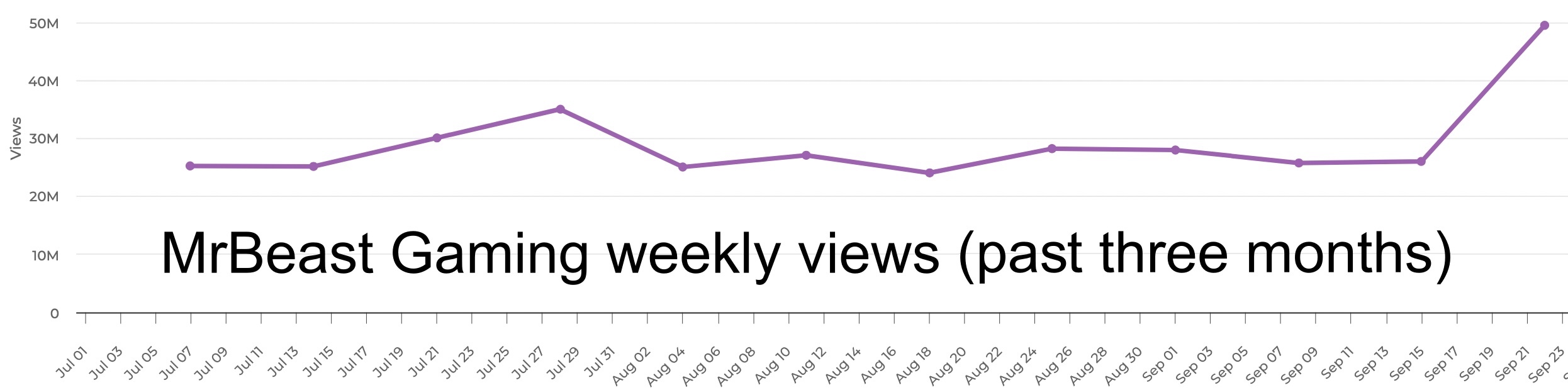
You might be surprised to hear that MrBeast is relevant even in this conversation. He’s not a sports creator himself, but on his MrBeast Gaming channel, he has started devising clever games that are bringing in even more subscribers beyond the OG MrBeast channel.
A Minecraft challenge embellished with real-world touches led the way as MrBeast Gaming brought in 500,000 weekly subscribers and reached 13th place in our corresponding chart. It really is the most MrBeast thing ever to look at the array of existing sports and think, “actually, I reckon I’ll make my own.”
Given how observant he is when it comes to YouTube trends, MrBeast must be noticing how well sports content is doing on Shorts. Is the time right for him to move into Jesser’s lane and dominate yet another category? I will remind you that Donaldson was a high school baseball player in North Carolina, and the MLB postseason is about to begin, so the time is right for a Beastly push into uncharted territory.
Channel Distribution
Here’s a breakdown of the Top 50 Most Viewed channels this week in terms of their countries of origin:
India: 17
United States: 12
Hong Kong and Mexico: 3
Australia, Brazil, and Indonesia: 2
Bangladesh, Canada, Czechia, China, Japan, Saudi Arabia, South Korea, Spain, and United Arab Emirates: 1
This week, 30 channels in the Top 50 are primarily active on YouTube Shorts.
As always, keep up to speed with the latest Tubefilter Charts and all our news by subscribing to our newsletter. You’re going to love it. 👉 Newsletter.Tubefilter.com.
[Editor’s Note: Tubefilter Charts is a weekly rankings column from Tubefilter with data provided by GospelStats. It’s exactly what it sounds like; a top number ranking of YouTube channels based on statistics collected within a given time frame. Check out all of our Tubefilter Charts with new installments every week right here.]
Scroll down for this week’s Tubefilter Chart. 👇
KIMPRO‘s weekly viewership is still at elite levels — or should I say 1337? The Korean short-form channel received 1.337 billion weekly views to reach the apex of our Global Top 50 while also making old-school internet hax0rs quite happy (iykyk).
Memes aside, it was a thoroughly competitive week in the Global Top 50. Channels needed at least 350 million weekly views to make the cut, and we’ve used the space below to highlight a few of the most impressive jumps we saw during the last week of September.
Can AI Jesus keep the honmoon sealed?
If you have young kids in your household, you won’t be surprised to hear that Kpop Demon Hunters is still one of the biggest things on the internet. Months after the Sony Pictures-produced, Netflix-distributed animated flick made a splash in the movie world and on the pop charts, creators inspired by it are still picking up hundreds of millions of weekly views.
The channel representing the KPop Demon Hunters fandom in this week’s Global Top 50 is Rumi and Demon, which already has nearly one million subscribers even though it only published its first video earlier this month. As its name implies, the channel is inspired by the lilac-haired protagonist of Kpop Demon Hunters, as well as her biggest secret (I would say “spoiler alert,” but given how ubiquitous this movie is, if you don’t know the main twists by now, I can’t protect you.)
Rumi and Demon videos harness the titular characters popularity by placing an impersonator into scenarios that require silly (and occasionally demonic) solutions. It’s a means of drafting off the popularity of KPop Demon Hunters while also playing to the large audience of comedy fans on YouTube Shorts, and it’s working. Rumi and Demon reached 22nd place in the Global Top 50 with 584.8 million weekly views.
Last time we talked about Kpop Demon Hunters, there were some devilish channels mixed in with the more straightforward fan accounts. This week, however, there are no such hubs to be found in the Global Top 50. Did the other major animated star of the week — AI-generated versions of Jesus Christ of Nazareth — banish the Kpop evildoers from the charts?
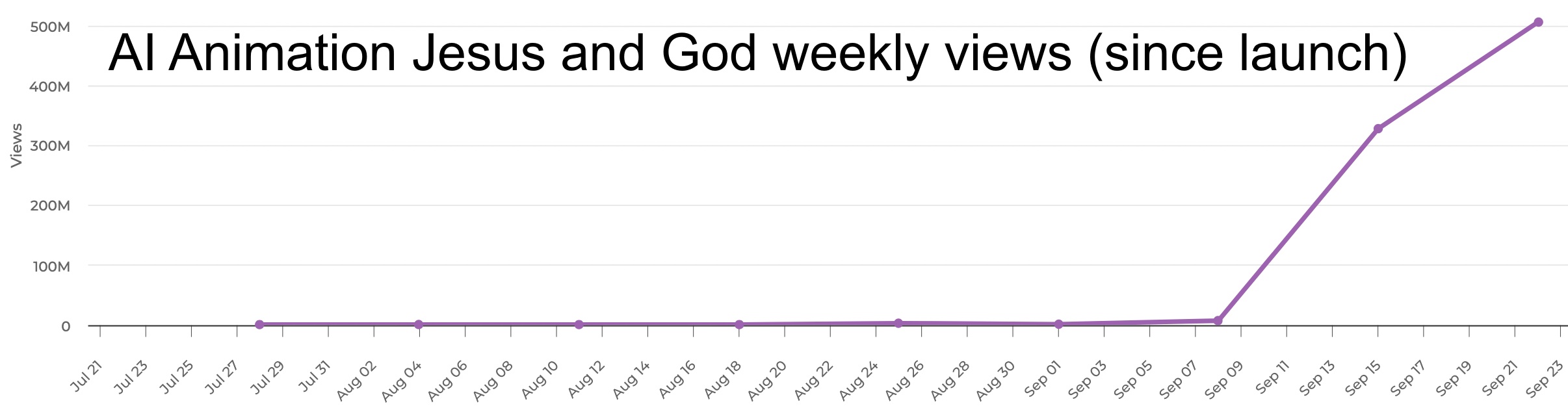
For as big as Kpop Demon Hunters is, AI Jesus is arguably even bigger. He is represented in this week’s Global Top 50 by a Danish channel called AI_Animation_Jesus_and_God. Bonus points for descriptiveness on that one. Even though this AI Jesus factory didn’t exist this time last year, it is all the way up in 20th place in the Global Top 50 thanks to its 613.3 million weekly views.
Data via Gospel Stats
The leading trio of Kpop Demon Hunters was already powerful to begin with, but if the girls now have AI God and Jesus on their side, will anyone be able to stop them? The honmoon figures to remain sealed for now, and these animated chart toppers show no signs of abandoning their positions.
Channel Distribution
Here’s a breakdown of the Top 50 Most Viewed channels this week in terms of their countries of origin:
India: 17
United States: 12
Indonesia: 4
Canada: 3
Australia and Pakistan: 2
Belgium, China, Denmark, Germany, Hong Kong, Japan, Russia, South Korea, Turkey,and Vietnam: 1
This week, 39 channels in the Top 50 are primarily active on YouTube Shorts.
As always, keep up to speed with the latest Tubefilter Charts and all our news by subscribing to our newsletter. You’re going to love it. 👉 Newsletter.Tubefilter.com.