Archive for 2025:

Top 5 Branded Videos of the Week: Cars, trains, and…pizza?

Welcome to our rundown of the most-watched branded YouTube videos of the week.

We’re publishing this snippet of a larger Gospel Stats Weekly Brand Report in order to analyze sponsorship trends in the creator economy. Any video launched in tandem with an official brand partner is eligible for the ranking.

And – as the name up above would imply – all the data comes from Gospel Stats. If you’re interested in learning more about Gospel – and which brands are sponsoring what creators on YouTube – click here.


Welcome back to our Gospel Stats Weekly Brand Report. If you’re a vehicle enthusiast, this week is for you–we’ve got frequent flyer Mat Armstrong back with another poor totaled Rolls Royce, Veritasium to explore the physics of railroad systems, and WhistlinDiesel with a no-holds-barred test of the Cybertruck‘s supposed invincibility. We’ve also got Drew Gooden with a crackdown on YouTube‘s AI thirst, and pizza enthusiast Charlie Anderson to share his experience opening his very own pie pop-up.

Check ’em all out right here:

#1 Whistlindiesel Cybertruck Durability Test #2
Channel: WhistlinDiesel
Brand: LF*GO!
Views: 10,593,034

As you may know, Cybertruck durability tests have historically gone…not very well for Tesla and its owner Elon Musk. But could this one be different? Offroad enthusiast WhistlinDiesel is no stranger to putting vehicles through their paces. He’s tested a Ferrari, a G-Wagon, monster trucks, a life-size remote-control tank (yes, really), and much more. All that is to say, he’s pretty tough on the toys in his garage. Whether or not Tesla’s famously fragile “truck” can compete–well, we won’t spoil. But we will say its high-octane adventures are appropriately sponsored by energy pouch company LF*GO!, which only paid for WhistlinDiesel’s vid this week.

#2 I BOUGHT A FLOOD DAMAGED ROLLS ROYCE CULLINAN & REBUILT IT IN 7 DAYS
Channel: Mat Armstrong
Brand: carVertical
Views: 7,777,469

Mat Armstrong is back and ready to rescue another Rolls Royce. Seeing these ultraluxury cars on his channel makes us cringe a little every time, not because we hate seeing Armstrong get ahold of them, but because we hate seeing what’s happened to cars worth hundreds of thousands of dollars. That is one appeal of Armstrong’s videos, though: they’re cathartic, letting viewers watch step by step as he returns a totaled car to its former glory. Like many of his previous restoration vids, this one is sponsored by crash history service carVertical.

#3 Why Don’t Railroads Need Expansion Joints?
Channel: Veritasium
Brand: Saily
Views: 4,164,584

And last but not least on the vehicle-enthusiast front, we have something for the train fans. Veritasium is one of the biggest science channels on YouTube, and appears on our Weekly Brand Report at least twice a month. This week? He’s sharing the physics behind train tracks and why they keep those massive cars running smoothly, without any need for expansion joints (aka gaps that allow for the metal tracks to shift, expanding and contracting as needed–except it isn’t needed!). We’ll let him do the explaining, all sponsored by e-SIM brand Saily.

#4 YouTube is obsessed with AI
Channel: Drew Gooden
Brand: SoFi
Views: 3,406,154

It’s no secret: YouTube is BULLISH about AI. Since ChatGPT hit the market, CEO Neal Mohan has spent a lot of time talking up YouTube’s artificial intelligence ambitions, all while promising to keep creators at the center of any developments. But do creators actually want all the tools YouTube is bringing out? An AI song maker, AI comment summaries, AI livestream summaries, AI audio dub tracks…It’s a lot, and more is in the pipeline. Drew Gooden‘s SoFi-sponsored video is a comprehensive (and, as usually, dryly funny) look at what one creator thinks of the AI takeover.

BONUS #995 What I’ve Learned Running a Pizza Pop-Up For a Year
Channel: Charlie Anderson
Brand: LMNT
Views: 40,839

As digital content has become more and more of a solid career, we’re finding that more and more creators use the skills they build managing their channels to start managing their own brands. That’s exactly what Charlie Anderson did. His content is all about pizza, and so he, of course, decided to open his own pizza joint. Obviously that’s easier said than done, and Anderson didn’t sugar-coat. His 13-minute video chronicles the struggles and successes of running a pop-up restaurant. And one of those successes? Raising nearly $27,000 on Kickstarter to help make his shop Good Pizza Cleveland a permanent fixture.


…and there’s a lot more data where that came from. If you’re interested in learning more about Gospel – and which brands are sponsoring what creators on YouTube – click here.
Top 50 Most Viewed U.S. YouTube Channels • Week Of 01/12/2025

[Editor’s Note: Tubefilter Charts is a weekly rankings column from Tubefilter with data provided by GospelStats. It’s exactly what it sounds like; a top number ranking of YouTube channels based on statistics collected within a given time frame. Check out all of our Tubefilter Charts with new installments every week right here.]

Scroll down for this week’s Tubefilter Chart. 👇


Two family channels have each unseated MrBeast at the top of this week’s U.S. Top 50. Toys and Colors, the well-coordinated media company that often winds up in the #1 spot, is there once again this week. J House jr. is right behind Toys and Colors, bumping MrBeast down to third.

Those three channels are in a tier of their own this week. They all got more than 500 million weekly views, and no other channels in the ranking even cracked 400 million.

42 channels in this week’s U.S. Top 50 operate primary on Shorts.

That’s one of the highest percentages we’ve ever seen in our charts, and it demonstrates just how saturated YouTube Shorts has become in the United States. If the federal TikTok ban goes into effect later this month, will Shorts’ share of top-performing YouTube channels get even higher?

#2 finisher J House jr. is an example of a kid-friendly channel that has exploded in popularity thanks to the Shorts boom, but it’s far from the only one. The family hub known as That’s Amazing was already thriving before YouTube Shorts existed, and the advent of YouTube’s TikTok competitor opened up new doors for the Amazing crew.

Consider the channel Colin Amazing, a spinoff of the That’s Amazing brand that focused on the family’s second-youngest sibling: the titular Colin. His prowess as a water bottle flipper now has him in the U.S. Top 50 separate from the rest of his family. Colin’s personal channel got more than 248.3 million weekly views and cracked the top ten in our all-American ranking.

Colin’s channel is all in good fun (though he should watch his knees on those soccer slides), and his sudden success shows that kids are hungry for YouTube content that helps them learn, explore, or try new things. Colin inspires his fans to be water bottle flippers, too, and based on the number of Top 50 channels that reference learning, there are a lot of youngsters who want to pick up new skills via YouTube.

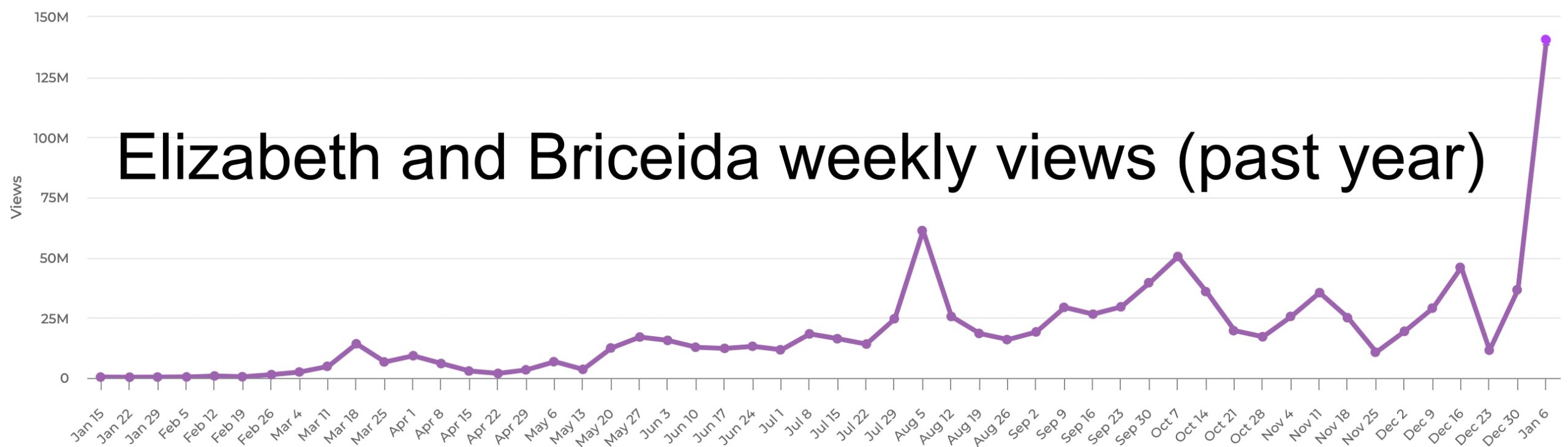
For another example of that phenomenon, we head to the long-winded hub Elizabeth and Briceida Learning & Fun. As more YouTube viewers look to learn, E & B have suddenly found themselves with way more views than they counted before.

And again — this is all in the pre-TikTok ban world. YouTube’s status as the premium short-form entertainment hub for young children is looking good.

Channel Distribution

This week, there are 42 YouTube Shorts channels in the U.S. Top 50.

As always, keep up to speed with the latest Tubefilter Charts and all our news by subscribing to our newsletter. You’re going to love it. 👉  Newsletter.Tubefilter.com.

Top 50 Most Viewed YouTube Channels Worldwide • Week Of 01/12/2025

[Editor’s Note: Tubefilter Charts is a weekly rankings column from Tubefilter with data provided by GospelStats. It’s exactly what it sounds like; a top number ranking of YouTube channels based on statistics collected within a given time frame. Check out all of our Tubefilter Charts with new installments every week right here.]

Scroll down for this week’s Tubefilter Chart. 👇


This week’s ranking of the 50 most-watched YouTube channels of the week is led by the nine channels that earned at least 500 million weekly views. At the top of the ground sits T-Series. The Indian record label, a regular chart-topper in this space, consolidated its existing lead by getting 951.3 million weekly views.

Indian music videos seem to be the only fare that consistently drums up that sort of viewership, but creators are looking to push the limits of safety in search of viral fame and fortune. This week, that phenomenon came to YouTube Shorts.

I hope this creator never shows us his full power

A surging hub called Experiment Channel enjoyed one of the biggest gains in this week’s Global Top 50. By getting 67% more traffic than what it earned a week ago, this unnamed experimenter moved from 149th in our ranking up to 45th. He topped out with a total of 261.2 million weekly views.

Like so many YouTube Shorts success stories, much of Experiment Channel’s viewership comes from a small number of mega-popular clips. Here, a single video has nearly three times as many views as any other upload by the same creator, and when you watch it, it’s not hard to figure out why. That’s the video in which the Experiment Channel host cracks his phone by using exactly 69% of his power.

If that’s what 69% power looks like, 100% of this explosion could be downright dangerous. Maybe it’s time the Experiment Channel to move onto other types of content that don’t put lives at risk.

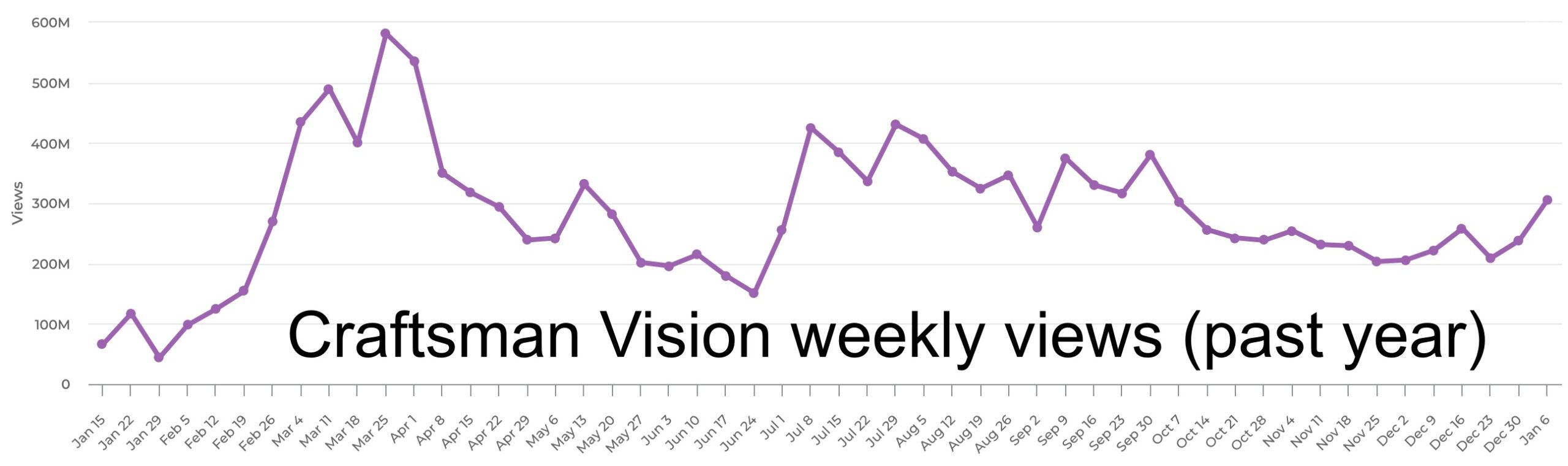
The pros are more than capable of satisfying viewer interest in homemade destruction. The Craftsman Vision channel, which hit a high point last year with its engineering content, is surging once again and destroying objects in a much more controlled fashion.

If you do want to try to replicate the Experiment Channel’s results at home, be very careful. YouTubers have been injured and killed while pursuing thrills, and it’s necessary to take safety precautions when possible.

Channel Distribution

Here’s a breakdown of the Top 50 Most Viewed channels this week in terms of their countries of origin:

  • India: 14
  • United States: 10
  • Hong Kong and Indonesia: 4
  • Vietnam: 3
  • Pakistan: 2
  • Argentina, Belgium, Canada, China, El Salvador, Japan, Kazakhstan, Mexico, Puerto Rico, South Korea, Thailand, and United Kingdom: 1

This week, 36 channels in the Top 50 are primarily active on YouTube Shorts.

As always, keep up to speed with the latest Tubefilter Charts and all our news by subscribing to our newsletter. You’re going to love it. 👉  Newsletter.Tubefilter.com.

Will YouTube be the new TikTok? It’s pushing longer Shorts and more creation tools

As the legal hammer potentially comes down on TikTok, YouTube is expanding three-minute Shorts to all users.

This is a stark illustration of the fact that even if TikTok vanishes from U.S. soil, it has left a permanent mark on U.S.-based digital platforms. When TikTok’s user base began to grow exponentially in 2020, YouTube, Instagram, Snapchat, and more all recognized it for the burgeoning competitor it was and rolled out their own copycats, attempting to capture some of the short-form fervor.

But as competitors went shorter, TikTok got longer: Over the last four years, it’s consistently pushed its max video time limit from just 60 seconds to 30 minutes.

That posed a problem for creators who wanted to crosspost their content from TikTok to YouTube, since YouTube Shorts has always had a one-minute max video time. We’ve seen thousands of videos that abruptly cut off because they were crossposted from TikTok…which likely means some YouTube viewers ended up over on TikTok, looking for the full uploads (and maybe continuing to watch more content there instead—a loss for YouTube).

Now, YouTube Shorts is softening that problem by allowing three-minute uploads.

YouTube’s Creator Liaison, Rene Ritchie, tweeted about how this is the fourth stage of a rollout first announced in October. The previous three stages were about shifting some longer (but still short) vertical videos into the Shorts feed.

So, to be clear, YouTube is backdating this change: any vertical or square VODs that are three minutes or less in length now automatically count as Shorts, whether creators want them to or not. They’ll appear on the Shorts tabs of creators’ channels, and will pop up when users are swiping through the Shorts feed.

The fourth stage also comes with updates to YouTube’s in-app Shorts creation tools to “support up to 3-minute Shorts, so in addition to uploading them, you’ll be able to make them right in the YouTube app as well,” Ritchie said.

It seems clear that YouTube is aware it will become the top short-form platform if TikTok is banned. But will these changes be enough to charm TikTok users after they’re stranded? Some replies to Ritchie’s tweet include complaints about midroll ads on longer Shorts, and at least one creator (The Bentist, who has 7.44 million subscribers) said he feels longer Shorts are “not ready algo wise.”

“So we tested this for 1 month and our analytics dropped over 60% including revenue,” he tweeted. “Went back to sub 60 chain and trying to recoup the losses.”

YouTube hasn’t said yet if it plans to further raise the time limit threshold on Shorts. Whatever happens, though, the platform is now in a place it wouldn’t have been without TikTok—and we’ll see whether that proves a net positive in the coming years.

Have you heard? MrBeast gives permission to repost his videos, and Nelk gives vapes to villagers.

Each week, we handpick a selection of stories to give you a snapshot of trends, updates, business moves, and more from around the creator industry. This week, creators are popping up on your flight, making acquisitions, and starting intercultural disputes.

Creator commotion

MrBeast “wouldn’t mind” if you reposted his content. In response to a poll on Marques Brownlee’s X feed, Jimmy Donaldson gave his fans permission to reupload and react to his videos. He seems to see it as free promotion, though creators with fewer than 300 million subscribers might not agree.

Vexbolts lost a million subscribers and still came out a winner. A viral TikTok campaign called the “Vexbolts Mass Unfollowing” – intended to troll influencer Vexbolts for his “cringeworthy” trend-hopping and meme-chasing – saw millions follow him in December 2024 just to unfollow him on January 1. His follower count on TikTok skyrocketed from 1 million to over 5 million before the unfollowing commenced. But the stunt backfired as only about a million of the new subscribers ended up leaving Vexbolts at the start of 2025. He’s now sitting happily at more than 5.1 million followers.

Ja-son De-ru-lo will host TikTok’s next global music event. The Global Live Fest is moving to London and passing emcee duties to TikTok’s favorite pop star-turned-memelord. Swedish singer-songwriter Zara Larsson has been announced as the headliner.

Movers and shakers

Alex Cooper’s Unwell Network goes sleuthing. The Call Her Daddy star has already launched original shows helmed by social media stars like Alix Earle and Harry Jowsey. Now she is turning her gaze to the world of true crime, where Unwell has found its first two podcast acquisitions.

Brat TV acquires, renames Electric Monster. The video brand “supercharger” that acquired React Media (formerly Fine Bros Entertainment) is now owned by the studio behind Gen Z-facing hits like Chicken Girls. Electric Monster will now be known as ZATV, and we may be headed for a different kind of Brat summer in 2025.

TikTok’s U.S. Agency Lead reads the writing on the wall. Brand wrangler Jack Bamberger left TikTok on January 3, 16 days before the app will likely be shut down in the United States. All those agencies will have to go elsewhere; the question is where?

The biz

YouTube hunts for live shopping dollars in Southeast Asia. ByteDance makes billions from ecommerce sales in nations like Indonesia, Singapore, and Vietnam. YouTube is hoping that its partnership with Shopee will help it cut into TikTok’s dominant market share.

TV is chasing YouTube now. While YouTube goes to Asia in search of ecommerce revenue, everyone else back home is trying to be the next YouTube. Long gone are the days when we wondered if YouTube would be the next TV; instead, the legacy media giants of today are trying to figure out how to reverse the forces that are sending advertisers to YouTube’s TV apps.

Amazon is back at the upfronts. The tech giant previously made its debut at the digital-oriented NewFronts in 2021. Its return to upfronts week comes as it chases traditional media buys for its now-ad-supported Prime Video service.

The latest tech

YouTube is on your seatback screen on Delta flights. The airline announced at CES that it will soup up its in-flight entertainment experience with help from YouTube’s vast video library. Delta even shelled out to give its fliers YouTube Premium. I wonder if it paid for the deal with SkyMiles.

Music publishers settle with AI company Anthropic. The publishers, including Universal Music Group, don’t want Anthropic’s AI bot Claude to provide users with song lyrics from their artists. In Claude’s defense, today’s pop lyrics are not too hard to think up on your own.

Keyboard modders are showing off tricked-out setups on YouTube. Videos related to mechanical keyboards got more than one billion views in 2024, according to YouTube. Come for the detailed build tutorials, stay for the keyboard ASMR.

The internet is a strange place

Nelk decided that remote Fijian villagers deserve vapes. The rambunctious creator group visited a community that has only had one Western visitor in 30 years, and Nelk immediately brought the tribe into the present day by giving them vapes. Now that they’ve started vaping, the villagers will have a competitive esports team in no time.

Interactive YouTube video games are back. Who needs the Playables hub? Clever creators have been making playable YouTube videos since 2008, and the latest example of that curiosity is a rhythm game set to Coldplay’s “Viva La Vida.” Make sure to set your playback speed to 1.8x for the best experience.

Want to make a TikTok hit your campaign song? Read the lyrics first. The U.K. Labour Party came under fire for posting a TikTok that featured a song with wildly explicit lyrics (in Portuguese). Somehow, the AI-generated law enforcement officials aren’t the most horrifying part of that video.

Is Twitch viewership at its lowest point in four years?

Something interesting may have happened on Twitch in December.

Over the course of the month, the platform accumulated 1.58 billion hours of watch time–apparently its lowest monthly total in over four years (since July 2020), according to Streams Charts. But, at the same time, Twitch also saw an uptick in new streamers joining, and an uptick in the average number of concurrent channels live at any one time.

We say this may have happened because we can’t independently verify Twitch’s total watch time, and Streams Charts has previously reported watch time totals that were lower than estimates from other analytics companies like TwitchTracker and Rainmaker.gg.

Streams Charts pointed out that it’s normal for December to be a slow month online, since both streamers and viewers are often AFK taking part in winter holidays. But what’s not normal is a year-over-year drop–and that’s what Streams Charts says Twitch saw. It averaged Twitch’s watch time totals from December 2020, 2021, 2022, and 2023, and says 2024’s total is 11% lower.

It’s not clear what’s contributing to this potential drop. Twitch is in a tough financial situation right now, and it’s been in hot water with streamers and viewers a few times this year over policy decisions, but we’re not sure backlash against it using AI to make emotes would cause a viewership dent this significant.

Streams Charts didn’t offer a theory, but did mention that one of Twitch’s biggest streamers, Kai Cenat, didn’t stream as much as usual in December. While that would potentially knock a couple million watch hours off Twitch’s total, we don’t think the full drop percentage can be attributed to him, either.

What’s also worth focusing on here is the other half of Streams Charts’ findings: the fact that more people are joining Twitch and going live.

In both October and November 2024, around 89,000 channels on average would be live on Twitch at any one time. In December, that figure pushed up to 92,392. Twitch also saw a bump in the overall number of active channels from 4,490,725 in November to 4,777,395 in December—a 6% increase.

Streams Charts notes that all these streamers broadcasted a more diverse range of content of content than usual.

“[I]t’s important to note that other key metrics for both viewer and streamer activity remain strong,” it wrote in a report about December’s viewership. “A positive takeaway from December was the variety of content on offer. Streamers broadcasted in 43,200 different categories, the highest figure of the year, second only to March.”

Just Chatting was the top category with 250.93 million hours watched, while Grand Theft Auto V was second with 99.06 million. Newly released games Path of Exile 2 and Marvel Rivals came in at #3 (69.99 million) and #7 (51.06 million), respectively.

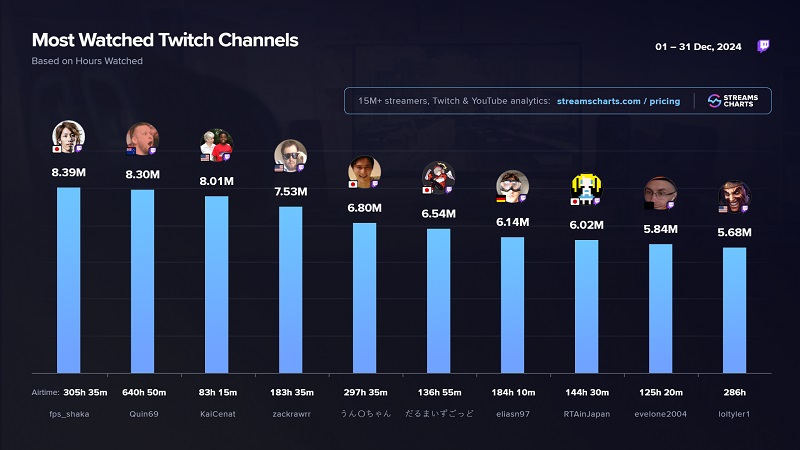
There were noteworthy trends in who was streaming in December as well. Not one, not two, but four Japanese streamers were in Twitch’s top 10 most-watched of the month: fps_shaka, Junichi Kato, darumaisgod, and RTAinJapan.

GTA streamer fps_shaka was actually #1 across the entire platform, generating 8.39 million hours of watch time. Cenat, despite slowing things down from streaming 24/7 during his subathon, was still #3 with 8.01 million hours watched:

We’re curious to see (providing Streams Charts’ numbers are accurate) if Twitch’s viewership stats will recover in January, or if this is a more lingering slump. It’s worth noting that while a slump could indicate competitors like YouTube, Kick, and Rumble taking more market share from Twitch, several major streamers who previously transitioned to other platforms, like Ludwig and Valkyrae, have returned in the wake of their deals with those platforms expiring.

So, Twitch is clearly still offering something streamers want—but maybe it has to do more work to keep viewers coming back.

Pickles, cherries, and cream sodas: Pinterest thinks 2025’s trends will be colorful and delicious

According to Pinterest, last year’s cucumber craze is going to get pickled in 2025.

The digital pin board has revealed a stylish list of the fashion trends that are due to dominate feeds in the coming months. Pinterest’s predictions are based on search frequency increases for related terms.

Among the upcoming trends Pinterest has pinned for us, a surprising number relate to beverages. On-platform search traffic went up for cherry martinis (+80%) and pickle margaritas (+100%) between September 2022 and August 2024. Pinterest users also hunted for the “cream soda aesthetic” (+105%) and paired their beverages with a slice of “rat cake” (+170%).

Pinterest’s preferences for cherry red and pickle margarita green may seem like mere curiosities, but the brightly-colored predictions list reflects broader cultural shifts among Gen Z and Millennials (who happen to be the two largest cohorts on Pinterest). Many of 2024’s start-of-year outlooks predicted that sustainability would become a stronger belief among those generations. According to Pinterest, that trend will continue to point up in 2025. Nostalgic, retro preferences will bring old fashions back into style, offering more opportunities for resource-conscious outfits and decorations.

Pickles — which “will be in absolutely everything” in 2025, Pinterest claims — are one part of that nostalgic obsession. So are rising search terms like “rococo wedding” (+95%) and “boho fits” (up nearly eight times over).

Based on Temu’s success with influencer marketing partnerships, I’d argue that Gen Z and Millennials’ turn toward sustainability is still a work in progress. If you’re tired of thrifting and looking back on days gone by, you can join the Pinterest users who are embracing the future. “Solarpunk houses” (+80%) and “skirt codes” for Roblox (+100%) are trending up, so even if some people want to stay in a pickle, new looks are bound to emerge.

As TikTok ban looms, other platforms are rushing in to court displaced creators

Barring an intervention from the U.S. Supreme Court, a law that would force a divestiture or ban of TikTok will go into effect on January 19. TikTok’s rivals in the social media world seem to feel that the upcoming ban is a fait accompli. Platforms as diverse as Triller and Peacock have announced programs and products that could allow them to bring in displaced creators in the wake of the TikTok ban.

Replacing TikTok is the hot new tech trend

Ever since a U.S. District Court ruled that the proposed divest-or-ban law is constitutional, U.S.-based TikTok creators have started preparing for a future in which the popular video app is unavailable. Brands are also preparing to jump ship if the Supreme Court chooses not to rescue TikTok.

In recent weeks, platforms have followed suit, and Triller’s plan for a TikTok-less U.S. is particularly intriguing. Fresh off its IPO, the headline-grabbing tech company has launched savemytiktoks.com. Powered by Triller’s proprietary technology, the self-explanatory site gives users a way to save their work — and it just so happens that those videos can be seamlessly migrated to Triller.

The potential ramifications of a TikTok ban have affected the discourse at the Consumer Electronics Show as well. As in previous years, the annual Las Vegas tech showcase featured some new products that replicate aspects of TikTok’s powerful feed. NBCUniversal’s announcement of vertical video playlists on Peacock is a good example.

But those products look a bit different this year than they did during previous CES presentations. Instead of trying to copy TikTok, Big Tech firms are angling to replace it.

Large platforms are most likely to benefit from a TikTok ban

So says eMarketer, which published a speculative report on the potential reallocation of marketing dollars that currently go to TikTok. According to eMarketer, approximately 50% of that pie will go to YouTube, Instagram, or Facebook. Meta and Google wouldn’t be the only winners. The eMarketer projections show that more than 30% of TikTok spend would end up on non-YouTube connected TV platforms or other channels outside the realm of social media.

It seems clear that, in the event of a TikTok ban, the rich would get richer. That proposed trend provided a partial explanation for Donald Trump‘s unexpected status as a TikTok supporter. The president-elect explained that he doesn’t want to ban the ByteDance-owned app because that would cede power to Mark Zuckerberg’s Meta — a company that previously suspended Trump’s accounts across multiple platforms.

Now that Meta has chosen to align with the incoming regime by stripping its fact-checking services, will Trump start singing a different tune? Maybe he won’t mind after all if Meta sucks up reallocated marketing money.

Could ByteDance replace itself?

What if the successor to TikTok is owned by the same company? These questions have become more relevant as Lemon8, a ByteDance-owned Instagram competitor, gains traction among U.S. users.

This isn’t the first time that Lemon8 has been proposed as a TikTok successor, but there are a few roadblocks that figure to stall the upstart app in the U.S. For starters, it too would be affected by the ban. The federal law can apply to any app with significant ties to a “foreign adversary,” and any properties owned by Beijing-based ByteDance would theoretically fall into that category.

The other issue is more philosophical: Lemon8 isn’t that exciting yet. It cooled off significantly after experiencing its first growth spurt in March 2023, and it only regained widespread public attention because of the looming nature of the U.S. TikTok ban.

Of course, TikTok itself has its own preparations to arrange before January 19. It has announced that it will cease U.S. operations unless the Supreme Court delays the law’s enactment. Given the potential economic impacts of the ban, its fading public support, and Trump’s stated desire to save TikTok, the incoming statute could become sour shortly after going into effect. ByteDance’s best move may be to wait it out, but other platforms clearly have their own ideas.

Meet the company making Skibidi Toilet a toy-aisle bestseller

In spring 2023, DaFuq!?Boom! became one of the most-watched YouTube channels in the entire world. Between January and May, it shot from getting 3 million views a month to nearly 3 billion, and cemented one word in the minds of all those hundreds of millions of viewers:

Skibidi.

Plagued by recurring nightmares of hands and heads coming out of toilets, animator Alexey Gerasimov (the creator behind DaFuq!?Boom!) had decided to exorcise them by turning them into short animated clips. In the very first, 11-second Skibidi Toilet video, the viewer swings through what looks like an office building (complete with tiny suited man) and into its bathroom, where a head pops out of the toilet singing a popular TikTok mashup of Timbaland’s “Give It to Me” and Biser King’s “Dom Dom Yes Yes.”

The next few videos were similarly simple, and set the tone for Skibidi Toilet as a lo-fi, surreal, dystopian world. But the human-headed toilets weren’t this world’s only inhabitants, and it wasn’t long before Gerasimov started introducing more lore. As the toilets tore through cities, spreading chaos, people with security cameras and TVs for heads surged onscreen, becoming the franchise’s protagonists. In later episodes, their battles would escalate to all-out war, with kaiju-sized toilets beaten down by enormous camera-headed mechs.

The internet was captivated.

And so was Bonkers Toys.

The San Diego-based company was founded in 2015 by CEO Brian Bonnett and got into the YouTube space back in 2018, when it became the first producer of official Ryan’s World toys in partnership with the Kaji family and pocket.watch. It went on to work with creators like Moriah Elizabeth, FGTeeV, Aphmau, LankyBox, Addison Rae, and Ninja Kidz, and is always keeping an eye out for YouTube-based IPs it thinks could dominate big-box toy shelves.

The moment Skibidi Toilet crossed its radar, it knew Gerasimov’s idea had the juice.

“We saw it, and we were like, ‘This is right up our alley,'” Dan Meyer, Bonkers’ Head of Brands, tells Tubefilter. “It has all these elements that are very ‘toy-etic,’ elements of a great action figure toyline. It has battling, good character development, things that are unexpected. Massive fanbase, massive viewership. All the ingredients. We said, ‘Let’s go after this.'”

By that time, Gerasimov had partnered with Adam Goodman‘s digital production company Invisible Narratives, of which Transformers and Teenage Mutant Ninja Turtles director Michael Bay is the Chief Creative Officer.

Bonkers’ reputation with content creators got it in the door for a pitch, and it decided to take a different approach from the “traditional action figure play,” Meyer says, where a line of toys is usually one of five or six in a company’s portfolio. Instead, Bonkers said it would make Skibidi Toilet the sole focus of its summer 2024 production efforts.

Invisible Narratives and Gerasimov agreed, and Bonkers got to designing. For the first Skibidi line, it decided to tap the enduring popularity of blind boxes and came out with minifigure and plush mystery packs. Then there was the marquee item: the Mystery Surprise Toilet, which is a foot tall and comes preloaded to pop out one of the series’ head characters.

It was made to stand out in stores. “Imagine, a closed toilet on a toy shelf,” Meyer laughs. “And it does have a handle, so you push and it flushes.”

Opening up the toy’s tank will reveal bonus minifigures, stickers, and a collectible lanyard.

Meyer says the Mystery Toilet was Bonkers Toys’ #1 best-selling item for Black Friday 2024. It also became the #1 new release on Amazon in the Action Figure category following its launch in October. Separately, Walmart confirmed the Skibidi line was one of its top-selling toy brands from October through December.

Bonkers doesn’t release revenue figures, so we don’t know how much this endeavor is making for it and for Gerasimov, but Meyer does say Bonkers is the second fastest-growing toy company in the world, and that it’s “competing with all the big guys” like Hasbro and Mattel, with shelf placement in the aforementioned Walmart, Target, and more.

Based on Skibidi Toilet’s digital and toyline success so far, Bonkers and Invisible Narratives have big plans for the franchise’s future. Gerasimov (whose channel brings around 200 million views a month currently) is working with Invisible Narratives and Bay on upcoming Skibidi Toilet episodes, as well as a potential TV series and film, both with Bay’s involvement. Bonkers, meanwhile, has 15 more Skibidi SKUs debuting over the course of 2025, and is also involved in the franchise’s creative direction.

“It’s awesome because from a toy company standpoint, we are supporting the world Michael [Bay], Adam [Goodman], and Alexey [Gerasimov] are creating,” Meyer says. “There’s so much ahead for Skibidi, it’s really blazing a trail in content and toy development.”

Skibidi fan creators get in on the action

Another area where he sees Skibidi Toilet being ahead is grassroots marketing on YouTube. As with any popular IP, Skibidi has seen a rise in knockoff channels that make their own videos in Gerasimov’s hallmark style, using the same audiovisual assets. While there could be an argument that some of these videos are legally protected as transformative works, Invisible Narratives has registered copyrights for a number of Skibidi Toilet’s characters and components, so could file DMCA claims and get YouTube to take down these fan creators’ channels.

Instead, it formed The Alliance.

Named after the camera- and TV-headed force that battles the toilet-heads, The Alliance is a network of YouTube creators who are allowed to post Skibidi Toilet videos without getting copyright claimed.

“At Invisible Narratives, when appropriate, we empower creators to build on our IP because collaboration drives opportunity. When creators engage with our brands authentically, it resonates with our fans and keeps our stories evolving,” Goodman tells Tubefilter.

And those Alliance creators truly are building: Together, the 40 channels in the program generate upward of 1.5 billion views per month.

Ultimately, Meyer says, the Skibidi Toilet universe is emblematic of where Bonkers thinks the toy industry is heading with Gen Alpha.

“Kids these days, fans these days, care about legacy brands like Star Wars a little bit,” he says. “But what’s ballooning, skyrocketing, are these creator brands.”

Ruby Franke’s oldest daughter has authored a telling memoir — and a cautionary tale for family vloggers

An eyewitness account of Ruby Franke‘s misdeeds has arrived on bookshelves nationwide. Shari Franke, the oldest daughter of the disgraced family vlogger, shares recollections from the Frankes’ Utah home in The House of My Mother, a memoir that became available on January 7.

The allegations against Franke and her business partner Jodi Hildebrant — which ranged from “physical torture” to “severe emotional harm,” according to court documents — unfolded into a widely covered case. The trial and Franke’s subsequent guilty plea raised ethical questions about the practice of family vlogging and children’s involvement in it. Franke and Hildebrandt are both facing prison sentences that could last as long as 30 years.

By the time Shari Franke left her mother’s house to attend Brigham Young University, she had already faced “really scary” behavior that included “physical” retribution and psychological abuse, she said during an interview with Good Morning America. “I think that she’s as sorry as she can be,” Shari said of her mother. “What she’s done is so bad that I don’t think her mind allows her to fully comprehend the guilt of all that.”

Shari used her personal Instagram page to document her family’s fraught life for more than 500,000 followers. Now, as she prepares to graduate from BYU, she’s speaking out about the predatory and exploitative nature of family vlogs. In an interview with Rolling Stone, she stated her belief that those channels cannot be produced ethically. “Making money off your kids [with] no oversight as to how much the kids are getting paid — there’s no way to do that well for me,” she said.

Some states, such as Illinois, have passed laws that require parents to allocate a portion of social media revenue to the underage children who appear in those posts. Shari Franke testified in Utah when her home state held a hearing to determine if it should adopt a similar measure to the Illinois law.

Even if a law of that type went into effect nationwide, Shari would still sound the alarm about family vlogging. “The consequences of it, growing up with your whole life online, I don’t think any amount of money would justify that,” she told Rolling Stone.

Ultimately, even if children are compensated for their appearances on platforms like YouTube, viewers can’t see the environment in which those videos are produced until it’s too late. That duality is something Shari Franke knows well, as her mother only rolled the camera on a “very selective” basis. “I don’t like to watch old vlogs because I don’t really remember the things that were filmed,” Shari said, “but I can remember the behind-the-scenes of like, “Oh, this was the day that Ruby was yelling, and that wasn’t shown, but that’s all that I can remember about it.”

The PGA Tour’s creator circuit is teeing off

Golf creators are due for a big year in 2025 — as long as they can make the cut.

The PGA Tour has announced that it will host three creator-centric tournaments across the upcoming calendar year. After going live with its inaugural Creator Classic in 2024, the world’s preeminent golf organization (sorry not sorry, LIV) is tripling its output of influencer overtures.

The first Creator Classic took place at the PGA’s Tour Championship last August. That pairing will return in 2025, and the PGA will add Classics adjacent to its Players Championship and Truist Championship. As a result, more than 20 golf influencers will get chances to compete against their fellow creators at events in Atlanta, Philadelphia, and Jacksonville.

The PGA’s efforts to connect with the rising crop of golf influencers have been multifaceted. The establishment of a Creator Council — which features some of the top names in YouTube’s golf scene — allowed the North American organization to get crucial advice as it reaches out to younger golf fans.

The Creator Classic, won in its first year by pro Luke Kwon, is one of those outreach efforts. As the influencer tournament scales up for its second year, established golf channels are concocting ideas that will bring novelty to the event series.

The stars of Good Good, a popular channel that has hosted its own creator golf tourneys, want the PGA Tour to inject more excitement into its influencer-facing proceedings. Good Good Co-Founder Garrett Clark told The Guardian that the first iteration of the Creator Classic “missed what made us special.” Good Good Creative Producer Max Putnam suggested that the PGA Tour can “bring more personality” to the tournament by adding touches like a “Cart Cam” and miced-up players.

The broadcast details for the upcoming trio of Creator Classics suggest that the PGA Tour will heed Good Good’s advice and turn its new series into a spectacle. YouTube, ESPN+, and Peacock will serve as distributors for the 2025 Creator Classic slate.

But even with some powerful broadcast partners signed on, will the Creator Classic be able to outdo efforts by independent creators? Grant Horvat recently got more than one million YouTube views in a single day by collaborating with the biggest name in golf: Tiger Woods.

At the Players Championship in March, we’ll learn how the PGA Tour’s creator-led efforts stack up against videos like these. The Creator Classic would definitely level up if Tiger Woods was on the player list, but the 49-year-old legend may need to launch his own YouTube channel first.

AI companies want digital content to train their models. RHEI’s new platform lets creators license it to them.

The creator-focused media and tech company formerly called BBTV has rebranded to RHEI, and today announced the launch of RHEI Data Pro, a data monetization platform it says can help creators earn up to $100,000 for every 1,000 hours of content they produce.

How? By licensing that content out to companies making generative AI models.

Shahrzad Rafati, founder and CEO of RHEI, tells Tubefilter Data Pro is launching with over $35 million in committed partnerships with AI companies, and that “a large number of content creators already have participated, both the existing creators we’ve worked with previously as well as new content creators.”

Generative AI’s rapid development over the past couple of years has given rise to creator concerns that models made by major players like OpenAI may have been trained on their content without their consent. Rafati says RHEI acknowledges those concerns, and views generative AI as an important avenue for creator monetization, so long as creators are able to control who uses their content and are appropriately compensated when it is used.

“RHEI is committed to ensuring that creators are empowered to actively take part in the evolution of AI by ensuring they are fairly compensated when their content and data fuel innovation,” Rafati says. “The increasing symbiosis between AI and human creativity is very exciting, and we developed RHEI Data Pro to create new revenue pathways for creators based on the years of work they’ve already put into their craft.”

RHEI is only partnering with companies that train their models on data given with consent (“as far as we know,” Rafati notes), and Data Pro is a path for creators of all sizes to give that consent.

“At the end of the day, a platform is not going to work directly with someone who has 5,000 hours of content, or 200 hours of content,” Rafati says. “So for us, one of the biggest pieces here is that we’re making this accessible to any creator, regardless of their size. If you have 500 good hours on fishing, it’s as valuable as someone who has maybe 10,000 hours of content, or 200,000 hours of content. It gives access to smaller creators.”

RHEI hasn’t revealed which companies it’s partnered with so far, but Rafati refers to them as “trillion-dollar technology businesses.” There are only 10 publicly traded companies in the world worth a trillion dollars, and among them are Amazon, Microsoft, YouTube‘s parent Alphabet, Apple, Meta, and Tesla.

These companies, Rafati says, are only the beginning. “We feel this is going to be a truly recurring revenue stream for content creators, because we’re not just looking at the foundational models, we are looking at every technology company and app that is going to be using their data for training purposes,” she explains.

When a creator decides they want to license their content to one (or more) of RHEI’s Data Pro AI partners, RHEI has a “large data team” that jumps into action, Rafati says. The team will take the creator’s videos, package them, make sure they’re “amplified with right metadata,” then send it over to the partner. The creator is largely hands off; they give consent, and then get paid a flat rate per hour of content licensed. They also retain all ownership rights to their videos.

In exchange for providing Data Pro and for packaging the videos, RHEI takes a cut of the flat rate the AI company pays to the creator. It isn’t publicly disclosing what that cut is.

RHEI has made several strategic pivots over the years, including a period where it was the internet’s largest multichannel network. Data Pro is the first development in what Rafati says is RHEI’s next evolution, “pioneering the symbiosis between technology and human creativity.”

Lewis Ball, RHEI’s Chief Strategy and Product Officer, adds that RHEI sees an opportunity to “redefine the role of data–transforming it into a lucrative revenue stream for creators and content owners.”

“We are no longer in the creator economy,” Rafati says. “This is what we call the ‘augmented creativity era’–because it is truly AI and creators working together.”

RHEI says it already has 5 petabytes of content available for AI companies to use in training. Creators/content owners interested in adding theirs to the pool can apply for Data Pro here: datapro.rhei.com.


RHEI is a Tubefilter partner.