Archive for 2025:

Top 50 Most Subscribed YouTube Channels Worldwide • Week Of 11/30/2025

[Editor’s Note: Tubefilter Charts is a weekly rankings column from Tubefilter with data provided by GospelStats. It’s exactly what it sounds like; a top number ranking of YouTube channels based on statistics collected within a given time frame. Check out all of our Tubefilter Charts with new installments every week right here.]

Scroll down for this week’s Tubefilter Chart. 👇


YouTube viewers are taking John Fairclough home for the holidays. One week after he surged onto our radar thanks to MrBeast-level subscriber gains, Fairclough has reached the #1 spot in our Global Sub Top 50 ranking. With his motivational short-form content, Fairclough brought in more than 2.3 million new subscribers during the week that was.

No other channel even managed to get 50% of that total, but Fairclough isn’t the only success story in this week’s ranking. With the holiday season in full swing, people around the world are double-checking their finances — at least according to the latest chart trends.

In South Asia, the creator economy lives on YouTube Shorts

India and Pakistan are not exactly the best of friends, and one recent rivalry between the two South Asian nations is playing out on YouTube. That’s where channels affiliated with major banks have become unlikely entrants in the Global Sub Top 50.

Let’s look first at Pakistan’s Allied Bank (not to be confused with the U.S. brand Ally Bank), which ranked 41st in the final Global Sub Top 50 chart of November. On its primary YouTube channel, Allied Bank added 240,000 new subscribers in a single week, pushing its lifetime total above 3.5 million.

How exactly is Allied Bank outpacing popular characters like Rumi and Ronaldo in our charts? The answer could involve the brand’s activity on YouTube Shorts, where it tells stories about small business owners. Those tales don’t just provide positive PR for the bank that sponsors them; they also reel in millions of views.

Not to be outdone, India’s financial scene is also represented in the Global Sub Top 50. The State Bank of India finished 31st in the ranking after adding 290,000 new subscribers at the end of the 11th month.

Like its Pakistani counterpart, the State Bank of India uses YouTube Shorts as a repository for its branded content endeavors. It has introduced animated mascots who share cybersecurity tips, and it occasionally posts public service announcements related to topics like deepfakes.

Other YouTube videos on the State Bank of India suggest that the holiday season could be playing a role in the sudden surge of South Asian financial channels. The final months of the year are a crucial period for any and all players in the world of ecommerce, and the State Bank of India certainly fits that bill. It even promoted a credit card that offers benefits to anyone who might be travelling internationally around the time of Christmas.

Data via Gospel Stats

We can’t say for sure that holiday shopping trends are pushing India and Pakistan’s banks toward the top of the charts. Other factors, such as recent extensions to Indian tax deadlines, must be considered as well. In general, however, the link between annual gift-giving celebrations and the global creator economy is too big to ignore. The companies that can recognize that connection have a chance to make bank — no pun intended.

Channel Distribution

Here’s a breakdown of the Top 50 Most Viewed channels this week in terms of their countries of origin:

  • India and United States: 10
  • Brazil: 6
  • Australia, Mexico, and Pakistan: 2
  • Argentina, Czechia, Egypt, Germany, Hong Kong, Indonesia, Japan, The Philippines, Russia, Spain, Türkiye, and United Kingdom: 1

This week, 41 channels in the Top 50 are primarily active on YouTube Shorts.

As always, keep up to speed with the latest Tubefilter Charts and all our news by subscribing to our newsletter. You’re going to love it. 👉  Newsletter.Tubefilter.com.
Top 50 Most Viewed YouTube Channels Worldwide • Week Of 11/30/2025

[Editor’s Note: Tubefilter Charts is a weekly rankings column from Tubefilter with data provided by GospelStats. It’s exactly what it sounds like; a top number ranking of YouTube channels based on statistics collected within a given time frame. Check out all of our Tubefilter Charts with new installments every week right here.]

Scroll down for this week’s Tubefilter Chart. 👇


KIMPRO needed one more #1 finish to complete a month-long run of dominance in our Global Top 50 ranking, but the Korean channel fell to third place in the chart during the final week of November. In its place, Cadel and Mia rose to the top spot. The Australian couple creators got the most weekly traffic of any YouTube channel by collecting 1.19 billion views during the final seven days of November.

The couples may be holding court at the pinnacle of the Global Top 50 ranking, but children’s channels are still a significant force as well. Here are some notes about kid-friendly hubs that enjoyed big weeks during the Thanksgiving break.

Vlad and Niki’s first public appearance gave them a bump on YouTube

On November 30, America proved that it was ready for the Vlad and Niki Experience.

That was the name of an event that took place during Thanksgiving weekend at American Dream, the mega-mall located in New Jersey’s Meadowlands region. For youngsters Vladislav and Nikita Vashketov, whose playful adventures reach 147 million subscribers on the primary Vlad and Niki hub, the mall hang was a momentous occasion: It was the first public appearance for the duo after years of YouTube videos.

The resulting event made local news in New Jersey, where Vlad and Niki proved that MrBeast isn’t the only creator who’s capable of filling up American Dream with fans. In the week leading up to their big debutante ball, Vlad and Niki collected 329.6 million weekly views. That was good for a 17% week-over-week bump that pushed the two Russian-born brothers from 71st place up to 43rd.

Those big numbers are nothing new for Vlad and Niki. By 2020, the duo was soaring toward the top of the Tubefilter charts, and by 2023, their primary channel crossed 100 million subscribers. After enjoying their latest uptick, the kidfluencers can now count more than 115 billion lifetime views on their namesake YouTube hub.

As great as that sounds, children’s content on YouTube is a competitive business, and the field is only getting more crowded with each passing week. Vlad and Niki don’t just have to contend with other global kidfluencer superstars like India’s Anaya Kandhal (#15 in this week’s Global Top 50) and Canada’s Diary of 4 (#28); they must also k eep up with the relative newcomers who are pouring into the Global Top 50 each week.

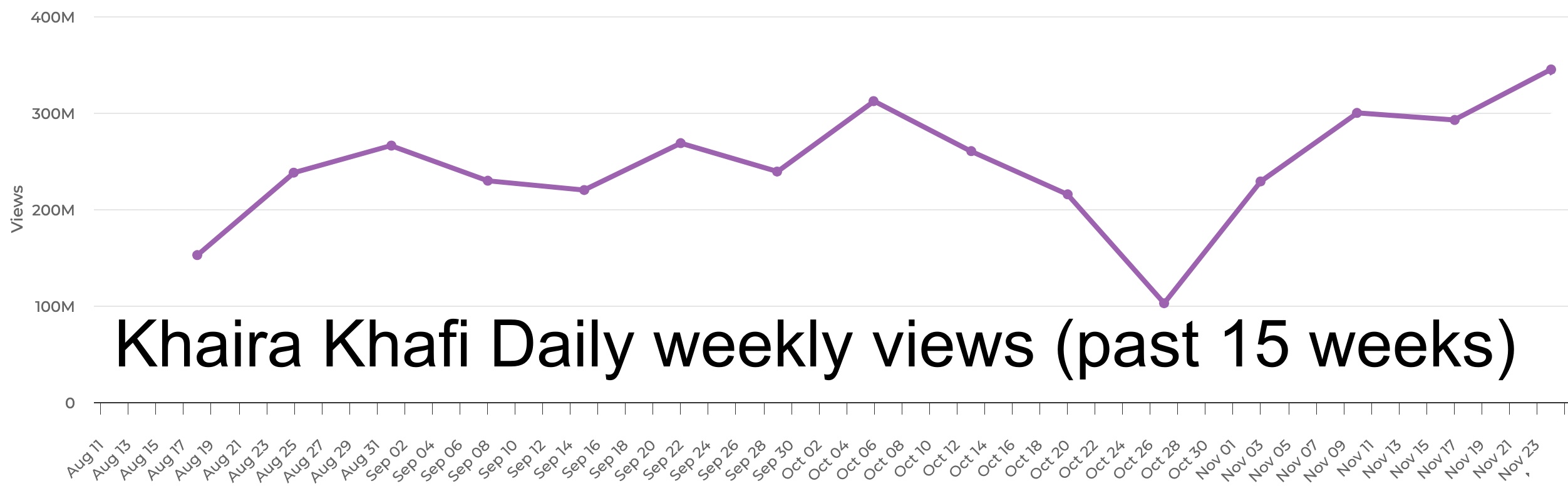
During the last week of November, one of the most impressive chart debuts came from Khaira Khafi Daily. The Indonesian channel offers a bizarre and chaotic form of children’s entertainment, but as weird as its videos may seem to adults, the kids love them. Khaira Khafi Dairy rose to 40th place in the Global Top 50 after picking up 344.8 million weekly views.

Data via Gospel Stats

Unlike channels like Khaira Khafi Daily, the Vlad and Niki franchise is best known for its long-form content rather than its short-form content. That means the brothers will have to work even harder if they want to hang onto their spot in the ranking. Their American Dream appearance is an example of what that hard work looks like, and for this formidable duo, it may be just the beginning.

Channel Distribution

Here’s a breakdown of the Top 50 Most Viewed channels this week in terms of their countries of origin:

  • India: 16
  • United States: 11
  • Indonesia: 4
  • Australia, South Korea, and Vietnam: 2
  • Argentina, Canada, China, Egypt, Germany, Hong Kong, Pakistan, Russia, Slovakia, Spain, Taiwan, and United Kingdom: 1

This week, 39 channels in the Top 50 are primarily active on YouTube Shorts.

As always, keep up to speed with the latest Tubefilter Charts and all our news by subscribing to our newsletter. You’re going to love it. 👉  Newsletter.Tubefilter.com.

Want to find the top YouTube videos of the year? Look on Shorts.

Each December, YouTube publishes a series of top ten lists to rank the most popular videos, creators, and songs of the past 12 months. From year to year, there are a few sources of stability: MrBeast has held court as YouTube’s #1 creator throughout the 2020s, gaming content has endured as a top category, and young viewers continue to drive a hefty share of platform-wide trends.

Halfway through the decade, YouTube’s culture is noticeably shifting. YouTube Shorts, a format that did not exist at the start of the 2020s, has become the primary force pushing top creators, videos, and trends into YouTube’s year-end recap.

But before we talk about Shorts’ significant impact on YouTube’s year-end reports, let’s run through what hasn’t changed. MrBeast still ranks as the top creator on the list, The Joe Rogan Experience has sustained its multi-year run as the platform’s top podcast, and Squid Game — bolstered by the launch of a new season at the end of 2024 — endured as one of 2025’s top trending topics. In a sense, YouTube’s culture looks a lot like it did in 2021, when MrBeast’s real-life Squid Game remake topped the year-end recap.

Even MrBeast, however, has been compelled to recognize the growing influence of YouTube Shorts. As his short-form viewership surpasses his tally on the long-form side of YouTube, he is sharing space in the rankings with a handful of short-form standouts. The #2 creator on the list, CaylusBlox, represented a Roblox community that exploded on Shorts in 2025. And without any Minecraft creators in the top ten, it’s safe to say there has been a changing of the guard in the world of sandbox-style video games.

Other creators in the top ten, such as Double Date (#4), Cadel and Mia (#5), Law by Mike (#7), and Zack D. Films (#9), harnessed the power of Shorts to achieve repeated high finishes in our Global Top 50 charts. And the ranking of YouTube’s top songs of 2025 alludes to another major Shorts trend: KPop Demon Hunters. Four tracks from either HUNTR/X or the Saja Boys cracked the top ten amidst a flurry of relevant Shorts content.

Creators who consume YouTube’s 2025 rundown will have a good idea of what to do in 2026. (Hint: Keep it short.) As for the fans, they’ll get a chance to celebrate their personal viewing habits with the next phase of YouTube’s year-end celebration. A new YouTube Recap feature offers “a personalized, shareable highlight reel of your 2025 watch history highlighting your top channels, interests, personality type, and more.” So if you want to know whether you love Rumi as much as the average viewer, YouTube’s take on Spotify Wrapped can provide a succinct answer.

YouTube podcasts are big business. In the UK, Acast and Little Dot Studios are vying for a bigger piece.

In the US, podcast ad revenue is projected to soar to $2.5 billion this year. Meanwhile, across the pond, podcaster fortunes are improving as well — and the rich are about to get richer.

Acast, which describes itself as “the world’s largest independent podcast company,” is launching a U.K.-based program that will look to dramatically increase ad opportunities for podcasters on YouTube. In partnership with Little Dot Studios, Acast will work with some of its high-profile show hosts to unlock new revenue streams and closer ties to advertisers.

When the beta version of the program launches in January, it will unite video podcast sponsors with a cohort of U.K. creators that collectively earns 45 million monthly plays. Later in 2026, Acast will expand the program to cover all eligible creators in the U.K. Expansions to other markets are on the horizon as well.

The launch partners for the program include some notable names from traditional media — including former footballer Peter Crouch and presenter Fearne Cotton — as well as creators who have built up significant social media followings (such as Abroad in Japan and Tristan Hughes). In total, Acast’s podcast ad marketplace includes 140,000 podcasts and 3,300 advertisers.

“We’ve built the UK’s most technologically-advanced and valuable marketplace for podcast advertising. Now, by unifying our premium audio inventory with immense video scale, Acast has created the definitive, single-point solution for brands and creators seeking measurable impact,” said Acast Managing Director of UK and Ireland Josh Woodhouse in a statement. “We reach 8 out of 10 podcast fans weekly in the UK, and we are now the largest, fully integrated premium podcast offering in the market.”

Little Dot, which operates more than 135 social channels, will provide the inventory needed to scale up Acast’s YouTube-based program. Both partners are looking to capitalize on the ongoing video podcast surge that has transformed YouTube into one of the industry’s major players.

That trend has emboldened YouTube, leading to the development of new podcast ad formats and data tools. And the Google-owned hub is not the only major platform making those types of moves. TikTok’s iHeartMedia partnership, Netflix’s negotiations with major podcast firms, and Spotify’s syndication of its original programming library have made social video platforms the biggest beneficiaries of the podcast boom.

Now, third-party operators like Acast are looking to claim bigger pieces of the pie. YouTube’s ten-digit podcast audience is one of the industry’s most lucrative assets, and the new accelerator program will bring U.K.-based creators closer to those viewers.

TikTok is working with Kim Kardashian to turn its Shop into a luxury retail outlet

On December 3, there will still be three weeks to go until Christmas, but it will be Kimsmas Eve on TikTok. Entrepreneur and socialite Kim Kardashian will host Kimsmas Live!, a shoppable special that will promote Skims, Kardashian’s luxury apparel brand.

Kimsmas Live! is set to kick off at 9:30 ET on the third, with Kardashian hosting a 45-minute variety show. Celebrity guests have been teased, though the identities of those co-hosts have not yet been revealed.  The special is being produced in tandem with OBB Media, a multimedia production company that previously worked with stars like Sabrina Carpenter and iShowSpeed.

Whether she’s launching social media challenges, promoting Kai Cenat’s Mafiathon, or shifting platform-wide policies, Kim K always brings star power and widespread influence to her projects. This time, she’s applying that star power inward to market Skims, a brand that has soared to a $5 billion valuation. During Kimsmas Live!, viewers will be able to browse through Skims’ holiday collection while taking advantage of limited-edition bundles, deals, and giveaways.

Kimsmas Live! is about celebrating the holidays in a fun, creative, real-time moment with my community,” Kardashian told Variety in a statement. “We’ve put together something special — surprises, festive moments, exclusive deals, giveaways, and bundles you can only experience in the livestream. I can’t wait for everyone to tune in.”

The holiday season has been a pivotal time for TikTok Shop ever since the ecommerce hub’s 2022 arrival in the United States. As part of its Christmastime strategy, TikTok has helped brands (including Skims) set up storefronts on its app, while also leaning on its creator community for some influencer endorsements.

2025 has been a checkered year for TikTok Shop. While its sales numbers continue to rise, its staffers have endured multiple rounds of layoffs. To make the current holiday season its biggest one yet, TikTok has shifted its strategy to highlight more luxurious goods. So if you want a Hermes handbag or a limited-edition Nike sneaker drop, TikTok Shop is the place to go to get it.

If luxury is what TikTok wants, Kim Kardashian is the perfect partner to provide it. The scion of the prominent Kardashian clan has become a powerful mogul in her own right, and Kimsmas Live! will show off just how far Skims has come.

Have you heard? Holiday music takes off, ChatGPT turns three, and The Wiggles land in hot water.

Each week, we handpick a selection of stories to give you a snapshot of trends, updates, business moves, and more from around the creator industry.

This week, The Wiggles are facing a TikTok controversy, ChatGPT is celebrating its third birthday, and MrBeast wants creators to form a tighter-knit YouTube community.

Creator commotion

Don’t worry: The Wiggles aren’t out to ruin your childhood. After inadvertently starring in a TikTok video set to Keli Holiday’s song “Ecstasy” in the aftermath of the TikTok Awards, the kid-friendly musical group issued a statement to confirm that they don’t, in fact, support illegal drug use. Personally, we’re relieved.

Are YouTubers living “on separate planets”? MrBeast took to X in late November to voice concerns about the lack of creator collaboration in the YouTube community. His main question: “How do we get the YouTube community more tight-knit like the Twitch streaming community?”

AI influencers are making bank. According to a recent report from the New York Post, lifestyle creator Aitana Lopez makes up to $11,000 per month from social media. The catch: despite teaming up with brands like Amazon and posting viral travel content, the Instagram-famous star isn’t actually a real person.

Marquay The Goat’s memory lives on. 24-year-old creator Marquay Collins (aka Marquay the Goat) passed away on November 26, as announced by his mother Sonja Collins. The young star’s death was met with an outpouring of support and tribute posts from fans and friends on TikTok, where he entertained a following of nearly 7 million.

Platform headlines

ChatGPT celebrated its third birthday yesterday. The world has changed in a big way since the launch of OpenAI’s iconic chatbot turned the AI race into an all-out sprint to the finish line. Will ads be the next big thing for ChatGPT?

Australia wants kids to stop using Twitch. The land down under has added Twitch to the list of platforms covered under an upcoming law that will ban users below the age of 16 from social media hubs. (Pinterest, on the other hand, still seems to be in the clear.)

YouTube’s new promotable feed sounds familiar. Google‘s video platform is testing a new type of feed that will allow users to shape their personal recommendation algorithm via text prompts. That experiment reflects Elon Musk’s plan to make X’s recommendation algorithm “purely AI” in order to give users the ability “to adjust your feed dynamically just by asking Grok.”

In other YouTube news, the platform is expanding pre-publish checks. TeamYouTube has announced that the platform is testing a new feature “that checks for some Community Guidelines violations in the video upload flow, similar to Copyright and Advertiser-friendly Guidelines checks.” The goal: to help users “avoid the frustration of a removal or strike.”

Democrats want to know what’s up with the U.S. TikTok deal. The next deadline for ByteDance’s divestiture from TikTok is coming up, and legislators are eager to know the details of the deal. Senator Ed Markey (D-Mass.) is the latest politician to press Trump for more information in the light of recent comments from Beijing that suggest China might not be fully on board.

Platform headlines

ByteDance achieves $480 billion valuation. A bidding war for a sizable chunk of ByteDance equity drove up the tech company’s price tag, making it one of the world’s most valuable startups. Keep that massive valuation in mind the next time the U.S. government tries to play hardball with TikTok’s deep-pocketed owner.

Nvidia isn’t a gaming company anymore. Remember when the tech giant was best known for selling GPUs and other pieces of gaming hardware? Pepperidge Farm remembers, even if Nvidia CEO Jensen Huang is now saying that his company’s immense AI chip sales have led it away from the gaming world.

This is your brain on Instagram. A study involving 98,299 participants examined the ways that short-form videos affect the brain. Those clips can cause social isolation, sleep problems, anxiety, and loneliness, but at least the dog memes are funny.

Holiday highlights

Is the holiday music fandom bigger than sports? According to Uproxx Studios CEO Jarret Myer, UPROXX’s Holiday Hits & Classics playlists attract at least 200 million monthly views during the holiday season, while channels with strong holiday catalogs see an average +89% view surge in Q4. Myer’s sports comparison: “The biggest games are massive—but holiday music owns multiple weeks, every year, across millions of living rooms at once.”

It wouldn’t be the holidays without Tini’s mac ‘n cheese. A recent profile in Rolling Stone deemed Tineke Younger “TikTok’s Thanksgiving Queen,” and it’s not hard to see why. The creator (aka Tini) has made a name for herself by teaching TikTok fans how to make simple and delicious meals. Her iconic mac ‘n cheese recipe might not be the most intuitive of the bunch (viewers often comment on the woes of making a roux), but it’s become an integral part of many fans’ holiday spreads.

MrBeast is going all out for the holidays. Over the last few weeks, our Top 5 Branded charts have been absolutely dominated by MrBeast videos sponsored by Feastables. YouTube’s most-followed creator has been on a mission to promote his snack brand as the ideal solution for any and all holiday needs (from Halloween candy to stocking stuffers to holiday baking ingredients), but Feastables isn’t the only food brand on his promotional slate. In one of his latest videos, MrBeast reminded fans that he also launched his own branded meat sticks in partnership with frequent sponsor Jack Link’s.

Industry potpourri

Like Nastya is coming to Zigazoo. One of YouTube’s top kid-friendly creators is bringing her content to a new platform. Zigazoo, which describes itself as “the world’s largest social network for kids,” announced on LinkedIn that “Nastya’s new Zigazoo channel will give her fans a safe, positive, and interactive space to connect through creative prompts, fun challenges, and videos.”

A former MrBeast strategist is building something new. Jay Neo—a former content lead for MrBeast—is joining forces with Palantir vet Shivam Kumar and creator Harry Jones to build Palo: a creator-focused platform that combines an AI-powered ideation and planning tool with analytics and community.

Top 5 Branded Videos of the Week: 7-Eleven for the holidays

Welcome to our rundown of the most-watched branded YouTube videos of the week.

We’re publishing this snippet of a larger Gospel Stats Weekly Brand Report in order to analyze sponsorship trends in the creator economy. Any video launched in tandem with an official brand partner is eligible for the ranking.

And – as the name up above would imply – all the data comes from Gospel Stats. If you’re interested in learning more about Gospel – and which brands are sponsoring what creators on YouTube – click here. You can also download our YouTube 2025 Sponsorship Landscape Report here.


This Thanksgiving, we’ve got an eclectic bunch showing up for dinner. MrBeast is bringing the beef, Mrwhosetheboss is bringing an iPhone (we guess we can pass it around so everyone gets a chance to see the big game + the new season of Stranger Things), MIYU ASMR is treating everyone to 7-Eleven mukbang, and Maisy Leigh is already getting us in the Christmas mood with a classic Advent calendar.

Oh, and fern tv is bringing the KKK–but don’t worry, there’s an FBI agent hot on their trail.

Check it all out right here:

#1 How I Became MrBeef
Channel: MrBeast
Brand: Jack Link’s
Views: 18,667,552

The candy aisle isn’t the only place to find MrBeast this holiday season. While he’s been pushing new Feastables products hard in Q3/Q4 this year, he’s also established some long-term brand partnerships, including one with Jack Link’s.

In this Short, MrBeast gives a cheeky nod to his noticeable increase in swole-ness, and attributes it (at least in part) to gnoshing on his sponsor’s beef sticks. He wants other people to have this same easy-protein experience, he says, so teamed up with Jack Link’s to release his own branded sticks in original, zero-sugar, turkey, and teriyaki formulations. Not the kind of meat you usually put on the Thanksgiving table, but we can see these popping up in some YouTube-obsessed kids’ stockings this year.

#2 How an FBI Agent Infiltrated the KKK
Channel: fern
Brand: Incogni
Views: 7,602,22

fern, run by YouTuber duo @hoogyoutube and @Simplicissimus, promises high-quality “armchair documentaries, almost weekly”–and that’s exactly what this 40-minute video offers. In it, our hosts tell the story of Scott Payne, aka “the redneck turned FBI agent who infiltrated America’s underbelly.”

Payne has shared details before in his own book (Code Name: Pale Horse) and podcast (White Hot Hate), but for this video he gave an extensive sit-down interview, getting into the details of what it was like to be embedded with the KKK. fern interlaces his story with intense animations (all made by humans, not AI, they emphasize), and their brand partnership with data broker removal service Incogni is more of a background factor, giving the spotlight firmly to Payne and his harrowing journey. We dig it.

#3 iPhone Charging is Weird.
Channel: Mrwhosetheboss
Brand: ESR
Views: 7,190,527

Here’s a fun game, stolen from legendary Dungeons & Dragons DM (and recent Last Meals guest) Brennan Lee Mulligan: Look at a piece of technology in your home and try to explain, in great detail, how it works. No Googling! Run that one by your relatives this Thanksgiving.

Anyway, that game is what this video feels like. Mrwhosetheboss, like many tech YouTubers, got his hands on the new iPhone 17 early. And, like many tech-heads (and regular consumers), he wants to know exactly how fast this thing will charge compared to older models. But not just charge–charge wirelessly. That’s where his sponsor, phone accessories company ESR, comes into play. He uses its wireless chargers, taking a moment to compliment how quiet they are, on multiple models of iPhone. The results? We won’t spoil.

What is worth spoiling about this brand deal is that the usual CTA link at the bottom doesn’t send viewers to ESR’s website. Instead, it sends them to the company’s Amazon storefront. Mrwhosetheboss even includes a bit of text in the video description urging people to “search ‘ESR 3-in-1 MagSafe Charging Station’ on Amazon.com.”

This incoming click and search traffic boost is a way for brands to make their items more charming to Amazon’s product recommendation algorithms, getting their items to show up in search results, and show up closer to the top. We bet we’ll see more of these types of CTAs as Black Friday rolls into the big winter holiday buying season.

#4 ASMR 7-Eleven Fried Foods 【Mukbang/ Eating Sounds】【English subtitles】
Channel: MIYU ASMR
Brand: 7-Eleven Japan
Views: 7,135,442

7-Elevens in the U.S. are in the midst of getting a Japan-esque makeover, with a bigger variety of better, fresher foods. But for those of who are still American and stuck here with overly crisp hot dogs and stale pizza, there’s always vicarious living. MIYU ASMR knows it, too: Her 12-minute fried foods mukbang is a long-distance trip through 7-Eleven Japan’s finest offerings–and, unsurprisingly, the chow-down is sponsored by 7-Eleven itself.

Over in Japan, 7-Eleven and other konbinis often introduce seasonal items, so we’re not surprised the chain is ramping up advertising as we head into Christmas–which, for Japanese folks, is a romantic holiday best celebrated with copious snacks and a big bucket of KFC.

BONUS #3,400 cozy holiday gaming nights ☕️🎄ft. Peanuts Digital Advent Calendar 2025
Channel: Maisy Leigh
Brand: American Greetings
Views: 35,027

https://youtube.com/watch?v=v_VwSS_9TDU

Maybe it’s just me, but going to holiday stores used to be an annual, multi-day event. In the late 90s, my mother would bring us to a Hallmark location before Thanksgiving even hit to pick out new ornaments and buy cards to send out to our sprawling family. Now we order ornaments online, and cards are digital, too.

There’s more maudlin stuff to say about that, but we’ll skip in favor of noting how American Greetings, a former bastion of holiday cards that shuttered all its physical locations after Chapter 11 in 2020, is revamping online. It sponsored gaming YouTuber Maisy Leigh to show off its digital Advent calendar, where each day, she unlocks new online content themed after classic Peanuts. Each virtual ‘ornament’ comes with comic strips, minigames, and more.

Will this replace all the deluxe IRL Advent calendar unboxings being posted right now? Probably not–but it is an interesting look at how a business whose brick-and-mortar bread-and-butter went defunct is doing things in 2025.


…and there’s a lot more data where that came from. If you like our Weekly Top 5, you’ll love everything else Gospel has to offer. Start with our newly released YouTube 2025 Sponsorship Landscape Report, which you can download right here.


More AI: Will YouTube’s new promptable feed replace the recommendation algorithm?

YouTube and X may be closer than they first appear: Google‘s video platform is testing a new type of feed where users will be able to use text prompts to shape their personal recommendation algorithm.

This sounds just like the promises made in September by Elon Musk. People–content creators and viewers alike–have complained about recommendation algorithms for as long as recommendation algorithms have existed, but after Musk bought X, those complaints had some extra justification. In the years following his purchase, X’s main feed algorithm deteriorated into slop, and on top of that has been (allegedly) tweaked to push posts from Musk and amplify right-wing views. Many users report a deluge of hate speech and violent videos showing gruesome fights and animal deaths, too.

Musk’s plan to combat user concerns is bringing in Grok, the ChatGPT-alike made by his company xAI. According to Musk, X’s recommendation algorithm will soon be “purely AI,” and “[b]y November or certainly December, you will be able to adjust your feed dynamically just by asking Grok.”

That hasn’t happened yet–at least, not on X.

But over on YouTube, only a week after Google CEO Sundar Pichai warned that the amount of money being poured into the AI bubble is “irrationality,” an experimental feature will allow users to “update your existing Home feed recommendations by entering a simple prompt,” Team YouTube wrote on the platform’s support/developer update notice board.

This also comes just after Google rolled out the third iteration of its own ChatGPT equivalent, Veo. We’re not sure if this custom feed feature will be built on Veo’s bones or even have Veo directly involved, the way X has Grok–but either way, Google’s investment in AI development is being shown in tangible form here.

“If you are part of the experiment, you will see ‘Your Custom Feed’ appear on your Home page as a chip besides ‘Home,'” Team YouTube wrote. “This feature is designed to give you an easy-to-use way to have more control over your suggested content. If you see it, check it out and share your feedback!”

As we mentioned above, the YouTube algorithm has long been a point of contention. Creators often have an antagonistic relationship with it, and have accused it of shadowbanning them and refusing to recommend their videos to subscribers. The algorithm has also been accused of recommending disturbing videos, sending users into conspiracy rabbit holes, and feeding viewers’ mental health and body image struggles. There are plenty of studies about how social media recommendation algorithms–not just YouTube’s–can negatively affect viewers.

But, at the same time, YouTube’s algorithm has unique charm. Anecdotally, I’ll often open my Home page and see 20-year-old flip phone recordings suddenly revitalized by an inexplicable algorithm boost. Other times, my partner and I will bond over being recommended the same video on the same day because we have niche intersecting interests (the operational minutiae of offshore oil platforms, anyone?), though the rest of our feeds’ components are pretty different. The algorithm has also, of course, introduced me to new creators, and at the same time resurfaced artists I used to know on DeviantArt.

There is a certain magic to the recommendation algorithm being undisturbed in its natural habitat. But Google, like every other big tech company these days, wants the AI bag bad, and we can see how this might be a perk for some viewers (especially those who mostly watch Shorts; we’ll admit that algorithm is, objectively, garbage).

Like any YouTube experiment, this new feed might not be rolled out as a real product to all users. Even if it doesn’t, its testing phase will give Google data about how people use chatbots to shape their online experiences…for better or worse.

Holiday music fandom is bigger than sports

We always hear that sports and music are the two things that bring people together across dividing lines, but when it comes to holiday time, I think music is the clear leader. Each December, something rare happens. The usual boundaries we draw around identity and taste dissolve as we all come together to celebrate a shared cannon of songs. Revisiting DMX’s rendition of “Rudolph The Red-Nosed Reindeer” is my favorite holiday tradition. But for you, it may be putting on Nat King Cole, Michael Bublé, Sia, or Kelly Clarkson to signal that it’s time to tap into the collective power of holiday fandom.

I’ve spent my entire career around artists, fans, culture, and the ways music moves among them. But every year, the holiday season reminds me of something simple: music culture is at its most powerful when it belongs to everyone at once.

Based on our own UPROXX content and audience insights, there’s scale behind that feeling: During the season, channels with strong holiday catalogs see an average +89% view surge in Q4, and individual holiday videos can spike +1,552% from November to December versus their annual average. That’s not a “moment”; that’s a multi-week, whole-household phenomenon.

When you look at who is actually listening, it’s everyone. UPROXX’s Holiday Hits & Classics playlists do a minimum of 200 million views per month during the holidays. Those songs reach about as even of a distribution you can get: ~52% female, 48% male, with 25–44 year-olds accounting for ~55% of views, and meaningful reach into both Gen Z and Boomers.

In a culture that chases the next big thing, this is the rare phenomenon that compounds with repetition. Combine that with YouTube and connected TV, and you have something that’s not just popular, but dependable, brand-safe, and measurable.

That “campfire” shows up in the metrics brands care about: longer CTV session times, higher repeat plays, and natural frequency without creative fatigue. In December, we routinely see artist channels jump ~9x in unique viewers versus the Jan-Oct baseline, with watch time growth even outpacing view growth. It’s attention that compounds, because the context (family, tradition, ritual) invites longer stays and replays.

For marketers, that means three practical truths:

  • It’s forecastable. The ramp begins mid-November and peaks through December—easy to pace around Black Friday, Cyber Monday, and final-week gifting.
  • It’s safe by construction. Adjacency is concentrated in official artist uploads and top curated playlists—high sentiment, low risk.
  • It’s household-level reach. With 25%+ of views on CTV, you’re not just catching one person on a phone; you’re meeting families where they gather.

Here’s the uncomfortable comparison for sports: The biggest games are massive—but holiday music owns multiple weeks, every year, across millions of living rooms at once. Sports crescendos are episodic and outcome-dependent; holiday fandom is calendar-locked and loss-proof. Even the “off nights” perform because the ritual drives the view, not the scoreboard.

Sports and music both build community. But in December, only one reliably turns the largest screen in the house into a shared ritual that repeats year after year, day after day, title after title. That’s why, if you’re measuring cultural impact the way it’s actually experienced, together, on CTV, for weeks at a stretch, Holiday Music Fandom is Bigger than Sports.

And if you’re a brand, it’s not just bigger, it’s better: more predictable, more welcoming, and more likely to earn you a place in the moments people remember.

With more than four million retail-related channels on YouTube, how do brands choose their partners?

Amid a banner year for the creator economy, brands are gearing up for one final influencer marketing push. The holiday season is here (whether we’re ready or not), and creator endorsements will play a big role as brands look to direct Black Friday shoppers toward their products.

The advertisers who are facing big decisions for their YouTube-based buys can get some guidance through Pixability. The firm known for providing thorough insights related to YouTube ads has released a report that, as stated in its title, outlines Retail Strategies for YouTube.

The topline takeaway from the new Pixability report won’t surprise anyone with a working knowledge of the creator economy: On YouTube, so-called “retail-based” creators — who operate in categories like fashion, beauty, home goods, and consumer technology — have become ubiquitous. 4.12 million retail-related channels were active on the platform during a one-year period that ran from Q3 2024 to Q2 2025. Over the same timeframe, retail and shopping content hauled in 688 billion views.

As you might assume, many of those views (and the associated ad dollars) flow through the channels of the biggest retail creators on YouTube. By blending product analysis with entertainment, and by bringing a radically honest approach to reviews, notables like Marques Brownlee (pictured above) and James Charles have become important assets for their sponsors.

The wealth, however, is not concentrated at the top of the pyramid. Pixability also highlighted the fastest-growing creators in retail-related categories, shining light on rising stars like Clara Afua and TheSamFindz.

Those rising creators are thriving because of one of the biggest X-factors related to influencer marketing: Authenticity. Pixability reported that users are 98% more likely to trust recommendations from YouTube creators compared to creators on other platforms, and 78% of viewers claimed that creators help them make quicker purchasing decisions. The majority of consumers (eight out of ten) don’t even mind when creators introduce products via paid endorsements.

“A rising trend among emerging creators focuses on practical content—videos that highlight usefulness, simplicity, and real-life value,” reads the report. “Creators like TheSamFindz and gadgetxplorer turn everyday problem-solving into engaging storytelling, from storage hacks to tech innovations to kitchen essentials.”

Pixability’s findings suggest that any brand can benefit from regular work with YouTube creators, but the specific nature of that work varies depending on each sponsor’s retail category and campaign goals. If you want to check out a more granular analysis of the ad formats, cross-category opportunities, and AI models that inform the most optimized YouTube campaigns, you can download your copy of the Retail Strategies for YouTube report via the Pixability website.

For some pro athletes, Twitch is becoming part of the injury rehab routine

Move over, skibidi: The internet is all about Skattebo now.

I’m talking about Cam Skattebo, the rookie running back for the New York Giants. After accumulating five touchdowns and nearly 400 rushing yards over the first seven games of his NFL career, the man known as “Skat” quickly became a fan favorite.

Then, during an October 26 game against the Philadelphia Eagles, disaster struck. Skattebo suffered a dislocated ankle, and team doctors later confirmed that the injury would bring an early end to the rusher’s rookie season.

Amid his rehab for his injured ankle, Skattebo has added a curious stop on his road to recovery. In recent weeks, his Twitch account — titled sk4tpack — has become one of the most popular entertainment hubs on the Amazon-owned streaming service.

At the time of this post, Skattebo’s follower count has reached 124,000. When he reached six digits in that category, the Arizona State alum celebrated by drinking out of a cleat. In other words, when it comes to streamer culture, Skat fits right in.

As silly as Skattebo’s Twitch activity may be, it represents a bold strategy utilized by several high-profile athletes. Serious injuries don’t just shorten careers and damage bodies: In a sporting era dominated by creators and personal brand building, pros can lose their marketing potential if they sit outside of the public eye for too long.

That’s why Skattebo’s streams are so smart. Injuries are so common among NFL players (and running backs in particular) that many rising stars break down before they can earn a big-money contract. If Skat’s streaming career takes off, it will serve as a safety net that can support his football activities, and it may even lead to generational wealth after his playing days expire.

Skattebo isn’t the first injured athlete to give Twitch a try. This phenomenon dates at least as far back as 2019, when wide receiver JuJu Smith-Schuster collaborated with streamers like THump and TimTheTatMan while dealing with a knee injury. Two years later, when a heart condition forced soccer star Sergio “Kun” Agüero into retirement, the Argentinian striker took his talents to Twitch. He quickly became one of the most familiar faces within the platform’s Latin American community.

For these high-level competitors, streaming video games on Twitch may not compare to the thrill of being a pro athlete. At the same time, the Cam Skattebos of the world gain privileged positions when they choose to become creators. They start their streaming careers with built-in name recognition and established ties to big-name collaborators (just ask Jynxzi).

In that context, the “Twitch rehab” is something of a no-brainer. By streaming to thousands of followers, Skat can ensure that his grind never stops — even when he’s physically unable to set foot on the field.

BRIDGE Summit is bringing together the creator economy, media, tech, marketing, and more. Here’s what you need to know about its programming tracks.

In just two weeks, the first ever BRIDGE Summit–in partnership with major platforms and brands like Meta, X, LinkedIn, Sony, Canva, Time, and Forbes–will welcome 60,000 attendees to Abu Dhabi’s ADNEC Centre. Among them will be Fortune 500 CEOs, government representatives and policymakers, investors, humanitarian foundations, academics–and, of course, content creators.

The three-day conference (which, for those who can’t attend IRL, will be streamed in full on X) is meant to be a place where “the future of media, entertainment, culture, and technology meets power, policy, and capital on one bridge,” organizers say.

In practice, that means a packed-full schedule offering “inspiring talks and keynote speeches,” “mind-opening panel discussions,” workshops, masterclasses, and roundtables from more than 400 expert speakers, plus 300+ exhibitions, new product launches, and innovation showcases.

“Through BRIDGE Summit, our ambition is to build a global arena where the meaning of media is not confined to a single track–it expands to encompass every sector that defines today’s content economy,” Dr. Jamal Al Kaabi, Vice Chairman of BRIDGE, said in a statement. “From journalism and broadcasting to digital platforms, social media, film, music, and technology–each track converges and intersects to create new opportunities for growth, investment, and influence.”

To help attendees navigate its wealth of programming, BRIDGE Summit has divided everything into three themed days and seven content tracks.

  • Day 1, Dec. 8, is themed Landscape, asking What is the state of media and entertainment?
  • Day 2, Dec. 9, is Vision, asking How is the ecosystem being reimagined?,
  • and Day 3, Dec. 10, is Blueprint, asking What strategies and steps will take us into media’s next era?

The content tracks are where BRIDGE Summit’s multi-industry is most apparent. Here at Tubefilter, we’ve covered plenty of creator events (and even put on some ourselves), but BRIDGE Summit is wrapping creators into a larger landscape that also covers traditional media, music, gaming, and more.

Here’s a rundown of BRIDGE Summit‘s seven tracks, including topics they’ll spotlight and must-see speakers who will share their insights, strategies, and goals for the future.

MEDIA

Spotlight topics:

  • Newsrooms
  • Social Platforms
  • Story Formats
  • Audience Dynamics
  • Distribution Models

Must-see speakers:

CREATOR ECONOMY

Spotlight topics:

  • Revenue Streams
  • Brand Deals
  • Platform Tools
  • Creator Agencies
  • Fan Subscriptions

Must-see speakers:

MUSIC

Spotlight topics:

  • Digital Production
  • Streaming Economies
  • Fan Communities
  • Rights & Royalties
  • AI Composers

Must-see speakers:

  • Haitian rapper Wyclef Jean, who’s also Chief Creative Officer at OpenWay
  • Donna Budica, COO & co-founder at Ten2 Media
  • TikToker and clarinet player Raphaël Froissart
  • Tobias Hoss, SVP of Operations at Lunar X (the Berlin-based company that acquired Theorist)
  • Imad Mesdoua, Director of Government Affairs MENA at Spotify

GAMING

Spotlight topics:

  • Esports Arenas
  • Virtual Worlds
  • Interactive Play
  • Modding Culture
  • Game Economies

Must-see speakers:

  • Chris Jacquemin, Head of Digital Strategy at WME
  • Brendan Greene, aka PlayerUnknown, former developer of PUBG: Battlegrounds and currently CCO at PlayerUnknown Productions
  • Amazon Web Services’ Lead of Media & Entertainment, Games & Sports, MENAT, Dave Mace
  • Mac Reynolds, CEO of Night Street Games and manager of the band Imagine Dragons
  • Cathy Hackl, CEO at Future Dynamics

TECH

Spotlight topics:

  • AI Models
  • Generative Tools
  • Mixed Reality
  • Automation
  • Data Futures

Must-see speakers:

MARKETING

Spotlight topics:

  • Performance Ads
  • Story-driven Brands
  • Consumer Insights
  • Omni-channels
  • Influencer Playbooks

Must-see speakers:

PICTURE

Spotlight topics:

  • Cinematic Tech
  • Short-form Videos
  • Streaming Originals
  • Immersive Visuals
  • Cross-media Stories

Must-see speakers:

Obviously this is only a small handful of the 400+ speakers attending BRIDGE Summit, but we hope these selections will give you an idea of the caliber of talent and innovation that will be present at the event.

If you’re interested in attending BRIDGE Summit this year, you can apply here. If you’re interested in exhibiting, you can apply here.

As we mentioned above, those who can’t make it to Abu Dhabi still have the chance to experience BRIDGE Summit up close. The summit has secured a partnership with X, and will use that platform to livestream various elements of programming during all three days of the event.

Stay tuned–we’ll have more details on that soon!


BRIDGE Summit is a Tubefilter partner.