Archive for 2025:

CreatorCare is here to help digital workers overcome mental health struggles and burnout

As the creator economy grows into a multi-billion dollar industry, pervasive mental health issues are becoming more common. Most creators experience issues like burnout and poor work-life balance, but there are only a limited number of resources that address those concerns.

Today, the resource list for creators struggling with their mental health is getting longer. CreatorCare is a new solution that connects digital workers to licensed mental health professionals. Think Teladoc meets the Creators Guild, with significant industry backing involved.

CreatorCare was born out of a partnership between Revive Health Therapy and Creators 4 Mental Health. The former organization is a Bay Area-based provider of in-person and telehealth counseling, while the latter is a self-descriptive initiative that emerged from Shira Lazar and Jordana Reim‘s Peace Inside Live. Lazar, perhaps best known as the longtime host of What’s Trending, has in recent years shifted her focus to creator mental health and the steps that can be taken to address problems like burnout.

To tackle those issues, creators need easy access to mental health services. That’s where CreatorCare comes in. The program offers on-demand access to therapists, and its sliding scale pricing model makes it tenable for creators big and small. CreatorCare is designed for use in “high-burnout industries,” including content creation and freelancing.

Amy Kelly, the Co-Founder of both Revive Health Therapy and CreatorCare, noted in a statement that the emerging creator class will face greater risk unless relevant mental health services evolve and grow. She noted that more members of Gen Z are becoming influencers without equipping themselves with the tools they need to thrive in that role. In her words, it’s equivalent to “sending kids into coal mines without protective gear.”

The goal of CreatorCare is to provide those necessary mental health precautions.”The creator economy has exploded but the support systems haven’t kept up. As more Gen Z step into this space professionally, we need to treat it like the real workplace it is,” Lazar said in a statement. “That means sustainable systems not just for monetization, but for mental health, too.”


View this post on Instagram


A post shared by Shira Lazar (@shiralazar)

Initially, CreatorCare will be available in California, though the ultimate goal is to expand the program nationwide. If you’re a creator based in The Golden State and you’re feeling burned out just thinking about all the videos in your pipeline, then head over to the CreatorCare website to peruse the services the new program has on offer.

TikTok expands its Pulse product to bring brands closer to its culture

Ahead of its presentation at the 2025 NewFronts, TikTok unveiled new additions to the product it has now dubbed the Pulse Suite. That’s the name of the ad program that lets brands target top-performing posts on the For You Page, and it is now extended to user-generated content through a vehicle called Pulse Core.

Pulse cordons off advertising space next to “the hottest, trending, and most-premium brand safe content,” as explained in a TikTok Newsroom post. The product has headlined TikTok’s NewFronts pitch in each of the past four years. It first debuted shortly before the 2022 pitchfest and expanded a year later with the launch of Pulse Premiere, which packages ad space next to “premium publisher content.”

Custom Pulse Lineups and a fresh batch of publisher partners arrived in 2024. This year, TikTok’s Pulse expansion is placing more focus on creators. Core campaigns can be customized to focus on specific trends, holidays, or other categories.

“TikTok has become part of people’s everyday lives—it’s where they go to be educated, entertained, and to discover something new. When brands show up with that same mindset, not just to advertise but to genuinely engage, they naturally become part of the conversation,” reads a statement from TikTok VP of Global Business Solutions Khartoon Weiss. “The real value comes from showing up consistently—not just during big cultural moments, but all the time—because culture doesn’t take a day off. It happens on TikTok every single day.”

Pulse Premiere is continuing to grow alongside its creator-oriented counterpart. New publishers added to the Premiere roster include Formula 1, Warner Bros. Discovery, and Red Bull Media.

The concept of a digital ad program that targets a slice of top-performing content is most closely associated with the Google product now known as YouTube Select. In recent months, other tech companies have rolled out their own versions of YouTube Select, with X and LinkedIn serving as two notable examples.

TikTok’s take on premium advertiser placements has a distinct focus on recurring events. Seasonal Lineups in Pulse Core hone in on annual happenings like Mother’s Day or back-to-school season. A separate product named Content Sponsorship Packages puts advertisers at the center of platform-wide tentpoles. Formula 1, for example, will build Sponsorship Packages around November’s Las Vegas Grand Prix.

This approach has unlocked a coveted audience that advertisers struggle to reach on other platforms. Per the latest TikTok Newsroom post, 45% of the audience reached through Pulse campaigns hadn’t previously seen an equivalent ad on TV.

The takeaway is that TikTok-based advertising continues to pay dividends, even as the platform finds itself in regulatory hot water. The jury’s still out on a potential U.S. TikTok ban, but the app’s economic impact is giving regulators a big reason to keep it running.

Top 50 Most Subscribed YouTube Channels • Week Of 05/04/2025

[Editor’s Note: Tubefilter Charts is a weekly rankings column from Tubefilter with data provided by GospelStats. It’s exactly what it sounds like; a top number ranking of YouTube channels based on statistics collected within a given time frame. Check out all of our Tubefilter Charts with new installments every week right here.]

Scroll down for this week’s Tubefilter Chart. 👇


To qualify for this week’s Global Top 50 subscriber ranking, channels needed to add at least 380,000 new fans over a seven-day period. The channels that reached that benchmark came from 20 different countries and included a mix of long-form and short-form standouts.

MrBeast, who added two million new subscribers between April 28 and May 4, is still lurking near the top of the chart. This time, however, he could only manage a second-place finish. A different channel hauled in a whopping 4.8 million new subs over the same period, pushing its lifetime total above 21 million.

Will synthwave be the soundtrack for the AI revolution?

Whether we like it or not, AI-generated video is becoming a more common sight among the most-watched and most-subscribed content on YouTube. As we head full steam ahead toward the dead internet of the future, some channels are playing familiar sounds: the thumping basslines and ethereal melodies of the synthwave genre.

One prominent purveyor of synthwave beats landed in the #1 spot in this week’s Global Top 50 subscriber chart. Masters of Prophecy is a favored source for Indian dance music, and it pairs those tunes with AI-generated imagery. The soft blues and purples that are associated with synthwave can sometimes feel out of this world, but for a generative AI model, those spacey hues are just another background.

Masters of Prophecy has grown its subscriber count by embracing YouTube Shorts, and it has expanded its library in that format by getting an assist from AI. Twinkly tunes draw South Asian consumers to the channel’s minute-long uploads, and the semi-realistic images that are paired with those songs keep people watching.

Maybe you would prefer for the AI-generated future to be a bit less vibey. If that’s how you feel, fret not — the subscriber charts include channels that employ AI in many different ways. Masters of Prophecy’s creations pair well with its musical stylings, but another Indian channel, MonkuMiya, prefers to concoct truly bizarre genAI videos.

Have you ever wanted to see what Spiderman would look like if he dressed in military fatigues and spoke Hindi? MonkuMiya has you covered, and the video fitting that description has more than four million views in all.

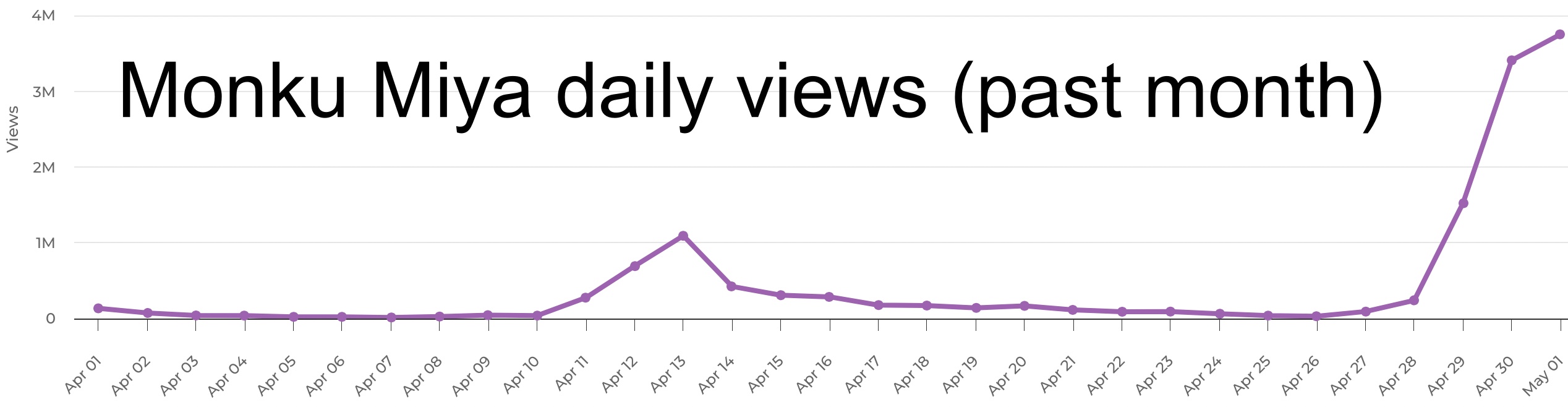
MonkuMiya’s use of AI may be more “random” than what we find via Masters of Prophecy, but even strange videos like that can draw in millions of subscribers. MonkuMiya added 391,000 new subs during our most recent seven-day measurement period, and its viewership has shot up as a result.

Data via Gospel Stats

For the AI skeptics among us, that upward trajectory is a point of concern. I understand where those people are coming from; in one sense, it was more fun to imagine fantastical images before it was easy to render them. At this point, however, little can be done. The AI-generated cat is out of the bag. Just throw on your favorite synthwave tunes and enjoy the ride as best you can.

Channel Distribution

Here’s a breakdown of the Top 50 Most Viewed channels this week in terms of their countries of origin:

  • India: 19
  • United States: 7
  • Japan: 3
  • Indonesia, Mexico, South Korea, and Spain: 2
  • Bangladesh, Brazil, Canada, China, France, Germany, Hong Kong, Indonesia, Latvia, Pakistan, Puerto Rico, Singapore and Vietnam: 1

This week, 40 channels in the Top 50 are primarily active on YouTube Shorts.

As always, keep up to speed with the latest Tubefilter Charts and all our news by subscribing to our newsletter. You’re going to love it. 👉  Newsletter.Tubefilter.com.

Top 5 Branded Videos of the Week: Would you drown for $500K? Jack Link’s wants to know.

Welcome to our rundown of the most-watched branded YouTube videos of the week.

We’re publishing this snippet of a larger Gospel Stats Weekly Brand Report in order to analyze sponsorship trends in the creator economy. Any video launched in tandem with an official brand partner is eligible for the ranking.

And – as the name up above would imply – all the data comes from Gospel Stats. If you’re interested in learning more about Gospel – and which brands are sponsoring what creators on YouTube – click here.


This week, Mark Rober gets Googley with so-called “chemtrails,” Veritasium takes a trip to Midtown Manhattan courtesy of eSIM company Saily, Joe Rogan slurps bone broth with Paleovalley, Tesla fanboys make some day trading cash, and MrBeast asks a man: Will you drown for $500,000?

It’s all in our latest Gospel Stats Weekly Brand Report right here:

#1 Would You Risk Drowning for $500,000?
Channel: MrBeast
Brand: Jack Link’s
Views: 96,583,462

Move over, Red Bull. You’re not the only gas station purchase sponsoring death-defying stunts on YouTube. MrBeast‘s latest video comes to the internet courtesy of beef jerky staple Jack Link’s, and looks more like a Bond villain tryout than an internet upload. In it, a former U.S. Army Ranger must Fear Factor his way through seven potentially deadly challenges, including being tied to a giant rock dragging him to the ocean floor and driving over a minefield. If he survives all seven, MrBeast will hand him five hundred grand. This is the only video Jack Link’s is sponsoring this week, but if it ends up getting really into this genre, there’s big money to be found. The aforementioned Red Bull has a frankly massive YouTube presence, generating over a billion views a month with footage of sponsored athletes absolutely dominating sports and stunts.

#2 The Most Dangerous Building in Manhattan
Channel: Veritasium
Brand: Saily
Views: 6,338,851

If you get the chance to see Manhattan from a distance, inevitably one of the first buildings to catch your eye will be the silver, shearing Citigroup Center. It’s not the city’s biggest scraper, but it’s got such a shape and is so blinding in the sunlight that it makes itself a focal point. In 1978, though, it wasn’t just an eye-catcher. It was something else: a disaster waiting to happen. Because of the building’s unique design, it had to be calculated to withstand a certain amount of wind coming off its Midtown fellows. But those calculations weren’t done right–and if it wasn’t for questions from one young architecture student, the building’s designer, William LeMessurier, might never have realized his creation could breed catastrophe. We’ll let Veritasium take the story from here–and if anyone wants to see Citigroup Center in person, his sponsor, travel eSIM company Saily, might come in mighty handy.

#3 These Clouds Aren’t What You Think… Now You Know Thanks To @Google 
Channel: Mark Rober
Brand: Google AI
Views: 7,903,807

Are all those chemtrails we see in the sky implanting us with cell-sized 7G wireless chips? Dousing us in hormones engineered to turn the friggin frogs gay? Getting our brains tuned to Fallout radio so when nuke day inevitably comes, the guv’ment can rally us all against the ghouls? No. And they’re not chemtrails–they’re contrails. But while the conspiracy theories might not be true, contrails are affecting us. They play a vital, unfortunate role in the growing amount of emissions trapped on Earth, contributing to global warming. All is not lost, though; Mark Rober is here to share how his sponsor Google used AI to create a tool that lets pilots see and avoid pockets of high humidity (which cause contrails to spill). That being said, it’s worth noting AI processing is also majorly contributing to global warming. So……………

#4 Joe Rogan Experience #2308 – Jordan Peterson
Channel: PowerfulJRE
Brand: Paleovalley
Views: 4,027,339

It’s a #4 threepeat for The Joe Rogan Experience, and this week’s guest is a notable one. Jordan Peterson might have one of the weirdest internet presences. He’s pretty stereotypically mad at The Woke and is bait for the red pill manosphere. But he also beefs with the hot menswear dude on Twitter and, believe it or not, originated that “There are cathedrals everywhere for those with the eyes to see” quote. Anyway, he’s right-wing, so he’s on Rogan, who continues to be possibly the most-watched conservative person on YouTube. Rogan’s episodes are typically sponsored by companies like DraftKings and BetterHelp, but he’s going for something a little different this week with Paleovalley, a clean food company that sells stuff like grass-fed beef tallow and bone broth.

BONUS #1,879 Vintage Looks, Tesla Speed: Electric Porsche Build Begins!
Channel: Electric Supercar
Brand: TESMEN
Views: 39,928

There are a lot of Tesla fanboys on YouTube. And we mean a lot. And since Tesla just filed its quarterly earnings, many of them were focused on getting sponsor $$$ from day trading outlets like Real Trading, eSignal, Trade Ideas, and Trade The Pool so they could praise Daddy Musk for going 🚀 to the moon 🚀 with his upcoming Cybercab. But not all Tesla videos are Musk mania. Over in his corner of the ‘net, electric car enthusiast Jeremy isn’t looking at new Teslas. Instead he’s slapping a Tesla motor on a retro Porsche and seeing how fast that baby will go. And when you’re doing that kind of mechanical and electrical work, it’s always great to have a TESMEN digital clamp meter in your toolbox.


…and there’s a lot more data where that came from. If you’re interested in learning more about Gospel – and which brands are sponsoring what creators on YouTube – click here.

Top 50 Most Viewed YouTube Channels Worldwide • Week Of 05/04/2025

[Editor’s Note: Tubefilter Charts is a weekly rankings column from Tubefilter with data provided by GospelStats. It’s exactly what it sounds like; a top number ranking of YouTube channels based on statistics collected within a given time frame. Check out all of our Tubefilter Charts with new installments every week right here.]

Scroll down for this week’s Tubefilter Chart. 👇


There’s a distinctly international flavor at the front of this week’s Global Top 50. The two countries with the most representatives in the ranking — India and the United States — are both absent from the top five.

Instead, the #1 finisher in the chart is (once again) a channel that hails from South Korea. KIMPRO broke two billion weekly views again and is well on its way to three billion. Over seven days, the short-form hub picked up 2.55 billion weekly views.

On YouTube Shorts, “technology” stands for “everything”

In the United States, people attend technical schools to learn specific trades in a focused setting. On YouTube Shorts, however, there’s nothing specialized about “technical” content: That adjective has come to stand for any popular category of short-form content.

Gulbahar Technical is an Indian channel that just made its first appearance in the Global Top 50, and its description offers a good definition of what “technical” has come to mean in the world of YouTube Shorts. “I will provide videos from every categories [sic] and put my effort to make my videos more understandable for you all,” reads the channel page.

A list that follows the description notes everything from “tech videos” to “heartwarming stories” to “how to join Indian navy” among the topics covered under the “technical” umbrella. The channel’s all-time most-watched video is a Tom and Jerry parody that comments on U.S.-China relations. Second on that list is a look at an unusual installation along the U.S.-Mexico border. With top video #3, things get decidedly less political, even if oil is the subject of the clip.

Gulbahar Technical offers a wide variety of videos, and that breadth explains how the Indian channel was able to make its first appearance in the Global Top 50. Thanks in large part to YouTube Shorts, Gulbahar Technical snagged 733.5 million weekly views between April and May.

That level of viewership puts Gulbahar Technical in line with some of the most famous channels in its particular niche. MaviGadget once became the most-watched YouTube channel in the entire world by depicting tradesmen who do their jobs. Recently, it has soared back in the rankings, thanks in large part to a view-counting adjustment that has favored YouTube’s short-form all-stars.

Data via Gospel Stats

So what’s the lesson to learn from all this? YouTube Shorts viewers clearly enjoy videos of people who do their jobs, but there’s more to the MaviGadget revolution than what we can see on the surface. The rise of technical content is, most broadly speaking, an appeal to generalism. Viewers are most likely to watch YouTube channels that offer a little bit of everything, especially when that wide net catches all of the most popular categories on Shorts. You don’t need a technical school degree to notice that trend.

Channel Distribution

Here’s a breakdown of the Top 50 Most Viewed channels this week in terms of their countries of origin:

  • India: 15
  • United States: 11
  • Vietnam: 3
  • Australia, Canada, Hong Kong, and Japan: 2
  • Bangladesh, Belgium, Brazil, China, El Salvador, Germany, Indonesia, Kazakhstan, Latvia, South Korea, Spain, Taiwan, and United Arab Emirates: 1

This week, 44 channels in the Top 50 are primarily active on YouTube Shorts.

As always, keep up to speed with the latest Tubefilter Charts and all our news by subscribing to our newsletter. You’re going to love it. 👉  Newsletter.Tubefilter.com.

15 years after it started streaming to library patrons, Kanopy is producing its first originals. Why now?

Over the past 15 years, if you’ve obtained a public library card or enrolled in a college or university, there’s a good chance you’ve encountered Kanopy. The streaming service offers access to more than 30,000 titles, which viewers can watch for free. Public and academic libraries facilitate their patrons’ Kanopy subscriptions and typically pony up for films and TV shows on a pay-per-view basis.

That model has made Kanopy into one of the most consumer-friendly streamers in the business; it reaches about 45 million people in the United States. In 2025, however, Kanopy started changing. While the service still offers its typical collection of licensed favorites, it has started adding some original content into the mix.

The first Kanopy co-production to hit the streamer’s digital shelves was Banned Together, a documentary about book bans that hit Kanopy on April 25. Around the same time, Kanopy announced its first original series, titled America’s Next Great Author. The reality competition show will go into production later this year and is due out in 2026.

The timing of Kanopy’s original content push is curious. In 2025, original streaming content has hit a low point. Many distributors in that space end up losing money on their productions, calling the viability of the industry into question. Platforms like YouTube and Snapchat have greatly reduced their investments in original content. High-profile streamers like Paramount+ and Peacock have gone through several rounds of layoffs. Even Netflix, once the king of original streaming content, is feeling the squeeze — hence its decision to police its subscriptions with a tighter grip.

Add up all of those concerns, and you arrive at a very clear question for Kanopy: Why now? That’s what we asked Kanopy GM and EVP of Content for OverDrive Jason Tyrell in an interview conducted over email.

Tyrell explained that Kanopy has reached “the natural point of scale where developing and supporting original content is viable.” Libraries are embracing Kanopy in greater numbers, but they’re also enduring a long-term decline. Tyrell argued that Kanopy’s originals can give viewers a “compelling reason” to get a library card, allowing those patrons to better support their local third spaces.

“Our long-term goals are to build a slate that libraries can be proud of, and to build a reputation as a home for artists looking to unlock smart audiences across a wide range of media formats,” Tyrell told Tubefilter. “It’s no secret that originals bring new audiences to a platform. We believe Kanopy is one of the strongest collections in streaming. So our hope is that once we’ve crossed that important bridge to awareness, they’ll keep coming back.”

Tyrell also argued that other streamers’ inconsistent policies could play into Kanopy’s hands. The platform’s academic ties make it a favorite for cinephiles, researchers, and older viewers who appreciate time-honored classics. As other streamers dumb down their offerings, Kanopy is seeing an opening to draw in new subscribers. “More recently we’ve found an influx of heavy film and television consumers who are tired of increasing subscription costs or frustrated with the ad-supported experience, that are finding there’s always something of quality to watch on Kanopy,” Tyrell said.

America’s Next Great Author epitomizes Kanopy’s appeal to erudite consumers. The show, hosted by writer Kwame Alexander, will begin with a nationwide casting call. The goal is to find aspiring authors who need funding and other forms of support to realize their novel ideas. The winner will receive a “significant publishing deal,” according to a Kanopy press release.

Kanopy Originals is co-producing America’s Next Great Author alongside Big Sea Entertainment and Can Do Entertainment. “We are here to literally make people’s dreams come true,” Alexander said in a statement.

There’s another wrinkle that makes America’s Next Great Author a perfect fit for Kanopy. The streamer’s parent company, OverDrive, also operates e-book rental service Libby — another product that is routed through local libraries. With its original programming, Kanopy is keen to identify candidates for “book-to-screen adaptations,” Tyrell said. A show about aspiring authors would seem to be an ideal candidate for a future adaptation of that nature.

Beyond America’s Next Great Author, Kanopy has “several other projects in development,” though Tyrell qualified that statement by stating that there is “nothing close to announcement yet” among the other projects. We’ll have to wait until 2026 to see how Kanopy’s original content push takes shape. Until then, its buzzy announcements are drawing more attention to its existing library of free, on-demand choices. That content base has long been one of the most compelling deals in the streaming world, and it’s about to get even better.

Will gen AI make YouTube’s next Elsagate?

YouTube is big on AI. It’s been promoting the use of generative artificial intelligence for years now, calling on creators to embrace this ‘new era’ of content-making where humans and AI work together to speed up and streamline video production.

But the very tools tech bros developed for this ‘new era’ are now being used to breathe new life into one of YouTube’s most expensive controversies.

Elsagate. Sparked by a single 2016 article from The Guardian about a trend of disturbing animated videos aimed at kids, Elsagate snowballed into a sweeping, years-long scrutinization of child safety on YouTube–scrutinization that eventually led to a $170 million Federal Trade Commission fine and mass demonetization of kids’ content. Under fire from creators, viewers, advertisers, and regulatory agencies, YouTube quashed most Elsagate content, and while there have been scat, the scale of them has remained small.

Until now. WIRED today reported a new flush of Elsagate-esque content on YouTube–and this time, the people making them are using AI.

Like the OG Elsagate vids, these feature kid-bait characters like Minions, Thomas the Tank Engine, and even Elsa herself. There are cute cats and dogs, too. Except those dogs and cats are likely to be the subjects of horrific transformations, and Elsa–again, just like the old days–is likely to be kitted out in lacy lingerie, with a swollen pregnant belly. In one video, a Minion is morphed by slime, then sneaks up behind a child and chews them to meaty pulp.

The channel that posted that last video is Go Cat, which had nearly 25,000 subscribers and more than 7 million lifetime views. It promoted itself as “a fun and exciting YouTube channel for kids,” and its banner was an AI-ified Thomas the Tank Engine with searing red eyes. “Every episode is filled with imagination, colorful animation, and a surprising story of transformation waiting to unfold,” its bio read. “Whether it’s a funny accident or a spooky glitch, each video brings a fresh new story of transformation for kids to enjoy!”

After WIRED pinged YouTube about Go Cat and other similar channels, YouTube terminated two that depicted generated animal violence, and suspended monetization of three more. At the time, Go Cat was not terminated, but it’s now showing a 404 error, so either its owner or YouTube deleted it within the last few hours.

“A number of videos have also been removed for violating our Child Safety policy,” a YouTube spokesperson told the outlet. “As always, all content uploaded to YouTube is subject to our Community Guidelines and quality principles for kids—regardless of how it’s generated.”

As for preventing further content like this, YouTube simply said these videos are against its TOS and that it’s enforcing guidelines “using a combination of both people and technology.”

The real story here is that–not to give any credit to the original Elsagate ‘creators’–back in the day, if people wanted to make this content, they had to draw and/or 3-D animate it themselves, a process that took significant time. That time requirement may have naturally constrained the amount they could make.

Now, though, all people have to do is load up Midjourney and its ilk, type a prompt, and push a button. We already knew there was a deluge of AI slop on YouTube that’s gathering both clicks and revenue for uploaders. It was inevitable that the sort of people who made Elsagate would want to use the same generators to effortlessly pump out their ‘content.’

In its response to WIRED, YouTube brought up the Youth Digital Wellbeing Initiative, which it formed in March with nearly 20 kids’ content creators and distribution companies, including Pinkfong, WildBrain, The Wiggles, and Cocomelon owner Moonbug. The initiative’s goal is to “actively [limit] the reach of low-quality content.”

“We want younger viewers to not just have a safer experience but also an enriching one,” a YouTube spokesperson told WIRED. “To support this, we partnered with experts to create a set of quality principles for kids and family content meant to help guide creators in creating quality content for kids and reduce the amount of content that is low quality, regardless of how it was created.”

But the fact that this AI Elsagate popped up a month after the initiative was founded makes us wonder what sort of systems YouTube is putting in place to limit the reach of this content. Go Cat had 7 million views by the time it was shut down, and it only came to YouTube’s attention because of WIRED‘s investigation. (This is a theme with problematic content on YouTube).

If YouTube wants to keep pushing AI and child safety, it has to figure out how to balance the two. And soon.

America’s Funniest Home Videos is a TV legend. Reaction content creators are helping give it new life online.

Creators make content. That’s the most basic tenet of our industry. Platforms like YouTube and TikTok are, at their bones, massive troves of user-generated content (UGC), all made by creators.

But some creators also need content.

Like people who make reaction videos and clip compilations. These genres of video (and livestream) can be contentious, with creators like SSSniperwolf and xQc catching flak for using other creators’ content without permission and not adding enough of their own original commentary. Despite that, though, reaction and compilation videos have a major presence on platforms. Just look at Daily Dose of Internet, which has more than 20 million subscribers on YouTube and to date has generated over 14 billion views.

There’s a big audience out there for this stuff. People who just want to watch “100 funniest clips of kids falling down” compilations, or their favorite YouTuber scrolling through cute cat videos. And where there’s an audience, there’ll be creators catering to it.

Which means those creators need somewhere to–legally, affordably, and in a way that’s not going to run them afoul of copyright systems like YouTube’s Content ID–license clips they can use.

That’s where V10 Entertainment comes in.

V10 was founded in 2023, and that same year acquired Vin Di Bona Productions, the longtime producer of America’s Funniest Home Videos for ABC. AFV has been one of TV’s most recognizable programs since its 1989 debut, but V10 envisioned a fresh frontier for it: a digital presence that could not only earn ad revenue for AFV’s massive trove of 2.6 million clips, but could also drive acquisition of new videos and build a business letting creators use its content for a fee.

“You could say AFV was the pioneer of UGC entertainment,” Shawn Kallet, V10’s Head of Revenue & Partnerships, tells Tubefilter. “We’re really focused on the growth of the clip and content library that the Vin Di Bona team had been collecting and curating and developing for the past 35 years.”

AFV has had a YouTube channel since 2011, but when V10 came in, it launched an expanded network of official accounts across YouTube, TikTok, Facebook, and Instagram, all powered by AFV‘s library. Those channels now collectively have over 100 million followers, and in 2024 drove over 9.5 billion views.

Being so present on social media showed V10 that “the UGC ecosystem really encompasses all of social media,” Kallet says. “All creator content is, by nature, UGC. And UGC can be enhanced and transformed into storytelling-driven content with the right editing and narrative applied.”

What V10 saw on social media was an opportunity to provide clips to creators applying that “right” editing and narrative–aka, reaction and compilation creators. Those creators can churn through dozens of clips every time they make a video, so need a constant stream of content. Sourcing that amount of content ethically and legally puts a strain on them, Kallet says.

The big draw for people out there to submit clips to America’s Funniest Home Videos is the chance that they may end up on the show and win $100,000 if their vid is voted funniest. But even if it isn’t, and even if the clip isn’t featured in an episode at all, V10 may still find ways to license it, giving the original owner a bit of cash and licensees clearance to use it.

“We have a system to obtain the rights and clear that video for use depending on whether it’s going to be used in the show, on our digital platforms, or held on to for future opportunities,” Kallet explains. “We have a clearance team under our VP of Licensing, Andrew Dignan, that’s both clearing content and working with licensing partners on utilizing our clips.”

Thanks to V10 embracing creators, they now comprise a number of those licensing partners. One type of creator/V10 partnership sees creators pay V10 a fee to license clips, and then are assured that those clips are cleared for use on platforms like YouTube. (V10 won’t say what creators pay to license clips, but Kallet says “we are competitive with the marketplace,” and that creators can pay via flat fee, subscription fee, or bulk order.) Creators are also allowed to use those clips in monetized videos, something that’s not always possible with licensed UGC.

“We will support creators who use our clips by allowing them to legally use them on channels eligible for monetization,” Kallet says. “We work closely with executives at YouTube at a very high level to ensure that everyone is following the latest platform policies and guidelines, and YouTube is very supportive of our efforts and of creators in general who are trying to grow their businesses on the platform.”

We said ‘one type of creator/V10 partnership’ above. That’s because there’s two types. V10 obviously sees a financial benefit from straight licensing partnerships. But it’s looking for benefits beyond the cash, which is why it also establishes marketing partnerships with creators, where creators can use V10 clips for free in exchange for encouraging viewers to submit clips to America’s Funniest Home Videos and continuing growing that licenseable library.

Kallet says these partnerships are vital, and have helped drive AFV to collecting over 200,000 new clips each year.

“Over the past 12 months, V10 has seen an 18% increase in organic video submissions to the library,” he says. “A large contributing factor has been the visibility and reach driven by digital creators and larger partners, including Daily Dose, Collab, and Mythical.”

And so this is the business in our year 2025: a longtime legacy TV brand leaning into creators, recognizing how valuable they are for brand exposure. V10 views the process as a flywheel, where AFV clips can support the creator economy, and creators in turn can call on their audiences to bulk up AFV‘s trove.

“I see the demand for UGC only growing,” Kallet says. “The creator economy is obviously booming, and the amount of content being uploaded to YouTube and Facebook and Instagram and TikTok is growing every day. Starting with a base of UGC, a nugget of entertainment, gets you one step further down the road of making more videos without burning out and without having to rely on being on camera every second. With our approach, we think we can help elevate the entire YouTube ecosystem by using UGC the right way.”

In India, Neal Mohan announces YouTube’s $100 million investment in local creator economy

India is a red-hot market for creator content, and YouTube is making sure to maintain its connections to local influencers. At the World Audio Visual &Entertainment Summit (WAVES) in Mumbai, YouTube CEO Neal Mohan shared that his company has already paid out millions to Indian videomakers — and it’s planning to invest millions more in the local creator economy.

Mohan revealed that more than 100 million Indian YouTube channels have uploaded at least one video in the past year. 15,000 of those channels have at least one million subscribers. In total, YouTube’s payouts to Indian creators, artists, and media companies have totaled ₹21,000 crore (~$2.5 billion) over the past three years. “YouTube’s ability to connect a creator anywhere with audiences everywhere has made it a powerful engine of cultural export, and few nations have leveraged this as effectively as India,” Mohan said to the audience at WAVES.

₹21,000 crore is just the beginning. Mohan used his WAVES speech to announce a ₹850 crore (~$100 million) investment in Indian creators. YouTube will parcel out that investment across the next two years, giving it a steady presence in South Asia.

YouTube is not the only company seeking a piece of India’s booming creator economy. Online video has become a national obsession in the world’s most populous country, where everyone from Prime Minister Narendra Modi to rural villagers operate active channels. Ahead of WAVES, the Indian government announced a $1 billion injection to jumpstart the production of local creator content.

Amidst that gold rush, YouTube has positioned itself as a tool Indian creators can use to reach viewers around the world. Expanded language dubbing tools and enhanced moderation are two examples of steps YouTube has taken to incubate international talent. The eye-popping viewership numbers achieved by Indian channels show that South Asian creators are taking advantage of the growth opportunities YouTube offers. At WAVES, Mohan said that Indian creators earned 45 billion hours of watch time in 2024 from viewers based in other countries.

YouTube’s presence in India is not merely an opportunistic investment. The Google-affiliated hub has a clear path to dominance among Indian consumers because TikTok is not present to compete with it. For as long as TikTok remains banned in India, YouTube can continue to roll up the numbers on YouTube Shorts.

Mohan’s address came on the opening day of the four-day WAVES event. For updates from the summit, tune into the WAVES Instagram account.


Peacock launched an accelerator for creators. Now it’s picking up their scripted shows.

Peacock is rolling out a slate of scripted originals, with a twist: The shows are all led by creators who have significant followings on platforms like TikTok.

The creators in question are Charlie Curtis-Beard, Katie Florence, Serena Kerrigan, and Daren Vongirdner. They developed their respective Peacock originals as part of NBCUniversal‘s Creator Accelerator Program, a year-long initiative that launched last year with 11 participating TikTokers.

As part of that process, the program participants earned development deals with NBCUniversal and took advantage of guidance from development mentors. Now, four of the projects greenlit in that fashion are set to premiere on May 19 as part of an effort dubbed the Peacock Emerging Artist Series.

Curtis-Beard’s contribution to that slate is The Warehouse Phase, in which he stars as a musician who starts making content. Florence is the topliner for The Kouncil, a breakup story. Kerrigan is putting her spin on the road trip genre with Older Hotter Wiser. Vongirdner’s entry, People Like Me, will explore his relationship with his therapist. Trailers for all four projects can be found on YouTube.

When NBCUniversal debuted Peacock in 2020, the streaming service boasted a strong lineup of licensed content. But as the quality of that archive diminished, Peacock found itself in the same situation as most other subscription-based streaming services: Chasing high-profile originals that could make its library more attractive to potential consumers.

Increasingly, that effort involves influencers. Netflix is going all-in on creator-centric programming as it looks to woo talent away from YouTube. Peacock dipped its toes into those waters last summer when it enlisted podcaster Alex Cooper as one of the hosts of its Summer Olympics coverage. Now it’s taking another step into the world of social media stars.

“Each series put the creator’s distinctive voice on display, and it’s taking the storytelling that they’ve been publishing for years and sort of amplified it for long-form premium video,” NBCUniversal CMO of Advertising & Partnerships Josh Feldman told The Hollywood Reporter. “They really developed and executed their series from concept to screen, but also they’re starring in them, which is great, right? So they wrote them, they produce them, they star in them as well.”

The relationship between Peacock and its new slate of showrunners is mutually beneficial. The creators get to tell stories with TV-quality polish, while the streamer gets to appeal to new fanbases that could be converted into subscribers. And if the shows live up to their silly premises, the viewers stand to benefit as well.

Have you heard? Alix Earle’s haircare hack, DrLupo’s chess cheat, and the VidCon Hall of Fame

Each week, we handpick a selection of stories to give you a snapshot of trends, updates, business moves, and more from around the creator industry. This week, one creator turned a bathroom find into a brand campaign, another interviewed the NBA commissioner, and nine more became part of an inaugural hall-of-fame class.

The biz

Alix Earle made expired shampoo cool. The it-girl influencer sparked a viral trend when she praised the effectiveness of an expired Pantene shampoo bottle she found in her family’s bathroom. Now she’s the star of a campaign that comes with a simple proposition: If Pantene works beyond its expiration date, imagine how good it is when it’s not expired.

Asian Pacific creators come to the cover of Bustle. At the start of Asian Pacific American Heritage Month, social media tastemakers like Drew Afualo and Monica Ravichandran joined standouts from other fields for a campaign that asks Bustle readers to “Face the Difference.” Bustle Media Group teamed up with Maybelline New York and Gold House to execute the campaign, which includes 40 Asian Pacific stars in all.

WillNE and James Marriott are getting their coffee buzz on. The English YouTubers are known for irreverent product reviews. Now they’re bringing a coffee brand called Rodd’s to 300 Sainsbury’s stores in the U.K. Will they offer up a review of their own product, for fairness’ sake?

Creator commotion

DrLupo got caught cheating at Pogchamps. The streamer proved himself to be the Hans Niemann of the creator chess scene. Here’s a tip, doc: If you go away from the chessboard for several minutes only to return with a sequence of suspiciously high-level moves, the grandmasters in the chat are going to figure out what’s going on.

The VidCon Hall of Fame is here. The seminal creator convention is honoring videomakers who have defined their industry over the past two decades. The inaugural class consists of an octet of YouTube stars: Rhett & Link, Ian Hecox and Anthony Padilla of Smosh, Rosanna Pansino, Tyler Oakley, Grace Helbig, and Joey Graceffa. Babe Ruth can join them once he starts vlogging.

Pop culture minute

Adam Silver’s appearance on Kenny Beecham’s podcast is a level-up for basketball creators. The NBA commissioner’s conversation with Beecham underscored the creator world’s increasing influence in the association. Beecham always seems to find his way to the forefront of that scene.

MrBeast gets a cameo in Love, Death + Robots. The mega-creator will join the animated series as the host of an intergalactic gladiatorial ring. No word on whether said coliseum offers a round-number cash prize to its winners.

M3gan is free on YouTube thanks to Blumhouse Productions. The horror studio is preparing to release a sequel for its hit killer doll film, and it wants viewers to get caught up before they head to the theaters. M3gan is the latest blockbuster that can be found for free on YouTube, and it’s just like Blumhouse to make use of a forward-thinking distribution strategy.

The papal brief

The Fantasy Pope League is here. Do you have a strong opinion about the conclave of cardinals? Are you interested in predicting who will be chosen as the next pope? If you answered yes to either of those questions, check out the Fantasy Pope League. Just be careful you don’t get confused and take Pat Mahomes first overall.

Holy See posts papal job requirements on LinkedIn. If you’ve ever wondered about the qualifications that factor into the pope-selection process, a visit to LinkedIn offers answers. I’m male, in sound mind, and not excommunicated. Should I apply to become the first Jewish pope?

Platform headlines

Pinterest’s Inclusion Fund is back for a fifth consecutive year. The digital pinboard has already used its inclusivity initiative to support 350 creators from a variety of backgrounds. The program is getting beefed up for its fifth birthday, and creators who want to be part of it can send in their applications until May 15.

The Tudum Live event is shifting from YouTube to home platform Netflix. The streamer’s fan festival was previously broadcast on YouTube, but the 2025 edition will take the form of a Netflix variety show. It makes sense; if Netflix CEO Ted Sarandos is going to talk all that talk about how Netflix > YouTube, he might as well show off the features and programming that make his streaming service so great.

YouTube is now on Peloton. The fitness brand’s smart workout technology already supported YouTube TV as well as other streaming hubs like Netflix and Disney+. Now it’s getting the general version of YouTube, so if you want to catch up on the latest hour-long drama vlog while riding your stationary bike, go right ahead.

The internet is a strange place

The Dr. Pepper Guy is the Michael Jordan of stream sniping. In general, the practice of “stream sniping” — finding a creator either IRL or in a game during a live broadcast — doesn’t have the best reputation. But the Dr. Pepper Guy’s extremely specific and weird form of stream sniping has a certain charm to it, and you can’t deny how effective his methods are.

Uno is YouTube’s new choose-your-own-adventure game. Want to play the classic card game without a physical deck or any friends? YouTube has you covered. Just make sure to comment “Uno” when you only have one card left.

Brands don’t have to spend big on Roblox worlds anymore. The studios that once made them are consolidating.

Consolidation is hitting Roblox.

Metaverse production company Super League has acquired Supersocial, which describes itself as “a leader in immersive marketing” that specializes in making branded digital experiences within Roblox for clients like Gucci, Walmart, and Warner Bros. This follows media/ecommere business Infinite Reality‘s January acquisition of 3-D store maker Obsess, and game developer Voldex‘s February acquisition of top Roblox game Brookhaven.

In some ways, it’s inevitable. Roblox has proven itself to be the lingering king of the metaverse, carving out a niche where creators are making nearly a billion dollars selling virtual items and IRL brands are connecting with consumers in digital worlds. Being at the forefront of a burgeoning industry has made Roblox an attractive prize for game development, marketing, and ecommerce businesses–and now that the market is crowded with 100+ companies specializing in Roblox, competitors are going to start swallowing one another.

Super League isn’t disclosing financial details of the acquisition, nor saying if the Supersocial team will be thinned as part of it. Super League CEO/President Matt Edelman did tell Digiday that post-acq, his company will have around 50 employees, with a sales team of between five and 10 people. ‘Supersocial’ as a brand will be dissolved; it’ll all be under the Super League umbrella.

Edelman added that with Super League and Supersocial combined, they now have a stable of 49 Roblox games/virtual destinations, with 390 million lifetime visits and 3 billion lifetime advertising impressions.

Chris Mann, SVP of gaming marketing agency REV/XP, told Digiday this could be the start of a wave of consolidation across the Roblox industry similar to the wave that went through gaming and esports teams following the initial surge of interest during early pandemic days.

“In the case of Roblox studios/agencies, this trend will likely continue, with those that succeed differentiating themselves through both unique, quality work, pricing and client communications,” he said.

While, like we mentioned above, this Darwinian rebalancing after the boom is inevitable as startups take stock after a couple years going for digital gold, there are other things happening here.

One of the biggest factors is likely Roblox’s introduction of programmatic ads. Up until recently, if a brand wanted to meet consumers in Roblox, it had to work with an individual development studio to create a game/experience where players could come visit. But when Roblox brought in programmatic ads, things changed. Just last month, Roblox partnered with Google to introduce offerings like “a billboard ad you see driving through a virtual city or an ad on the big screen during a virtual football game.”

Basically, brands that want to reach the Roblox audience don’t need to work with studios and splash out for their own custom fully developed virtual destinations anymore. They can just hand money directly to Roblox, and buy a billboard in one of the platform’s already popular games. That means less income for developers–a pinch we’ve already seen them speak up about.

Charles Hambro, CEO of metaverse spend tracker company GEEIQ, told Digiday studios were once commanding a million dollars plus to develop a single branded world, but now struggle to charge this price, since companies are being given other, much cheaper ways to advertise. It’s been a significant cut to studios’ cash flow.

“A lot of these studios were used to charging a certain price, and they built their business models around charging that certain price,” he said. “Now, it’s starting to not really work with what the market rate is, in terms of what a brand is willing to spend.”

Studios have to pivot to less expensive offerings to avoid shutting down, he added. Or, as we expect we’ll see in the coming months, they can merge with competitors (like Super League?) who are successfully navigating this shift.