Archive for 2025:

VidCon’s new owner says it’s “the Super Bowl for creators,” but doesn’t have concrete plans to pump it up

When the Green brothers founded VidCon in 2010, there was no other event like it. Now, the creator industry is a $250 billion business that spans dozens of platforms and monetization machines, with millions of creators making their living from posting content; then, it was a collection of creatives who were doing cool stuff online, with no real expectation that their YouTube videos would turn into a career. VidCon was one of the only places for creators and fans to meet up, and was a hallmark annual social event.

But as our space evolved, more events popped up, most of them (like VidSummit and Creator Economy Live) biz dev-focused and more about getting creators face time with potential management, marketing, and merchandising partners than about arranging fan meet-and-greets.

This has left VidCon in kind of a weird spot, especially after its 2018 sale to Viacom (which later, through a convoluted series of occurrences, became Paramount Global). It tried flexing to embrace the TikTok era, and also experimented with an East Coast expansion that it cancelled after one convention, saying it wanted to “dedicate its full efforts and resources to VidCon’s flagship event in Anaheim.”

So, what’s the deal? Can VidCon get a refresh?

Its new owner is hoping so.

Last September, Paramount Global sold VidCon to Informa, a London-based company that–through its “Fan Expo HQ” division–runs nearly 20 events, including Toronto Comicon, Megacon, and the Game Developers Conference. While Informa has history in putting on conventions for fan communities, the VidCon acquisition was its first move in the creator industry, and it’s been pretty quiet about its long-term plans thus far.

We still don’t have concrete details, but with VidCon 2025 kicking off a week from today, Fan Expo HQ President Aman Gupta told The Hollywood Reporter his team wants this event to “set the foundation for the future.”

“We have a lot of big, exciting things that we have planned,” he added.

Fan Expo HQ has a high opinion of VidCon; Gupta calls it “the Super Bowl for creators.”

That being said, the 2025 event won’t look too different from past conventions. This year’s VidCon will continue with its usual creator, industry, and community programming tracks, with some special-edition stuff to mark title sponsor YouTube‘s 20th anniversary.

Programming around that will include a creator game show, a live “Roblox Hunt,” and an outdoor experience adjacent to the Anaheim Convention Center. A keynote from YouTube Head of Culture and Trends Kevin Alocca and VP of Creator Products Amjad Hanif will mark 20 years of operation for the internet’s biggest video platform.

VidCon will also introduce a hall of fame that will honor OG YouTubers who shaped our industry before it was an industry. The inaugural inductees are VidCon co-founder Hank Green (curiously absent: his Vlogbrother/fellow co-founder John Green), Rhett & Link, and Grace Helbig. It seems like new inductees will be added each year.

Fan Expo HQ is eyeing other developments for 2026 and beyond, too. Gupta told THR Informa wants to “bring VidCon to the world. What that means is still to be determined, there’s still lots of work to be done in this space.”

VidCon has held a number of international conventions before, in countries and regions like Europe, Australia, Mexico, Singapore, and Abu Dhabi. Many of them seemed to quietly go the way of VidCon Baltimore, but perhaps Informa will reignite them.

Meanwhile, VidCon VP Sarah Tortoreti pushed that VidCon is a biz dev event, and a wellspring of fresh content opportunities for creators.

“We give creators as much flexibility as we can in terms of filming content,” she told THR. “We want that to happen, that’s part of the experience. The creators themselves also come not only to do business, they meet with friends, they meet with sponsors, they meet with the industry executives, because they get business done at VidCon.”

Based on these statements, Informa doesn’t quite know yet what it wants to do with its new acquisition. It wants VidCon to keep being a hub for creators (and to keep making it money), but how can it upscale the convention’s offerings to compare with other events’? And how can it expand VidCon’s presence beyond Anaheim in a way that’s both sustainable and valuable for creators?

Guess we’ll see for VidCon 2026.
The streamer who beat Malenia with her mind wants to try Nintendo games next. But that might be a problem.

Here at Tubefilter, we love weird stuff on the internet (so much so that we made it a category in our weekly Friday news roundup). And there are few things weirder–or more wonderful–than gamers finding new and inventive ways to test their skills (and patience) with FromSoft games like Dark Souls, Bloodborne, and Elden Ring.

One of those gamers is PerriKaryal, a YouTuber, Twitch streamer, and Master’s degree holder who made a “mind control” system using an electroencephalogram, which measures electrical activity in the brain. Using that cap and brain-computer interface software, she’s able to ‘think’ commands that coordinate to different inputs on a game controller. She does this by thinking about specific things to represent actions. As she’s previously described, for example, she thinks about a cricket jumping to move forward and attack, and thinks about pushing a block to dodge.

As PC Gamer writes, she already used this system to beat notoriously difficult FromSoft bosses like Malenia and the Divine Beast Dancing Lion from Elden Ring and its DLC. She’s currently streaming the latest Elden Ring installment, co-op DLC Nightreign, and this new dimension of play–where she has to combine skills and manage timing with other people–is stretching the limits of what she’s designed.

PerriKaryal’s system runs on a one-second delay, and if you know FromSoft games, you know that can be devastating. Bosses have extremely powerful attacks that are often telegraphed only a breath before they happen, so PerriKaryal has to build pre-reaction into her gameplay.

“Something I have to do in Soulslike games, that I don’t necessarily have to do in other games, is really know what’s coming next one whole second before [in-game enemies] do it. And sometimes I get it wrong, and sometimes it just doesn’t work,” she told PC Gamer.

Now that she’s stress-tested her EEG/BCI against some of the strongest bosses in all of gaming–with tens of thousands of people watching across Twitch and YouTube–she’s potentially turning her attention to someone else who’s seemingly impossible to beat: Nintendo.

PerriKaryal designed her system for PC usage, then expanded it to PlayStation for Nightreign, which means she can now use it on any console…including the Nintendo Switch.

But she expresses hesitation over whether Nintendo will be thrilled she’s developed that capability.

“I don’t know if Nintendo will let me, but maybe,” she said.

Nintendo is notoriously unfriendly to content creators, and especially unfriendly to anyone who tries to mod its games. We’re not sure if it’ll view PerriKaryal’s system as an attempt to mod, but either way, it seems unlikely to appreciate her technological feat.

We appreciate it, though, and appreciate that content creators are consistently at the forefront of making potentially revolutionary projects, then sharing them online. It’s only been a month since the first time Neuralink was used to successfully edit a YouTube video, and while PerriKaryal’s invention isn’t strictly content creation-related, she’s still using her digital presence as a place to show what could be the next big advancement in gaming.

Lowe’s just became the “exclusive building partner” for Beast Games 2

A third company creator program has hit the internet.

We just had both Ulta Beauty and Starbucks launch initiatives that will pay both content creator employees and outside content creators to make brand-friendly content for their own socials and company accounts. Now we have Lowe’s, which is doing something a little different, but has already snagged MrBeast and the upcoming second season of his Amazon show Beast Games as an inaugural partner.

Unlike Ulta and Starbucks, the Lowe’s Creator Program isn’t very selective on who joins. It’s open to U.S.-based creators of all sizes, and Lowe’s says more than ~17,000 creators joined during its beta period. (For reference, Ulta Beauty accepted around ~30 employee creators from ~1,500 applications, and Starbucks is only looking for two people: one an employee creator, and one an outside creator.)

Also unlike other programs, Lowe’s’ doesn’t require creators to produce a certain amount of content, and doesn’t guarantee they’ll get paid. Instead, it operates on a tier system. Creators of all tiers get the ability to make custom storefronts where they can officially recommend products, and they’ll receive a 20% cut of any sales generated from those custom affiliate links. All member creators additionally get things like “product samples, training resources and a range of opportunities to help grow their businesses and connect with their audiences,” Lowe’s said.

Creators whose Lowe’s-themed content performs best will ascend through tiers and receive “additional perks and incentives” like “project funding, long-term sponsorships and exclusive access to events like the annual Lowe’s Creator Summit,” the company adds.

And, of course, some members of the program have already achieved marquee status. MrBeast is the biggest, alongside DIY creators DadSocial and Chris Loves Julia.

Lowe’s partnership with MrBeast is an expansive one. It’s become the “exclusive building partner” for Beast Games, and will provide materials and labor for building “BeastCity,” a massive complex that will serve as both set and contestant housing for Season 2.

“The building of BeastCity marks the first of many landmark projects between Lowe’s and MrBeast, with future content collaborations anticipated,” Lowe’s said.

“We are always looking for strategic partnerships that will enhance the unique and exciting experiences our audiences are used to and this collaboration with Lowe’s Creator Network is exactly that,” Jeff Housenbold, CEO of MrBeast, chimed in. “We wanted to go even bigger and over-the-top with BeastCity in season two and we found the perfect partner to help us achieve that goal.”

Jen Wilson, Lowe’s CMO, said this program is about helping it “gain relevance with young generations while increasing digital engagement.” She described MrBeast, DadSocial, and Chris Loves Julia as “exciting names in the world of influencers.”

“[A]nd now they’ll be DIYing with Lowe’s across their social channels,” she said.

We’re used to seeing ‘typical’ digital ad spend slump during the summer, so it makes sense that all these programs are rolling out just in time for the season. Companies are leaning on established creators for reduced-cost brand visibility. At the same time, Lowe’s, Ulta, and Starbucks’ programs show brands are taking creators seriously en masse, and want to give a larger number of creators more ways to connect directly with their brand–including ways that (crucially) get creators paid for their enthusiasm.

Will 2025 be the year when ad spend on creator platforms outstrips traditional media?

Social media’s conquest of traditional entertainment hubs could be close to completion. WPP Media, a division of ad agency giant WPP, has projected that ad spend on content destinations like YouTube, TikTok, and LinkedIn will outpace spending on traditional media platforms in 2025.

WPP Media estimated that so-called “creator-driven platforms” — where big-name influencers attract millions of followers and billions of views — will com haul in more than $325 billion of combined ad spend during the 2025 calendar year. That sum would be just big enough to eclipse spending on TV, audio, print, and film, which WPP collectively describes as “professional content” hubs.

There are a lot of caveats that go into a prediction like that, but the projected totals are the latest evidence that the creator economy will soon be a bigger moneymaker than studio-driven fare. Creators stand to rake in $185 billion of ad revenue in 2025, WPP claimed, and that figure could soar as high as $376 billion by 2030. 60% of that revenue will come in the form of brand deals and sponsorships.

A decade ago, a sea change of this magnitude seemed like a far cry. Though platforms like YouTube were growing steadily at the time, traditional sources like TV still gobbled up the majority of viewership and ad spend.

As attention shifted from TV to streaming, so did the fortunes of creator-driven platforms. YouTube’s presence on TV screens has helped it become the single most-watched streaming platform; according to Nielsen, more than 10% of all TV usage goes to the Google-affiliated hub.

Ad spend is starting to catch up with attention. In April of this year, the Interactive Advertising Bureau (IAB) noted that digital media — a definition that encompasses connected TV ads, social video, and online video — captures nearly 60% of TV and video ad spend.

Per the IAB, that figure has doubled since 2020, and WPP Media noted a similar growth trend. The agency said that creator-driven platforms accounted for just 30% of measured ad spend in 2019. Meanwhile, ad spend on TV and print media continues to decline.

The creator economy’s ability to catch up with traditional hubs is an open question. Here’s another brainteaser for you: Does the distinction between TV and digital still matter? The platforms that support the most creators look more like TV than ever before, and big-name influencers like Alan Chikin Chow and Dhar Mann are operating similarly to traditional content studios. I’m not sure if advertisers are reallocating their budgets to platforms like YouTube, or if they merely reshaped those platforms to look more familiar.

No matter what sort of distinction you make between all these platforms, creators are bound to benefit. YouTube recently claimed that its creator community added $55 billion to the U.S. GDP in 2024. With help from advertisers, that number is set to soar even higher in ’26.

According to YouTube’s latest economic impact report, its creators added $55 billion to U.S. GDP in 2024

YouTube is still a vital piece of the business sector in the U.S. That’s the main takeaway from the platform’s latest Impact Report, which details its contributions to the U.S. gross domestic product (GDP) and workforce.

The Impact Report is an annual collab between YouTube and Oxford Economics. Based on estimates about the value of YouTube-adjacent work, Oxford provides research on the platform’s total contributions to the U.S. economy. YouTube then publishes the findings via its official blog.

This year, the topline numbers are as impressive as always. YouTube’s creator community added $55 billion to the U.S. GDP during the 2024 calendar year, and that industry supported the equivalent of 490,000 full-time equivalent jobs.

Both those numbers represent increases over previous Impact Reports. YouTube’s U.S. GDP contribution was measured at $25 billion in 2021 and $35 billion in 2022, so that figure is steadily rising by about $10 billion per year, even in the face of challenging economic conditions.

The professionals who are part of that 490,000-strong workforce include creators as well as their associates, such as editors, publicists, and managers. The report also considers the economic impact of platforms like Patreon, Linktree, and Spotter, which creators use to supplement the income they receive from YouTube ads.

Lately, there has been a lot of talk about how those secondary revenue sources are starting to provide more significant portions of creator earnings, but YouTube’s report reminded readers about the power of the humble pre-roll ad. “We launched the YouTube Partner Program in 2007, which laid the foundation of the creator economy as we know it today. At that time, the term creator didn’t even exist — now it’s a dream career for millions of people,” YouTube CEO Neal Mohan wrote in a preamble to the report.

“With more viewers and more advertisers coming to YouTube, the opportunity for creators has never been greater,” Mohan added. “For over a decade, the total amount YouTube has paid creators has grown every single year. And this growth has accelerated the last three years.”

Much of YouTube’s economic growth can be attributed to the continued diversification of the creator business. Each year’s Impact Report highlights categories where YouTube made substantial gains over the previous calendar year. In 2024, for example, the Impact Report noted YouTube’s growing influence in the world of education. After making a concerted push in that area earlier in the decade, and adding in new tools for students in 2024, YouTube is at the top of its class.

90% of teachers who use YouTube said they have employed the platform’s content in their lessons, and 92% of YouTube viewers have watched videos to acquire knowledge or information. Schools are getting the message about the potential educational value of YouTube videos.

For a more thorough analysis of the YouTube creator economy’s year-over-year growth, check out the full Impact Report here. It’s a good time to be making videos on the Google-affiliated hub — and creators have more moneymaking options than ever before.

TikTok kids need to stop with the pricey skin care serums, pediatricians say

TikTok Shop is making billions of dollars selling products to TikTok users. And one of its biggest categories is beauty, with thousands of products from brands promising to make your face prettier, tighter, smoother, and less, well, old.

It’s generally not considered advisable to overload your face with products, since the wombo combo of too many syrups and serums can do more harm than good. But if an adult with adult judgment and adult money wants to have a 15-product, three-hour morning skin care routine, that’s their prerogative.

What about kids, though?

We know: The whole But what about the children refrain can be tiresome. In this case, however, it seems TikTok’s large population of kid and teen users may be especially affected by the platform’s overwhelming amount of skin care marketing.

A new study in the journal Pediatrics analyzed beauty routines from 100 TikTok videos. Those videos were made by uploaders ages 7 through 18, and on average featured routines six steps long, costing around $168/month for the various products used.

Study authors found “many” of the products used by these kids and teens contained an average of 11 potentially irritating ingredients, including fragrances that can cause contact dermatitis; niacinamide, a form of vitamin B3 that can irritate skin if overused; and alpha hydroxy acids, which can make skin more vulnerable to sun damage. Only a quarter of products used in these routines contained any kind of sun protection.

Since the routines emphasize using multiple products in quick succession, “In many caes, the girls may not have realized they were applying the same active ingredient again and again, which just increases the risk of irritation,” Dr. Tara Lagu, an author on the study and a lecturer of medicine/medical social sciences at Northwestern University’s Feinberg School of Medicine, told CNN.

“The majority of [children] featured in these videos didn’t have any visible acne. They had perfect, clear skin,” Dr. Molly Hales, the first study author and a board-certified dermatologist in the department of dermatology Feinberg, chimed in. “For many of them, the harms probably outweigh any potential benefits.”

She, Lagu, and fellow study authors think the ingredients are an issue, but also think there is a potential major social problem stemming from the prevalence of skin care videos for kids.

“When you have kids waking up at 5:30 in the morning on a school day to have enough time to layer on these complicated regimens, I think it becomes less about health and more [about] pursuing an idea of beauty that is unrealistic and problematic,” Hales said.

They recommended against children using any kind of anti-aging products, and said basic, gentle cleansers can be used for kids dealing with the age-old teen scourge, acne. They also recommended against serums etc with any active ingredients, saying cleansers, fragrance-free moisturizer, and mineral sunscreen are all under-18s should need.

And, ultimately, they put the onus on parents, advising that they talk to their kids and explain why not everything they see on social media is good for them.

A TikTok spokesperson defended the prevalence of kid-aimed skin care routines by saying this type of content is “common across all media.” They added that TikTok is for users age 13 and older, and that anyone suspected of being under 13 has their account terminated. (Interesting, considering Hales et al were able to find videos by kids as young as seven.) The spokesperson also said TikTok works with doctors and experts in adolescent development to implement safeguarding policies. It’s not clear where those policies played here.

TikTok is right, however, that this sort of content is everywhere. YouTube, Instagram, and other platforms have spent years populated with content that say you’re only likable if you’re super skinny and look 20 forever. The question is, what are they and TikTok willing to do to actually drive a countermessage for young users?

Top 100 Most Subscribed U.S. YouTube Channels • May 2025

[Tubefilter Charts is a periodic rankings column from Tubefilter with data provided by GospelStats. It’s exactly what it sounds like: a top number ranking of YouTube channels based on statistics collected within a given time frame. We use data directly from YouTube and in terms of subscribers, YouTube rounds that data to the first three significant figures. Check out all of our Tubefilter Charts with new installments every week right here.] 

Scroll down for this week’s Tubefilter Chart.


If you add together the monthly subscriber gains for Masters of Prophecy and MrBeast, the total comes out to 21.3 million. Let’s put that number in context: If you add up the monthly subscriber gains for the next ten channels in our U.S. Top 100, it amounts to…about 21.3 million. That’s how far ahead of the field the top two channels are.

Even if no one can catch the two top dogs of the U.S. Top 100, it’s still fun to take a look at channels that are reaching the ranking for the first time. This month, that list includes a number of creators who ply their trades via a classic YouTube pastime.

Because Minecraft wasn’t enough already…

It’s funny to think of Minecraft as an under-the-radar trend. After all, we’re talking about a game that has thrilled the internet for more than 15 years and has generated over one trillion views on YouTube alone.

Minecraft is as mainstream as mainstream gets, but over the past few month, the blocky sandbox title has seen its popularity soar even higher. The release and success of A Minecraft Movie was a massive boon for the game’s creator community, and months after the film’s premiere, it is still providing a bump to Minecraft viewership on YouTube.

One thing I’ve always enjoyed about Minecraft is the great diversity of videos that exist within the game’s ecosystem. The current YouTube meta is defined by imitation. Channels find the trends that get millions of views (typically on YouTube Shorts), and they repeat those formulae ad nauseam until the hits come rushing in.

But that’s not the case with Minecraft. In this month’s U.S. Top 100, we can find silly “monster school” animations courtesy of Googly, who brought in 970,000 new subscribers to reach 31st place in the U.S. Top 100. If you prefer more traditional forms of gameplay, you might enjoy the clips Glebo has to offer. The masked Minecrafter took on some of the game’s many challenges, pulling in 1.2 million monthly subscribers in the process. That put him in 18th place in our all-American ranking.

https://www.youtube.com/shorts/JKmGtlt2BnQ

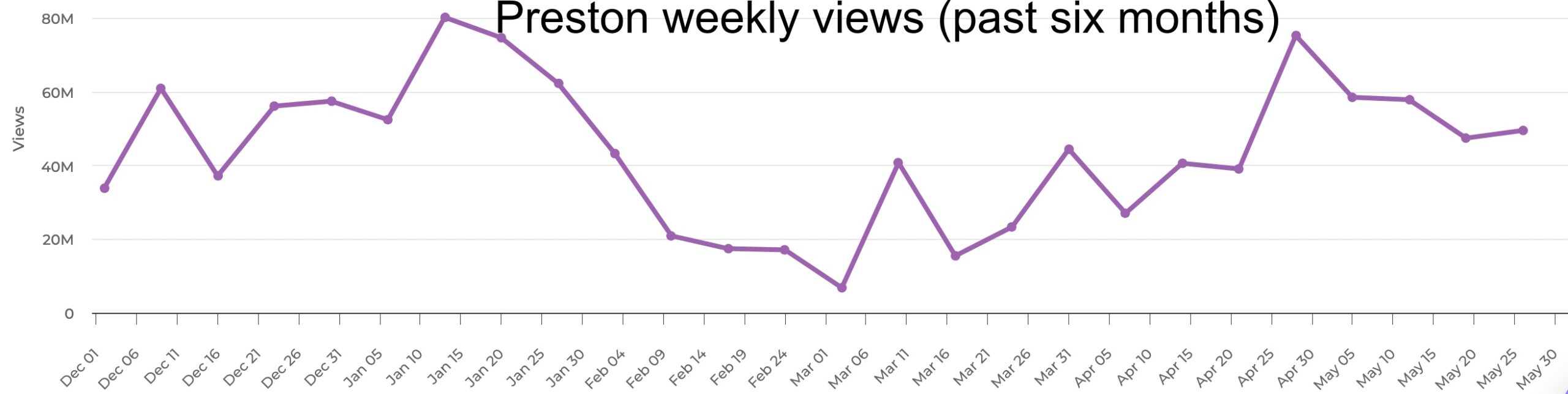
Even longtime YouTube legends are benefitting from the Minecraft Movie bump. Few players of the blocky game are as well-known as Preston, the Texas-based creator whose family-friendly video game content has brought more than 12.1 billion lifetime views to his primary YouTube channel.

Even during his most fallow periods, Preston still gets nearly 20 million views per week on his main YouTube hub. His recent numbers have soared far beyond that baseline, and his subscriber numbers have been going up, too. He crossed 30 million subs after adding 600,000 new subscribers during May.

Data via Gospel Stats

It’s funny to think that this resurgence may not have happened without Jack Black, a chicken jockey, and hordes of young theatergoers who love memes. But there’s something that just feels right about silliness underpinning the latest Minecraft boom. That’s always been the tone of the game’s best-performing videos, and given recent numbers, creators have no reason to change up their strategies.

Channel Distribution

This month, 81 channels in the Top 100 are primarily active on YouTube Shorts.

As always, keep up to speed with the latest Tubefilter Charts and all of our news at Tubefilter by following us on Twitter, becoming a fan on Facebook, and watching our videos on YouTube.

Top 100 Most Subscribed YouTube Channels Worldwide • May 2025

[Tubefilter Charts is a periodic rankings column from Tubefilter with data provided by GospelStats. It’s exactly what it sounds like: a top number ranking of YouTube channels based on statistics collected within a given time frame. We use data directly from YouTube and in terms of subscribers, YouTube rounds that data to the first three significant figures. Check out all of our Tubefilter Charts with new installments every week right here.] 

Scroll down for this week’s Tubefilter Chart.


MrBeast hit an unprecedented milestone in May 2025, but Jimmy Donaldson’s channel wasn’t the world’s most-subscribed hub during the fifth month of the year. That honor went to Masters of Prophecy, which collected 11.3 million monthly subs to outpace MrBeast’s 10 million monthly subs — even as the latter channel became the first YouTube hub with at least 400 million total subscribers.

All of the channels in this month’s Global Top 100 added at least 1.1 million new subscribers during a 31-day period. Here’s what it takes to reach that level:

Want to be a YouTube Shorts star? Time to hit the gym.

May 2025 was a good month for the beefy boys of YouTube. Muscular dudes like Mr. Azmaik (who reached 99th place in the Global Top 100) reached millions of new fans through a measured combination of physique, humor, and charisma.

What is it about the himbos that makes their videos so popular on YouTube Shorts? The format’s viewers have a penchant for challenge videos, which certainly helps. As Top 100 creators like Amilcar Aballay (#37) show us, attempting ridiculous stunts is a reliable way to reel in millions of views. And if that’s your game plan, it helps to be in good shape. For challenge creators, a heavy training regimen is about more than just idealized beauty standards.

Some of the creators in this month’s Global Top 100 have taken the obsession with getting swole to the next level by filming their videos inside of the gym. Jamshid Jamshid, who represented Uzbekistan in this month’s ranking, is one example of that trend. Most of his top-performing Shorts clips take place at the gym, where he works out while seeking silly gains. I don’t think you can actually grow taller by hanging from a pull-up bar, but hey — Jamshid claims that it works for him.

Comedic gym videos are almost as old as YouTube itself, but the rise of Shorts has breathed new life into that setting. Jamshid Jamshid reached 68th place in the Global Top 100 by attracting 1.25 million new subs during the month of May.

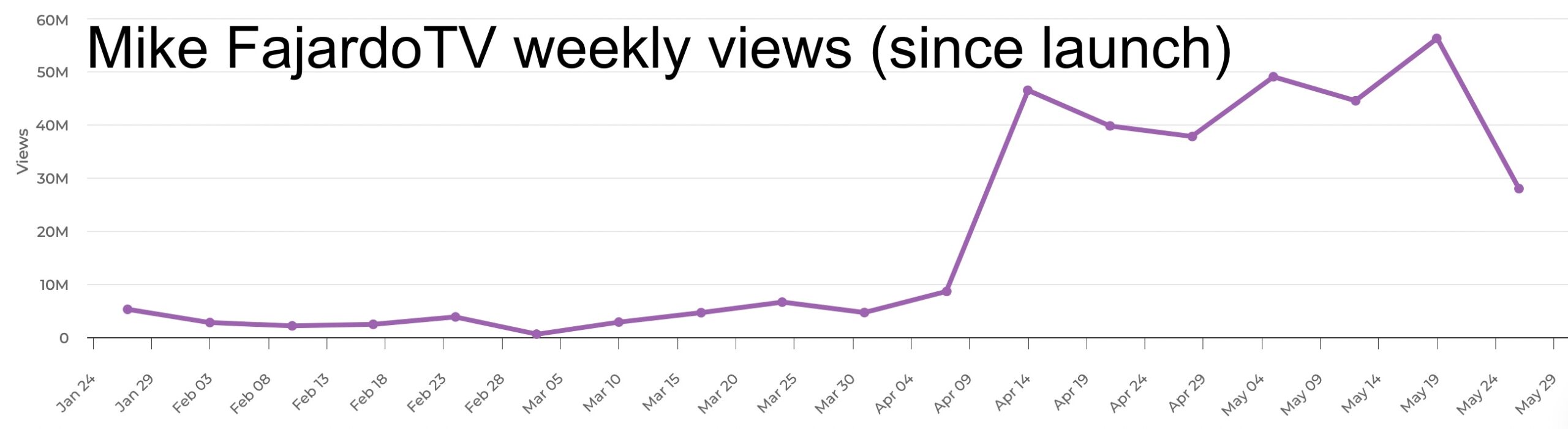
And he’s just one of many gym rats who have made gains in our charts. Last month, Mike FajardoTV was out our ranking entirely, but thanks to his short-form videos (many of which require physical exertion on his part), he’s roaring up the charts once again. He brought in 1.52 million new subs during May to reach 40th place in the chart.

Data via Gospel Stats

The success of fit dudes on Shorts may seem like a positive movement that encourages viewers to stay in shape, but is there a dark side to the trend? Videos featuring steroid-like drugs get millions of views per year in the short-form world, so its fair to ask whether a cultural focus on musclebound bodies is setting a dangerous example for young, impressionable minds. The truth is not cut-and-dry, but the simple fact of the matter is that videos like the ones depicted above provide a realistic path for individual creators who want to attract millions of subscribers per month on YouTube.

Channel Distribution

Here’s a breakdown of the Top 100 Most Subscribed channels this month in terms of their countries of origin:

  • India: 35
  • United States: 21
  • Spain: 5
  • Hong Kong: 4
  • Ukraine: 3
  • Australia, Canada, Indonesia, Japan, Mexico, Saudi Arabia, South Korea, and Vietnam: 2
  • Argentina, Austria, Belarus, Belgium, Brazil, China, Germany, Ireland, Kazakhstan, Latvia, Pakistan, Peru, Puerto Rico, Russia, Turkey, and Uzbekistan: 1

This month, 80 channels in the Top 100 are primarily active on YouTube Shorts.

As always, keep up to speed with the latest Tubefilter Charts and all our news by subscribing to our newsletter. You’re going to love it. 👉  Newsletter.Tubefilter.com.

Rhett & Link’s new gig? Recommending mythical products on Etsy

Creators can make big dollars recommending mass-produced products on ecommerce hubs like Amazon and TikTok Shop because, as you probably know, affiliate codes do be going crazy sometimes (unless the buyer has Honey installed). But there isn’t as much infrastructure for creators to quickly and easily recommend handmade products from independent sellers.

That’s where Etsy wants to fit in.

The marketplace earned nearly $3 billion last year from sellers who offer over 100 million products–everything from handmade jewelry to art to fursuits, crocheted onesies, full-sized, functional leather horse saddles, and more. (The “more” includes gen AI products, which has been a source of contention from sellers and buyers alike.)

Now, it’s looking to sell a little more by partnering with Mythical‘s Rhett & Link on an official recommendation shop.

Mythical’s digital storefront currently includes recs in several categories: Rhett & Link’s faves from across Etsy, a special Father’s Day collection, an “as seen on Good Mythical Morning” section, and perhaps the most interesting, a shelf for products made by “Mythical Beasts,” aka known fans of Mythical’s flagship show, Good Mythical Morning.

A Mythical rep says the goal here is to “spotlight unique items, champion small businesses and help fans discover products they’ll love through strategic curation and branded content designed to capture attention in an authentic way.” (And that’s the main benefit for Mythical, btw: It’s not taking a cut of revenue from any sales.)

“Creativity and curiosity are core values of Mythical that Rhett & Link have long espoused, and our fans–the self-styled Mythical Beasts–reflect that ethos,” Jacob Moncrief, Mythical’s COO, said in a statement. “Among our millions of viewers, we know there are countless artists, crafters, and small-business entrepreneurs. Who in the world of online commerce better matches the creativity (and wit) of our fandom than Etsy? This partnership gave us the perfect opportunity to integrate Etsy into our content in a way that felt both seamless to Mythical–imaginative, comedic, and deeply authentic–and allowed us to spotlight some incredible sellers and the unique customizations their products offer.”

A rep says the Mythical storefront is part of Etsy’s broader efforts to “show up in culture and connect with new audiences, all while spotlighting our sellers and their incredible items.”

While Mythical isn’t getting a cut of sales, these partnerships could still be a social complement to the bevy of other affiliate programs out there–one that lets creators, as Mythical said, support small and fan-run businesses. It opens the door for creators to recommend more unique products suited to their audience niches, and gives them the chance to uplift skilled fans directly, in a way other platforms don’t offer.

MLB buys into creator content with Jomboy deal

The MLB‘s latest attempt to connect with America’s youth involves a deal with a prominent digital media company. The top professional baseball league has announced a “strategic partnership” with Jomboy Media, the sports brand known for its humorous social media content and its irreverent podcast network.

Jomboy’s namesake founder is Jimmy O’Brien, a New Jersey native who kicked off his media career in 2017 with a podcast called Talkin’ Yanks. O’Brien expanded beyond regional content on YouTube, where Jomboy’s lip-reads and highlight reels showcased the absurd and offbeat side of America’s pastime.

Emboldened by a fanbase that now includes more than two million YouTube subscribers, Jomboy began raking in ad deals and partnerships with regional networks like YES, the official broadcaster of O’Brien’s beloved New York Yankees. The 2024 launch of a wacky competition called Warehouse Games — which Bally Sports picked up — and the 2025 promotion of Courtney Hirsch to CEO signaled that Jomboy was ready for bigger, bolder undertakings.

Enter MLB. As the league nears its 150th anniversary, it is falling behind some of its rivals in the realm of creator content. The MLB has given some opportunities to sports-savvy influencers like Katie Feeney, and it built one of the most prominent video players in internet history, but its creator slate doesn’t look so expansive where compared to those of the NFL and NBA.

Is it a coincidence that the MLB is also struggling to maximize its TV deals? I think not — after all, we live in an age where creator culture is directly linked to sports viewership.

The Jomboy deal will give the MLB a path to relevancy among younger generations. “MLB will utilize Jomboy Media’s expertise on MLB’s digital channels, create activations around key MLB events like the All-Star Game and Home Run Derby and help grow Jomboy Media’s stable of intellectual property including Talkin’ Baseball, Talkin’ Yanks, and The Warehouse Games,” reads the league’s official announcement of the deal.

In a video on his channel, O’Brien cheered the great progress his team has made in just a few short years. “We started making baseball content as a hobby and we have scaled it into a company with 60ish employees, tons of creators, and now we have huge news,” he said. “We’re nothing without the people who have been advocating for us, watching, engaging, and getting us to this point.”

If the MLB is wise, the Jomboy deal will only be the start of its creator push. As a matter of fact, there’s another Jimmy on YouTube who just so happens to be a former high school baseball standout. But before that potential cleanup hitter steps to the plate, O’Brien and his team of enthusiasts will get an at bat of their own.

Top 50 Most Subscribed YouTube Channels • Week Of 06/08/2025

[Editor’s Note: Tubefilter Charts is a weekly rankings column from Tubefilter with data provided by GospelStats. It’s exactly what it sounds like; a top number ranking of YouTube channels based on statistics collected within a given time frame. Check out all of our Tubefilter Charts with new installments every week right here.]

Scroll down for this week’s Tubefilter Chart. 👇


MrBeast got his 400 millionth subscriber a week ago, and he’s not stopping there. The world’s most-subscribed YouTube channel is now on its way to 500 million thanks to the 3 million subscribers MrBeast added during the first full week of June.

In total, nine channels got at least one million new subscribers over the past seven days. Most of the hubs in that number are either short-form standouts (KIMPRO), kid-friendly stalwarts (Kids Diana Show), or generative AI weirdness. Let’s ignore all of those categories and talk about some dank memes.

Italian Brainrot. Tanto caldo adesso.

As far as I can tell, Gen Alpha’s sense of humor is taking a tour of the subjects that have dominated internet culture for more than a decade. First, there were the “lol so random” activities of the Skibidi Toilet gang. Then there was a dose of cute animals, including some strange, AI-generated pets.

Now, the hot new thing in Gen Alpha japes is a style of comedy that has entertained us millennials for a long time: Nonsense words. For the generation that is driving current pop culture trends, humorous gibberish takes the form of Italian Brainrot, a meme that pairs AI-generated images with fake Italian names for those creations.

Italian Brainrot is a major force in the latest Global Sub Top 50 chart. Some entrants in the ranking are straightforward distributors of the latest Italian Brainrot memes. That’s the case with DRЫNDA, a Ukraine-based channel that has made a name for itself by infusing its short-form clips with dancing cappuccinos.

How much work has Italian Brainrot done for DRЫNDA? After finishing outside of the Global Sub Top 50 a week ago, the channel in question rocketed up to 27th place by adding 430,000 new subscribers. Its views have also increased steadily since the Italian Brainrot phenomenon skyrocketed in May.

Data via Gospel Stats

At this point, the Italian Brainrot memes are evolving. While some channels prefer to dispense the generative AI jokes in straightforward fashion, others are applying growth hacking tricks to get fake Italian silliness in front of as many viewers as possible.

That’s the best explanation I can muster for Chief Brioso, a Spain-based channel that reached 43rd place in the Global Sub Top 50. Chief Brioso added 353,000 new subscribers by pairing Italian Brainrot with gameplay from Geometry Dash, a game that has powered some of YouTube’s top channels in recent months.

https://www.youtube.com/shorts/8kciTA-zcYI

Is this the peak Gen Alpha video? It has AI-generated content that’s totally inscrutable to older generations, twitchy gameplay from a free-to-play classic, and no intelligible sense of order. Chief Brioso may have found the key to reaching an entire cohort of YouTube viewers: Stuff in as much nonsense as possible.

There is one thing about this video that makes perfect sense to me: The use of a Theragun as a “fast-clicking” aid for games like Geometry Dash. I have one of those in my house, which means I may be ready to become the next big thing on YouTube Shorts.

Channel Distribution

Here’s a breakdown of the Top 50 Most Viewed channels this week in terms of their countries of origin:

  • India: 18
  • United States: 14
  • Hong Kong and Spain: 2
  • Australia, Brazil, Canada, Chile, China, Germany, Latvia, Mexico, Saudi Arabia, South Korea, Taiwan, Ukraine, Uzbekistan, and Vietnam: 1

This week, 43 channels in the Top 50 are primarily active on YouTube Shorts.

As always, keep up to speed with the latest Tubefilter Charts and all our news by subscribing to our newsletter. You’re going to love it. 👉  Newsletter.Tubefilter.com.

Top 50 Most Viewed YouTube Channels Worldwide • Week Of 06/08/2025

[Editor’s Note: Tubefilter Charts is a weekly rankings column from Tubefilter with data provided by GospelStats. It’s exactly what it sounds like; a top number ranking of YouTube channels based on statistics collected within a given time frame. Check out all of our Tubefilter Charts with new installments every week right here.]

Scroll down for this week’s Tubefilter Chart. 👇


Are we about to get our first three-billion-view channel in the Global Top 50. It looks as if KIMPRO could become the first YouTube channel to generate that much viewership over a seven-day span. It topped 2.8 billion weekly views to take the #1 spot in our most recent Global Top 50.

The channels shattering new records are impressive, but the average creator can learn just as much from the short-form superstars who are just breaking through for the first time. Here are some thoughts about kid-friendly channels that are employing mimicry to blow past viewership milestones.

Are we heading into Ms. Rachel Summer?

An early childhood educator beloved by (almost) everyone is inspiring creators around the world. With her cheerful sing-alongs and positive, enriching videos, Ms. Rachel has become one of the most-watched YouTube creators across all categories.

Ms. Rachel can be easily identified thanks to her overalls and pink shirt, which she wears in almost all of her videos. Is that outfit the secret to her success? Other creators in the children’s entertainment space seem to think so.

Recently, a few “Ms. Rachel clones” have broken into our Tubefilter charts. First, there was France’s Kidi Fun, who enjoyed a surge of subscribers after donning colorful overalls and putting on the bright smile Ms. Rachel shows off in her content.

This week, BabyBillion is taking its turn in the spotlight. The India-based channel is not a one-for-one imitation of the Ms. Rachel approach; its primary stars are children rather than adults, and its videos trend more toward comedic sketches rather than educational ditties.

But there are some uncanny similarities between the two channels’ wardrobe choices. BabyBillion’s on-screen talent is typically seen wearing overalls, and that item is always paired with a colorful shirt, just like how Ms. Rachel does it. It may be an oversimplification to tie this particular combo to Ms. Rachel exclusively, but it has become a more common look since her channel took off a few years ago.

Want to know why kids’ channels are paying so much attention to aesthetics? Check out BabyBillions’ view count. The channel lived up to its name by getting one billion weekly views during the first full week of June. That was good enough to push it into tenth place in our Global Top 50.

Even channels that don’t seem to be consciously copying Ms. Rachel are enjoying the “overalls bump.” 123 Andrés is a long-running children’s channel that blends music with life lessons, and while its YouTube success predates Ms. Rachel, its co-star does rock a pair of overalls.

And hey, what do you know — 123 Andrés is moving up in our charts. It reached 46th place in the Global Top 50 after picking up 577.2 million weekly views.

Data via Gospel Stats

I’m willing to believe that children’s channels first arrived at the overalls-and-colorful-shirt look because young kids think overalls are comfy (and they love bright colors). Ms. Rachel’s success ensures that the standard getup for kid-friendly YouTube content will have legs for years to come. Secondhand clothing store owners should take note.

Channel Distribution

Here’s a breakdown of the Top 50 Most Viewed channels this week in terms of their countries of origin:

  • United States: 12
  • India: 11
  • Hong Kong and Vietnam: 4
  • Canada: 3
  • Australia and Taiwan: 2
  • Belgium, Brazil, China, Germany, Indonesia, Japan, Jordan, Kazakhstan, Latvia, Russia, South Korea, and Spain: 1

This week, 43 channels in the Top 50 are primarily active on YouTube Shorts.

As always, keep up to speed with the latest Tubefilter Charts and all our news by subscribing to our newsletter. You’re going to love it. 👉  Newsletter.Tubefilter.com.