The Amazon-owned platform does something unique with sponsored content: It offers open-invitation campaigns, where brands can list requirements and offer a number of spots, and Partner streamers can apply to join in.
But for the first time, it opened a sponsored campaign to Affiliates, too.
In case you’re not familiar, there are two tiers of affiliation and monetization on Twitch–Affiliate and Partner. Affiliate has a much lower bar; it just requires streamers to reach 25 followers, stream for four hours total across four different days, and reach an average of three viewers on those four different days. Once they become an Affiliate, they unlock the ability to earn money through things like ad revenue and subscriptions.
To qualify for the higher Partner tier, streamers have to hold 12 individual streams over a 60-day period with “a predictable +75 viewers per stream.” And unlike with Affiliate, a streamer meeting Partner qualifications doesn’t automatically mean they will become a Partner. They have to go through an application process with internal review from the Twitch team, and can be denied even if they did hit those 75+ viewers per stream.
So, all that is to say, becoming a Partner is difficult, and so newer/smaller streamers find themselves locked out of monetization opportunities like these open-call sponsorships.
Until this week.
Minecraftpartnered with Twitch to run a “Tiny Takeover” sponsored campaign, where both Partner and Affiliate streamers can earn up to $1,000 in bonus revenue by streaming at least one hour of Minecraft gameplay April 6-8.
Streamers who opt in to the Minecraft event will get a “special promotional skin overlay that lets your viewers know you’re part of this exciting campaign,” Twitch said in a company blog post. It also warned that “[t]his is a first-come, first-served opportunity and only available for a limited time, so don’t wait!”
Participating streamers could also get a visibility boost from Twitch: The platform is running a special home page shelf displaying streamers who are part of the campaign.
As for what viewers get, anyone who buys a sub for themself or gifts a sub to another viewer on a participating streamer’s channel will get a Baby Chick Chat Badge. Also, anyone who watches at least five minutes of content on a participating streamer’s channel will get three in-game Drops equippable on their Minecraft avatars: the Hatchling Hat, Turtle Tunes headphones, and Bunnie Beanie.
“This marks a major milestone for our Affiliate community. Sponsored campaigns have traditionally been exclusive to Partners, but we’re expanding access because we believe in supporting creators at every level,” Twitch wrote in its post. “Whether you’re just starting your streaming journey or you’re a seasoned pro, Twitch and Minecraft are offering a chance to get in on the action.”
Twitch is right: This is a big step for Affiliates, and a notable effort from Twitch to promote and monetize smaller streamers. In an age where more people than ever are trying to stream for the first time, this sort of outreach could set Twitch apart from challengers like Kick, and give it longevity others–like DLive, which just announced its shutdown–haven’t been able to master.
Filed under: Homepage Feature, Minecraft, Twitch by James Hale Comments Off on For the first time, Twitch opens sponsored campaigns (and their revenue) to Affiliates
As videos for kids on platforms like YouTube receive international scrutiny, leading media company Moonbugis forging a partnership that will bring more educational merit to its content library. The owner of notable IP like CoComelon and Blippi has announced a pact with the UCLA-affiliated Center for Scholars & Storytellers (CSS).
The Center’s mission is to connect creators with academic research that can be used to improve programming for preschool audiences. Its partnership with Moonbug will incorporate those findings into shows like CoComelon, Blippi, Little Angel, and CoComelon spinoff The Melon Patch.
The teams that bring those shows to millions of young viewers will utilize the Center’s research throughout the entire creative process, from early concepting to production. “To make great stories for young kids, you have to start with how they learn,” said Moonbug Chief Creative Officer Rich Hickey in a statement. “Our teams already think deeply about how toddlers experience music, stories, and everyday moments. This partnership with CSS renews that commitment.”
Moonbug extended that effort last year when it pledged to join YouTube’s initiative to promote “the development of high-quality, age-appropriate content for young people.” Google is committed to uplifting those types of videos on YouTube.
Now, with the CSS as its guide, Moonbug is looking to add even more enrichment to its library. The Center developed four core principles by reviewing research on early childhood learning and passing that analysis along to partners like Moonbug. Equipped with the Center’s information, Moonbug will be able define learning goals, shape themes, and ensure clear conveyance of its educational messages.
That effort won’t just please partners like YouTube. Parents have also demonstrated a desire for more beneficial children’s content on YouTube, which is one reason why educator Ms. Rachel has achieved eye-popping viewership numbers. CoComelon’s live-action Melon Patch, led by Ms. Appleberry (pictured above), could be its answer to Ms. Rachel — and now, thanks to the CSS, Melon Patch videos will have even more merit for their young viewers.
Filed under: Articles, Family, Featured, Homepage Feature, News by Sam Gutelle Comments Off on Moonbug’s UCLA partnership will bring more “child development research” into programs like CoComelon
Golf is one of the hottest sports on YouTube, and a new network is ready to help creators in that category unlock more revenue. Source Golf is here to serve some of the biggest names on the fairway, and its inaugural roster includes stars like Bryson DeChambeau, Grant Horvat, and brothers Wes and George Bryan.
Source Golf is a subsidiary of Source Media Group, a company that, according to its website, “builds media businesses for rights holders, creators and brands.” To accomplish that goal, the new entity will operate in a similar lane as the multi-channel networks that flourished on YouTube in the 2010s. Source Golf will package together videos from its creator roster and will sell those bundles to advertisers as a “unified, television-style media buy.”
A press release announcing the Source Golf launch noted that the sport’s current base of 48.1 million participants is driven by rapid growth among younger players. That’s why the golfers those under-35s admire — many of whom are active on YouTube — are getting opportunities to qualify for PGA events. The 2024 Creator Classic signaled a turning point for golf’s most prominent tour, which acknowledged that digital voices are an important part of its future.
Source Golf partners are leading that wave. Horvat, for example, has teed off with Tiger Woods, while two-time major winner DeChambeau has raised his profile via an official YouTube hub.
“The way people consume golf content has changed, and YouTube is a massive part of that,” DeChambeau said in a statement. “I’ve seen how powerful that direct connection to the fans can be.”
At the same time, a golf network faces unique challenges. It’s not surprising, for example, that a sport filled with traditionalists is resisting the creator invasion. (Just ask Rory McIlroy.) And the PGA’s decision to skip the 2026 Creator Classic raised questions about the tour’s ability to accept change.
Even with those reservations, Source Golf has a massive opportunity on its hands. As creators like Horvat rack up millions of views, brands can no longer ignore them, and the new network is ready to play the matchmaker.
Filed under: Articles, Featured, Homepage Feature, News, Sports by Sam Gutelle Comments Off on Golf creators are teeing off on YouTube. A new network is ready to be their caddy.
Sixty years ago, as Russia and the U.S. were locked in fierce competition to achieve ever greater feats of space engineering and exploration, people watched launches and landings on their TVs, broadcast by major networks like ABC, CBS, and NBC.
Now, we’re watching NASA and the crew of the Orionmake humanity’s first trip back to the moon since 1972–and it’s all being streamed on YouTube and Twitch.
While Artemis II mission astronauts Victor Glover, Jeremy Hansen, Christina Koch, and Reid Wiseman set records in space, traveling farther from Earth than any other humans in history, NASA is beating its personal records on the internet.
Per data from Streams Charts, the April 1 launch of the Orion reached 10 million concurrent viewers across YouTube and Twitch. The most-watched distributor was NASA itself, with a YouTube stream that peaked at 3.9 million live viewers. Other top channels were NASA en Español, with 426K concurrent viewers, and Fox News, with 338K.
Streams Charts also gave a nod to YouTuber Everyday Astronaut, saying he achieved the highest viewership among individual, non-media streamers. It didn’t give exact numbers, but the VOD of his livestream now has 1.5 million views.
While the launch from Kennedy Space Center racked up major attention, things weren’t over. As the Orion sailed toward the moon, NASA continued broadcasting 24/7 on YouTube, offering two streams: one a silent video of live views from the Orion as it headed away from Earth; the other, an official “mission broadcast,” with the same views plus some shots from Control, with mission chatter audio.
Those streams are still ongoing, and at publication time have 8K and 81K concurrent viewers, respectively.
Of course, the Artemis II mission hit another significant milestone April 6, as the Orion made a loop around the far side of the moon. Stream viewership shot back up for that event, and while we don’t have total numbers yet, we do know NASA’s YouTube stream of the flyby has reached nearly 650K views so far. It was a 7-hour stream, including covering the harrowing (at least, for a viewer; NASA seemed pretty calm) 40 minutes when the Orion vanished behind the moon and had no radio contact with Earth.
One thing here at home was different between the launch stream and the flyby stream: Netflix joined in on the latter, broadcasting the Orion’s journey and publishing some related editorial content celebrating the crew’s achievements (as well as advertising that Netflix has “plenty more NASA+ live feeds headed your way in the future”).
This stream was part of an overall NASA x Netflix deal signed in summer 2025, where Netflix will broadcast live coverage of various rocket launches, spacewalks, etc. It’s not clear why it didn’t broadcast the Orion’s launch. Most of the content included in its deal also broadcasts for free on the streaming service NASA launched in 2023, NASA+.
We’re sure there will be further stream view spiking as the Orion returns to Earth and prepares for a (hopefully) safe splashdown in the Pacific Ocean. For now, NASA continues to broadcast 24/7 views from the Orion and mission chatter, giving thousands of live viewers a nonstop window into spaceflight.
Not to be too on the nose, but compared to the broadcasts of the 1960s, the access we have now–on YouTube, Twitch, and beyond–is a huge leap for curious minds. The TV programs following the Space Race were often time-limited (though some, like Walter Cronkite‘s 46-hour coverage of the Apollo 11 mission, stretched on), and we weren’t yet technologically capable of showing much live footage from space.
But look: At this moment, you can go to YouTube and see Earth from hundreds of thousands of miles away. You can see what our astronauts see.
Incredible.
Filed under: Homepage Feature by James Hale Comments Off on NASA is broadcasting history live on YouTube
Can a robust selection of ecommerce products and features make the link-in-bio obsolete? Meta seems to think so.
At the Shoptalk Spring conference in Las Vegas, the company formerly known as Facebook announced some key updates related to Instagram Reels. Most notably, the vertically-oriented posts are getting a feature that will bring them in line with analogous formats on YouTube and TikTok. A select group of Instagram creators can now tag products in their Reels, thus allowing them to bypass link-in-bio solutions that flourished earlier in the decade.
Product links in Reels are currently available in five markets. As tests expand throughout the spring, more creators with at least 1,000 followers will gain access to the feature. A single Reel can contain up to 30 product links.
Meta Head of Global Business Group Nicola Mendelsohn discussed product tagging on Instagram Reels during her address at Shoptalk Spring. “For creators, when it comes to highlighting products, this means that the era of link in bio is finally over,” Mendelsohn said. “We’re basically shrinking the distance between discovering and purchase and putting creators right to the center of the journey.”
Instagram was indirectly responsible for the rise of the link-in-bio industry. For years, the app’s profiles only had room for a single link, and that deficiency spawned a glut of third-party companies that turned individual URLs into sprawling creator hubs. Some of those firms, like Linktree, hauled in massive funding rounds and attracted millions of users.
The tide began to shift in 2023, when Instagram announced that it would start allowing multiple links in its bios. Since then, major social media platforms have made it easier for creators to use first-party products to promote their products and partnerships. The Linktrees of the world have shifted gears to serve the evolving needs of those creators.
Both YouTube and TikTok have used product links to open up more affiliate marketing and brand partnership opportunities across long-form and short-form videos. Instagram brought product tagging to its posts in 2022, and the latest update adds Reels to the equation.
Meta noted that it is not taking commissions from the new product links. Instead, the feature is designed to uplift the creator economy across the platform. “When creators can monetize, performance is better for everyone,” said Meta Group Lead of Retail and E-Commerce Karin Tracy at Shoptalk Spring. “Everyone wins.”
Welcome to our rundown of the most-watched branded YouTube videos of the week.
We’re publishing this snippet of a larger Gospel Stats Weekly Brand Report in order to analyze sponsorship trends in the creator economy. Any video launched in tandem with an official brand partner is eligible for the ranking.
And – as the name up above would imply – all the data comes from Gospel Stats. If you’re interested in learning more about Gospel – and which brands are sponsoring what creators on YouTube – click here. You can also download our YouTube 2025 Sponsorship Landscape Reporthere.
This week MrBeast and Tucker Carlson split the stage, plus Ryan Trahan gets sweet and a yacht company is hoping to find its ultra-luxe audience on YouTube.
Buckle up–the Gospel Stats Weekly Brand Report has it all right here…
These days, it’s not often that we see MrBeast pick up a new sponsor. Most of his sponcon is put on by his own brand, Feastables, or by longtime partners like Shopify and Moose Toys (the company responsible for his MrBeast Lab toy line). But occasionally he’ll dip into a new partnership, and that’s what happened this week.
This video is a half-hour island “survival” adventure, where MrBeast and ~the boyz~ are “abandoned” somewhere in the Pacific Ocean and have to build their own means of escape. (Of course, they are glazed at all times in high-quality lighting.) It’s sponsored by Typeless, which says it offers “AI voice dictation that’s actually intelligent.”
Not what I would have picked as my one thing to bring to a deserted island, but MrBeast gives the app a ringing endorsement that seems cropped from its own website description: “Write 4x faster with the Typeless voice keyboard. Just speak naturally and Typeless turns your speech into your best writing by understanding your intent: removing fillers, refining wording, and structuring your sentences. Works in any app on any device.”
MrBeast‘s million-dollar Salesforce challenge is officially over. In case you missed it, the Beast Man tweeted earlier this year about having a great idea for a Super Bowl commercial, if only there was a company willing to bring him on as its spokesperson (and give up creative control of its spot during the big game).
Salesforce–which calls itself “the #1 AI CRM”–responded, and MrBeast’s idea came to fruition. He put a cool million bucks in a vault and issued a series of challenges for viewers to fulfill. Whoever cracked the code first would get the money. Weeks went by, but finally someone named Colin was able to finish all the puzzles. In this minute-long Short, he tells MrBeast he poured “hundreds and hundreds” of hours into solving clues.
Now he’s been amply rewarded for his efforts, MrBeast got his Super Bowl spot, and Salesforce got hundreds of millions of views, with this video heaping 30 million more on the tally.
MrBeast isn’t the only creator in the candy aisle. Ryan Trahan is trying to make his brand Joyride into the top-selling candy in all 50 states. He’s also trying to get it wider distribution since, as he puts it, “There’s still so many towns that don’t have Joyride in them.”
So, in 2026, he’s hitting those locales by expanding Joyride to new stores like Publix, Casey’s, and Love’s, and is also rallying his 22.6 million subscribers to help pump the brand’s sales nationwide. Based on these ambitions, we expect to see a lot of Joyride-sponsored Trahan content this year…And maybe some Joyride-sponsored content from other creators?
National Counterterrorism Center Director Joe Kent made his much-talked-about exit from the Trump administration March 17, warning that the U.S.’s attacks on Iran were a bad idea because the country poses no “imminent threat” to the States. He spent a little under a year in the position, and apparently has a lot to say about his time served, because this interview with Tucker Carlson is two hours long.
Carlson would know about fraught exits: He was abruptly fired by Fox News in 2023, and since then has been self-producing The Tucker Carlson Show on YouTube. It’s helped bring him 5.5 million subscribers, and allowed him to continue platforming his conservative views despite not being wanted by the U.S.’s top conservative network.
His interview with Kent is pretty frank, and offers an inside look at the Trump White House. It’s also (presumably) earning Carlson a nice chunk of money beyond AdSense, since it has not one, but four sponsors: Ethos, Audien Hearing, Dutch, and Joi+Blokes.
Oh, the Cribsof it all. I know we’re in a terrible place economically (it’s six bucks a gallon for gas here in California) and that makes it harder to enjoy the voyeuristic content that drove MTV‘s 2000s, but sometimes looking at stuff rich people spend money on still hits.
What’s interesting here is that the posting channel, AQUAHOLIC, is sponsored by SETAG Yachts, but is reviewing a vessel from Australian producer Riviera, an entirely separate brand. AQUAHOLIC’s host, yacht salesman turned marine journalist Nick Burnham, spends 25 minutes on a very thorough walkthrough of Riviera’s latest model.
So why, you ask, would one yacht brand sponsor a video about another? Because SETAG’s specialty is refitting. Whenever someone buys a yacht–like, say, a Riviera–and wants some personalization done, SETAG puts itself on offer. It choosing to advertise on a video about the base model (as base as a multimillion-dollar yacht can get, at least) is a flashing neon sign saying HEY! IF YOU LIKE THIS YACHT BUT IT’S NOT EXACTLY PERFECT, WE CAN MAKE IT EXACTLY PERFECT!
Smart marketing–though I’d love to see some data about how many YouTube viewers are secretly people capable of splashing that much on a boat…..
…and there’s a lot more data where that came from. If you like our Weekly Top 5, you’ll love everything else Gospel has to offer. Start with our newly released YouTube 2025 Sponsorship Landscape Report, which you can download right here.
[Editor’s Note: Tubefilter Charts is a weekly rankings column from Tubefilter with data provided by GospelStats. It’s exactly what it sounds like; a top number ranking of YouTube channels based on statistics collected within a given time frame. Check out all of our Tubefilter Charts with new installments every week right here.]
Scroll down for this week’s Tubefilter Chart. 👇
MrBeast reassumed his rightful place atop our Global Sub Top 50 chart. The man behind the most-subscribed channel on YouTube added two million weekly subscribers to push his total count up to 475 million. Perhaps he was aided by his big streamer showdown video, since the co-host of that clip — iShowSpeed — also cracked the Top 50 in 37th place.
Even if MrBeast is #1 in the Global Sub Top 50, he’s not the most dominant theme in the chart. That distinction belongs to a platform that is redefining internet culture across national and linguistic borders.
This isn’t even Roblox’s final form
Did you think that an era of bloated brainrot adaptations and loud phonk music would lead to a state of Roblox fatigue? Well, if you did, you thought wrong, because Roblox is not only as popular as ever, but the content surrounding it is also evolving.
Amid a handful of Roblox channels in this week’s Global Sub Top 50, a few unconventional entrants stood out. One creator who caught my eye is Jie GamingStudio. Malaysia’s lone entrant in the ranking thrives with his Roblox content, but his most-watched Shorts clips don’t feature gameplay or brainrot memes. Instead, he tells stories from the game’s past and imagines what its future could look like.
Roblox players are flocking to these stories like moths to a flame. During the first week of April, Jie GamingStudio added 400,000 new subscribers to reach 22nd place in the Global Sub Top 50. During a week when another gaming historian announced his plan to move on from his channel, the rise of a Roblox historian — and his first appearance in our charts — just feels fitting.
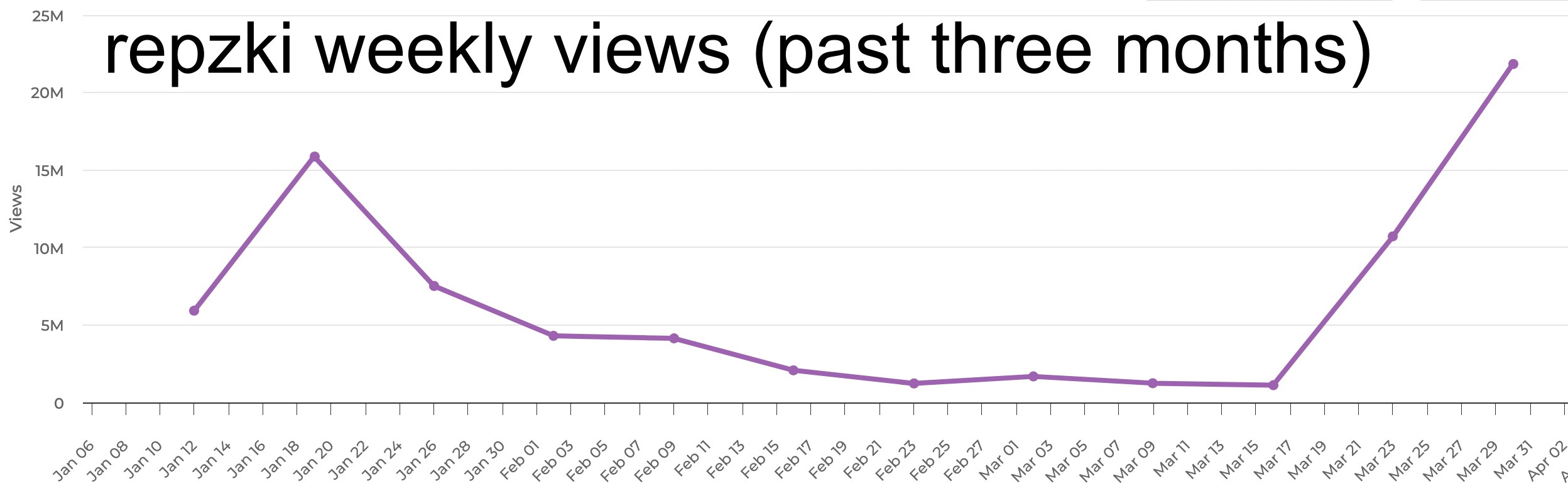
Roblox history clips aren’t the only unique framing of the game in the Global Sub Top 50. While the Minecraft creators in the ranking still focus primarily on gameplay (like 46th-place finisher ShaosMC, for example), the Robloxers are treating their game of choice as a creative canvas. Spanish creator repzki, who just made it into the Top 50 for the first time, has turned Roblox into a comedy routine. The laughter will continue as long as she has noobs to troll.
Data via Gospel Stats
Compared to Minecraft, Roblox’s roots always leaned more toward the creative side of things rather than toward pure gameplay. That tendency is now having a profound affect on the types of Roblox videos that are making it into our charts.
Meanwhile, the platform continues to expand globally. Its popularity in Brazil has already reshaped our rankings. Which country will be the next one to redefine the current “meta of Roblox content?
Channel Distribution
Here’s a breakdown of the Top 50 Most Viewed channels this week in terms of their countries of origin:
United States: 9
Brazil: 6
India and Mexico: 5
Indonesia and Japan: 3
Argentina: 2
Australia, Hong Kong,Malaysia, Pakistan, Russia, Spain, Turkey, and Ukraine: 1
This week, 39 channels in the Top 50 are primarily active on YouTube Shorts.
As always, keep up to speed with the latest Tubefilter Charts and all our news by subscribing to our newsletter. You’re going to love it. 👉 Newsletter.Tubefilter.com.
[Editor’s Note: Tubefilter Charts is a weekly rankings column from Tubefilter with data provided by GospelStats. It’s exactly what it sounds like; a top number ranking of YouTube channels based on statistics collected within a given time frame. Check out all of our Tubefilter Charts with new installments every week right here.]
Scroll down for this week’s Tubefilter Chart. 👇
BabyBillion dominated our charts in March. It finished #1 in all of the Global Top 50 rankings we released during that month. As the calendar turns over April, BabyBillion isn’t slowing down. It got 1.14 billion weekly views to once again lead our ranking of the most-watched YouTube channels of the week.
To make the list at all, channels needed to get at least 278 million YouTube views over a seven-day period. That may seem like a daunting threshold, but some creators are still finding interesting ways to break into the chart.
To succeed on YouTube Shorts, all you need is a big brother
And no, I’m not talking about a reality show or a widespread surveillance system. On YouTube, familial content often performs well, and brothers are particularly well-positioned to roll up massive view counts.
We initially noticed this concept via channels like Zamzam Electronics Trading, which used brotherly love as a strategy for promoting a small business. Now, there’s another interesting case study demonstrating the power of the big brother: Say hello to the BN Brothers.
Though both boys are referenced in the channel’s title, older brother Bhavesh Koranga is the clear leader. He feeds local cats, plays with his favorite toys, and helps little brother Navneet learn how to ride a bike.
That may seem like fairly standard fare in the world of Indian family content, and that genre dominates YouTube Shorts. 27 of the 50 channels in this week’s chart hail from the world’s most populous nation. In such a crowded landscape, how do Bhavesh and Navneet stand out? How were they able to get 280.7 million weekly views when longer-running Indian family hubs end up with far less traffic?
The answer to those questions concerns the channel that first launched the BN Brothers to prominence. They are two members of the BN Family, which has uploaded YouTube videos since 2013 and amassed more than nine million subscribers. But the family’s group channel never quite reached the number the BN Brothers have recently achieved. That fact represents the power of the big brother.
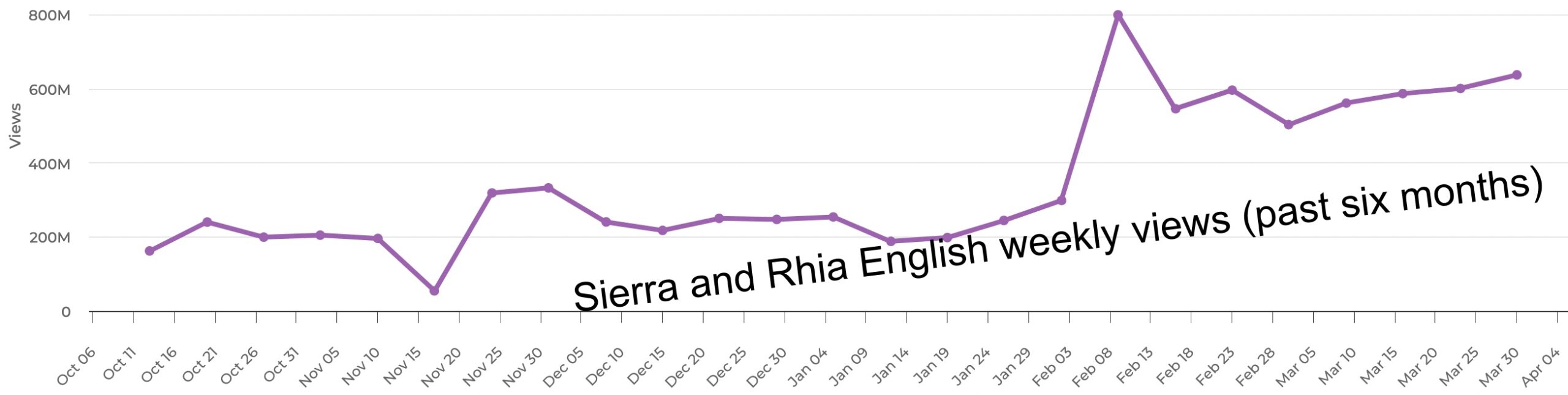
Of course, that’s not to say that other family members don’t hold sway, either. Sierra and Rhia are two sisters whose primary channel has been a stalwart in our charts over the past few years. Now, a secondary channel is bringing more Sierra and Rhia adventures to the masses, and it too is now generating more traffic than the channel that put its stars on the proverbial map.
The real growth hack on display here is the power of an established channel. YouTube Shorts is far noisier than it was three years ago, which puts the OG Shorts superstars at an inherent advantage. Kids like Bhavesh, Navneet, Sierra, and Rhia are thriving amid that ecosystem.
There’s a question about who these channels are really for — the kids or the parents? But Bhavesh seems to have a lot of fun on the BN Brothers hub, and in the case of this big brother, we’re the ones who are always watching.
Channel Distribution
Here’s a breakdown of the Top 50 Most Viewed channels this week in terms of their countries of origin:
India: 27
United States: 7
Canada: 3
Argentina, Australia, Bangladesh, Brazil, China, Colombia, Germany, Indonesia, Russia, South Korea, Taiwan, and Vietnam: 1
This week, 39 channels in the Top 50 are primarily active on YouTube Shorts.
As always, keep up to speed with the latest Tubefilter Charts and all our news by subscribing to our newsletter. You’re going to love it. 👉 Newsletter.Tubefilter.com.
Cirque du Soleil. America’s Got Talent. Penn & Teller: Fool Us. Masters of Illusion.
Xavier Mortimer has done them all.
Mortimer fell in love with magic when he was a kid growing up in Briançon, France. The catalyst, as he told Vegas Never Sleeps in 2019, was seeing a local magician performing at a restaurant. His father subsequently gifted him a book on magic, and Mortimer never looked back. In just a decade, he went from hawking flowers at a local market so he could buy props, to performing his own show at Theatre Le Temple in Paris.
From there, he was picked up by Cirque du Soleil, and after a three-year tour with them, ended up landing his own nightly stage show in Las Vegas.
Mortimer, who by then was an expert at his craft and had featured on the above TV shows, figured it was time to try pitching his own series. The concept was deceptively simple: Instead of putting on a public performance, he’d go somewhere like a coffee shop and do subtle tricks like having a napkin zip across the room and into his hand–the sort of thing that could convince a bystander that maybe he really was a wizard.
But no networks agreed to greenlight the idea for production.
So, when TikTok’s precursor/former rival musical.ly began to take off, Mortimer decided to do the producing himself.
Expect to see more on that in the future. For now, let’s dive into our chat with “the Dream Maker”…
Tubefilter: Obviously you’ve done a lot with magic in your lifetime. Tell us what you were working on before you got into social media.
Xavier Mortimer: It’s actually very funny. I pitched a show to a couple of producers, a TV show, and the concept was basically a real-life wizard. Someone who just walks in the streets, doesn’t necessarily perform, but just does random things in front of people that are magic.
For example, you go to Starbucks and, well, you need a napkin. But you don’t walk to the napkin, the napkin comes to you. That was the whole idea: How would a magician act if he was in real life?
I pitched that idea and no one picked it up. I didn’t get my show, basically. Then social media came and I was like “Oh! I have a phone! I can do this! This is pretty good!” I figured, if it works, great, if it doesn’t, well, the TV executives were right. And they were wrong!
Tubefilter: Clearly! How did you start with social media? What was your first platform?
Xavier Mortimer: I opened an account right when musical.ly was transitioning to TikTok. It was just young kids dancing, so I wasn’t sure, but I was like, “Okay, I’ll try to publish my videos.” And they got lots of views! I was like, “Okay, that’s the test, that’s proved it.”
So I started to publish on other platforms, like Instagram, Facebook, YouTube. People started to discover me this way, and it was a learning experience, because I didn’t know that people would be happy to see a different type of magic from what I was used to doing. I was always afraid of what people would say. I went through so many steps, where first it’s bad, then you get traction and people discover you and they’re kind of like, “Uhh, okay, this isn’t magic, this is social media.” But then you grow and get bigger and bigger and put more energy into your production.
Tubefilter: I think that’s a pretty universal experience, where creators feel their first content isn’t very good, that they haven’t found their footing yet. When did things start to come together for you?
Xavier Mortimer: My first viral video was at Starbucks. I made a napkin fly and a cup of coffee come to me. The video instantly got millions of views. I was like, “Wow!” You know that feeling of your first viral video? You’re refreshing every minute, I was getting thousands of views every minute. It showed me that I can go viral, so let’s keep doing it.
I took my idea and put it in different situations. What if I’m at a fast food restaurant, what if I’m at the library, what if I’m at the casino? This guy who’s walking in Target or Walmart and just does incredible things that people barely notice, but it’s magic.
Tubefilter: What was it like transitioning from doing onstage magic to magic on video? Is there a different feel?
Xavier Mortimer: Live show is a completely different animal. There are similarities, like you create illusions and magic tricks that can be performed, that are reliably performable. But when you play for the camera, you can do smaller things, and also you can be in different situations, like in a restaurant, in a library. So that gives you context, a reason to do your magic.
When you’re onstage, you’re here to entertain a big audience, so you’re here to present something. The difference between being on video/social media and being onstage, is the same difference between an actor doing a movie and a play. It’s not the same acting, it’s bigger when you’re acting onstage.
Tubefilter: How did you move forward and develop your content and grow your audience after that initial viral video?
Xavier Mortimer: I got so many viral videos from that same concept. I started to publish them across platforms, and they did well on every platform, which proved they are something successful. That was really my foot into the social media business. I did that for a year or two, where it was always the same pattern.
Then I was like, Let’s do something different. Things I always wanted to do, but I didn’t have the money, the connections. But now I can do that. Now I can invest $20,000 or more into one video, so I start to publish long-form videos on YouTube.
Tubefilter: And now you’ve posted hundreds of YouTube videos. What’s next?
Xavier Mortimer: I want to keep doing this. I have so many new ideas coming in. I get so much joy from coming up with an idea and putting it together and seeing if it works, seeing if the video will go viral. I have a few big videos coming up, and we’re actually in the process of making a TV show from this concept, from what I’ve been publishing online. There are so many things happening now. Then, in a few years, when it’s harder for me or when it’s died down, I will maybe go back to a Vegas show. I could be home every day, settle down. [laughs] But for now, I really want to ride that wave.
Viral Nation is a Tubefilter partner.
Filed under: Creator, Homepage Feature, Viral Nation by James Hale Comments Off on When networks turned him down, Xavier Mortimer made his own show on YouTube. Now, with over 30 million followers, he’s ready to try TV again.
What happens when 50 of the world’s biggest streamers convene in a hi-tech cube for a series of games and challenges? MrBeast just answered that question.
Over Easter weekend, the biggest star on YouTube extended his dominance to the world of streaming. MrBeast used a fitting distribution strategy for his 50-streamer competition by concluding it with a live broadcast on his primary YouTube channel. The results were spectacular: At its peak, the stream drew more than one million concurrent viewers, even though it aired during a major holiday.
The 50-streamer challenge began the same way a typical MrBeast video does. In a fast-paced video featuring hyper-kinetic editing, MrBeast and guest host iShowSpeed emceed a series of competitions that pitted some of the biggest names in the creator universe against each other. As with MrBeast’s last multi-creator gauntlet, this one drew big numbers. At the time of this post, the VOD version of the challenge has tallied more than 52 million views just two days after its initial upload date.
With four streamers left in the running, MrBeast did things a little bit differently. His pivot to a live broadcast maximized his audience at the point when the competition was fiercest. Just Chatting streamer and former FaZe Clan member YourRage ultimately emerged victorious, but MrBeast may have been the true winner. The man known for his obsession with retention found a novel way to keep viewers trained on his content, even during an international holiday.
A live-streamed conclusion to a streamer challenge is a fitting choice, but don’t be surprised if MrBeast employs the same setup in future videos. His recent arrival on Kick and his activity on Whatnot signaled his growing interest in streaming, and the current state of the content landscape explains his enthusiasm for that format. Streamers like Speed are using clips to challenge MrBeast’s viewership records on YouTube, and hours-long streams demand attention on increasingly divided feeds. Is it any surprise, then, that someone who prides himself on going bigger than anyone else also wants to go live?
In a sense, a push into streaming would be a return to MrBeast’s roots. When he was first climbing the YouTube ladder, he published long-form videos that featured endurance-based stunts, like his famous count from zero to 100,000. Back then, those stunts were formatted as YouTube videos, but if MrBeast were coming up now, he’d probably be counting to 100,000 on stream.
Though MrBeast’s evolving brand of content left those initial long-form uploads in the past, he never lost his interest in streaming. His donations to streamers every time they blinked, for example, allowed him to stay connected to the growing community of streamers. Now, he has leveraged those connections to put together one of his biggest videos ever — and it may be just the beginning of his foray into live content.
Filed under: Articles, Featured, Homepage Feature, MrBeast, News by Sam Gutelle Comments Off on MrBeast breaks into streaming with one million concurrent viewers on streamer challenge
YouTube is the #1 most-watched distributor of content on TVs in the United States. As of this moment, there isn’t a challenger capable of threatening that position–but YouTube is still doing everything it can to stay in that spot ahead of Brandcast, its annual presentation to advertisers.
Like it has the past few years, YouTube will hold its 2026 Brandcast during the TV-focused Upfronts (after already presenting during the digital-focused NewFronts). There, it’ll woo marketers who’ve spent decades paying premium prices for TV ads.
Two other new features, though, got a slightly less splashy reveal.
First is “Ask,” YouTube’s video-specific chatbot. It’s already available on YouTube desktop and mobile, but now is coming to TVs with added abilities, like being able to use your TV’s microphone (if it has one) to ask questions.
When Ask launched, YouTube called it a way for viewers to “engage more deeply with the content they were watching.” Example functionalities include “break[ing] down specific moments while watching podcasts, learn[ing] about a city’s landmarks in travel vlogs, and more–all without having to hit pause on their video.”
In an example screenshot posted by Kurt Wilms, YouTube’s Senior Director of Product Management, a viewer asks the chatbot how Nick DiGiovanni got started as a YouTuber. The bot (which runs on Google’s Gemini LLM) responds with facts about DiGiovanni’s background as a MasterChef finalist, and mentions how his first videos were filmed in his apartment.
Obviously this is all information a viewer could find out themself with a search engine, but YouTube’s goal here is to keep people from pausing. More to that point: In his LinkedIn post, Wilms also suggested that viewers should use Ask to find out “What other videos from this creator should I watch?” so YouTube is clearly hoping viewers will let the bot push them to more content.
The other feature is TV Companion, a pairing system where a user’s phone “automatically recognizes what’s playing on your TV, allowing you to interact with comments, control playback, or dive deeper into content without missing a beat,” Wilms said. This system is strung together on YouTube’s end, “no complex pairing or Wi-Fi troubleshooting required,” he promised.
What’s interesting about both the TV Ask feature and TV Companion is that YouTube is going the complete opposite direction of Netflix’s now infamous “second screen” strategy. Netflix is actively dumbing down its productions, assuming viewers will be looking at other content on their phones while ‘watching’ its movies and shows. The results have been…not great.
But YouTube’s features are designed to encourage viewers to stay locked in on content and engage beyond just sitting and staring. It’s aiming to get a viewer’s TV and phone at the same time. It also has enough faith in its audience to think people might have the cognitive capability to ask critical questions while watching videos.
As Wilms put it, “YouTube on the big screen is no longer just a passive experience—it’s an interactive one. Can’t wait for everyone to try these out!”
Filed under: Homepage Feature, YouTube by James Hale Comments Off on YouTube’s new TV features are the antithesis of Netflix’s second screen problem
Each week, we handpick a selection of stories to give you a snapshot of trends, updates, business moves, and more from around the creator industry.
This week, a TikTok star delivers an Olympic-sized shrug, a short-form sensation gets tart, and the mad wizard of Roller Coaster Tycoon is back with another vee-dee-o.
Creator commotion
Khaby Lame is an ambassador for the 2026 Youth Olympic Games. The Games are being held in Dakar, Senegal, where Lame — the most-followed personality on TikTok — was born. If the Olympics are meant to be a celebration of global collaboration and communal spirit, than a creator who communicates wordlessly with fans around the world is an ideal partner.
FaZe Lacy and Sketch got kicked out of a March Madness game. The two streamers had courtside seats in Houston for the Elite Eight, but they were asked to leave after illegally broadcasting the action from their personal devices. With the way sports partnerships are going these days, it won’t be long before creators get the express written consent of the NCAA.
LeBron James hit the links with Bob Does Sports. The brightest star in the NBA universe likes to golf during his spare time, so he ingratiated himself into the booming world of golf creators on YouTube. It was a once-in-a-lifetime opportunity for the Bob Does Sports gang and a reminder of the media presence LeBron has built since moving to L.A. and joining the Lakers.
The biz
ZHC is the latest creator moving into the candy aisle. The short-form superstar teamed up with Warheads to deliver a colorful — and piquant — product to retail and digital shelves. The “Extreme Sour Chewy Candy” is not for the faint of heart, which incidentally makes it the perfect foodstuff for a YouTube challenge.
The U.S. men’s national soccer team debuted its World Cup kits on Roblox. In partnership with the hard-working Roblox agency Gamefam, the USMNT showed stars-and-stripes faithful what their uniforms will look like on the pitch this summer. Activating on Roblox is a great way to reach kids, but it didn’t help the USMNT in their recent friendlies against Belgium and Portugal, as they lost both matches.
The Jim Henson Company has a new manager for its YouTube channels. The audience growth company Viewed will help the late puppeteer’s brand scale up its operations on YouTube. Kermit the Frog has already become a brainrot character on YouTube Shorts. Will the Jim Henson Company lean into those silly videos or move in a different direction?
Pop culture minute
You might remember the ‘Pizza Movie’ filmmakers from their time on YouTube. The upcoming stoner comedy is the product of BriTANicK, a sketch duo that has led a cult classic YouTube channel since way back in the day. Brian McElhaney and Nick Kocher are well-versed in short-form laughs. Now, in their college-set flick, they’ll try to keep our attention for over 90 minutes.
Captain Disillusion signs first-look deal with Nebula. On YouTube, Alan Melikdjanian produces videos that stylishly and thoroughly debunk fakes, hoaxes, and other shams. Now, the man known as Captain Disillusion is headed to the creator-led streaming service Nebula, where he’ll move into scripted territory. Per Variety, one of the first projects he’s planning to launch is a sci-fi series.
Kid Cudi is your Big Bro in a new digital series. Luminaries like Kylie Jenner will be guest stars for a show that will fall somewhere between an unscripted web series and a video podcast. It seems like celebrity podcasts are a dime a dozen these days, but maybe Kid Cudi’s big brother persona has some sage advice for making his entry pop.
Platform headlines
YouTube is testing the ability to like comments in bulk. The platform is already employing AI to automate fan interactions for some creators. Now, a new batch liking tool turns the thumbs-up into a streamlined signal, and YouTube is also offering to automatically “heart” comments that read as positive.
Should Instagram let users pay to keep their lurking anonymous? The app is testing a feature that would let paying customers hide their viewing activity on other people’s stories. On one hand, letting people pay to be a little more stalker-y is an odd choice. As a long-time lurker, however, I can’t say I wouldn’t pony up for this particular product.
Australia is threatening social platforms over questionable compliance with teen social media ban. Are hubs like TikTok and Snapchat doing enough to prevent Aussie youngsters from evading federal rules? The government Down Under has its doubts, but if Australian leaders think it’s so easy to keep kids from making dummy social media accounts, I’d like to see them try to root out those fakes.
The internet is a strange place
A Roller Coaster Tycoon creator made a ride that takes longer than the history of the universe. You need 227 zeroes to express the number of years it would take to ride Marcel Vos‘ latest in-game creation. If, like me, you think Roller Coaster Tycoon is the greatest game ever made, you’ve likely heard of Vos. We may be a small community, but we are mighty, and Vos’ mainstream recognition is proof.
A case of on-stream theft had a heartwarming conclusion. Streamer Musa_usa had his tip jar pilfered while he was broadcasting from the inside of his food truck. A few days later, the thief’s mom returned with the stolen money. Get that woman a Musa_usa Subscription, stat!
McDonald’s has a solution for people who don’t want to get fry grease on their controllers. The chain’s “Pro Gamer Menu” in Turkey includes a doohickey that lets you use a controller while eating dinner, no greasy mess added. Or you could just wait until you’ve finished eating to hop into your next game of Overwatch, but I suppose that’s against the spirit of fast food.
Filed under: Articles, Homepage Feature, News by Sam Gutelle Comments Off on Have you heard? Khaby Lame’s Olympic gig, ZHC’s sour candy, and a never-ending roller coaster.