Archive for 2015:

The Onion Pokes Fun At Vice With New Web Series Called ‘EDGE’

Across an expanding digital network, The Onion has parodied everything from SportsCenter to TED talks to BuzzFeed. Now, as it looks to build up a new destination called Onion Studios, it will dish out EDGE, a parody of Vice’s singular, rule-breaking brand of journalism.

In EDGE, young correspondents will travel to distant countries in order to uncover thrilling, under-reported stories. However, if the show’s teaser is any indication, the EDGE reporters seem more interested in messing around with locals, dishing out profanity, and scoring drugs.

Vice Media is one of the fastest-growing properties on the web. As it has pulled in hundreds of millions of dollars of capital, it has pursued a number of exciting ventures, including its own TV channel. As Vice’s star has grown, it has found itself to be a ripe target for parody, with Twitter accounts and former SNL cast members among those taking aim. The Onion, no doubt fueled by the success of BuzzFeed parody Clickhole, will now add its own satire to the Vice-skewering mix, and given its reputation, we’re expecting big things.

According to The Hollywood Reporter, episodes of EDGE will run for about four minutes each. The first one will be available on August 3rd.

Netflix Renews ‘Bojack Horseman,’ Announces Premiere Dates For Two More Series

Netflix’s steady stream of original entertainment will continue unabated into the fall of 2015. The streaming video platform has announced release dates for the fourth season of Longmire, which will arrive on September 10th, as well as the first season of the Netflix original Master of None, which will premiere on November 6th. In addition, it has revealed some plans beyond Q3 2015 by announcing the renewal of Bojack Horseman, which will come back for a third season.

While both Longmire and Master of None will be distributed on Netflix, they have very different origin stories. Longmire, set in the American West, was a hit on A&E before being cancelled in August 2014 after three seasons. Netflix quickly moved in and revived the series for a 10-episode fourth season. Master of None, on the other hand, is a brand new series from Aziz Ansari, who previous starred in two stand-up specials released exclusively on Netflix. This time, Ansari will star in a sitcom that follows the life of an aimless 30-year-old.

Also coming soon to Netflix is Chelsea Does, a series of four documentaries featuring Chelsea Handler. Chelsea Does is the precursor to Handler’s Netflix talk show, which is expected to launch in 2016.

Beyond its new series, Netflix continues to give new seasons to the majority of its existing originals. Bojack Horseman, an animated series that stars Will Arnett as the voice of a horse who is also a washed-up actor, first arrived in August 2014. The second season of Bojack arrived on July 17th and was hailed as a marked improvement over season one. The release date for the third go-round has not yet been announced.

While most Netflix series have demonstrated strong staying, the platform’s first original series is officially done for good. Among all its positive announcements, Netflix has also revealed the cancellation of Lilyhammer after three seasons. Lilyhammer never managed to amass a huge following, but it served as a big stepping stone that helped Netflix legitimize itself as an exclusive distribution platform for TV-style original programming. For that reason, it will remain significant, even if following Netflix series have surpassed it in terms of quality.

BroadbandTV, BMG Partner For Cross-Platform Production, Promotion For Emerging Artists

BroadbandTV will bring more music content to the online video masses through a new partnership with a label whose name is well-familiar to any child of the ’90s. The multi-channel network has teamed up with music publishing and recordings company BMG to launch Windfall Music, a service-based, digital-first effort to help artists create content and launch their careers.

Under the deal, BroadbandTV and BMG will use Windfall to provide what a release calls “an end-to-end solution to find, develop, and service artists across all platforms.” Musicians working with the brand will gain access to BMG’s expertise with distribution, rights management, and promotion. Artists will also be able to tap into BroadbandTV’s video production, monetization, content management, and audience development.

While this iteration of BMG has been in the music industry since 2008 (and has helped produce over two million songs and recordings since then), BroadbandTV also has plenty of experience when it comes to tune-based content. The MCN is home to YouTube music network Opposition, which launched in January 2015 and focuses on hip-hop culture. BroadbandTV also owns the electronic dance music-based WIMSIC network; overall, the MCN claims its music network has grown 62% in the Q2 of 2015.

“This deal is another shining example of our commitment in advancing the online video ecosystem, and is an exciting addition to our growing portfolio of services,” said Shahrzad Rafati, founder and CEO of BroadbandTV, in a release. “The launch of Windfall supports our goal to more than double the size of our music network over the next 12 months. Not only does this partnership with BMG break new ground in expanding the relationship between artists and labels, it’s a big step forward in the music industry as a whole where online video has become such a massive strategic component to engage with fans. With Windfall, we’re not just creating music stars, but media stars.”

“For many artists and music fans, music is now an audio-visual art-form,” added BMG’s CEO Hartwig Masuch. “With online video emerging as a breeding ground for new talent, our partnership with BroadbandTV brings an innovative new offering to the market, creating an artist-friendly suite of online video services which we believe will be a game-changer.”

You can learn more about BroadbandTV and BMG’s joint venture at WindfallMusic.com.

Ivana Kirkbride Leaves YouTube To Join Vessel’s Executive Team

Many of Vessel’s most prominent content creators first made their names on YouTube, and now, it is hiring executives away from the world’s largest video site, too. Ivana Kirkbride, who was previously a member of YouTube’s original programming team, has departed the company to join Vessel in newly-created role.

Recode, which reported the news of Kirkbride’s move, explains that she will head up a new office in Los Angeles (Vessel’s headquarters are located in San Francisco.) In her new role, she will work with Vessel’s burgeoning creative community, which includes many people who are also big stars on YouTube. The long list of creators who are posting videos to Vessel includes Rhett & Link, Ingrid Nilsen, and Connor Franta.

At YouTube, Kirkbride was a key member of YouTube’s original programming team. When the video site’s content division shuffled its staff in October 2014, she was put in charge of unscripted programming. Her departure comes less than a week after YouTube announced Susanne Daniels, a former MTV programming exec, as its new VP of Originals.

Kirkbride joined YouTube in 2011. Before that, she worked at Generate, which was later acquired by Alloy Digital.

Kirkbride’s experience at YouTube should be a key asset for her at Vessel. As Recode tells it, Jason Kilar’s video platform is now looking to sign deals with “less prominent” content creators, who “are more likely to see the benefit of Vessel’s subscription-plus-ads model.” Kirkbride knows what these videomakers want, and with her help, Vessel will be able to strengthen what is already an attractive pitch to creators.

Madame Tussauds Debuts Smosh Wax Figures At VidCon

VidCon brought hundreds of real-life online video stars to Anaheim, but at the same time, an adjacent event featured the first two YouTube stars made entire of wax. At both Defy Media’s VidCon suite and the nearby “Viewseum” in Anaheim, Madame Tussauds debuted wax figures of Smosh duo Ian Hecox and Anthony Padilla.

The wax figures, which Madame Tussauds first announced in May 2015, are the first ones to ever feature YouTube stars. “What an honor it is to be recognized and chosen for Madame Tussauds first YouTube wax figures in their 250 year history,” said the Smosh guys in a press release. “To have the big reveal take place on the red carpet at the premiere of our first movie just made this eventful day even more memorable. We’re excited to bring them along to VidCon and can’t think of a more fitting venue to show off our wax selves!”

While Ian and Anthony are the first YouTube stars to receive the wax treatment, they will not be alone for long. Madame Tussauds is also planning to make wax figures of YouTube power couple Zoe Sugg and Alfie Deyes for its London location. As for the Smosh figures, they will tour the company’s six American locations, in San Francisco, New York, Hollywood, Orlando, Las Vegas and Washington D.C.

Marriott’s Moxy Hotels Launches Celebrity Gossip Series With Taryn Southern

Marriott International’s newest digital series comes from its millennial-focused Moxy Hotels brand. The budget-friendly chain of boutique hotels, which launched its first location in Milan, Italy in 2013, partnered with YouTube comedian and actress Taryn Southern to create the celebrity gossip and interview web series DO NOT DISTURB.

Produced by Marriott Content Studio and filmed at YouTube Space LA, DO NOT DISTURB is hosted by Southern and has a laid-back setting in a mock-up Moxy hotel room. In each episode, Southern will interview celebrities about their careers, best travel experiences, and even topics like what they keep in their overnight bags or what was their last Google search. DO NOT DISTURB also functions as an introduction for the Moxy brand to U.S. viewers, ahead of the hotel chain’s ten upcoming locations in New York City, San Francisco, Seattle, Chicago, San Diego, and Washington, D.C.

“We are excited about our collaboration with Moxy Hotels and Taryn Southern to produce DO NOT DISTURB,” said David Beebe, VP of Creative and Content Marketing at Marriott International, in a release. “This partnership allows our studio to create innovative content that will entertain and amuse a new generation of consumers, and speaks to the playful nature of the Moxy Hotels brand. Furthermore, this series is another example of how our portfolio of brands is partnering directly with the YouTube creator community to establish long-term relationships with a focus on enabling creators to do what they do best – tell original stories, engage audiences, and ultimately create entertaining content where the brand plays a character in the story.”

“Moxy fully embraces today’s contemporary traveler and welcomes guests with its style, design, affordability, and attitude,” added Vicki Poulos, brand director at Moxy Hotels. “Marriott’s Content Studio gives Moxy creative platforms that sets us apart from other lifestyle brands and helps us connect with travelers through the power of YouTube.”

You can catch all episodes of DO NOT DISTURB on moxyhotels.com and the brand’s YouTube channel starting September 2015.

Snapchat Drops Yahoo, Warner Music Group From Discover, Adds BuzzFeed, iHeartRadio

Snapchat has lost two content partners, but added two more as replacements. The ephemeral-messaging app removed Yahoo and Warner Music Group from its branded content aggregation platform Discover. In those companies’ places, Snapchat has signed up BuzzFeed and iHeartRadio.

Discover, which charges advertisers two cents per video ad view, allows brand partners to publish what are known as Stories, 24-hour pieces of content made up of video, text, and images. Both Yahoo and Warner Music Group were two of the dozen or so launch partners when Snapchat unveiled its Discover platform in January 2015. Now, BuzzFeed and iHeartRadio will serve up content on Discover instead.

BuzzFeed will provide Snapchat with the content the brand is famous for – viral videos and posts. AdWeek notes the first piece of content BuzzFeed posted on Snapchat Discover on July 27, 2015, was a clip of the Try Guys comedy group wearing women’s lingerie. As for iHeartRadio, the popular music streaming site will share news, spotlights on upcoming musicians, and artist interviews.

Does this mean Yahoo and Warner Music Group’s relationships with Snapchat are over? The messaging app, which has over 100 million active users doesn’t think so. Snapchat is still working with both brands to figure out how to include them on the app and its related platforms.

“Since launching Discover with Yahoo and Warner Music six months ago, the teams have been continuously experimenting and learning what type of content works best,” a Snapchat rep said in a statement. “Although we have new partners joining Discover today, we continue to look at different ways we can work with Yahoo and (WMG) on Snapchat in the future.”

AdWeek also quoted a Yahoo spokesperson who said, “As we continue to find unique opportunities to reach people with our content, we’re looking forward to continuing to work with partners, including Snapchat, that can bring our live video and other properties to new users.”

At VidCon, YouTube Sets Up Dates Between Its Stars And Brands

Between its production spaces, its creator-focused advertising campaigns, and its recently-expanded original programming team, YouTube offers lots of support to its homegrown stars. At VidCon, the world’s largest video site assisted its top creators in a novel way: It set up a “speed dating” event at which it paired its stars with representatives from relevant brands.

According to Adweek, each YouTube star was matched with a brand that fits his or her brand message. Beauty icon Bethany Mota, for example, met up with Maybelline, while the filmmakers from Wong Fu Productions had a chat with Apple. According to Mota, the meetings were both amusing and productive. “I think there were a few love connections,” she told Adweek. “It was fun. The conversation is slightly different [than a real date]. They didn’t ask me what my favorite food was.”

Both brands and YouTube stars crave partnerships with each other, for different reasons. The brands are looking for spokespeople who can reach young, digital-first viewers, while the creators need additional revenue streams to supplement the income they earn from advertisements. By setting up informal meetings, YouTube acted as a matchmaker between these two groups. In doing so, it mimicked the business model of companies like Niche and Mozaic.

The speed dating session didn’t result in any immediate partnerships, but as YouTube director of content commercialization Jamie Byrne put it, that wasn’t really the goal. “The intent isn’t to get a deal signed tomorrow,” he told Adweek. “But it’s meant to drive a follow-up conversation later.” From the sound of it, many of the assembled brands will indeed ask their corresponding creators to second dates.

Google Separates Google Plus From YouTube

Google’s 2013 decision to incorporate Google+ accounts into YouTube’s channels and comments resulted in one of the most intense user firestorms in YouTube history. Nearly two years later, Google is reversing its change, as Google+ accounts will no longer be a requirement for creators who wish to post content on YouTube.

Google’s decision to decrease Google+’s influence across its other properties is not surprising, given the limited impact the social media network has had in its four years of existence. “In the coming months, a Google Account will be all you’ll need to share content, communicate with contacts, create a YouTube channel and more, all across Google,” reads a post from the Google+ blog. “YouTube will be one of the first products to make this change, and you can learn more on their blog.”

Previously, YouTube’s channels, videos, and comments were linked to each user’s Google+ account. This format proved to be hugely unpopular for multiple reasons. It pushed YouTube users onto a social network many of them did not wish to use, jumbled up subscription boxes, and, at least initially, threw the video site’s comment section into chaos.

In the year-plus since YouTube’s Google+ integration, criticism has cooled down. Nonetheless, the move away from the previous format seems to be resonating well with site users. “I’ve been advocating this change for ages, due especially to continuing problems with YouTube trolls — sometimes threatening ones — polluting my G+ threads when I share YouTube video references on G+ along with my own thoughts,” reads a top-voted comment on YouTube’s most recent blog post about the topic.

While there are a few dissenters, most YouTube users seem to be strongly in favor of the new policy. YouTube knew Google+ integration was unpopular. As the site’s blog post succinctly described the new change: “We think you’ll like it.”

Everyone At VidCon 2015 Loves The Ad Formats On Jason Kilar’s Vessel

Vessel’s ad format has managed to impress lots of industry executives and creators at VidCon. During a fireside chat with the annual online video conference’s co-founder Hank Green, Vessel CEO Jason Kilar explained how his subscription video platform chose the ad format that people have now raved about in various VidCon panels, despite the overall negative perception of online video advertising.

Green started the discussion about ads by positing the idea that despite advances in digital media, advertising hasn’t innovated at the same pace and generally sticks to a tried and true method of 15 and 30-second spots. Kilar agreed and said Vessel approached its advertising model with that same perspective in mind. The former Hulu CEO said his team asked themselves what they wanted Vessel’s advertising to look like. They decided it had to be beautiful, thoughtful, and most of all respectful of consumers.

“I think along the way, advertisers and advertising companies have lost a little bit of respect in some ways for people’s time and what is appropriate,” Kilar said. The Vessel CEO clarified he does still respect advertising’s role in lowering the price of content so people around the world, no matter their economic situation, can afford to watch quality programming. Kilar said this ad mechanism is exactly why Vessel only has to charge subscribers $2.99 per month. The ads help defer the cost to consumers and provide Vessel creators with a reportedly very nice $50 CPM. Kilar just wants to make those ads better.

The Vessel CEO said he wanted to approach advertising on the platform differently than before, starting with length. “We think if the content you’re watching on Vessel is shorter format, the ads should be shorter, too,” Kilar explained. So Vessel implemented five-second ads instead of the more traditional 15 and 30-second pre-rolls currently seen on YouTube.

Additionally, Vessel created what Kilar called “motion posters,” which are “beautiful cinematic” ads that only move every so often as a subscriber browses the platform. Kilar said these motion posters replace the traditional banner ads or pop-ups internet users are so used to seeing on other sites.

Vessel takes its honest approach to advertising so seriously that the company custom-builds all ads for its site in-house by collaborating directly with marketers and brand partners. Kilar noted how this is an incredibly difficult and expensive endeavor, but Vessel believes it needs to invest its resources in high-quality ads because the company believes they will resonate with fans and viewers will appreciate the effort.

“It’s the luxury of starting fresh,” Kilar said. “And asking ourselves, ‘What would we as fans want to see?’”

But Green and Kilar weren’t the only ones to talk about their affinity for the ads seen on Vessel. Rich Greenfield, Dean Gilbert, Fred Seibert, Justin Fuisz, and Richard Raddon all lauded the format during part of their discussion on the panel Where Do We Go From Here? – Predictions For The Future. “A few years ago a kid asked me why the ads on YouTube weren’t five seconds long, and then I thought, ‘You know, they probably should be,'” noted Seibert. “An now that’s what Vessel is doing and it makes a whole lot of sense.”

Mark Cuban’s Cyber Dust App Gets Into The Original Content Game

About a year after its launch, Cyber Dust is looking for its niche. Some early reviews have suggested that the messaging app, launched by billionaire entrepreneur Mark Cuban, doesn’t quite fit into a saturated market. In order to help itself stand out, Cyber Dust is using a popular strategy among social media platforms: It is turning to original content. Its first original series, That’s A First with Adam Rose, premieres July 30th.

In That’s A First, Rose–a TV veteran who has had roles on shows like Veronica Mars–will try various activities for the first time. He’ll flying a helicopter, ride a horse, and eat weird food, all while offering his candid reactions. While episodes of the series will be available on YouTube, behind-the-scenes footage will debut on Cyber Dust, where fans can follow it by subscribing to its official feed.

By moving into the world of original content, Cyber Dust is following the lead of Snapchat, which has made content partnerships a large part of its m.o. since it launched its Discover section in January 2015. For Cyber Dust, taking a page out of Snapchat’s book makes sense, since that’s the social media service Cuban’s app–with its disappearing text messages–resembles the most.

Do users care enough about Cyber Dust to use it as a content hub? Can That’s A First bring new viewers to the platform? We’ll have answers to these questions soon, but at any rate, it’s nice to see Cuban use Cyber Dust for something other than bickering with NBA players.

YouTube Unveils New Mobile App Design With Emphasis On User Subscriptions

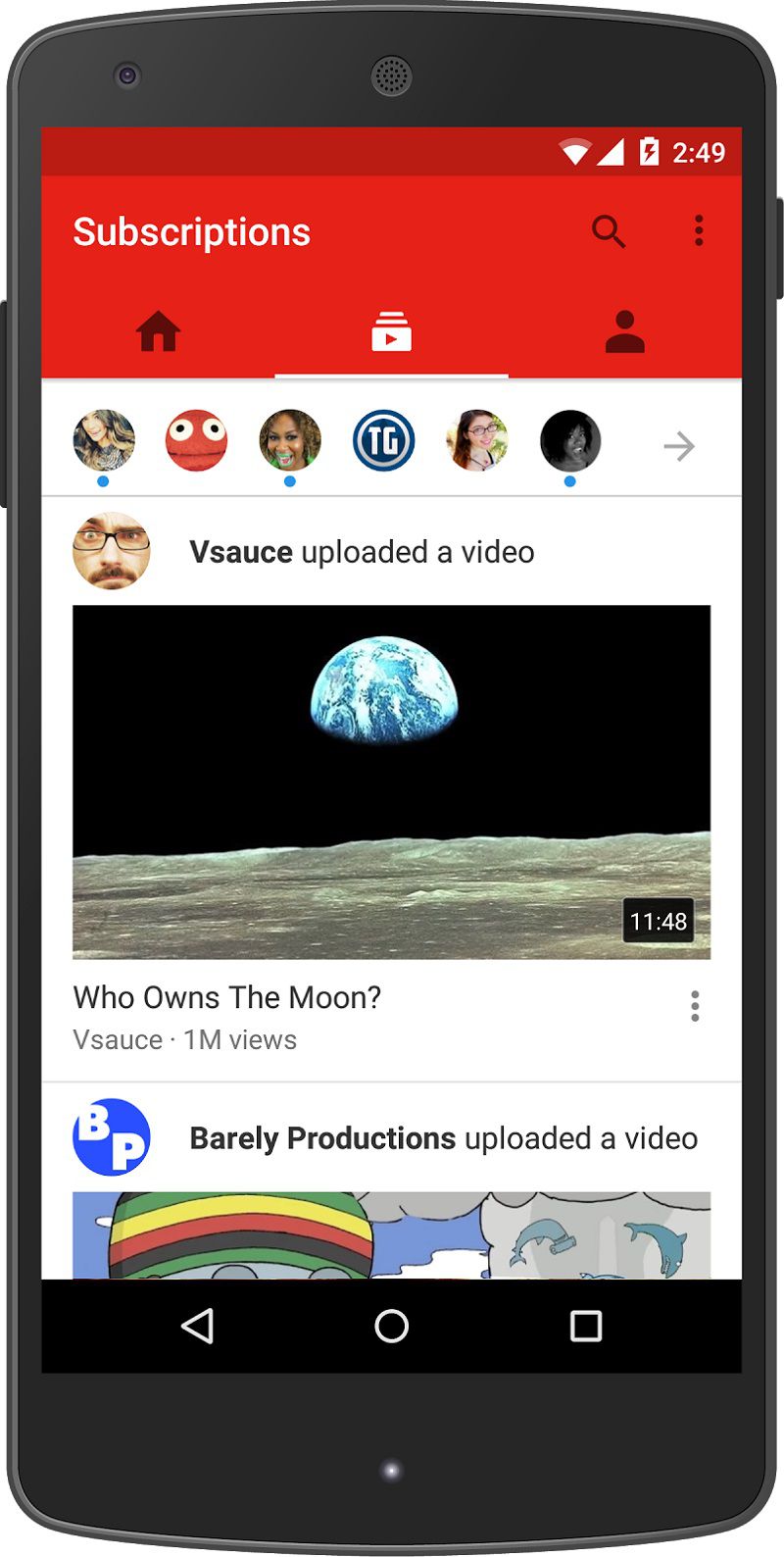
The YouTube app just got a makeover. Google’s online video site officially updated the design of its mobile app on July 23, 2015 to better enable video and subscription discovery.

At her keynote speech during VidCon, YouTube CEO Susan Wojcicki outlined all the new features and elements of the re-designed app. For starters, the app’s re-worked editing and capture tools now help users trim video clips, add filters and music, and upload videos directly to YouTube, all from within the mobile experience. The YouTube app now also supports full screen playback of vertical videos, and boasts three simple tabs across the top: home, subscriptions, and account.

It’s that subscriptions tab which is the biggest update to YouTube’s mobile app, especially considering the online video community at large has had its fair share of complaints about the idiosyncrasies of YouTube’s current subscription system. Wojcicki noted how YouTube listened to users’ frequent demands for better subscription interactions and updates. In response, Google’s online video site made one of the main tabs dedicated solely to subscriptions. There, users can see the latest videos from the channels they’re following, as well as tap a bell icon to receive push notifications every time a creator uploads new content.

YouTube-Mobile-App-Update-Subscriptions-2

“We’ve got more new features coming later this year, all designed to give you the best mobile YouTube experience possible,” Wojcicki said.

You can read more about YouTube’s updated mobile app via the company’s official blog. And you can download the app via Google Play or the iTunes app store.