Archive for November, 2014:

Top 50 Most Viewed YouTube Channels Worldwide • Week Of 11/14/14

After a one-week hiatus in second place, everyone’s favorite YouTube channel featuring videos of adults playing with children’s toys is back in the #1 spot on the charts. DisneyCollectorBR unboxed and played its way to nearly 92.1 million views in the last seven days. That means PewDiePie has once again been relegated to #2. Felix Kjellberg‘s prolific online video catalog of Let’s Play videos scored more than 80.3 million views on the week.

The Ellen Show jumped up a spot to third place. The YouTube home of Ellen DeGeneres’ eponymous syndicated daytime talk show netted nearly 60.4 million views during the week. Next up is Taylor Swift in a very close fourth place. The pop star with a new album witnessed a 69% uptick in views to end the week with more than 59.2 million of them.

And rounding out the Top 5 for the third week in a row is LittleBabyBum. The UK-based channel that has nearly all the favorite songs of any English-speaking toddler in the world racked up more than 53.2 million views during the week.

Top Gainers

The honor of one our Top Gainers this week goes to Selena Gomez.

YouTube viewers want what they want, and this week they wanted a lot of Selena Gomez’s latest single. The 22-year-old TV, movie, and now pop star’s music video for “The Heart Wants What It Wants” quickly amassed an eight-figure view count on YouTube. That helped give her channel a 348% week-over-week increase in views, over 27.1 million views on the week, and the #37 spot on the chart.

Distribution

All in all, the top 50 most viewed YouTube channels accounted for 1,788,137,994 views last week. Here’s the distribution of a few of those channels by multi-channel network:

  • VEVO: 17 channels in the Top 50, with Taylor Swift at #3.
  • Maker Studios: 5 channels in the Top 50, with PewDiePie at #2.
  • BuzzFeed, XMediaDigital: 2 channels each in the Top 50, with BuzzFeed’s BuzzFeed Yellow at #25 and XMediaDigital’s getmovies at #12.

And here’s the distribution of the this week’s Top 50 YouTube channels by country of origin:

  • United States: 31 channels in the Top 50.
  • Great Britain: 5 channels in the Top 50.
  • Canada, India, Russia, Spain, Thailand: 2 channels each in the Top 50.
  • Ireland, Netherlands, South Korea, Sweden: 1 channel each in the Top 50.

As always, keep up to speed with the latest Tubefilter Charts and all of our news at Tubefilter by following us on Twitter, becoming a fan on Facebook, and watching our videos on YouTube.

OpenSlate is a video content analytics platform that tracks more than 225,000 YouTube video channels and measures their ability to attract, engage and influence an audience. By providing one consistent measure of quality – the SlateScore™ – OpenSlate helps marketers, producers and agencies hone their online video marketing strategy.

Beau Bryant Exits WME, Joins Fullscreen As SVP Of Talent, Programming

Fullscreen has found its replacement for Larry Shapiro, and he’s another talent agent-turned-online video executive. Beau Bryant, who previously served in the digital unit of talent agency WME, will become Fullscreen’s SVP of Talent and Programming, according to a report in TheVideoInk.

The deal isn’t yet final, but it seems as if Bryant will be asked to oversee Fullscreen’s talent network, which collectively gathers more than three billion views each month. Bryant will continue the work of Shapiro, who joined Fullscreen from CAA in April 2013 and left 18 months later to join Big Frame, the talent management company now owned by AwesomenessTV.

One trend Shapiro helped pioneer was a new type of deal that more closely resembled traditional media talent management partnerships. A good example of this model is Fullscreen’s deal with JennxPenn, through Fullscreen helped find her new opportunities across multiple media without affecting her existing channel management deal with AwesomenessTV.

If Fullscreen wants to continue down that path, Bryant is a good choice. Like other traditional talent agencies, WME has shown a keen interest in the digital space, partnering with creators like The Fine Bros, Grace Helbig, and Rosanna Pansino. The Fines and Helbig are both partnered will Fullscreen as well.

The main difference between Shapiro’s role and Bryant’s is their respective job title. Shapiro was Fullscreen’s head of talent; Bryant’s role appends programming onto the end of its title, suggesting a slightly different role moving forward.


Report Says 17.9% Of Internet Users Account For Over 80% Of Video Shares

How do the online masses from different countries share video content? That’s the question marketing technology company Unruly sought to answer in its newest Geography of Sharing Report, which found almost one-fifth (17.9%) of internet users are responsible for 82.4% of all video shares worldwide. It’s the Pareto Principle in full effect.

Unruly noted how various countries’ video watchers play a different role in the sharing ecosystem. For example, South Korean viewers are some of the most actively involved in video, typically sharing 20% of videos within the first 24 hours of the media’s launch. They also have the highest engagement rate of all the countries Unruly surveyed at 28%.

Unruly-Geography-Sharing-Report-2

Unruly also discovered Brazilians are far more likely to share a video with all the people they know (and then engage with it at 21%), as opposed to Americans who tend to share with select friends (and who only engage with 11% of videos) and UK residents who only seem to share a video with their families (with an even lower engagement rate of 8%).

The marketing tech company found YouTube views to comprise 24.3% of all video views around the globe, with viewership destinations varying widely between countries. Viewers in Brazil tend to stay on YouTube for their videos (50.3% of the time), while Japan has the lowest percentage of YouTube views at 19%.

The Geography of Sharing Report also delved into the reasons behind video viewers’ sharing habits based on what part of the world they live. Unruly’s key takeaway was that in order for a video to go viral on global level, it must have a happiness trigger. However, each region has different social motivations for sharing. American viewers will share a video based on a shared passion, Germans share to start conversations, Nordic citizens share videos to seek an opinion, and British viewers share videos because of social utility.

Unruly-Geography-Sharing-Report-3

Unruly compiled its statistics using data from its analytics software. The company has been tracking more than 521 billion video views since 2006 and roughly 3100 brands across various social media platforms (including Facebook, YouTube, and Twitter). Data was collected from the US, UK, Australia, Brazil, France, Germany, Sweden, Norway, Japan, South East Asia, and South Korea.

For more stats, you can visit Unruly’s site to download your free copy of the Geography of Sharing Report.

Twitter’s Native Video Player To Arrive “Next Year”

Twitter, not content with its domination of the world’s 140-character updates, is building a video player. The social media site, which has 284 million unique users each month, will unveil a native video platform, which tweeters “can expect to see this in the first half of next year.”

That quote comes from a Twitter blog post, which discussed the planned video player as well as several other upcoming developments. “Aside from just watching video more easily on Twitter, you should be able to record, edit and share your own videos natively on Twitter too,” reads the post. “Alongside short looping Vine videos, we think you’ll have fun sharing what’s happening in your world through native video.”

Twitter has mulled its own video player for at least two years. Since many video posts on the site run through third-party sites like Telly, Twitter misses out on any potential ad revenue. At the same time, when those third-party sites run bad, Twitter has to deal with users who think Telly is its own native video player.

The launch of Vine in 2013 has helped solve these problems, at least to some degree. Since Twitter owns Vine, it controls a platform through which it can direct video traffic while also keeping that traffic within its grasp. But Vine, with its six-second limit, is an inflexible platform, and Twitter’s native platform will likely support videos of all shapes and sizes.

Facebook has recently shown how native video players on social media sites can be a powerful resource. Now, Twitter is hoping to follow suit.

Eight-Second Video App Startup Ocho Launches With $1.65 Million In Funding

Manhattan-based Ocho thinks it can take on Twitter’s Vine. The startup founded in 2012 by Jonathan Swerdlin and Jourdan Urbach officially launched its eight-second video app on November 12, 2014 to a solid response from potential users.

Ocho had spent the last 24 or so months in beta, where it’s generated generated thousands of video uploads and a $1.65 million seed investment round (led by businessman Mark Cuban). The application’s official launch was accompanied by a content deal with Vice Sports (which is getting into content deals with a lot of apps these days) to exclusively post social and mobile video content on Ocho twice per day.

“Ocho is redefining the way we share our stories through creating a powerful, video-based social network in a way that hasn’t been possible until now,” Cuban said in a statement as reported by Variety.

So how exactly is Ocho different from Vine? For starters, Swerdlin and Urbach wanted to make an app that was a complete video experience in and of itself. “We started with the idea of, What would YouTube look like if it launched today?” said CEO Swerdlin. “There wasn’t a place for sharing HD video easily with your social network.”

Once in the Ocho app, users can watch videos in their feed in a continuous stream without having to click each individual video. The app is also created to capture videos in 16×9 aspect ratio no matter which way a user’s phone is oriented. This means the video will always show fullscreen on every device its played (including HDTVs).

Additionally, the app only allows video replies instead of text to keep the founders’ “video experience” intentions for the app as accurate as possible. Ocho also has volume and brightness control, made-for-video filters, voice-over narration feature, and the ability to embed URLs in video captions. Once a video is created, the app’s users can share that media to Facebook, Twitter, Tumblr, YouTube, and Google+.

And like its namesake implies, Ocho limits users’ videos to eight seconds. Urbach told Variety studies have shown eight seconds is the “precise attention span for uninterrupted video viewing.” “Videos shorter than 10 seconds are a distinct class from those that are longer,” he said.

“As the popularity of short-form video surges, we see Ocho as a complement to YouTube channels,” Swerdlin added. “This is content capture, versus content creation.”

Ocho has no current plans to monetize the app, but will undoubtedly look at revenue options down the line. Ocho is only available for iPhones in the app store at this time, but Swerdlin says a version for Android is coming in 2015.

Here Are What YouTube’s New Video Card Annotations Look Like

At VidCon, one of the new site features YouTube announced was a “card” annotation system, which offers greater flexibility and more options than the old annotations. As YouTube continues to debut features it talked about over the summer, it has debuted these cards as well, as they can now be seen on select videos.

The cards aren’t yet available to the public, but we found them on FOX Sports YouTube channel, where they link to related videos and offer small images pertaining to those videos. When they’re done displaying across the screen, they retreat to a box in the corner, where a click pauses the current video and brings up several external links. Give it a try for yourself:

The cards won’t just improve the physical appearance of YouTube annotations; they will also give creators a lot more options. Cards will be able to link to YouTube’s new “fan funding” feature as well as Kickstarter, Indiegogo, and merchandise sites. They’ll also display on mobile, where the old YouTube annotations didn’t work.

We don’t know when exactly these cards will become available to all YouTube users, though based on the information we’ve obtained, we expect they will arrive in the near future.

Online Video Ad Completion Rates Top 90% For Authenticated Viewers

While the IAB was tracking digital video advertising revenue, FreeWheel was figuring out the trends behind the viewership of online video advertising. The ad technology and monetization company released its Q3 Video Monetization Report for 2014, noting the substantial 368% growth in authenticated video ad views over 2013.

FreeWheel arrived at the 368% year-over-year number after counting ad views on content from behind authentication walls (where users need to provide their login credentials for their programming distributor, like Comcast or DirectTV, to access the content). The ad monetization company noted authenticated views were evenly split between both live and on-demand content, and accounted for 46% of all ad views on long-form content (20+ minutes) on all online video platforms.

Interestingly enough, FreeWheel’s Video Monetization Report revealed how the quantity of ads on long-form content grew by 41% year-over-year while completion rates remained high at over 90% for both 15 and 30-second ads. This is important to note because even though some viewers have complained about the number of ads displayed during TV shows or films, FreeWheel’s stats prove users are still willing to sit through TV-like advertising on their digital platforms to watch their favorite content.

Finally, FreeWheel wanted to see on what devices marketers were investing their advertising and monetization efforts. The company found ad monetization hit double digit growth for all devices, including desktop/laptops, smartphones, tablets and over-the-top (OTT). But the biggest growth in 2014 happened on OTT devices with a 208% year-over-year increase in spend from 2013 (jumping from only 2% of total ad views by device to 6%). It’s likely OTT advertising and monetization will increase over the next few years, especially with companies like CBS and HBO creating their own subscription services.

“The paramount importance of digital video to the future of TV and entertainment has become indisputable,” writes FreeWheel’s Brian Dutt in the report. “New digital-only offerings by TV networks, a dramatic increase of streaming device sales, ever-expanding screen sizes, media conglomerates purchasing digital-first Publishers, and a new generation of platform-agnostic millennial viewers coming of age – all continue to drive advertising dollars to digital channels.”

You can view the rest of the report by downloading it from FreeWheel’s site (but you’ll need to register first).

Stacy Moscatelli Joins Vevo As Vice President of Marketing

Expect to see and hear a lot more Vevo in your media. The music video hosting company has hired Stacy Moscatelli as its Vice President of Marketing.

Moscatelli will be in charge of Vevo’s consumer marketing and branding pushes, overseeing everything from publicity to social media to events. She will also lead the company’s Creative Services team, and collaborate with its Product Marketing and Commercial Marketing teams to keep the company’s branding and marketing goals cohesive across the board.

Prior to Vevo, Moscatelli was Vice President of Marketing and Brand Strategy for Bedrocket Media Ventures (which savvy online video viewers will recognize as the company behind the sports-oriented YouTube channel NetworkA, an investor in What’s Trending, and a producer or backer of a number of other digital media initiatives). Before that, the executive spent over 13 years with Turner Broadcasting, first focusing on public relations and marketing initiatives for Cartoon Network and then spending her last 11 years at the company with Adult Swim.

“I enjoy building brands that don’t take themselves too seriously and that are willing to have fun and take risks,” said Moscatelli on Vevo’s blog. “I see so much opportunity in Vevo and look forward to building a rapport with music fans around the world. I’m ready to turn up the volume a little.”

“I’m thrilled to welcome Stacy to lead and further develop our consumer marketing efforts,” said Vevo’s President and Chief Executive Officer Rio Caraeff. “Stacy’s track record of building groundbreaking media brands is the right cultural fit for Vevo. With Stacy’s guidance, Vevo’s brand will continue to evolve and help us further strengthen ties to our viewers.”

Moscatelli will work out of Vevo’s New York City headquarters, reporting directly to Caraeff.

Anatomy Of A Viral Video: You Poked My Heart

[Editor’s Note: Why do some videos rack up millions of views while others linger in obscurity? How does a particular clip become a cultural phenomenon while others remain perennially unseen? What is it that makes a video go viral? Tubefilter has partnered with Jukin Media to take an analytical dive into online video ephemera to try to come up with some answers. Join us for our new regular series Anatomy Of A Viral Video as we explore today’s biggest viral hits and how all those views add up. And for more Anatomy Of A Viral Video installments click right here.]

On September 24, 2014, Arkansas mother Tara Willmott posted a video to YouTube that showed her son Ty and his schoolmates having an (adorable) argument about the weather. Ty insisted it was sprinkling outside, while a classmate was adamant that it was not sprinkling; she was sure it was raining instead. The comical debate builds for a minute or so until the climax of the action, when the already cute video takes a turn for the delightful, and Ty looks at his sparring partner, aghast, and proclaims, “You poked my heart.

This is the stuff that the Internet was built on. “You Poked My Heart” was an instant sensation, following a remarkable trajectory that would net the video more than 9 million views in its first week, and more than 11 million views to date.

First, take a look at the video if you haven’t seen it yet:

What explains the video’s success? After all, there is a boatload of content uploaded to YouTube every day (or 100 hours of video every minute). What caused this particular video to take off so quickly?

Today’s viral video ecosystem, which can amplify a piece of video content like Willmott’s and make it a worldwide phenomenon in a matter of hours, relies heavily on three main components: social media, blogs and websites, and YouTube itself. While it’s possible, few videos go viral simply from sharing by individuals on social networks. Most videos need to be shared by publishers, bloggers, and online communities to get enough views and shares to truly go viral.

The biggest factor in this video’s ascent came as a result of it being picked up and shared by some big-time digital publishers. As is often the case with viral content, this video appears to have first gained traction on Reddit, which referred 66,000+ views to the video the day that it was uploaded, and 170,000+ overall.

Over the ensuing few days, the video was embedded on dozens of websites, which accounted for 43% of its total video views. The YouTube analytics suggest that the biggest traffic referrer to “You Poked My Heart” was Rare.us. The Cox Media- owned website, which calls itself “America’s News Feed”, was responsible for a robust 353,000+ playbacks of the video, edging out BuzzFeed (335,000+ views) and HuffPost (315,000+ views) for the top spot on the list of sites that embedded this video. With those numbers – roughly one million combined views from only the top three sources – it’s easy to see how important large digital publishers are to helping a video go viral.

you-poked-my-heart-viral-engagement

Curiously, the video received the fourth-most embedded playbacks (186,000+) from a clothing and apparel sales website called Conservative Outfitters. As its name indicates, the site sells t-shirts and other gear emblazoned with politically right-leaning phrases and sentiments. How did this retail website, which sells clothes and has no noticeable video content, refer such a massive amount of traffic to a YouTube video about children and precipitation?

Well, after some poking around the site and snickering at (and with) some of the clothing items, I noticed that Conservative Outfitters has a blog that’s barely visible from the homepage. One look at the blog and it was clear that this was the source of the views – it has user-generated and viral videos of all kinds posted to it.

So what gives? Conservative Outfitters is, ostensibly, using viral videos like Willmott’s to generate web traffic, in an attempt to boost its apparel sales. Seemingly, their logic is that if even a tiny percentage of those (whopping) 186,000 visitors who came to the site for “You Poked My Heart” leaves with a “Reagan Bush ‘84” T-shirt or some other garment, then their efforts were worth the embed. Not a bad idea. This is not the first site to use viral videos to help peddle its wares, to be sure, but certainly it’s one of the more prolific.

Herein lies an important takeaway for online video marketers and creators: huge views can come from the unlikeliest of places. Use YouTube analytics to figure out where the audiences are coming from, and use that information to inform your marketing decisions on your next video. In fact, guess which retail clothing website is going to get an email the next time Jukin Media has a clip featuring cute kids.

mike skogmo headshotMike Skogmo is Senior Director of Communications at Jukin Media, the worldwide leader in user-generated and viral video content. Jukin Media’s rapidly expanding clip library receives more than 800 million monthly views on YouTube and its content is licensed for use by the world’s largest broadcasters, publishers, and brands on a daily basis. Learn more at JukinMedia.com.

YouTube Millionaires: Sorted Food Having “A Bit Of Fun” Online

Welcome to YouTube Millionaires, where we profile channels that have recently crossed the one million subscriber mark. There are channels crossing this threshold every week, and each has a story to tell about YouTube success. Read previous installments of YouTube Millionaires here.

Out of all the chefs sharing their recipes on YouTube, the four British gentleman who make up the team at Sorted Food might be the friendliest. Jamie Spafford, Ben Ebbrell, Michael Huttlestone, and Barry Taylor have accumulated a devoted following by making their viewers feel like they are right there in the kitchen as virtual sous chefs. Sorted Food’s audience has surpassed one million subscribers, so its four hosts took time out of their quest to find the Internet’s ultimate burger and answered a few of our questions.

Tubefilter: How does it feel to have one million subscribers? What do you have to say to your fans?

Sorted Food: We honestly can’t believe we’ve gone over 1 million subscribers, it’s an incredible feeling to know there are that many people out there around the world who have an interest in food and want to explore it further with us. The best thing is how passionate everyone is, people don’t just watch the videos, they actually suggest the recipes, cook them, photograph them and share them with the rest of the community! You’re incredible and we can’t thank you enough for being on this journey with us.

TF: Who or what made you all want to cook, and then post videos of your cooking experiences on YouTube?

SF: After being friends at school, we went separate ways to university and very quickly discovered that we couldn’t cook for ourselves! Fortunately for the rest of us, Ben was training to be a chef so he started sharing some really simple recipes with us. We started the YouTube channel as a bit of fun to try and share the recipes with more people.

TF: Each of you must love to eat a certain food, not just cook it – what are those?

Jamie: I love a good curry, can’t get enough… My current favourite is a Lamb Dhansak

Ben: There are very few foods I don’t love… but favourites tend to stem from recent travels. Moroccan and Vietnamese food are pretty high up on the list right now.

Barry: Sunday Roast – succulent beef, a giant Yorkshire pudding, all the trimmings, swimming in a rich gravy served with a tub of horseradish sauce. Never fails to impress.

Mike: Peanut butter. I’ll eat it on anything. Anything.

TF: Camping isn’t necessarily what someone thinks of when you say “cooking show.” So what inspired your “Sorted Goes Camping” videos?

SF: We got thinking over the summer that not all cooking happens in a kitchen where you have tonnes of equipment and ingredients, so where could we go to prove that you can cook up some great food with the bare minimum? Camping seemed like the perfect fit… Plus it was a lot of fun as well!

TF: What’s one recipe you’d like to make on video yet that you haven’t?

Jamie: Oooh I really want to try and make the most incredible Philly Cheese Steak sandwich.

Barry: The world’s biggest…Don’t care what it is, I just want to set some records!

Ben: I’m keen to do more with fish…fillets of fish served all sorts of ways – steamed, BBQ’d, put it on soups, in stews, there’s so much to explore!

Mike: Grilled lobster. It’s the best tasting chicken you can get.

TF: If you could cook with any one person/group from history, who would it be?

Jamie: How cool would it be to attend a medieval banquet with someone like Henry VIII?! Imagine preparing all the food and actually sitting down to eat the feast?

Barry: The lost boys. As a kid, my dream was to join Peter, Tink and Rufio and tuck into the greatest meal of all time! Maybe we should recreate this in a FridgeCam?! I believe.

Ben: I feel like a character such as Phileas Fogg (fictional I know) would be cool. He’d have just discovered some incredible foods and ingredients on his 80 day trip around the world…items that we’re probably more familiar with now. How awesome would it be to cook up great recipes with things he’s only just discovered?

Mike: The meal on board Apollo 11 before the moon landing. Can’t imagine the food would be great but it’d be interesting. I’d try to smuggle a BLT on board.

TF: Those in the cooking/restaurant industry can be very picky about their tools. What is one tool each of you simply couldn’t live without?

Jamie: Not being a chef, my tools are quite basic! It might sound sad, but I have a favourite pan…It’s like a crockpot but everything seems to cook really well in it…That is really sad…

Barry: I’m not ashamed to admit this but mine would be the microwave. I tend to make my meals in batch for the week and re heat either parts of, or all of it in the trusty microwave.

Ben: For me…a decent sized chopping board to give you plenty of space and good set of knives with a steel. There aren’t many recipes that won’t use those items at some point or other…so it’s a good idea to invest in good ones.

Mike: I’ve got a mini blender which is awesome because my knife skills aren’t great. Ben once described them as worse than a chimpanzee with an axe.

TF: Would you ever consider expanding your channel to include other topics? If so, what might those be?

SF: It’s strange, we’ve been exploring food for the last 4 years and none of us feel like we’ve even broken the surface of how much food there is to find around the world. So there’s no plans to expand into other topics at the moment, but who knows in the future?!

TF: What’s next for your YouTube channel? Any fun plans?

SF: Over the last few weeks we’ve been working to find the internet’s ultimate burger and we think we’re getting closer to tracking it down! After that we’ve got some incredible plans to include the community more and more within the channel and see how far we can spread the SORTED message!

On Deck (channels that will soon reach one million subscribers): No Copyright Sounds, Sam Smith, Vikkstar123HD

Netflix Orders First Season Of UK-Based Original Series ‘The Crown’

The upcoming Marco Polo isn’t the only historical epic Netflix has in the works. The streaming video-on-demand service just ordered a series called The Crown, based on the life and times of Queen Elizabeth II.

The series will span several decades of the Queen’s life, with the first 10-episode season set for release sometime in 2016. That season will introduce viewers to 25-year-old Elizabeth, a princess set to take over her father’s throne in Britain. Netflix said each season will cover a decade of the Queen’s life.

Produced by Left Bank Pictures along with Sony Pictures Television, The Crown is based on the play The Audience by Peter Morgan (who also penned the movies The Queen and Frost/Nixon). Morgan will executive produce the series along with director Stephen Daldry (from The Hours) and producer Andy Harries (also from The Queen).

“‘The Crown’ is not only about the royal family but about an empire in decline, a world in disarray and the dawn of a new era,” Morgan said in a statement reported on by Variety. “I am beyond thrilled to be reunited with partners from film, theatre and television for this epic project and delighted to be working for the first time with Netflix.”

“‘The Crown’ is storytelling that lives somewhere between television and cinema from Britain’s foremost chroniclers of modern politics, class and society,” said Cindy Holland, VP of original content at Netflix, via Variety. “We are enormously proud to be the exclusive home of a series from Peter Morgan and Stephen Daldry that promises to fascinate and entertain audiences around the world.”

Earlier this year, a report circulating the web discussed Netflix’s intention to pick up The Crown. While today’s news about the series’ official order doesn’t come with any foretold production costs, the report from May claims the series could easily run upwards of £100 million (roughly $170 million) due to the vast scope of the show. Covering multiple decades of the Queen’s reign can’t be cheap.

While no casting announcements have been made as of yet, The Crown will be Netflix’s first UK-based original series. It’s likely we’ll see plenty of Brits gracing the screen (along with plenty of other nationalities as Netflix rapidly expands into other countries).

Cyanide And Happiness Debuts First Episode Of Kickstarter-Funded Show

The politically incorrect animations of Cyanide and Happiness have officially arrived at a new format. The webcomic-turned-YouTube channel created by Rob DenBleyker, Kris Wilson, Dave McElfatrick and Matt Melvin has released the first episode of The Cyanide and Happiness Show, which collects several animated sketches across a ten-minute installments.

Cyanide and Happiness’ YouTube channel, which is based off its vulgar webcomic, has 3.6 million subscribers and is partnered with Collective Digital Studio. The channel is dominated by short comedy sketches that repeatedly show off new, imaginative ways to kill off stick figures.  In 2013, after some unfruitful talks with TV executives, the comic’s founding quartet headed to Kickstarter to turn these sketches into a long-form show.

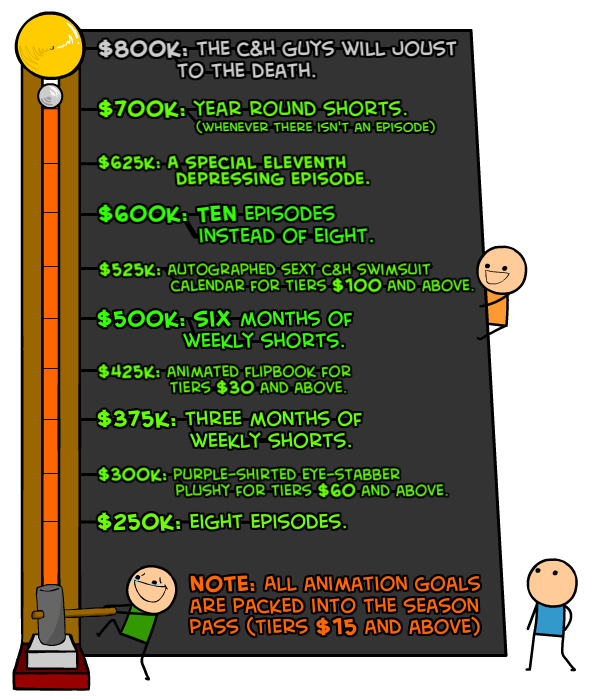
They hoped to “create an online show that everyone in the world can watch anytime they want,” and by raising a whopping $770,309 from their fans (more than three times their initial goal), they were able to do just that. The first episode of The Cyanide and Happiness Show includes three distinct sketches, which are linked together by short vignettes that imagine a world where bugs are humans and humans are bugs.

Judging from the information on The Cyanide and Happiness Show‘s original Kickstarter campaign, there will be nine more episodes in season one, plus “a special eleventh depressing episode.” In addition to the show, the Cyanide and Happiness channel will continue to feature regular shorts to go along with daily webcomic updates. With all that activity, Cyanide and Happiness fans will be well sated over the next few months.