Archive for 2025:

RHEI introduces Made, a set of AI agents it says will “unlock creativity” by assisting creators with making content

RHEI, the media-tech AI company formerly known as BBTV, today unveiled its second artificial intelligence product: Made, which it says is a platform featuring “emotionally intelligent” AI agents that are designed to “unlock creativity” by assisting creators with day-to-day content creation and community management.

“Creators have to juggle multiple roles, acting as the director, the community manager, the producer, the strategist,” Shahrzad Rafati, founder and CEO of RHEI, tells Tubefilter. “The biggest challenge is, if you look at the stats, 75% of content creators experience burnout, and it’s because of the fact that creators have to wear many hats while working with so many different tools in a landscape that’s evolving so rapidly, whether it’s the evolution of formats, the evolution of platforms, new competition, or new players coming to the market.”

Rafati says Made is meant to support creators of all sizes across various areas of content creation. The three AI “agents” it offers at launch, Milo, Zara, and Amie, each have their own skill set based on their roles, “personalized to the creator and highly in-tune with micro and macro trends relevant to the creator. The agents analyze trends, creator interactions, audience behaviors, and successful strategies tapping into more than 5 petabytes of data.”

Once a creator decides to work with Made, the agents will learn about them through their channels and become personalized to them. This approach is what makes them “emotionally intelligent” and individualized to each creator, and turns them into a creative “dream team,” RHEI says.

“What’s really different about Made’s AI agents is that they are predictive and proactive, with unique skills that integrate seamlessly into creators’ daily lives,” Lewis Ball, RHEI’s Chief Strategy and Product Officer, said in a statement. “Our focus has been to build agents that don’t just assist creators, but proactively drive the entire workflow, eliminating the friction and manual effort that typically comes with AI-powered content creation. Unlike other AI solutions that require users to do the heavy lifting–tweaking prompts, managing outputs, and iterating endlessly–RHEI’s platform guides creators seamlessly, delivering high-quality results with minimal input.”

Rafati adds, “The way we see this is, for you to be able to actually solve the biggest challenge and close the gap between these large foundational models and the human brain and human creativity, that can only be done through the agentic approach.”

With Milo, Zara, and Amie, RHEI is addressing three areas of content creation: creative direction, audience engagement, and relationship management. Milo is a “master brainstormer” that “refines concepts into polished masterpieces that captivate audiences,” it says, while Zara comes in with “an intuitive grasp of audience sentiment and personalized engagement strategies.” Amie, meanwhile, is a “relationship manager” RHEI says will “enable creators to seamlessly navigate the platform and maximize the potential of each team member.”

RHEI hopes each agent will become a core part of creators’ daily work. For example, with Milo, “you get up in the morning, you log in to the platform, and Milo proactively has done some of the work for you to get you started, to get you inspired, to get you to want to be passionate about creation,” Rafati says. “I think our agents are providing the level of scale, personalization, and proactive collaboration that was never possible before.”

She adds that, in the future, RHEI plans to launch more agents that will specialize in other areas of content creation, both on the creative and business sides.

For now, Made is launching into closed beta, but will have a wider rollout in the future. At the same time, RHEI will continue developing its other AI tools, including RHEI Data Pro, a platform that lets creators license their content to companies making generative AI models.


RHEI is a Tubefilter partner.
Top 50 Most Viewed U.S. YouTube Channels • Week Of 02/16/2025

[Editor’s Note: Tubefilter Charts is a weekly rankings column from Tubefilter with data provided by GospelStats. It’s exactly what it sounds like; a top number ranking of YouTube channels based on statistics collected within a given time frame. Check out all of our Tubefilter Charts with new installments every week right here.]

Scroll down for this week’s Tubefilter Chart. 👇


The second full week of February is in the books, and music is still a driving force in the U.S. Top 50. There’s room for a lot of different artists in the ranking, no matter if they perform nursery rhymes in a studio or play live in front of millions of TV viewers at the Super Bowl.

The #1 channel in the U.S. Top 50, however, is less musically inclined. MrBeast earned 521.3 million weekly views on his primary YouTube hub to keep his string of chart-topping finishes alive. But can he sing, though?

Musicians in the U.S. Top 50 are not like us

Last week, I used this space to discuss Lady Gaga’s success with her new single “Abracadabra.” In a YouTube landscape dominated by kid-friendly songs and rhymes, Gaga used a multi-pronged distribution strategy to get her artistic vision in front of as many eyeballs as possible.

Another musician who has mastered the art of digital distribution is Kendrick Lamar. In addition to showcasing his artistic vision, the Compton-born rapper uses platforms like YouTube to ensure that his Drake disses have as long of a shelf life as possible.

Case in point: Toward the end of a blockbuster February — in which Lamar won a Record of the Year Grammy Award for “Not Like Us” before performing the diss track at the Super Bowl — Kung Fu Kenny is back in the U.S. Top 50. His recent music video uploads, including the buzzy track “Squabble Up,” are continuing to draw major viewership as Lamar’s public profile grows.

Lamar is now enjoying the same sort of post-Super Bowl bump that performers like Snoop Dogg have enjoyed in the past. With 107.3 million weekly views, the man behind “Not Like Us” squabbled up to 40th place in the U.S. Top 50.

You almost have to be as famous as Kendrick Lamar to claim a spot in the U.S. Top 50. Otherwise, the best way for a musician to climb the charts is to appeal to YouTube’s youngest audience. Media intended for young kids continues to thrive among U.S. YouTube viewers.

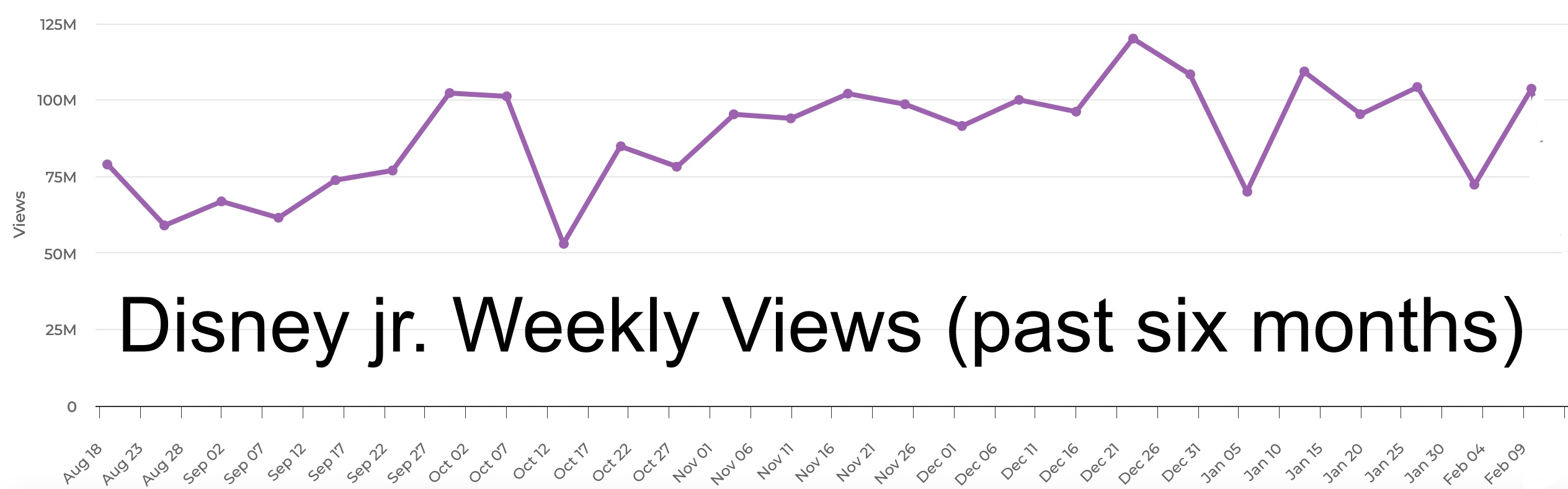
The digital outpost of Disney Jr. is a notable example. Though it routinely hovers around the 100 million view mark each week, it surged forward to a 43rd-place finish during the third week of the second month.

Data via Gospel Stats

Clearly, it’s time for Bluey and Kendrick Lamar to team up on a track. If not, they’ll have to diss one another. Watch out, Kendrick: That blue heeler has some bite to his bark.

Channel Distribution

This week, there are 36 YouTube Shorts channels in the U.S. Top 50.

As always, keep up to speed with the latest Tubefilter Charts and all our news by subscribing to our newsletter. You’re going to love it. 👉  Newsletter.Tubefilter.com.

Top 5 Branded Videos of the Week: Pyramids, paddles, and Facebook Marketplace

Welcome to our rundown of the most-watched branded YouTube videos of the week.

We’re publishing this snippet of a larger Gospel Stats Weekly Brand Report in order to analyze sponsorship trends in the creator economy. Any video launched in tandem with an official brand partner is eligible for the ranking.

And – as the name up above would imply – all the data comes from Gospel Stats. If you’re interested in learning more about Gospel – and which brands are sponsoring what creators on YouTube – click here.


MrBeast is back in our latest Gospel Stats Weekly Brand Report, chronicling a 100-hour journey through the Giza pyramid complex. While he did gamify the whole experience–and use it to promote his products at Moose Toys–he did capture the kind of footage most people wouldn’t be able to see otherwise, plus got an interesting historical walkthrough thanks to his Egyptian guide. Following him, we’ve got some Veritasium, a little pre-Super Bowl table tennis, a professional scammer robot, and some winter weather on the California coast.

Check ’em all out right here:

#1 I Spent 100 Hours Inside The Pyramids!
Channel: MrBeast
Brand: Moose Toys
Views: 122,610,887

What happens when you give a YouTuber “unrestricted access” to the Giza pyramid complex, one of the world’s most somber and awe-inspiring historical sites? Well, if that YouTuber is MrBeast, he makes a challenge out of it, and turns it into the latest video promoting his Moose Toys lineup. He got permission to go into the pyramids and surrounding landmarks–including burial sites of the workers who erected the enormous tombs–and spent the full 100 hours squeezing through tunnels, encountering intricate hieroglyphics, and learning about Egyptian history from his very knowledgeable guide. The adventure was sponsored, as we mentioned, by Moose Toys, which partnered with MrBeast back in January 2024. The duo are doing pretty well together: their mad scientist-esque Lab Mutators line was the top-selling action figure brand in October and November.

#2 What if you just keep zooming in?
Channel: Veritasium
Brand: Incogni
Views: 8,900,264

This is the sort of video YouTube was made for. If there’s anything doing the Gospel Stats Weekly Brand Reports has taught us, it’s that YouTube viewers love science. STEM videos are almost always at the top of our reports, week after week, and this week is no different. Veritasium is back–and he wants to know just how far you can zoom in to see the intricacies of small things in our world. He starts with a tiny piece of metal just 3 mm (around 1/8 inch) long. Then he zooms in. And zoom again. Finally (though not with a microscope your average person could get ahold of) we’re zoomed so far in we’re talking about atoms. This latest Veritasium deep dive is perhaps surprisingly not sponsored by usual partner Brilliant, but is instead paid for by digital security company Incogni, which sponsored a whopping 30 videos this week.

#3 Micah Parsons, Kirk Cousins, Taylor Rooks and More Compete in P&G Battle of the Paddles LIVE
Channel: Complex
Brand: Lowe’s
Views: 5,536,262

The Super Bowl gets plenty of attention on YouTube, from podcasts about it (sometimes hosted by players involved in it) to creators recreating it in video games to endless dissection of the halftime shows. There’s also the deluge of pregame events, including Battle of the Paddles, which pits NFL stars like Micah Parsons, Kirk Cousins, and Taylor Rooks against fans in vicious games of table tennis. Whoever wins walks away with their very own championship belt. And the premier sponsor for this event? Lowe’s, which we don’t often see sponsoring YouTube content.

#4 A Bot that Scams People
Channel: Michael Reeves
Brand: NordVPN
Views: 5,211,128

Ever list something on Facebook Marketplace? Ever try to buy something on Facebook Marketplace? Then you know what sort of nightmare awaits. Sure, there are some normal people buying and selling there…but sometimes it seems like they are few and far between. Anyway, then you have Michael Reeves. We’re not sure what category he fits into, considering the long title of this week’s video is Gaslighting people on Facebook Marketplace so they sell me their shit for cheap. We do respect the hustle, and it’s especially creative, because Reeves doesn’t do the gaslighting or lowballing himself. Instead, he outsources to his very own custom bot. His endeavor is all sponsored by NordVPN, which paid for a total of 18 videos this week.

BONUS #1,128 🔴 CALIFORNIA WINTER WIND STORM – LIVE STORM CHASERS
Channel: StormRunner Media
Brand: Prescott Tire Pros & Automotive Service
Views: 61,546

Weather keeps getting increasingly erratic, and California has had (excuse our French) one hell of a time lately. Between the wildfires, the floods, and now a winter windstorm (did you know that was a thing? We didn’t), California is in a cycle of misery. Here to observe it are meteorologists and storm chasers Garrett Thompson and DL Scales, the folks behind StormRunner Media. This six-hour livestream chronicles the storm’s impact on Donner Summit, and includes footage from still cameras as well as dashcams from the duo’s car, which they drove through the storm. And that’s why the video’s sponsor, Prescott Tire Pros & Automotive Service, makes so much sense.


…and there’s a lot more data where that came from. If you’re interested in learning more about Gospel – and which brands are sponsoring what creators on YouTube – click here.

Top 50 Most Viewed YouTube Channels Worldwide • Week Of 02/16/2025

[Editor’s Note: Tubefilter Charts is a weekly rankings column from Tubefilter with data provided by GospelStats. It’s exactly what it sounds like; a top number ranking of YouTube channels based on statistics collected within a given time frame. Check out all of our Tubefilter Charts with new installments every week right here.]

Scroll down for this week’s Tubefilter Chart. 👇


T-Series surged past one billion weekly views to once again reclaim the #1 spot in the Global Top 50. KIMPRO, which surpassed one billion views during the previous measurement period, fell back to third after losing 32% of its traffic week-over-week.

Even with channels crossing the ten-digit view threshold as if it’s nothing, the more interesting stories in the Global Top 50 can be found further down in the ranking. In particular, shifting ideas among kid creators are showing up as notable trends.

Kidfluencers just want to grow up

Ever since we started tracking YouTube viewership on a week-to-week basis, creators under the age of ten have carved out regular spaces for themselves near the top of the charts. From globetrotters with Slavic roots — such as 45th-ranked Kids Diana Show — to Indian chart-toppers like KL BRO Biju Rithvik (#2) and Anaya Kandhal (#4), so-called “kidfluencers” are still mainstays in the Global Top 50.

As those creators continue to dominate the world of children’s YouTube content, some new faces are sprinkling in ideas adopted from the big-kid side of the platform. Santi Oficial, a fast-rising videomaker from Mexico, provides a good example of that process in action. With the electric blue hair and big smile in his channel thumbnail, Santi almost resembles a miniature version of a Jacksepticeye or Markiplier.

His videos also resemble short-form content uploaded by adults. He’s no stranger to a popular “baile pa TikTok,” like in this Shorts clip that has earned nearly five million likes.

https://www.youtube.com/shorts/SiCKtpQ-3Nk

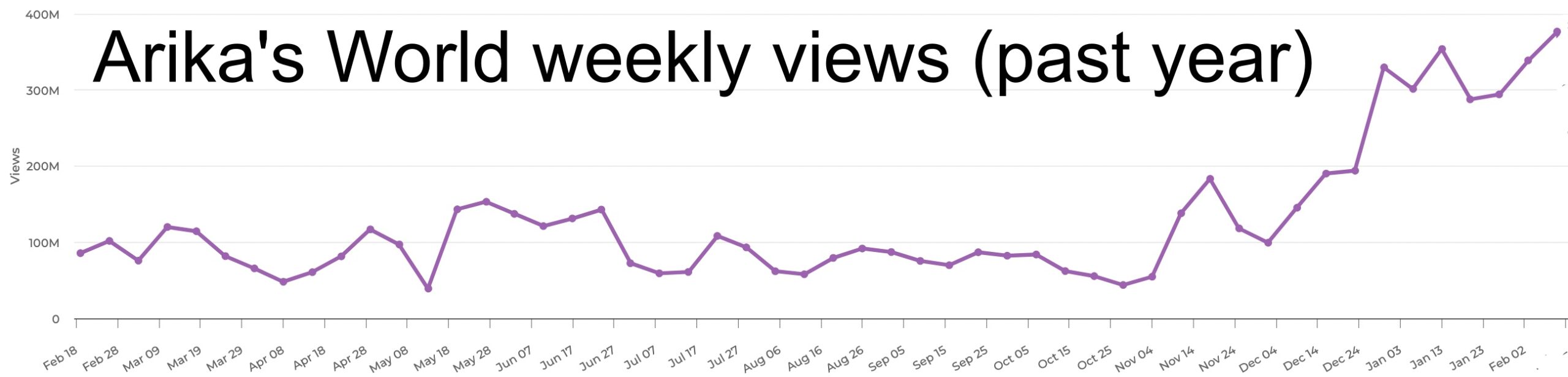
Santi isn’t the only little kid adding his name to our ranking of big channels. Another recent riser is Arika’s World, a channel from India based around family-friendly skits. Arika’s World reached a high water mark during the second full week of February, when the titular creator picked up 376.8 million weekly views. That total rocketed Arika and her family up to 15th place in the Global Top 50.

Data via Gospel Stats

There are a few grown-up creators, such as Belgium’s Celine Dept and Spain’s Celia Reina, who have stuck around in the Global Top 50. Overall, however, the best strategy for a place in the chart looks to be simple: Take something that works for adults, and do it for the kids.

Channel Distribution

Here’s a breakdown of the Top 50 Most Viewed channels this week in terms of their countries of origin:

  • India: 17
  • United States: 10
  • Indonesia: 4
  • Canada, Hong Kong, and Pakistan: 2
  • Argentina, Australia, Belgium, China, El Salvador, Japan, Kazakhstan, Mexico, South Korea, Spain, Ukraine, United Arab Emirates, and Vietnam: 1

This week, 33 channels in the Top 50 are primarily active on YouTube Shorts.

As always, keep up to speed with the latest Tubefilter Charts and all our news by subscribing to our newsletter. You’re going to love it. 👉  Newsletter.Tubefilter.com.

TikTok ban architects say criticism of Israel got the law passed

On social media, there have been rumblings that U.S. efforts to restrict TikTok are motivated by the platform’s connections to the ongoing violence in Palestine. At the Munich Security Conference, two of the politicians responsible for the “divest-or-ban” law all but confirmed those suspicions.

During a panel, Senator Mark Warner (D-VA) urged Congressman-turned-Palantir exec Mike Gallagher (R-WI) to tell the “real story” behind the Protecting Americans from Foreign Adversary Controlled Applications Act. Gallagher, who has pushed ByteDance to divest TikTok, obliged the Senate Intelligence Committee Vice Chair.

“So we had a bipartisan consensus,” Gallagher said at Warner’s behest. “We had the executive branch, but the bill was still dead until October 7th. And people started to see a bunch of antisemitic content on the platform and our bill had legs again.”

That explanation lines up with the timeline of events that led to the passing of the divest-or-ban law. In early March 2023, bipartisan group of Senators led by Warner put forth a bill then known as the RESTRICT Act. A few weeks later, a contentious hearing with TikTok CEO Shou Zi Chew seemed to delay progress on Warner’s proposal. Congress’ rough treatment of Chew made the exec a national hero in China, public support for TikTok regulations began to fade, and the RESTRICT Act went into the shop for revisions.

As Gallagher explained, Hamas’ October 7 attack changed the narrative. All of a sudden, there were widespread calls for TikTok to address content that some people — including a few notable celebrities — perceived as anti-Semitic. That wave of criticism gave regulators like Warner the opening they needed to revive the divest-or-ban proposal.

“Some wonder why there was such overwhelming support for us to shut down potentially TikTok or other entities of that nature,” Senator Mitt Romney (R-UT) said last May. “If you look at the postings on TikTok and the number of mentions of Palestinians, relative to other social media sites – it’s overwhelmingly so among TikTok broadcasts.”

The rationale behind American efforts to regulate TikTok suggests that national security concerns related to the app are overemphasized, whereas TikTok’s ability to awaken the collective political consciousness of Gen Z deserves more attention.

As more Americans use TikTok as a news source, intercultural clashes related to Israel and Gaza are creating fissures between big-name creators. The U.S. government’s position in that conflict is clear. Let’s just say there’s a reason why the divest-or-ban law was passed as part of an aid package for Israel and Ukraine.

Congress and Gen Z firebrands may agree that violence in the Middle East influenced American restrictions on TikTok. Where they seem to differ is in their characterizations of TikTok’s political bias. Senators and celebrities may see anti-Semitism amid widespread sympathy for the Gazan cause, but progressive activists believe TikTok is clamping down on pro-Palestinian viewpoints. As evidence, they have cited posts that seemed to be flagged for removal because they included the phrase “free Palestine.”

TikTok could still survive the U.S. government’s attempts to divest or ban it, but Congressional motivations on this issue should still be examined. Social media warps national discourse in a way that doesn’t align with old-school political thinking. Is the resulting regulatory action the result of a protective instinct, or is it nothing more than fear of the future?

Have you heard? Kai Cenat U, YouTube vs. Paramount (again), and the Shirley Temple king

Each week, we handpick a selection of stories to give you a snapshot of trends, updates, business moves, and more from around the creator industry. This week, Kai Cenat has academic ambitions, an old-school online video rivalry has bene revived, and an 11-year-old is becoming a beverage connoisseur.

Creator commotion

The king of streaming wants to take his fans to school. Kai Cenat has expressed his desire to set up a “streamer university” by renting out a college, putting creators up in the dorms, and bringing in big shots like MrBeast and Mark Rober to teach classes. Just think of how legendary the parties would be.

Pokimane’s security bill is getting expensive. The popular streamer told Colin and Samir that she spends five figures per month on her security detail. Taylor Lorenz of User Mag has dubbed that expense the “Female Creator Safety Tax,” and it’s much higher than the average male creator might expect.

Charlie, who bit his brother’s finger, is celebrating YouTube’s 20th birthday. The viral star of the “Charlie bit me” video told The BBC that he’s never known a world without YouTube fame. Whatever you say, boss — just maybe refrain from the NFTs from now on.

Platform headlines

YouTube and Paramount had a dispute for old time’s sake. More than a decade ago, a legal battle between YouTube and Viacom set an important precedent for digital applications of copyright law. These days, YouTube and Viacom’s current owner are duking it out over carriage rights. YouTube TV nearly lost channels like Comedy Central and MTV before a short-term deal was reached.

Trump may extend the length of TikTok’s U.S. reprieve. The President initially gave TikTok 75 days to negotiate a deal that would keep it operation in the United States, but it looks like the app might get an extension on that deadline. Turns out that brokering an agreement that appeases the Chinese government is easier said than done.

TwitchCon is coming back to Rotterdam. The European edition of Twitch’s annual convention is due to return to the Dutch port city for a two-day gathering that will begin on May 31, 2025. After hosting events in Berlin, Amsterdam, and Paris, Twitch seems to have found a regular home for TwitchCon Europe in Rotterdam.

Pop culture minute

Season one of Beast Games is in the bag. The winner of the $10 million grand prize in MrBeast’s Amazon Prime competition series has been revealed. I won’t spoil it in case you’re still trying to catch up on Beast Games, but at this point, Jimmy Donaldson might as well change his moniker to MrMoneybags.

The head of YouTube Music is trying to talk some sense into Kanye. In his pre-YouTube role at Def Jam Recordings, Lyor Cohen worked with hip-hop stars like Kanye West. These days, Cohen is more concerned about Ye’s hard left turn toward antisemitism, and he’s trying to do something about it, as futile as that effort may be.

YouTube says dog grooming videos are the new hotness. That genre earned more than 400 million total views in 2024, according to a post on YouTube’s Culture and Trends Blog. The grooming sessions will continue until there are no more dogs with “crazy hair coming out.”

The biz

More than 11,000 “new media” reporters want access to Trump’s White House. The current administration called on creators and podcasters to apply for press credentials, and those fresh-faced news sources have taken up the offer in astonishing numbers. At this rate, we might need a new YouTube Space inside the White House.

Gushcloud and Azure Capital are launching a Finance Fund for creators. The management company and the financial firm are teaming up to seek out “high potential creators” in key verticals like beauty and wellness. Creators who are looking to launch their own businesses are in the best position to benefit from the new fund.

The U.S. radio industry has surpassed $2 billion in digital revenue for the first time. The rise of podcasting and digital stations has been big business for radio companies, which are expected further growth over the 2025 calendar year. Just wait until they get TV on the radio — then the numbers will really start going up.

The internet is a strange place

Leo Kelly is the Shirley Temple king. The New York Times profile of the 11-year-old beverage reviewer noted his Keith Lee-esque power to reshape restaurant menus. And yes — the interview was conducted over a pair of Shirley Temples.

Everybody wants an Poppi vending machine. The beverage brand’s Super Bowl campaign has been criticized for connections to influencers that many consider tone-deaf. Case in point: Poppi apparently gifted social media stars with personal vending machines, and that doesn’t sit well with the normies who also want free soda in their houses.

Apple Watch is the hot new anklet. Wearing the device right above your foot is becoming a notable fashion trend. Some people argue that the fit provides more accurate readings. I get it — I also hate it when my fitness tracker shortchanges my steps, and if I have to look incredibly dorky to rectify that, I will.

YouTube shuts down “true crime” channel that was all AI lies

YouTube has been extremely bullish on generative AI for over a year now–but even as it’s introduced generative tools, encouraged creators to make gen AI a core part of their production pipeline, and (with parent Google) talked up AI as an essential part of humanity’s future, it’s also exhibited at least a little caution about what gen AI can produce. It’s added rules allowing people to request takedowns of videos that include “realistic” recreations of their faces and voices, and is also working with Creative Artists Agency and other entities to preemptively protect celebrities from deepfakes.

As with most things concerning AI, YouTube’s rules around it are developing in real-time, with situations being judged on a case-by-case basis.

And a recent situation appears to have highlighted one of its no-go zones for creators using gen AI to make content: YouTube terminated a channel called True Crime Case Files whose owner said he was making fake crime videos to “overdose the viewer on luridness.”

He had uploaded over 150 videos, all of them using ChatGPT, gen AI image creators, and AI voiceovers. But it was a video called Husband’s Secret Gay Love Affair with Step Son Ends in Grisly Murder that would end up getting his channel deleted.

As 404 Media reports, the 26-minute “true crime” video covered a heinous crime that supposedly took place in Littleton, Colorado, a town with around 45,000 people. Elizabeth Hernandez, a reporter for the nearby Denver Post, found out about the video when people began contacting her newsroom, asking for more information about the murder.

“Some people in fact were saying, ‘Why didn’t The Denver Post cover this?’” Hernandez told 404 Media. “Because in the video, it makes it sound like it was a big news event and yet, when you Google it, there is no coverage.”

There was no news coverage because the murder wasn’t real. Nothing said in the video was true; the channel owner had made it all up, with the help of ChatGPT. But he didn’t disclose anywhere on the channel that the stories were false, nor that AI had been used to create supposed images of killers and victims, parents and children.

“It needs to be called ‘true crime,’ because true crime is a genre,” he told 404 Media. (His identity was not reported because he has apparently been receiving death threats.) “I wanted [the audience] to think about why […] they care so much that it was true, why it matters so much to them that real people are being murdered.”

His explanation did not fly with YouTube. True Crime Case Files’ other videos had stories just as clickbaity as Husband’s Secret Gay Love Affair with Step Son Ends in Grisly Murder. Some involved kids, and had storylines tied to political hot topics. In one, a child was sold to a local sheriff as a sex slave; in another, transgender teachers slept with their students and killed to cover it up.

And those storylines were the reason YouTube ended up deleting his channel.

“We terminated the channel in question for multiple violations of our Community Guidelines, including our policies covering child safety that prohibit the sexualization of minors,” YouTube spokesperson Jack Malon said.

There’s no telling how much money the channel owner made from these videos before YouTube caught up to him. The video that caught Hernandez’s attention had around 2 million views, and was monetizeed. The channel owner described it as a “gold rush” when he realized true crime would get views–especially if he chose to hide the fact that it was all fake.

Unfortunately, True Crime Case Files is likely far from the only fake content channel capitalizing on both the gen AI slop era and audiences’ continuing fascination with grisly crimes. But whether this situation will make YouTube more proactive in targeting and removing these channels remains to be seen.

Nebula to film and TV creators: “Our streaming service can offer a prestige home for existing projects”

A streaming service that provides a home for “education-ish” creators is extending its reach to the world of cinema. Nebula has announced that it will “build the pipeline from digital to Hollywood” by offering to distribute indie shows and movies alongside the platform’s existing educational content.

Nebula Founder Dave Wiskus explained his company’s approach to content distribution in a blog post. He contended that Nebula creators are not bound by any particular category but by their status as storytellers. Within that community, indie filmmakers and showrunners are natural fits.

“We think it’s time to expand the toolbox a little and make room for more storytellers,” Wiskus wrote. “We want to make Nebula a home for indie filmmakers in the same way we made it a home for factual creators.”

Nebula has already used its original content slates to produce film-length projects led by members of its creator community. One of the first examples of that distribution strategy was IDENTITEAZE, a narrative short helmed by commentator Jessie Gender and available to stream on Nebula.

To attract additional pieces of bold, thoughtful work, Nebula is offering to apply its creator-friendly approach to the indie filmmaking process. The creator-owned streaming service began as a vehicle for experimental content that may be too risky or labor-intensive to exist on a free, ad-supported platform like YouTube.

Wiskus thinks Nebula can be “a prestige home for existing projects.” To make that belief a reality, he is approaching indie filmmakers with perks like Getty and Reuters archive access, financial tools from Karat, logins for audio providers like Epidemic Sound and SoundQ, and a new technical partnership with RED Digital Cinema. The Nebula Founder sees those features as potential lifelines for methodical creators whose vision and workflow may not jibe with the fast-paced, algorithm-driven environment YouTube offers.

Nebula can point to its work with creators to sweeten the deal it is offering indie artists, and given the current climate in the film world, the company is likely to get a good number of takers. Indie distributors like A24 and Neon have scooped up compelling films from creators whose careers began on YouTube. Nebula is ready to flip that script by offering Hollywood types a place in the creator economy. If you want to be a part of that movement, Nebula would love to hear from you.

As Hollywood writers seek AI lawsuits, OpenAI asks “why can’t we be friends?”

Tech companies like OpenAI are bullish about the potential uses of video generation models like Sora within the realm of entertainment, but some Hollywood professionals are doing what they can to resist that push. As OpenAI hunts for deals with major studios, artists who work alongside those studios are asking for lawsuits to protect their work.

The loudest call for legal action has come from the Writers’ Guild of America, which published a letter that called on studios to challenge the owners of prominent generative AI models. Though a significant number of creators — ranging from authors to YouTubers — have filed copyright infringement suits of their own, WGA members are arguing that the nature of intellectual property compels studios to join in.

“The studios own the copyrights to our material that’s being stolen, so they have grounds for legal action, and that’s why we wrote the letter,” said WGA West President Meredith Stiehm during an interview with the Los Angeles Times. “Frankly, they’ve been negligent. They have not protested the theft of this copyrighted material by the AI companies, and it’s a capitulation on their part to still be on the sidelines.”

The furor coming out of the Writers’ Guild suggests that tensions related to generative AI are still high, even after Hollywood power players recognized screenwriter frustrations as part of the negotiations that ended the 2023 WGA and SAG-AFTRA strikes. OpenAI, however, is eager to turn over a new leaf. The Microsoft-backed firm is still talking to studios about Sora’s future in the film, TV, and streaming industries, but according to Bloomberg, no deals have come out of those conversations.

One problem holding back OpenAI’s Hollywood ambitions is confusion surrounding the legality of AI-produced work. The U.S. Copyright Office has clarified that works can still be copyrighted so long as a human interprets and reimagines AI-generated material rather than letting it exist on its own. “Where that creativity is expressed through the use of AI systems, it continues to enjoy protection,” said Shira Perlmutter of the U.S. Copyright Office.

In those cases, what counts as creativity? The case of The Brutalist underscores the ambiguity facing Hollywood. The Best Picture contender saw its Oscar chances take a hit when its editor revealed that generative AI had been used to touch up a few scenes. Do the resulting editorial choices count as human creativity, or have The Brutalist‘s rights owners forfeited their claim?

There are still a lot more questions to ask. Even as startups seek deals with up-and-coming AI artists, Hollywood is pondering a simpler conundrum: Can an AI even make art, anyway?

One month in, Spotify’s Partner Program is paying off and raising video consumption by 20%

Last year, Spotify announced that it would revamp its Partner Program to unlock more revenue for creators across the platform, whether they be podcasters, musical artists, or videomakers. That program has now been running for a month, and earlier results are promising for both partners and Spotify itself. The streaming service has revealed that on-platform video podcast consumption is up 20% since the new Partner Program went live.

Spotify’s rising tide has lifted all boats, with payouts to creators and networks quadrupling year-over-year. The top 20 video podcasts eligible for the Spotify Partner Program have seen their consumption go up 24% on average since December of last year.

According to Spotify, “hundreds” of creators have earned at least $10,000 since the start of the program, with some top stars pushing their earnings into six figures. CEO Daniel Ek gave the encouraging results a shout-out on social media.

The Spotify Partner Program was revamped with video podcasters in mind, and that subset of creators has seen particularly strong results over the past month. Chris Williamson‘s Modern Wisdom saw its consumption go up 36% month-over-month, Devorah Roloff’s We’re All Insane enjoyed an exponential surge in viewership after adding video, and the Kinda Funny Gamecast — a show led by veteran games journalists — pushed its consumption to an all-time high.

Those returns provide evidence that Spotify can rustle up the “premium video revenue” it promised to deliver through its monetization framework. YouTube’s is no longer the only Partner Program in town, and Spotify’s bullishness on video podcasts has creators seeing green.

Your favorite creator? There’s an app for that (and the company making it just got $150 million).

Creator-fan connection is one of the dominant topics in our industry. Digital content creation is now a $250 billion business, commanding immense amounts of screen time and drawing communities filled with thousands of passionate fans. YouTube has been investing in tools to keep creator interactions with fans within its bubble; meanwhile, companies like Patreon, Substack, and Fanfix are urging creators to establish monetized connections with their audiences outside of major platforms.

Now here comes Uscreen, a company that just scored a $150 million investment to help creators build their own content distribution apps for websites, mobile devices, and streaming devices like Roku smart TVs and Fire TV sticks.

That last one is particularly of note, considering the sheer amount of digital content being watched on TVs these days. YouTube this week revealed that U.S. users are watching more content on TVs than any other devices, including smartphones. That’s wild–and a company letting creators build their own streaming apps to port content onto TVs could capitalize on that continuing growth.

“More and more creators are looking to leverage and own their land, rather than rent that land via all those Big Tech companies and social media platforms,” PJ Taei (pictured above), Uscreen’s co-founder, told Business Insider. “That’s really where Uscreen comes in, where you own that audience, own your customers, and can continue to remarket to them.”

Uscreen’s investment came from PSG Equity, which just raised $8 billion to invest in startups with scale potential, it told BI. As part of the investment, PSG took a majority stake in Uscreen.

PSG selected Uscreen for investment because it believes right now, companies should be working with “hyper-personalized, community-oriented, identity-oriented creators”–especially if those creators have “like-minded people in the community, lifting each other up,” principal Reid McCann told BI.

Uscreen has been around since 2015 and says it’s so far helped creators generate over $600 million in subscription revenue from their apps. It makes its money by charging creators a monthly or annual fee to use its platform, and by taking an undisclosed cut of the subscription revenue they in turn make from their fans.

It plans to use the $150 million to add products that will drive fan engagement–things like rewards for subscribing for a certain number of months.

We know subscriber badges are appealing for fans; both Twitch and YouTube use them to keep viewers engaged long-term. But it does make us wonder if Uscreen is truly innovating here, considering Twitch, YouTube, and other players in the creator space have had reward badges for years.

McCann told BI PSG is also eyeing Uscreen for expansion to creators outside the U.S., and possibly for introducing AI video production tools.

“As a bootstrapped business, we’re very small, nimble,” Taei added. “We do our best to be resourceful, but with a partner such as PSG, we can really put the pedal to the metal.”

YouTube, TikTok, Meta address scrutiny with resources for teens

A 21-year-old tradition is giving tech companies a chance to roll out new layers of protection for users under the age of 18. For Safer Internet Day, new teen-focused safeguards arrived on platforms like YouTube, TikTok, and Instagram.

Safer Internet Day began in 2004 as part of the European Union’s SafeBorders project. Two decades later, the annual February 11 observance has taken on a new meaning: Major tech platforms use it as a megaphone to advertise their efforts to protect the mental health of children and teens.

Last February, YouTube used Safer Internet Day to announce a supervised browsing experience that lets parents keep tabs on their children’s internet activity. A year later, YouTube has announced a partnership with The Jed Foundation to commission videos for teens about mental health. The creators behind those videos include some familiar names from the YouTube community, including Tim Chantarangsu, Cassandra Bankson, Ashley Yi, and Dylan Lemay.

TikTok was active on Safer Internet Day as well, rolling out a Digital Safety and Privacy Guide that’s available in the app. And Meta followed YouTube’s lead by bringing supervised teen accounts to Instagram.

Despite platforms’ efforts to address teen mental health struggles, the likes of YouTube, TikTok, and Meta are still facing intense scrutiny from a wide array of watchdogs, ranging from the European Union to Poynter to the courts. A decision regarding the “blackout challenge” — and the linked death of a 10-year-old girl — put more pressure on platforms to address teen crises before it’s too late.

Tech companies like TikTok, Meta, and Snap have played nice with regulators by serving as founding members of Thrive, a program launched by the nonprofit Mental Health Coalition. But the most important work will be done on platforms, and that’s why the new features announced during Safer Internet Day are significant updates.