Archive for 2025:

Top 5 Branded Videos of the Week: Beast Games, Saddam Hussein, JRE and DraftKings

Welcome to our rundown of the most-watched branded YouTube videos of the week.

We’re publishing this snippet of a larger Gospel Stats Weekly Brand Report in order to analyze sponsorship trends in the creator economy. Any video launched in tandem with an official brand partner is eligible for the ranking.

And – as the name up above would imply – all the data comes from Gospel Stats. If you’re interested in learning more about Gospel – and which brands are sponsoring what creators on YouTube – click here.


Attention: please sing the headline above to the tune of “We Didn’t Start the Fire.” Okay, that’s all, thank you.

Check out our latest Gospel Stats Weekly Brand Report right here:

#1 The Biggest Misconception In Physics
Channel: Veritasium
Brand: KiwiCo
Views: 6,439,422

It seems like every week, Veritasium is back to dismantle another foundational belief in physics and/or math. And while we’re betting his content is interesting for the very smart people who work in those fields, it’s also digestible to the slightly less math and/or physics-inclined laypeople out there (e.g., us). That’s what puts him in the top 5 of our Weekly Brand Reports pretty much every time he uploads a video: he takes extremely esoteric and complicated concepts and breaks them down so anyone hungry to learn–which is a lot of people on YouTube–can do so. If there’s anything we’ve seen from putting these reports together, it’s that YouTube viewers want to know more stuff. And Veritasium has gotten himself over 17 million subscribers by fulfilling that desire. (Oh, and this week’s video is sponsored by kid-friendly education company KiwiCo, so parents can start ’em early.)

#2 How the U.S. Found Saddam Hussein
Channel: neo
Brand: Nebula
Views: 6,338,851

If you’re up to date on your geopolitical history, you’ll recognize this thumbnail as a historical image. But, if you’re too online, like we are, you’ll recognize the thumbnail of this video as a meme, thanks to people of the internet who abstracted a diagram of Saddam Hussein‘s hiding place until they could meme on absolutely anything that even vaguely resembled his supine position. The meme has floated around for a few years but experienced a recent resurgence on TikTok. Why? Who knows. That’s just the flow of the internet, baby. And now, courtesy of neo and his sponsor Nebula, the denizens online can actually learn about the military movement that led to this infamous image.

#3 Beast Games: Charity Edition
Channel: Beast Philanthropy
Brand: Albertsons
Views:  5,431,772

Wait…wait…A MrBeast video? And it’s not #1?? What universe are we in??? Well, we’re in the Beast Philanthropy universe, because that’s where he posted this latest video. A channel dedicated to his charitable efforts (with all ad revenue benefiting his food bank in his hometown of Greenville, North Carolina), Beast Philanthropy still flies somewhat under the radar compared to his main channel. On his main, he’s got 388 million subscribers. Beast Philanthropy? 27.8 million. Now, to be clear, 27.8 million subscribers is still a whopping number. But the difference in viewership is clear. While a video on MrBeast’s main channel generally brings between 50 and 120 million views, this Beast Philanthropy video–a twist on his Amazon show, Beast Games, where YouTubers compete for a $200,000 dono to the charity of their choice–has netted just over 5 million. Its sponsor Albertsons still got some big screen time, though, considering the challenges take place in one of its locations.

#4 JRE MMA Show #166 with Ilia Topuria
Channel: PowerfulJRE
Brand: BetterHelp, DraftKings
Views: 3,059,524

Just like last week, Joe Rogan takes spot #4–and just like last week, he’s sponsored by fantasy sports betting company DraftKings. The service is one of the most prolific sponsors on YouTube, and while it and competitor FanDuel are usually mentioned in the same breath, when it comes to this platform, they’re vastly different. DraftKings makes a significant investment in content creators: This week alone, it sponsored more than 75 videos. FanDuel? Just seven, with the most-viewed of those coming in at spot #541. Both sites have been all over major sports leagues since the law banning sports betting in the U.S. was struck down in 2018, but it’s clear they have divergent strats online. We’re curious how that’s paying off for DraftKings……

BONUS #1,699 DIY CARDBOARD TRASH INTO EXPENSIVE HOME DECOR FOR FREE ✨ $$$
Channel: Tina Le
Brand: Away
Views: 41,095

Speaking of companies investing in content creators…Each week, we like to find a bonus video that isn’t in the top 5, but still fills an interesting niche or has an intriguing sponsor. This week, that’s a video from DIY expert Tina Le. As you probably know, things are not exactly financially excellent in the U.S. right now, so if you’re hurting for cash and hard up for some home decor, Le has you covered. And her video is part of an advertising strat from luggage company Away, which doesn’t pay for many videos each week, but does carefully choose which creators it sponsors. Le is one, and another is fashion/lifestyle creator Lauren Norris, at spot #2,071 this week. Both these women target artsy, budget-savvy viewers–and it’s clear Away wants those viewers to spend the money they save on decor and fashion, on its products instead.


…and there’s a lot more data where that came from. If you’re interested in learning more about Gospel – and which brands are sponsoring what creators on YouTube – click here.
Digital video is dominating ad budgets, thanks to connected TV and live sports

In 2020, the first COVID lockdowns kicked in, bringing with them extreme anxiety that brands would go megaconservative with their ad spends–and would see newer, younger digital ads as a place to cut the fat, so they could keep pumping dollars into legacy media marketing. But that’s not what happened. Instead, after a brief dip, digital ad spend (like viewership on digital platforms) surged.

Now, five years later, the Interactive Advertising Bureau (IAB) believes digital video–encompassing connected TV ads, social video, and online video–is on the verge of capturing 60% of all TV/video ad spend. That’s double its share from 2020, and builds on its growth from 2024, where digital video ad spend surpassed spend on linear TV for the first time.

In its 2025 Digital Video Ad Spend & Strategy Report, IAB says this growth makes digital video “one of the fastest growing channels in all of media.” In fact, it added, digital video ad spend is growing between two and three times faster than total media overall.

What’s that mean in terms of dollars? Well, in 2024, U.S. digital video ad spend rose 18% year over year, putting it at $64 billion total. It’s expected to rise another 14% this year, putting it at $72 billion by the end of 2025.

Top categories earning this spend are consumer packaged goods with an anticipated $14.3 billion spend in 2025, retail with $8.4B, tech with $7.3B, pharma with $6.3B, and entertainment/media with $6.2B.

A notable portion of digital video’s growth comes from the increasingly dominating presence of live sports on connected TV through platforms like YouTube, the IAB says. It points to a trend where platforms snagged exclusive deals with major sports leagues, then “stood up and scaled programmatic and self-serve activation tools making it easier for brands of all sizes to invest their ad dollars more seamlessly” and place their ads alongside that viewership-driving content.

We’ve written before about how live sports are maybe the only bulletproof thing out there in terms of always generating views, but this shows how they continue to be significant moneymakers for the outlets that air them. There’s a direct line from radio to broadcast TV networks to digital platforms–and it’s clear advertisers are following that line.

Another aspect worth noting: Connected TV alone generated $23.6 billion in ad spend last year, and is expected to generate $26.6 billion this year. That’s almost double what online video earns. This makes sense, considering people in the U.S. are now watching more YouTube on their TVs than on any other device. YouTube has been pushing living room TV viewership for years, and introduced new CTV-specific ad formats to go along with it. Now that seems to be paying off.

In 2025, the IAB expects to see connected TV’s continued growth come from brands reallocating ad spend from other types of media. For example, 36% of advertisers said they intend to reallocate funds from both linear TV and social media in favor of connected TV. 34% said they intend to reallocate from online video (excluding YouTube), while 33% said they intend to reallocate from “other types of traditional ads,” and 31% said they’ll siphon away from digital display ads.

“2024 was a pivotal year for digital video advertising. With high-quality content moving to streaming, advancements in advertising technology, and an influx of new inventory accelerated growth for both consumers and advertisers,” David Cohen, CEO of IAB, said in a statement. “CTV is making it clear it’s a go-to channel for both viewers and advertisers and is expected to continue growing along with social video and online video.”

The tl;dr here is that digital ad spend is bigger than ever–and YouTube is right on the money pushing connected TV.

Spotify’s payouts to creators and podcasters reached $100 million in Q1 2025 alone

Spotify‘s revamped partner program is only a few months old, but its first full quarter of activity produced encouraging results. In a post on its For the Record blog, the audiovisual platform noted that its payouts to creators (including podcasters) topped $100 million during the first three months of 2025.

The nine-digit figure includes earnings from the Spotify Partner Program as well as ad revenue. Spotify boasted that its multifaceted toolkit allows creators to reach a “global audience” while giving them “flexible earnings options” that can help them “capture and engage a loyal fanbase.”

Those earnings have been supercharged thanks to the Spotify Partner Program, which kicked off at the start of the year. One month after the Partner Program’s launch, Spotify was already cheering the strong returns the revenue stream had delivered. According to one estimate, Spotify video consumption rose by 20% over the first 30 days of Partner Program activity.

Per Spotify’s latest For the Record update, the Partner Program is continuing to pay dividends. The number of participating creators rose 29% month-over-month between February and March, and the number of active monthly video podcasts has gone up 28% since the Program’s start date.

Like on other platforms, podcasters are set up to benefit the most from the expansion of Spotify’s revenue streams. The blog post included testimonials from the creators behind Goalhanger and FlightStory, two shows that have benefitted from Partner Program adoption.

“Since we added video to our shows on Spotify, we’ve been delighted by the growth we’ve seen across the Goalhanger network,” said Goalhanger co-founder Tony Pastor in a statement. “It’s clear that our audiences love watching their favourite hosts and we’re really encouraged by the engagement levels we’ve seen so far.”

The Spotify Partner Program hasn’t been immune to criticism. Some publishers have argued that the system has lost them money, with creator Amanda McLoughlin arguing that “the risk just isn’t worth it.” The duality of the Partner Program is reminiscent of the hurdles Snapchat went through when it started paying its stars for posts on its Spotlight hub.

To build a Partner Program up to $100 million in three months is an impressive feat, even if Spotify has hit some bumps along the way. Right now, the Partner Program is only available in select markets, so Spotify has room to growth if it wants to continue the global expansion of its hot new product.

Top 50 Most Subscribed YouTube Channels • Week Of 04/27/2025

[Editor’s Note: Tubefilter Charts is a weekly rankings column from Tubefilter with data provided by GospelStats. It’s exactly what it sounds like; a top number ranking of YouTube channels based on statistics collected within a given time frame. Check out all of our Tubefilter Charts with new installments every week right here.]

Scroll down for this week’s Tubefilter Chart. 👇


The most-subscribed YouTube channel in the world was also the only channel to add at least two million new subscribers during the final week of April. Fans of high-concept YouTube videos will know that I’m talking about MrBeast, the North Carolina-based creator who develops some of the platform’s most astonishing content.

MrBeast’s consistent approach has made him a chart-topper in this ranking ever since we began publishing it, but other channels are finding their own ways into the rankings. In some cases, it helps to be able to serve a specific audience in a time of need, and that approach paid off for a handful of channels in a contentious part of the world.

YouTube is a preferred source for Indian news

On April 22, a terror attack in the contested territory of Jammu and Kashmir killed 25 tourists and a local guide. For decades, India and Pakistan have each claimed sovereignty over Kashmir, leading to numerous instances of violence.

The latest attack in the mountainous region has left Indians with a lot of questions, and many of them are turning to YouTube for answers. Major news broadcasts are distilling their reports into easily digestible nuggets that can be delivered through both the long-form and short-form versions of YouTube.

One channel providing that service is Republic Bharat. Its name, which refers to a local name in India, is a reminder that there are millions of non-English-speaking Indians who have access to YouTube and are eager to use the platform to discover the latest news and current events.

Republic Bharat got 400,000 new subscribers during the final week of April. A lot of those new viewers flocked to videos about the Kashmir attack. One such clip has accrued nearly five million views already.

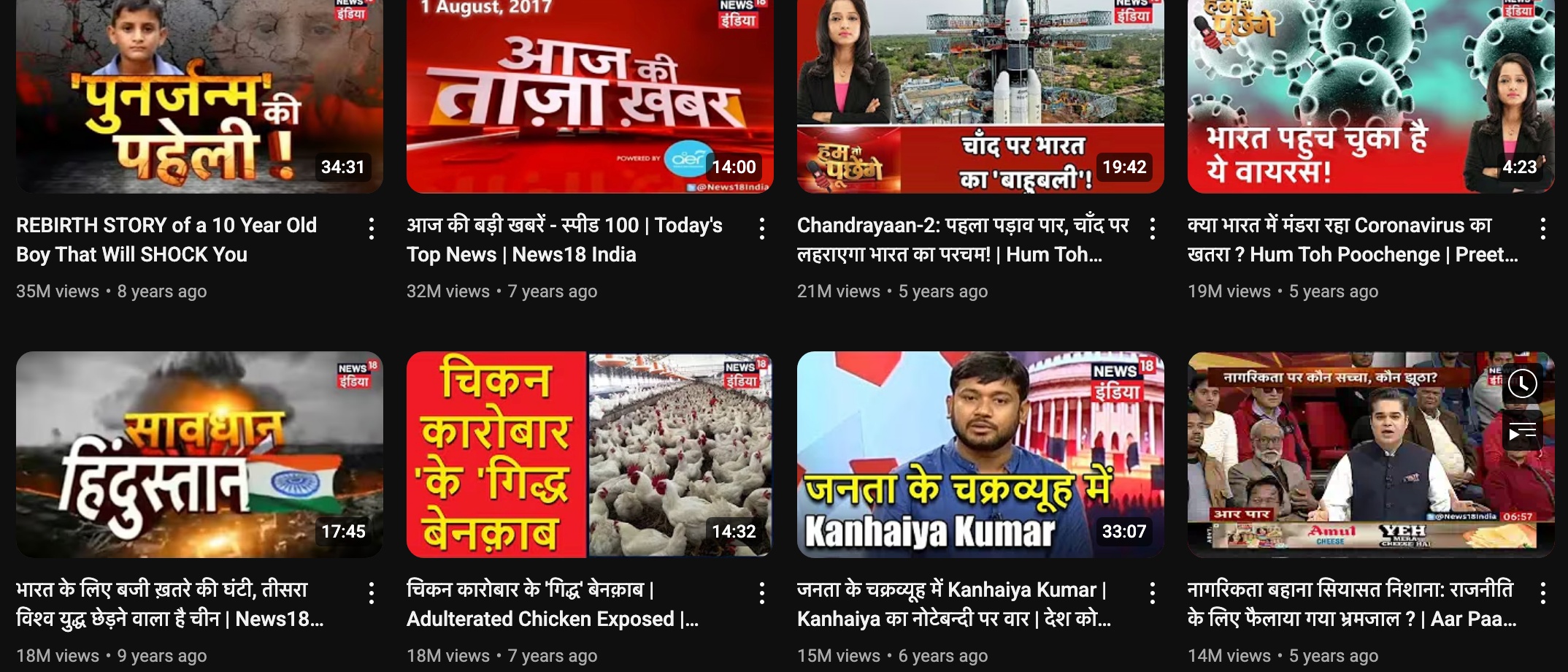
Like Republic Bharat, the News18 India YouTube hub added 400,000 new subscribers in the week following the attack. For that channel, a surge of attention following a newsworthy event is nothing new. Its most-watched long-form uploads include a contemporaneous update about the COVID-19 outbreak, footage from the Chandrayaan rocket launch, and some softer news items to balance the more tragic updates.

Popular videos on the News18 India YouTube channel.

Even Indian Prime Minister Narendra Modi is getting into the action on YouTube. The video site has become a versatile news source in South Asia, as it is in the United States. If you want to see the American version of this trend, just wait for our next election to roll around.

Channel Distribution

Here’s a breakdown of the Top 50 Most Viewed channels this week in terms of their countries of origin:

  • India: 15
  • United States: 11
  • Japan and Spain: 3
  • Bangladesh, Brazil, and South Korea: 2
  • Australia, Belgium, Canada, China, Germany, Hong Kong, Indonesia, Kazakhstan, Mexico, Pakistan, Puerto Rico, and Vietnam: 1

This week, 40 channels in the Top 50 are primarily active on YouTube Shorts.

As always, keep up to speed with the latest Tubefilter Charts and all our news by subscribing to our newsletter. You’re going to love it. 👉  Newsletter.Tubefilter.com.

Top 50 Most Viewed YouTube Channels Worldwide • Week Of 04/27/2025

[Editor’s Note: Tubefilter Charts is a weekly rankings column from Tubefilter with data provided by GospelStats. It’s exactly what it sounds like; a top number ranking of YouTube channels based on statistics collected within a given time frame. Check out all of our Tubefilter Charts with new installments every week right here.]

Scroll down for this week’s Tubefilter Chart. 👇


We’re approaching the one-month mark since YouTube changed its view-counting formula to make the numbers go up on Shorts. At first, that update created major noise in our Global Top 50, but the dust now seems to be settling.

KIMPRO is still the most-watched YouTube channel in the world, hauling in more than two billion views per week since the Shorts measurement change. But there are fewer billion-view channels in this week’s chart than last week’s, with only seven channels (all of them Shorts-adjacent) reaching that milestone.

Brace yourselves, Shorts. The chicken jockeys are coming.

Now that the new landscape of Shorts viewership is starting to take shape, it’s back to business as usual on YouTube’s TikTok competitor. Translation: The video game memes are back.

You may have heard about the chaos A Minecraft Movie is causing in theaters. Children are screaming lines at the screen and clamoring to spread the legend of the chicken jockey, a memetic character who has become the bane of existence for parents everywhere.

There’s nothing popular YouTube Shorts channels love more than an internet trend that can easily translate across linguistic and cultural lines. That’s what A Minecraft Movie provides: It’s a global phenomenon that is becoming a shared experience for kids around the globe, and channels like Hopper Sprunki Incredibox are taking advantage.

If the name Hopper Sprunki Incredibox sounds like gibberish to you, then you’re probably unfamiliar with Incredibox, a music-making app that features the sort of big-headed, colorful characters that typically thrive in the short-form meme economy. Sprunki is a fan-made mod for Incredibox.

There are some chicken jockey-themed Incredibox videos out there, but the Hopper channel has seen more success with references to a different Minecraft character. Jack Black’s Steve stars in a video that now has the second-most views among all Hopper Sprunki Incredibox uploads.

A Minecraft Movie has given more mainstream attention to a trend that was already lurking under the surface on YouTube Shorts. Channels that feature popular games in their videos tend to get a leg up on those that don’t.

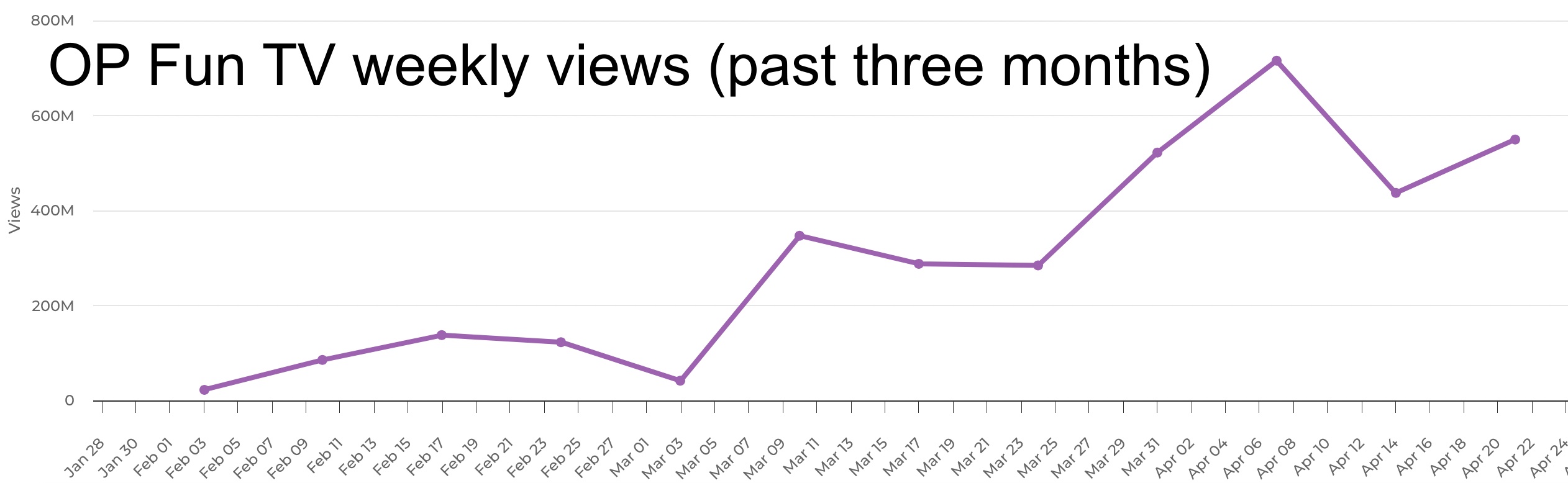
OP Fun TV has been a regular in the Global Top 50 for a while, but it recently surged up the charts. It saw its weekly viewership go up 26% at the end of April, topping out at 549.2 million weekly views. In a perhaps related twist, Op Fun TV has recently uploaded some videos created using BeamNG, a popular vehicular sandbox game.

Data via Gospel Stats

There are a lot of lessons we can take away from A Minecraft Movie‘s runaway box office success. It’s a triumph for video game adaptations and internet culture at large. The blockbuster was built on a foundation of memes, and those in-jokes are now running up the tally on YouTube Shorts.

Channel Distribution

Here’s a breakdown of the Top 50 Most Viewed channels this week in terms of their countries of origin:

  • India: 13
  • United States: 11
  • Hong Kong and Vietnam: 3
  • Australia, Canada, Indonesia, and Japan: 2
  • Bangladesh, Belgium, Brazil, China, El Salvador, Germany, Kazakhstan, Pakistan, Russia, South Korea, Spain, and Taiwan: 1

This week, 42 channels in the Top 50 are primarily active on YouTube Shorts.

As always, keep up to speed with the latest Tubefilter Charts and all our news by subscribing to our newsletter. You’re going to love it. 👉  Newsletter.Tubefilter.com.

Have you heard? MrBeast’s baseball stats, CaseOh’s cat computer, and Trisha Paytas’ pope drama

Each week, we handpick a selection of stories to give you a snapshot of trends, updates, business moves, and more from around the creator industry. This week, a creator’s high school sports career resurfaces, a Minecraft star opts for a rebrand, and a streaming star shows love for his cat.

Creator commotion

MrBeast’s Aaron Judge collab reminded viewers about his high school baseball career. Did you know that MrBeast used to be a slugger? His fans are rediscovering his MaxPreps profile from his time at Greenville Christian Academy. Even though he hit .424 during his high school career, he gave up the game to pursue a career as a creator. The man just loves YouTube that much.

Socks creates Minecraft in real life. The YouTuber with 1.4 million subscribers turned his backyard into a blocky playland complete with a Technoblade tribute. I did Minecraft in real life once, but it was just called “camping.”

Speaking of Minecraft…Dream is rebranding. The man who led the Dream SMP — which saw its popularity spike during the height of the pandemic — wants to start a “new chapter.” His plan is to debut the new Dream at the start of May. No word on whether Minecraft will still be involved.

The biz

CaseOh’s Starforge Systems build paid tribute to his cat. The popular streamer got the chance to design a product line for the OTK-affiliated systems integration firm Starforge. He chose to introduce the KITTY bundle, and if you have a feline friend of your own, you’ll probably think that this product is the cat’s meow.

Jynxzi accidentally leaked his (substantial) monthly earnings. The streamer who rose to fame playing Rainbow Six: Siege inadvertently revealed that he pulls in more than $450,000 per month from sources like subscriptions and ad revenue. It’s embarrassing to flash that data on screen, but with that amount of income, I don’t feel too bad for him.

Is a viral sweet treat causing a worldwide pistachio shortage? Some sources say yes, others say no. The only thing we can say with complete certainty is that TikTok is obsessed with the brown-and-green confection known as “Dubai chocolate.”

Pop culture minute

The Liver King is the subject of a new Netflix docuseries. The bodybuilder’s unusual diet and alleged fabrications will go under the microscope in Untold: The Liver King, a program due to hit Netflix on May 13. You do not need to be on a raw meat diet in order to watch.

Dylan Mulvaney wrote a book. The transgender TikTok star describes herself as a “late bloomer,” and she will use that point-of-view to explore her personal girlhood in the memoir Paper Doll. The book just came out, but it’s already a New York Times bestseller.

Tefi Pessoa is getting into business with The Cut. New York Magazine‘s pop outlet has looked to TikTok to find its next cultural commentator. Pessoa, a host, creator, and comedian, will begin her Cut collab with an advice column before launching a podcast due out this summer.

Agency dealings

Jesser signs with CAA. The talent agency will provide the prominent basketball creator with representation in all areas. Jesser continues to rake in brand deals hand over fist, including a recent team-up with PowerAde.

Fixated absorbs clients through acquisitions. The digital entertainment company already reps creators like the Botez sisters and Sketch. Now, by acquiring management firms CAMP Talent and Moondust Management, Fixated will be able to onboard prominent clients like Jason Nash, Catarina Mello, Heath Hussar, and Lee Asher.

Platform headlines

TikTok adds alt text on still images. Lengthening descriptions on image posts will provide more flexibility and new creative options for TikTokers. The change also encourages posts with more keywords in them, which helps TikTok secure its status as a legitimate search engine.

YouTube brings AI summaries to some types of travel content. If you search for things to do in San Francisco, for example, YouTube will provide you with a video carousel filled with AI-influenced suggestions. Google is clearly content with the growth of AI overviews in its search business and is eager to expand those summaries to other platforms.

The internet is a strange place

The internet is obsessed with a theory that links Trisha Paytas to the Pope. The social media star’s first pregnancy coincided with the death of Queen Elizabeth II, and her third child is due to arrive shortly after the death of Pope Francis. The idea that her children are cosmically linked to world leaders is so silly, but we could all use a little levity these days — especially the Catholics.

The third most-watched YouTube video of the week is deeply weird AI slop. A channel called ChengyuMovies uploaded a bizarre AI-generated video in which a pug rescues a baby from a plane crash and lives with it on a deserted island. Somehow, that video has more than 400 million views. I guess the human creators of YouTube are all doing it wrong.

Why do we love Akinator? The company behind the celeb-guessing genie explains its “divinatory art.”

I don’t remember who I thought of the first time I encountered Akinator. I only remember that the guessing game felt like a magic trick.

It would have been around 2009, two years after French company Elokence first launched its sleuthing genie. My friends and I huddled around my computer while thinking of movie stars, obscure basketball players, and fictional characters. No matter who we thought of, Akinator solved the puzzle more times than not. The predictive program was able to read our minds with fewer guesses than what seemed possible.

Early reviews of Akinator show that I was not alone in my assessment. Outlets described the program as magic, wondrous, and a timekiller.

Akinator search volume dipped in the early 2010s, but then a funny thing happened: Creators discovered Elokence’s genie and fell in love with it. Over the past decade, there has been a steady stream of Akinator videos uploaded to YouTube. Markiplier played the guessing game in 2015, AliA “beat” it in 2022, and Foltyn gave it a try a couple of months ago. The advent of YouTube Shorts has led to brief Akinator clips from creators like CaseOh, NotLeah, and Sambucha. At the time of this post, multiple Akinator videos with thousands of views have been uploaded within the past three days.

Jérôme Soreau, the Chief Commercial and Marketing Officer at Elokence, told Tubefilter that word of mouth has been a potent marketing tool for Akinator. “Players,” Soreau said, “are our main ambassadors. And, of course, this effect is augmented when some influencers talk about Akinator.”

Viral marketing has helped Akinator stay relevant, but it doesn’t explain why the program is still popular in an era that offers far more powerful predictive tools. Generative AI should have made Akinator obsolete, but it hasn’t. Why?

To answer that question, we have to dive into the algorithm that dictates Akinator’s behavior. Acording to the “fabulous story of Akinator,” a subsection of the program’s website, Elokence founder Arnaud Mégret encountered Akinator after rubbing an oil lamp in “the far away lands of the East.”

The actual story is less fanciful, but more interesting from a technical standpoint. Soreau explained the Mégret created the first Akinator algorithm after drawing inspiration from his family life. “His starting idea was to create a guessing game based on a common game that French parents played with their kids,” Soreau said.

Mégret began with a French database before expanding globally. The genie was originally called Devinettor before changing his name “to be more international,” Soreau said.

A Medium post published last September identified four “key components” that serve as the building blocks of Akinator’s “algorithmic magic”: binary search, decision trees, machine learning, and collaborative filtering. Through deductive reasoning, Akinator is able to whittle millions of potential answers into a much smaller subset of educated guesses.

Elokence’s R&D team continues to refine Akinator with help from the data collected from player guesses. (That data isn’t used for external purposes outside of Elokence, Soreau said). The result is an alogirthm with “huge guessing power,” allowing the genie to continue impressing players with his accuracy.

Soreau said that the refined nature of the Akinator alogrithm keeps the program relevant amid an AI boom. “We think that Generative AI is really good for general tasks, but these tasks are particularly power-intensive consuming and therefore very expensive, while the divinatory art of Akinator is very power-low consuming thanks to the efficiency of our proprietary technology,” he told Tubefilter.

So even as AI-generated content becomes more common and lifelike, creators will continue to flock to a 2D genie with a deep knowledge of the YouTube community. The game’s simplicity is arguably the key to its staying power. As long as there are celebrity creators, there can be celebrity creators trying to get Akinator to guess them.

That video topic has become a genre so vast that, when I asked Soreau to name his favorite Akinator video, he demured. “There are many videos featuring Akinator, in several languages and countries,” he said. “So how to select only one?”

Creators are building their own streaming services. Dropout, the Try Guys, and the Sidemen all used Vimeo to do it.

With creator entrepreneurialism at an all-time high, more YouTube channels turned media companies have been exploring how to bulk up monetization and maintain control over their content by offering paywalled extras to fans. But going off-platform, away from things like YouTube’s Channel Memberships and Patreon’s monthly subscriptions, isn’t easy.

Especially when you’re trying to design an entire custom streaming service.

That’s the problem Dropout faced. In 2020, the digital comedy brand–at that point called CollegeHumor, with a streaming service component named Dropout–was cut by its corporate owner, IAC/InterActiveCorp. Then-Chief Creative Officer Sam Reich bought it, and as he prepared for a revamp urged fans to stay subscribed to Dropout, calling it “the #1 way you can support me.”

Now, five years later, Reich is CEO, Dropout has 15 million subscribers on YouTube with successful shows like Dimension 20 and Game Changer, and it has a custom streaming service powered by Vimeo‘s latest product, Vimeo Streaming.

Vimeo Streaming debuted to the public earlier this month, but it’s already been used by major creators: Dropout, the Try Guys (who used it to build their service 2nd Try), and the Sidemen (who built Side+), to name a few. Vimeo’s tagline for the product is that it allows creators to “build your own Netflix-style streaming service,” complete with robust video hosting/playback tools and monetization.

So far, Vimeo Streaming has been used to launch more than 5,400 apps, which have collectively attracted 13+ million subscribers and generated nearly $430 million in annual revenue for creators.

For Dropout, Vimeo Streaming was what it needed to build the kind of subscription service that would suit its dedicated fanbase.

“We’re a creative team, not a tech company,” it tells Tubefilter. “Building and maintaining a custom platform, especially with apps across multiple devices, was an incredibly expensive and a high liability venture that was only an option for us when we were fully owned by IAC–and even then, we didn’t have the scale to afford to build a platform robust enough to suit the needs of subscribers.”

With Vimeo Streaming’s tools, though, Dropout has been able to build, maintain, and monetize a service that can handle all of its subscribers watching hundreds of episodes of content. Vimeo handles the service’s infrastructure, plus customer support and troubleshooting tickets. Not having to manage the technology is “a huge relief,” Dropout says. “The less we have to worry about the technology behind our platform, the more time we have to focus on the content we’re making. Seriously, the stability and reliability have been incredibly helpful.”

Using Vimeo Streaming has also helped Dropout keep the service’s price low; it has raised the monthly cost just once from the original $5.99 to $6.99.

“It’s been such a monumental shift for our business, and one that’s allowed us to grow and strategize in ways we never could have before,” Dropout says. “We are no longer beholden to social media algorithms and inconsistent ad revenue.”

On that topic, it says that the rise of TikTok and YouTube Shorts have been “a nightmare” for its business. “Short-form vertical video ad units are still in their infancy, and if you think YouTube Shorts can replace the ad revenue you were making on traditional longer-form YouTube videos, think again,” it says. “Unfortunately for the folks who rely on that ad revenue, everything is shifting in this direction.”

Having its own streaming service is helping Dropout compensate for short-form’s impact.

“We also have a direct relationship with our audience, and never have to compromise on our content to please advertisers,” it notes, adding that the relationship with its audience is “night and day” from YouTube to the Dropout service. “On platforms like YouTube, you’re competing for attention in a sea of content. With our own service, we’ve created a dedicated space for our fans, where we’re not in competition with every other content creator in existence. They’re here because they specifically want Dropout content, and that fosters a much deeper sense of connection. We can engage with them directly and cultivate an experience just for them that just isn’t possible on larger platforms.”

All this being said, Dropout is honest in saying that Vimeo Streaming is “not for everyone.” But perhaps not for the reasons you think.

“You need to have a lot of faith in yourself, in your content, and in your audience’s willingness to follow you to your own platform. But if you have all those things, we recommend giving it some real consideration,” it says. “Being able to break free of the constant grind and pivoting of algorithmic platforms, changing advertiser rules and rates, and the constant uncertainty about how your next video’s going to perform is a dream come true.”

Creators interested in launching their own services can check out why the folks behind brands like Dropout chose Vimeo Streaming here.


Vimeo is a Tubefilter partner.

YouTube’s quarterly ad revenue approaches $9 billion after double-digit year-over-year bump

YouTube‘s strong first quarter has helped cement it as a crucial holding under the Alphabet umbrella. The parent company of Google reported its Q1 2025 earnings on April 24, and YouTube was a major focal point thanks to its ballooning ad revenue.

During the earnings call, Alphabet execs reported that YouTube’s quarterly ad revenue totaled $8.9 billion. That sum represents a year-over-year increase of 10.3%.

Surprisingly, those gains fell slightly short of analyst expectations. YouTube had been projected to achieve $8.97 billion in ad revenue during Q1 2025. Overall, Alphabet exceeded projections by generating $90.23 billion of quarterly revenue. Analysts had predicted that the company’s topline figure would reach $89.12 billion.

YouTube’s first-quarter activity showed an effort to diversify its revenue beyond ads. Thanks to increasing activity from podcast fans and senior citizens, the platform’s audience on TV screens continues to swell. A new Premium Lite tier figures to attract more customers to YouTube’s subscription service, and a host of new features timed to coincide with the platform’s 20th anniversary will open up new options for creators. YouTube’s rapid expansion led Wall Street firm MoffettNathanson to tag the video hub with a $550 billion valuation as part of a recent estimate.

Alphabet doesn’t break out YouTube TV and YouTube Premium revenue in its earnings reports, but overall, the holding company enjoyed substantial subscriber growth during Q1 2025. “We’re pleased with our strong Q1 results, which reflect healthy growth and momentum across the business,” Google CEO Sundar Pichai said during the call. “Driven by YouTube and Google One, we surpassed 270 million paid subscriptions.”

There’s a lot of reasons for optimism in Mountain View, but Alphabet’s properties are also facing pressure on Capitol Hill. Thanks to a recent court decision, the breakup of Google’s ad business — which opponents see as a monopoly — is looking likely. A similar dissolution could affect the tech giant’s search business as well.

If regulators succeed in their plan to break up Google, YouTube will become an even more important asset for its parent company. The 20-year-old platform is a consistent high point in quarterly earnings reports, and Alphabet is hoping to keep it that way.

Kids’ content makes hundreds of millions on YouTube. A new company–filled with execs from Disney, Nick, and more–wants in.

Kids’ content is a dominating force on digital platforms–and a big business, with giants like Moonbug, Pinkfong, and WildBrain making tens or hundreds of millions of dollars from IPs they built on YouTube.

Now a new company, helmed by a team of writers, directors, producers, and executives with experience at YouTube, Nickelodeon, Disney, Apple TV+, and Max, wants a slice of that pie.

The Kids’ Table, which describes itself as “a premium content company for creators and brands,” launched this week, promising it “will provide the expertise to deliver high-quality, evergreen stories and build franchises that reach kids wherever they are, on screens, platforms, and devices worldwide.”

It’ll do that by offering individual content creators and companies original IP development, help with adapting existing IPs into other mediums, content slate building, production resources, and licensing. It says digital distribution of these IPs on YouTube “will play a key role” in its overall strategy.

“YouTube is the #1 destination for kids, and we plan to meet them where they are,” co-founder Brent Coble said in a statement. “Whether it’s YouTube creators wanting to expand to a new demo or brands aiming to amplify their YouTube presence, we are well equipped to achieve those goals.”

Coble is a longtime digital content strategist who’s worked with Google, YouTube, Nickelodeon, and Jubilee Media, and built digital IP for brands like the NFL and Hulu.

Joining him on The Kids’ Table team are:

  • writer/producer Chris Viscardi, who formerly headed Nickelodeon Animation and wrote for films like Alvin and the Chipmunks, The Tale of Despereaux, Snow Day, and The Plankton Movie
  • creative exec/producer Nikki Reed, who worked with Max, Disney, and Paramount Television on IPs like National Treasure, Descendants, and Jessie
  • exec/producer/filmmaker Michael Sammaciccia, the former head of Nickelodeon Original Movies who worked on 30 movies including Holes, The Chronicles of Narnia, Bridge To Terabithia, and Spy Kids
  • and creative exec Angela Silak Vargas, who was at Nickelodeon and Apple TV+, working on series including Slumberkins, Interrupting Chicken, and Get Rolling With Otis

Sammaciccia said this group of co-founders has been “coworkers, friends, and fans of one another for years,” and that they launched The Kids’ Table because they “see an incredible opportunity for brands to connect with kids and parents.”

The Kids’ Table is specifically looking for content that will be parent-approved–and maybe even engaging for parents, considering “how important co-viewing is for families,” Vargas noted. (We’ve noticed, too: numerous reports have shown just how often parents are watching YouTube content with their kids.)

The company says it’s actively developing partnerships with YouTube creators and “celebrity talent,” along with consumer product manufacturers, retailers, and brands.

“We all remember sitting at the kids’ table. It’s where imagination runs wild, creativity thrives, and the best stories unfold,” Reed said. “That’s the spirit we’re bringing to every project, and we invite digital creators and global brands to pull up a chair.”

Meta is addressing the “unfortunate reality” of spammy content with new moderation tactics

After enduring years of complaints, Meta is trying to do something about spammy posts on Facebook. A blog post revealed ongoing and upcoming steps Meta is taking to address spam that manipulates recommendation algorithms to show up uninvited in users’ feeds.

Last year, social media users and media outlets noticed a concerning rise in the number of spammy posts that show up in individuals’ Facebook feeds. That type of content is not merely an annoyance; it’s also a hindrance for authentic creators who are trying to break out on a noisy platform.

“Some accounts try to game the Facebook algorithm to increase views, reach a higher follower count faster, or gain unfair monetization advantages,” reads the post. “While the intentions are not always malicious, the result is spammy content in Feed that crowds out authentic creator content.”

Meta’s ongoing investment in generative AI has emboldened accounts that spam social media feeds. While generative AI tools possess significant creative potential, they also encourage the proliferation of so-called “AI slop” — low-effort posts that often target kids.

AI is an important part of Meta’s future, but so are humans. Mark Zuckerberg and co. are reviving bygone features like the Friends feed to bring back the community spirit that made OG Facebook so thrilling. The hope is to build an ecosystem that works for individual creators and generative AI models alike.

That’s where the company’s latest moderation efforts come into play. Accounts utilizing “long, distracting captions” that are “completely unrelated to the content” will be stripped of monetization. To address the “unfortunate reality” of spam content that engineers “fake engagement” — i.e. through tactics that artificially inflate reach — Meta will de-rank offending comments and posts.

Accounts that impersonate other creators are also in Meta’s crosshairs. The tech giant said that it removed 23 million profiles for unauthorized mimicry in 2024, and there’s “more to be done” on that front this year.

Meta’s fight against spammy content is admirable, but its moderators should keep in mind that attempts to clean up a platform can sometimes cause collateral damage. Creators who endured YouTube’s adpocalpyse learned that truth firsthand. Here’s hoping that Meta is able to root out the spam that infests its platforms without rankling too many users along the way.

Jynxzi made $452,000 on Twitch in the last 30 days. Here’s why that’s good for our industry.

As the creator economy has matured, more people have become interested in tracking how content performs for the people who make it. Stats like follower numbers and view counts are publicly available for anyone to see, and sites like Streams Charts, MrBeast‘s ViewStats, and Tubefilter‘s own Gospel Stats take a deeper look by plugging into the backend of YouTube and Twitch.

But one stat that’s still difficult to predict with accuracy is creator revenue. Sure, we can make our best guesstimate based on industry knowledge of things like YouTube’s average CPM, but there are dozens upon dozens of factors that go into each creator’s individual earnings. Creators can have wildly different CPMs on the same platform. Then there’s brand deals. Merch sales. What if they licensed their content library? What about Super Chats on YouTube, or donations on Twitch?

What we’re saying is it’s impossible to tell exactly how much a creator is making without that creator or a member of their team personally confirming–and getting those confirmations is rare. So, there’s simply no 100% bulletproof way to nail it down for a large number of creators, and thus no way to establish a reliable, industry-wide scale of creator earnings.

However, sometimes creators do reveal how much they make. Most of the time, those reveals are on purpose.

But sometimes they’re not.

On April 24, Jynxzi–who has 7.2 million followers and is one of Twitch’s top creators–was chatting with viewers when he stood to take a break and accidentally switched to his Twitch analytics tab, which showed that he’s made a whopping $452,448 on the platform in the last 30 days.

It also showed that he currently has more than 80,000 active channel subscriptions and has streamed 236 hours over the past month, with an average of 24,513 concurrent viewers.

This is all interesting data, but Jynxzi didn’t mean to reveal it. After a gasp and a quick “Oh my god,” he switched the tab back, then sort of froze for a moment and asked, “What just happened?”

Unfortunately for him, because he was live, this moment is now preserved on the internet forever.

There is an upside here, though. While he may not have wanted his earnings to be public knowledge, we would argue this is a positive thing for our industry.

Jynxzi is, according to Twitch Tracker, the 10th top-performing streamer on all of Twitch. Over the past five years, we’ve seen more and more outside people and companies begin to view content creation as the powerhouse it is; seeing just how much Jynxzi makes from his position can only add to this mainstream legitimacy.

On top of that, his monthly revenue figure is a valuable insight for other creators, especially newbies. There aren’t many direct-from-creator resources about the financials people can expect when they get into making content. Now, obviously not a lot of people are going to achieve Jynxzi numbers, but knowing what a high-level creator makes can still help up-and-comers contextualize the cash that hits their own bank accounts.

Again, we get why creators–especially top creators–choose not to reveal their earnings. It’s a privacy thing, and in some cases, a safety thing. But when numbers do come out, there can be industry-wide positives.