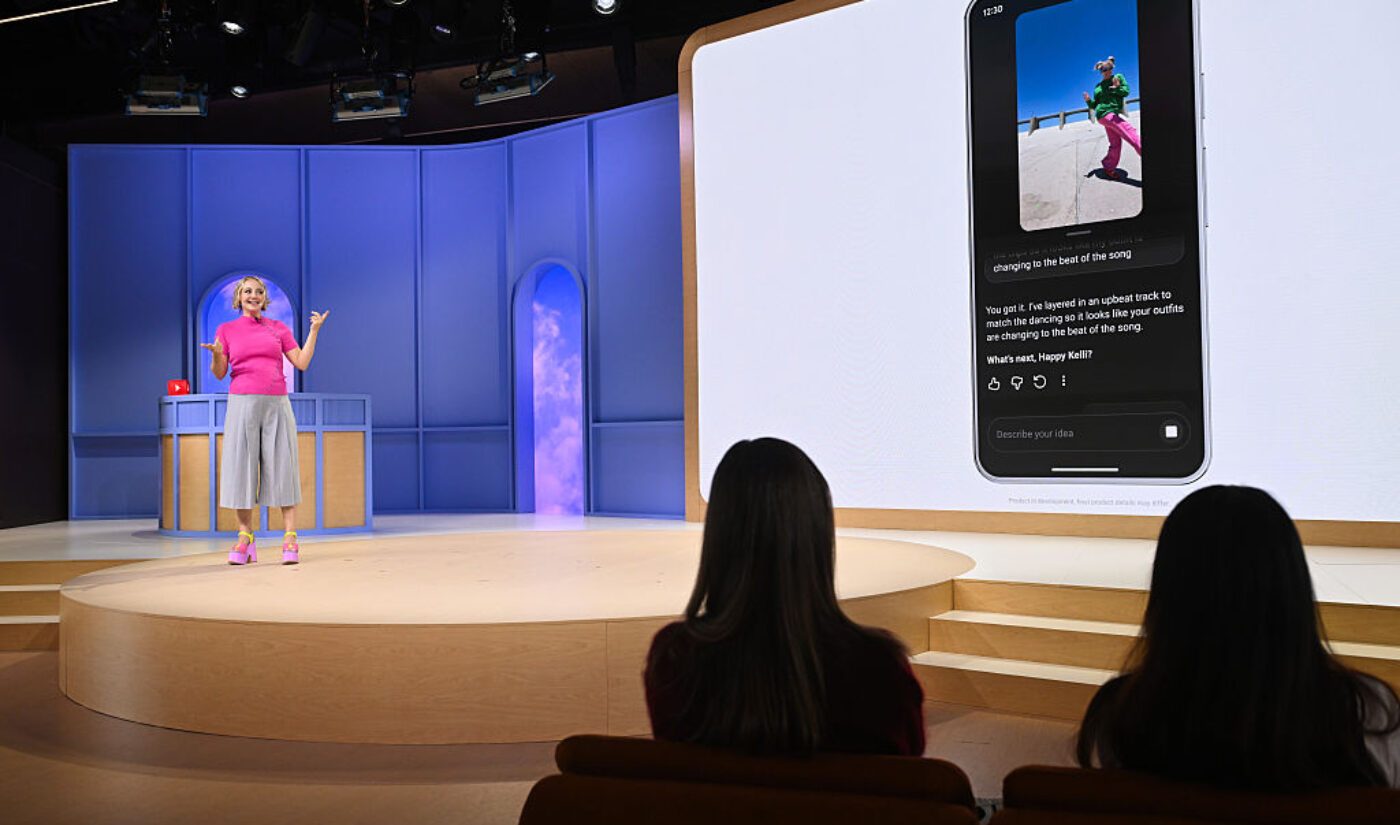
At its 2026 Made on YouTube event, Google‘s video platform revealed that microdrama content has racked up 6.5 billion views in the first half of this year. That’s a 50% jump from 2025.
And, of even more interest to YouTube, microdrama views on TV screens increased by more than 90% year-over-year during the first half of 2026.
YouTube has been the United States’ dominant distributor of content on TV screens for two years now, beating every streaming service and cable/broadcast network for sheer watch hours. This is a point of pride for YouTube, which is always looking to capture a bigger slice of advertisers’ budgets by proving it now wins attention that used to be owned entirely by traditional TV networks.

Subscribe to get the latest creator news
As microdrama apps like ReelShort and DramaBox sap mobile watch time from streamers like Netflix and Amazon Prime Video, YouTube could edge ahead by combining its top-of-the-food-chain TV viewership with the trendy short format.
In tandem with announcing microdrama viewcounts, YouTube unveiled “Shorts Series,” a feature that lets creators organize Shorts into TV-style seasons for maximum follow- and bingeability.
If this sounds familiar, it’s because YouTube already introduced something similar for long-form content back in August 2025. That feature, called Shows, is very similar, allowing creators to organize horizontal uploads into chronological collections of episodes.
The Shows (and now Shorts Series) UX mimics the sort of slick TV series panels you see on major streaming services, and is engineered to get viewers to flow from one episode to the next.
With microdramas, we imagine that flow is even easier. Instead of having to commit to a 45-minute episode, viewers are asked to tune in for clips that are only three minutes, two minutes, one minute, even 30 seconds long. Very easy to “just one more” for an hour…or two…or three, especially when videos autoplay. And microdramas are often sprawling, with a cliffhanger-laden story spread over dozens or hundreds of episodes. That could add–and clearly is adding–a lot of TV watch hours to YouTube’s wallet.
Kurt Wilms, YouTube’s Director of Product for the Living Room, said onstage that YouTube originally wasn’t sure about bringing Shorts to living room TVs, let alone special serialized Shorts playlists. But then he heard about one major use case.
“I spend a lot of time talking to creators and viewers about why they’re using the TV,” he said. “The first thing everyone was telling me about Shorts on the TV is there was no good way to watch this content with friends or family. The TV unlocked communal viewing for Shorts in a way that just wasn’t possible before, and I love watching it in my household with my significant other, with my family, and it took off.”
YouTube was clear, though, that microdramas are not just for TV.
Dina Berrada, YouTube’s Senior Director of Product for Shorts, added, “Overall, we see a lot of success of bite-sized content that can be personalized to your taste. Whether it’s Shorts, microdramas is a big one, and then people seeing it as a place to spend breaks in their day from an entertainment standpoint, and doing that across a bunch of different screens.”
Watching bite-sized content during breaks in the day…Hm, where have we heard that one before?
It’s also worth noting here that Shorts Series will not only work on TVs. It’s rolling out to YouTube Partner Program creators to use on the web and on mobile as well.
Spreading creator-made microdramas across as many viewing surfaces as possible might pay off for YouTube in more than watch time. Separate from Made on YouTube and the platform’s announcements, Digiday reports that advertisers are looking at microdramas as a method of “capturing shopper attention in a fragmented digital ecosystem.”
Microdramas have brands’ attention as much as, or perhaps even more than, civilian viewers’. Microdrama apps are running more ads than apps in any other category–and some brands are even going beyond placements to produce their own shows.
Geneva Wasserman, EVP and Head of Entertainment, IP Strategy, and Financing at marketing firm dentsu, told Digiday that brands judge microdrama ad ROI based on the organic chatter they drive, not views.
She said a microseries that gets 200,000 views and drives $2 million in earned media is considered higher value than a series that gets 500,000 views but no chatter.
“Traditional metrics are misleading. The real north star is: ‘Does the content create cultural credibility that extends beyond the watch,'” she said.
Digiday points to Bob’s Discount Furniture as an exemplary case. It ran its own microseries, Till Decor Do Us Part, in summer 2025. Episodes drove 152 million views and $9 million in attributable sales, the company claims–a success that led it to putting out a second season this week.
The views and millions in sales are “a strong signal that we’re building both attention and affinity, which are increasingly important indicators of long-term brand health,” Stephen Nesle, Bob’s Discount Furniture’s CMO, told Digiday.
From these macro-sized twins of microformat news, it’s clear both platforms and brands are focusing in on serialized short-form, hoping it will drive the most important metric of all in our current culture economy: just a few precious seconds of undivided attention.