December is the time of year when Big Tech platforms publish year-end posts that recap the year that was. While those companies are talking about KPop Demon Hunters and short-form music trends, Snapchat has a different meme in mind for its year-end recap: SIX SEVEN!
The ubiquitous Gen Alpha exclamation powered one of Snapchat’s biggest success stories of 2025. The app known for its disappearing videos and messages created a Bitmoji version of 6-7, and after its launch, that graphic became the most-used sticker on the platform.
Bragging about a nonsensical phrase may not seem like much of a boast, but the high usage of the 6-7 Bitmoji sticker reinforces Snapchat’s deep inroads into youth culture. For many social media users in the Gen Alpha and Gen Z cohorts, Snapchat is as indispensable as it was a decade ago.
To wit: Snapchat reported that 40% of its Gen Z users see Snaps of “random moments” as evidence that the sender wants to become closer friends. Group chats grew up as well, with 5% more users adopting that format year-over-year. Some Snapchat users set more than 8,880 messages to their top Group Chat over the past 12 months.
Those data points paint Snapchat as an integral cog in the machinery of youth culture. Other platforms may tout their strong links to Gen Alpha, but Snapchat is the app that many youngsters trust for their social interactions.
“Across the board, 2025 was defined by friendship, creativity, and connection,” reads Snapchat’s year-end recap. “From quick chats to long calls and everything in between, friends showed up for each other in more ways than ever.”
Of course, not all Snapchatters belong to Gen Alpha and Gen Z. No matter how you use the app, you can find a personalized recap of 12 months of activity by checking out your custom Snapchat Recap. So if you’ve ever wanted your Bitmoji habits to get the Spotify Wrapped treatment, you’re in luck.
Last year, DraftKings co-founder Matt Kalishinvested $11 million in FaZe Clan as it ended its disastrous attempt at being a public company. His cash went into the FaZe Media half of the biz (separate from FaZe’s esports endeavors), and was chunky enough to give him 49% ownership.
While we haven’t heard much about FaZe’s profitability since the privatization, it did win Best Content Organization at the 2024 Streamer Awards.
And now, Kalish is planning to expand his efforts to other creators by launching HardScope, a company that describes itself as “the operating system for the creator economy, connecting brands and fans with the most influential streamers built to lead culture.”
It does that by “back[ing] the established and emerging talent shaping what’s next, and set the standard for creator led [sic] businesses,” HardScope says.
In practice behind the buzzwords, that means providing creators with support around content strategy, production, and distribution, plus social media management–all aimed, of course, at generating revenue from brand deals and putting ads in front of their Gen Z viewers.
Per The Wrap, Kalish’s team has so far worked with livestreamers including JasontheWeen, Lacy, Stable Ronaldo, Adapt, YourRage, Kaysan, and Silky. In October, it ran a subathon it said generated 1.8 billion views and 85 million engagements on social media.
“We take pride in being the battle-tested team of makers, who create valuable assets in-house and get results for partners in a sea of unaccountable middlemen,” Kalish said in a statement. “The mission of HardScope is to directly platform top talent that own the keys to Gen Z and invest in building their empires, while seamlessly onboarding brands into their universe through authentic integrated partnerships and collaborations that drive performance.”
Mandy Gardiner, HardScope’s SVP of Brand Partnerships, added, “Brands know the audience has shifted, but they struggle to navigate the fragmentation of the creator space. We’re making it simple to create authentic partnerships that place brands at the center of creator communities and culture, while driving powerful business results. Our native DNA and proprietary technology is able to turn streaming moments into movements that dominate feeds and drive sales.”
Kalish’s original investment into FaZe Clan wasn’t a surprise considering the org’s partnership with DraftKings, where he’s still on the board and serves as President, North America. And, honestly, we’re also not surprised that he sees the creator economy as the next place to make money–especially if he can keep working with esports-oriented creators who might similarly take DraftKings sponsorships and/or might be otherwise integrated into the ever-growing digital sports ecosphere.
Filed under: Homepage Feature by James Hale Comments Off on A DraftKings co-founder just launched a company to “build empires” for creators
If you want to see what the future of AI-generated entertainment might look like, step into the Fairground. That’s the name of an upstart content studio that is working with generative AI artists to produce and distribute an ethical, polished library of shows and movies.
Fairground burst onto the genAI scene earlier this year. That’s when CEO Colin Petrie-Norris, the Co-Founder of the FAST hub Xumo, launched his new studio and announced a $4 million funding round to support its growth.
Since then, Petrie-Norris and his team have been leveling up Fairground’s operation. In collaboration with 24 AI artists and studios — including TikTok standout blvcklightai — Fairground has surpassed $100,000 in payouts to its creator partners. In a statement, Petrie-Norris called that revenue milestone a “proud moment,” though he acknowledged that six-digit payouts are only the beginning for Fairground.
“We’re building AI-powered shows the way television has always been built: around story, pacing, and audience engagement,” Petrie-Norris told Tubefilter. “Fairground Studios works closely with creators who bring real craft to the process, using AI responsibly to produce long-form content that meets broadcast-level expectations without compromising ethics or quality.”
One of those creators, Michal Jan Owerczuk, has gained recognition from AI film festivals thanks to his lauded film Broken Arrow. The flick is part of a Crime Stories: Wild West show financed by Fairground.
By investing in AI artists and helping them bring their stories to life, Fairground is providing support for a creative class that’s ready to embrace the future. But in theory, it won’t just be the creators who benefit from Fairground’s continued growth. The platforms that work with the studio will receive a steady supply of efficiently-produced content, and as Petrie-Norris said, Fairground viewers can expect the resulting programs to feature the same level of polish and craft found within traditional productions.
2026 will be the year Fairground really puts that model to the test. More partnerships — and perhaps, payouts scaling up to seven digits — are on the way.
In 2024, 10% of Meta‘s revenue–around $16 billion–came from predatory ads targeting users for things like scams, illegal gambling, and banned products.
And Meta knew about it.
An investigation from Reuters revealed that in early 2024, Meta devoted resources to figuring out why so much scam advertising was coming out of China. Chinese ads are big business on Meta; there are entire industries built around making, deploying, and “optimizing” them to reach the most eyeballs (often by finding loopholes in Meta’s platform rules), and together they purchase enough marketing to supply over one-tenth of Meta’s global annual revenue.
But Meta had noticed that with the flood of normal ads came a deluge of dangerous material: ads for unproven health supplements and directions to WhatsApp groups that pushed people from foreign nations to buy overpriced stock.
So, it took a closer look at Chinese ads–and the results were dire. “We need to make significant investment to reduce growing harm,” staffers told Meta leaders in an April 2024 presentation, Reuters reports.
Meta responded by forming an anti-fraud team that was focused on China. The team was effective: During the latter six months of 2024, it cut rule-breaking Chinese ads in half, dropping them from accounting for about 19% of China’s total ad revenue to 9%. That meant users were safer from scams–but it also meant Meta was bringing in less money.
According to Reuters, that just didn’t sit well with Mark Zuckerberg.
In late 2024, the China ads team was “asked to pause” work, it reports. This decision came from on high: “As a result of Integrity Strategy pivot and follow-up from Zuck,” an internal memo notes.
Ultimately, the special team wasn’t only paused–it was disbanded. At the same time, Meta walked back a freeze it had instituted to prevent new Chinese ad firms from accessing its platform, and inexplicably trunked other anti-scam efforts that it had determined would be effective..
You’re probably not going to be surprised by what happened after those changes were made: By the middle of 2025, Chinese scam/gambling/banned product ads were almost back to their previous levels, and now totally unchecked. Internally, Meta staffers refer to China as the platform’s #1 “scam exporting nation.”
Rob Leathern, who worked as a Senior Director of Product Management at Meta but left in 2020, told Reuters the level of predatory ads is “not defensible.”
“I don’t know how anyone could think this is okay,” he said.
Meanwhile, Meta spokesperson Andy Stone said the special China ads team was always meant to be temporary, and that actually, Zuckerberg didn’t order the team to be disbanded. Instead, Zuck’s order “was to redouble efforts to reduce [scams] all across the globe, including in China.”
“Scams are spiking across the internet, driven by persistent criminals and sophisticated, organized crime syndicates constantly evolving their schemes to evade detection,” Stone said. “We are focused on rooting them out by using advanced technical measures and new tools, disrupting criminal scam networks, working with industry partners and law enforcement, and raising awareness on our platforms.”
This all boils down to Meta (reportedly) being willing to sacrifice its users’ safety to earn an extra dollar. But while it may (reportedly) be willing to do that, some American lawmakers aren’t.
After another Reuters report last month, where the outlet noted Meta earns $7 billion a year from scams ads it considers “high risk,” U.S. senators Josh Hawley and Richard Blumenthalasked both the Securities and Exchange Commission and the Federal Trade Commission to look into Meta’s practices.
“The FTC and SEC should immediately open investigations and, if the reporting is accurate, pursue vigorous enforcement action where appropriate,” the duo wrote.
Filed under: Homepage Feature by James Hale Comments Off on Meta is (reportedly) letting scammers target its users, so long as it keeps making the big ad dollars
If you prefer Kick to Twitch because you don’t like it when commercials interrupt a stream, then get your ad-free viewing in now while you still can. Kick CEO Ed Craven recently indicated that the platform won’t be ad-free forever. In-stream spots are coming “at some point” in the future.
Craven commented on Kick ads during a live-streamed interview. “Kick will have ads at some point,” Craven said, “so enjoy the ad-free experience while it lasts.”
Eddie says ads will be coming to Kick
“Kick will have ads at some point so enjoy the ad free experience while it lasts..no release date for ads at the moment but they’re gonna come..goal is to add ads that isn’t overtly intrusive”
Kick’s ad-free status (except for banner ads) makes it unique when compared to rivals like Twitch and YouTube Gaming. Its link to gambling company Stake gave it a financial lift upon its 2022 launch, but Craven has long claimed that Kick will need to run ads to achieve long-term profitability. He said his company “loses a little bit of money” at the moment.
Even if Kick viewers appreciate the ad-free experience the platform currently offers, they must acknowledge that the platform can only compete in the competitive streaming landscape by generating more revenue for its creators. Kick’s early success was driven by big-money, exclusive contracts that drew in big names from Twitch and elsewhere. That strategy proved tricky to sustain, and these days, Kick’s exclusive deals are limited to streamers like Mizkif who have become pariahs on other platforms.
In other words, if Kick doesn’t want to run into the same problem Vine encountered a decade ago, it needs to find a more sustainable monetization structure than splashy, one-off contracts. Ads can provide that sense of sustainability, but they also come with drawbacks. Craven acknowledged that his team wants to develop an ad format “that isn’t overtly intrusive,” so that the viewers who appreciate the current ad-free experience aren’t hung out to dry completely.
That’s no small task, but Craven is giving his employees plenty of time to find a solution. There’s still no exact timetable for the launch of Kick ads, so the platform will remain a blissful ad-free oasis in the near future.
Welcome to our rundown of the most-watched branded YouTube videos of the week.
We’re publishing this snippet of a larger Gospel Stats Weekly Brand Report in order to analyze sponsorship trends in the creator economy. Any video launched in tandem with an official brand partner is eligible for the ranking.
And – as the name up above would imply – all the data comes from Gospel Stats. If you’re interested in learning more about Gospel – and which brands are sponsoring what creators on YouTube – click here. You can also download our YouTube 2025 Sponsorship Landscape Reporthere.
The holiday shopping adstravaganza is in full swing–but despite the many videos peddling stuff to put under the tree, our #1 video this week comes from a channel that’s decidedly less festive.
We won’t spoil any more than that (don’t look down. Don’t do it. Resist temptation.), but we’re guessing you won’t be surprised by the presence of this particular creator, who’s popped up on our top 5s several times this year. As for his company…check them all out below!
True crime has become one of the top content niches online, and a lot of that charge was led by Netflix, with slickly produced, attention-grabbing, and sometimes lurid specials like Making a Murderer, Tiger King, and Don’t F**k with Cats. But YouTube is also a home to true crime–and it has the speed-to-market advantage, with channels like Dr Insanity getting ahold of police and security camera footage sometimes just months after a crime took place, and using it to narrate the story for hungry viewers.
In this case, Dr Insanity covers the case of Kristil Krug, who was murdered by her husband Daniel. Dr Insanity’s coverage runs over an hour, detailing what led to Kristil’s death in December 2023 and Daniel’s conviction in April 2025.
Often with true crime channels, we see creators take sponsorships that at least loosely fit into the genre–things like cybersecurity companies and personal info protection apps, or self-defense lessons/products. But this video is sponsored by Outskill, an AI company that Dr Insanity promises will let viewers “Dive deep into AI and Learn Automations, Build AI Agents, Make videos & images – all for free!” That promise is followed up with letting viewers know that if they decided to “join and attend” Dec. 6 or 7, they’d get “Bonuses worth $5100+.” Yeah, okay…
Disney might be going after Google now that it’s best billion-dollar buds with OpenAI, but that doesn’t stop it from recognizing the power of YouTuber marketing. To pump up its latest sequel Zootopia 2, it tapped couple channel NickandCarrie. The video title spotlights both smart-light company Govee and the Disney flick as the couple decks out their pad in some sponsored lighting arrangements.
We’ve been seeing it more and more: smaller channels getting hyperspecific brand deals that are steadily turning Shorts into an ad network. This week, it’s family vlog ChasingSage and outdoor outfitters Sierra. The clip is only 27 seconds, and is cut like something we’d see on TV, with smiling kids, fresh snow, and a vicarious sledding day that’ll make you want to reach for hot chocolate. It’s homey family fun–lo-fi and (the magic word) authentic.
Something tells us Sierra is pleased–especially with the over 5 million views it’s racked up.
It’s rare that we see YouTube itself sponsoring content, but we’re not surprised this is the topic it chose for brand partnerships. As we wrote last week, YouTube used to produce annual year-end look-backs called Rewinds. That went down in flames in 2018, and after the initial surge of COVID shutdowns, YouTube announced it was no longer going to do Rewinds.
But, with podcast competitor Spotify basically owning the end of the year with its fancy, made-to-share-on-socials Wrapped, YouTube is back in the game. Instead of doing a single house-produced video, it’s doing–well, it’s doing Wrapped. Each user (as long as they don’t mess with their watch history in any way) will get a personalized Recap that shows them which creators they’ve been watching, their top niches, and more.
Okay, yes, we know this slot was filled by Critical Role last week, so we’re doubling up on Dungeons & Dragons. But this ad was too nerd-cool for us to pass up, and–like Sierra’s ad Short–was made by a growing channel. Will Henry, tabletop gaming enthusiast, has been making sketch videos about D&D for a while now, and though his audience is small in number, they’re huge in passion.
And Emberglow Gaming knew they’re exactly who to target for one of its top products: A real-life Bag of Holding. In D&D, the Bag of Holding wraps around an extradimensional pocket, so the user can store things with no limit. While that’s not possible IRL (yet), Emberglow got as close as it could by making a bag built to hold everything your local tireless Dungeon Master could need. There are clips for a gaming mat, pockets for dice and miniatures, a water bottle holder, and more.
Look, we just think this is rad. This is a company that knows its niche and is making functional products for the people enjoying it. We could all use more human creativity these days, and brands enabling that creativity are what we like to see.
…and there’s a lot more data where that came from. If you like our Weekly Top 5, you’ll love everything else Gospel has to offer. Start with our newly released YouTube 2025 Sponsorship Landscape Report, which you can download right here.
In case you haven’t heard, 2024 was the year of the influencer election — and whether you go by the social media feeds or the ballot counts, right-wingers emerged victorious. The night of Donald Trump‘s re-election also delivered record-high traffic for the internet’s community of conservative pundits.
The right wing retained the digital spotlight during 2025, but a startup is trying to turn the tables ahead of the 2026 election. AND Media is launching to support left-wing political creators by providing them with new content opportunities, financial support, and other services.
The Hollywood Reporter describes AND Media as a “venture studio” that will provide production assistance and funding for liberal creators as they pursue serialized projects. The startup is launching with an initial slate that features author Hunter Prosper and comedian Matt Buechele. Prosper will adapt his TikTok format Stories From a Stranger for YouTube, while Buechele will launch a new video podcast.
These creators are just as popular as the right-wing influencers who supported Trump during his 2024 campaign; now, they’ll have the chance to speak louder. In a sense, AND Media looks to answer a hypothetical question: What would happen if the digital strategies of the Biden White House were divorced from that administration’s policies?
The problem was that Biden — and, by extension, his Vice President Kamala Harris — could not separate their novel ideas about digital media from their political positions. A planned collab between Harris and Subway Takes host Kareem Rahmafailed to materialize after the two parties failed to see eye-to-eye on Gaza. As for TikTok, Biden’s use of the platform made his attempts to ban it seem hypocritical.
Two years later, the political landscape has shifted. The biggest celebrity of the 2025 election cycle was Democratic Socialist Zohran Mamdani, who used a robust social media strategy to become New York City’s next mayor. Mamdani showed that the left could use YouTube and TikTok as effectively as the right.
Christian Tom is looking to capitalize on that momentum. Biden’s White House Director of Digital Strategy is the CEO of AND Media, and he has a unique vantage point somewhere in between creator content and politics. He was a keynote speaker at VidCon Baltimore and a driving force behind the effort to bring lefty creators to Washington D.C.
“We believe that the value in digital media, cultural, monetary and otherwise lies in the scalable formats, stories, franchises, IP born from creator-led brands,” Tom said. “And we think that is the tectonic shift that is happening in culture today and, in our assessment, is increasingly shaped by digital creators, as opposed to kind of traditional institutions, and that’s kind of the foundational thesis for the company itself.”
Tom’s venture studio is taking on an ambitious moment during a pivotal moment in U.S. politics. If AND Media wants to reshape digital discourse during the 2026 midterms, it’s off to a good start.
Filed under: Articles, Featured, Homepage Feature, News, Politics by Sam Gutelle Comments Off on Right-wing creators dominate political discourse online. Can a lefty startup flip the script?
[Editor’s Note: Tubefilter Charts is a weekly rankings column from Tubefilter with data provided by GospelStats. It’s exactly what it sounds like; a top number ranking of YouTube channels based on statistics collected within a given time frame. Check out all of our Tubefilter Charts with new installments every week right here.]
Scroll down for this week’s Tubefilter Chart. 👇
During the second week of December, MrBeast got one million new subscribers to bring his YouTube-leading total up to 454 million. As impressive as that total is, the Argentinan answer to MrBeast is outdoing his American counterpart on a week-to-week basis. Alego Igoa “only” has 97 million subscribers on his main YouTube channel, but he added 1.5 million weekly subs to lead our Global Sub Top 50 ranking.
South American creators are using categories like challenges, pranks, and reaction videos to flourish in our charts, but this week, the Asian invasion is in full swing. The chart is filled with East Asian tastemakers, and the biggest pop culture phenomenon of the summer may still be responsible for that uptick.
Who needs KPop Demon Hunters when you have J-Rock Mystery Players?
The hot new music group on YouTube Shorts is a Japanese rock band that’s shrouded in mystery. Few people know how many members Zutomayohas, and the true identities of its musicians is a mystery as well. But those missing details aren’t stopping fans from eating up the band’s new music.
It’s safe to say that the second week of December was the biggest seven-day stretch Zutomayo has ever had on YouTube. Even though the group has been active since 2018 (with anonymous frontwoman ACA-Ne leading the way), it picked up about a third of its lifetime subscribers during our most recent week-long measurement period. With 1.15 million weekly subs, Zutomayo ranked #2 in the Global Sub Top 50, trailing only Alejo Igoa.
The typical upload on Zutomayo’s YouTube Shorts channel is a brief snippet of a music video from the band’s catalog. In December, however, the group reminded its 3.3 million subscribers that it hasn’t forgotten about the long-form side of YouTube. A new track titled “Yushinron,” which pays homage to fellow J-Rock group Radwimps, has received more than 1.7 million views about three weeks after its initial upload date.
The Radwings homage is a nice tribute, but is it really nice enough to push Zutomayo into the runner-up position in the Global Sub Top 50? It feels as if there have to be other forces in play here — and one of them may be coming from across the Sea of Japan. When we talk about East Asian pop music in 2025, KPop Demon Hunters is never that far away, and the Netflix original movie still has an outsized presence in our rankings.
Aorun-520 is one channel that continues to harness worldwide interest in Rumi, Mira, Zoey, and the rest of the KPop Demon Hunters cast (but let’s be real, it’s mostly just Rumi). It’s almost as if there’s a new rule for success among East Asian family channels: Take your normal content, throw in some purple hair dye, and profit.
That formula is certainly working for Aorun-520. After peaking during the summer — when KPop Demon Hunters ruled the cultural zeitgeist — the popular hub has slowly inched forward over the last few weeks. It added 410,000 new subscribers during the week that was.
Data via Gospel Stats
K-pop and J-rock are pretty different (despite both using initials in their names), so it wouldn’t be fair to say for sure that KPop Demon Hunters is responsible for Zutomayo’s recent uptick. But global recogition for Asian pop music isn’t just helping purple hair dye sales. Zutomayo is about to head out on tour, and if fans are still this excited about East Asian culture when the tour begins, box office returns are likely to soar.
Channel Distribution
Here’s a breakdown of the Top 50 Most Viewed channels this week in terms of their countries of origin:
United States: 9
Brazil: 6
India and Spain: 4
Australia, Egypt, Hong Kong, Japan, and Mexico: 2
Argentina, Bangladesh, China, Czechia, Germany, Russia, Türkiye, and United Kingdom: 1
This week, 40 channels in the Top 50 are primarily active on YouTube Shorts.
As always, keep up to speed with the latest Tubefilter Charts and all our news by subscribing to our newsletter. You’re going to love it. 👉 Newsletter.Tubefilter.com.
YouTube‘s latest annual Culture & Trends report leads with a few insights that are likely unsurprising to anyone who spent time on the platform (or on the internet) at any point in 2025:
MrBeast is the top-watched creator in the U.S. and most other regions
Roblox was the talk of the gaming town (especially buzzy UGC titles like Grow a Garden
Labubus were in
so was Netflix animation sensation KPop Demon Hunters, leading the charge as not only a most-talked-about topic, but also hitting high on YouTube Music’s charts with tracks like “Soda Pop” and “Golden”
AI was a common topic, with basically every big tech company–including Google–pouring billions of dollars into it while usage and concerns both soared
“Brainrot” was a defining word this year (though in the broader scope, it lost to “6-7,” which Dictionary.com named 2025’s official word of the year)
But YouTube’s report also broke down some interesting region-by-region trends, spotlighting groundbreaking creator projects, the evolution of creator/fan connections, on-the-rise niches and formats, and overall just giving us a picture of what it’s like to be a creator right now–no matter where you are in the world.
YouTube says it chose to spotlight broader trends because “the very top of these lists only tells part of the story.”
“Whether it’s the development of a new youth-driven music genre in Indonesia or live-streamed reality shows in Mexico, each commentary explores the dynamics at play today that have the potential to fuel future top 10 lists for years to come,” it wrote.
Here are some of YouTube’s highlights from around the globe…
UNITED STATES
In the U.S., YouTube spotlighted Druski, who spent much of 2025 producing a variety of MTV-esque, YouTube-first reality series. Some weeks, his episodes were among the most-viewed sponsored content on all of YouTube, raking in millions of views (and presumably a nice chunk of brand revenue). IShowSpeed also got a nod for his athlete guest-starring show Speed Goes Pro.
Also in the glow? The Amazing Digital Circus producer Glitch, which YouTube praised for launching Glitch Direct, a dev update stream that let its legions of dedicated viewers “preview upcoming episodes and series in a conversational, transparent manner,” YouTube wrote. This format was emblematic of creators building their own ways to have a closer connections with fans, it added.
And never out of the spotlight was Technoblade, whose family continues raising money for charity through his channel, which posthumously crossed 20 million subscribers this year. Truly, Technoblade never dies.
KOREA
In Korea, high-tech human content stood in the flow of AI slop. YouTube nodded to creators like MMA fighter Choo Sung-hoon, who had the most subscriber growth in the region this year. Choo “[offered] an unvarnished portrayal of his life. For instance, the room tour video where Choo revealed his messy home exactly as it was, delivered a refreshing shock to viewers and amassed more than 10 million views,” YouTube wrote. The trend he represented? “Unfiltered authenticity.”
Continuing on that theme, YouTube nodded to Anxious Kim Hamzzi, who used AI to make what’s almost a VTuber model, but narrated all the hamster’s actions and stories with her own voice.
“Even in AI-driven content, success stems from compelling narrative and human connection,” YouTube said.
It wasn’t done talking AI: “In an era of hyper-accelerated content production, especially with AI, viewers are increasingly placing a premium on substantial human effort. Go Jae-young is a prominent example, taking on difficult challenges like walking a million steps in 30 days or surviving seven days on an inhabited island,” YouTube said in the report. “His demanding journeys require time and perseverance, leading to deep engagement and strong emotional connection with viewers.”
MEXICO
Move over, Logan Paul vs KSI. In Mexico, “combat as content” was 2025’s theme, YouTube wrote. What started with Spanish creator Ibai’s La Velada del Año—a massively popular annual boxing event between top creators—has inspired a wave of similar tournaments. The latest and biggest, Supernova Strikers, organized by Amigo Telcel, drew millions of viewers and cemented creator boxing as a major cultural spectacle.
“Since then, numerous creator boxing tournaments have emerged and one, in particular, broke through this year,” YouTube said. “New in 2025, Supernova Strikers, organized by mobile carrier Amigo Telcel, brought together top creators such as Alana Flores, Alex Montiel, and Franco Escamilla to compete in the ring, generating a surge of content both before and after each match and garnering over 2 million peak concurrent viewers for this fandom-driven cultural moment.”
India is one of the largest drivers of internet traffic in the world–and that means a lot of MrBeast viewers live there. As we’ve written before, MrBeast has spent serious production bucks on making sure his content is accessible in as many languages as possible. That effort is paying off in India: YouTube said he’s gained nearly 50 million subscribers this year in that region alone.
On the complete opposite side of things, Indian viewers are really digging non-verbal Shorts. (We’ve also seen those on the rise in countries like Japan, where an entire genre of salarymen are posting about their brutal day jobs, keeping their voices concealed so they can’t be identified by their employers.) Instead of voiced content, Indian creators are using gestures and music to communicate–likely so their videos can appeal to people who speak other languages.
Labubus got their mention in this section as well. The cute/ugly toys that were virtually inescapable this year were spotlit alongside ‘Tung tung tung sahur,’ an Italian Brainrot AI character. Both these phenomenons “were not only social memes, they also became fertile creative fodder for channels like Carry Depie, Ayush More and Wanderers Hub,” YouTube wrote. “These creators integrated the memes into scripted stories, horror satire and modded recreations within Minecraft and Roblox, helping localise the phenomena with Indian sensibilities.”
A couple more noteworthy highlights:
In France, creators are going IRL. YouTubers Byilhan and Nico Là captivated the country with a “high-stakes, low-fi challenge-a live-streamed 900km walk from Montpellier to Paris” that pulled in “millions of views on YouTube through condensed highlights, and drawing thousands of fans in person along the route,” YouTube wrote.
In MENA, fandoms are full-throttle. Horror games like PoppyPlaytime, anime series like Blue Lock, and soccer were all trending topics–and turned into valuable fodder for creators making content in those niches.
We’ve given you the quick rundown, but YouTube dug even further in its full report, which you can check out here.
Filed under: Homepage Feature by James Hale Comments Off on Here’s what made YouTube YouTube in 2025
[Editor’s Note: Tubefilter Charts is a weekly rankings column from Tubefilter with data provided by GospelStats. It’s exactly what it sounds like; a top number ranking of YouTube channels based on statistics collected within a given time frame. Check out all of our Tubefilter Charts with new installments every week right here.]
Scroll down for this week’s Tubefilter Chart. 👇
Five different YouTube channels got at least one billion weekly views during the second week of December. Only one channel, however, eclipsed the two-billion mark: CoComelon topped our ranking after collecting 2.14 billion weekly views.
Overall, it was a competitive week in the Global Top 50. Channels needed to snag at least 300 million weekly views to crack the ranking, and the easiest way to reach that number is through YouTube Shorts. Creators are learning to keep it short and sweet — here are some of the trends they’re following:
The rural life is getting big city-level viewership on YouTube
For many families, Hallmark Christmas movies are integral to the holiday season. If you’ve seen one of those flicks, you’ve seen them all: The typical plot involves a high-achieving city slicker who ventures out to the sticks, where they discover a humble way of life that conveys the magic of Christmas. It’s a tale as old as time (or at least as old as 2009, when Hallmark introduced its “Countdown to Christmas” branding).
Hallmark Christmas movies might not get a ton of play on YouTube, but the central thematic ideas shared by those films have inspired some of the biggest channels on the platform. If the latest traffic figures are to be believed, YouTube Shorts viewers have become infatuated with the pace, industriousness, and natural beauty of rural living — and they’re willing to travel across the world to witness that lifestyle.
CY is one channel delivering the bucolic scenes viewers desire. The Indonesian hub describes itself as a font of “rural moments” that depict “authentic farm life.” That focus touches popular categories like cooking and DIY, but most CY viewers seem to be showing up to witness farm machinery in action. The most-watched short-form uploads on the channel all feature the heavy equipment that supports the farming profession — and it just so happens that a lot of those tools are very satisfying to watch.
CY only has a little more than 400,000 subscribers, but even if its base audience is lower than most of the other channels in the Top 50, it is outranking nearly one-third of them. The Indonesian channel collected 363.6 million weekly views to reach 35th place in the Global Top 50. Its lifetime view count is above 1.8 billion — a far bigger number than the population of the rural areas it depicts.
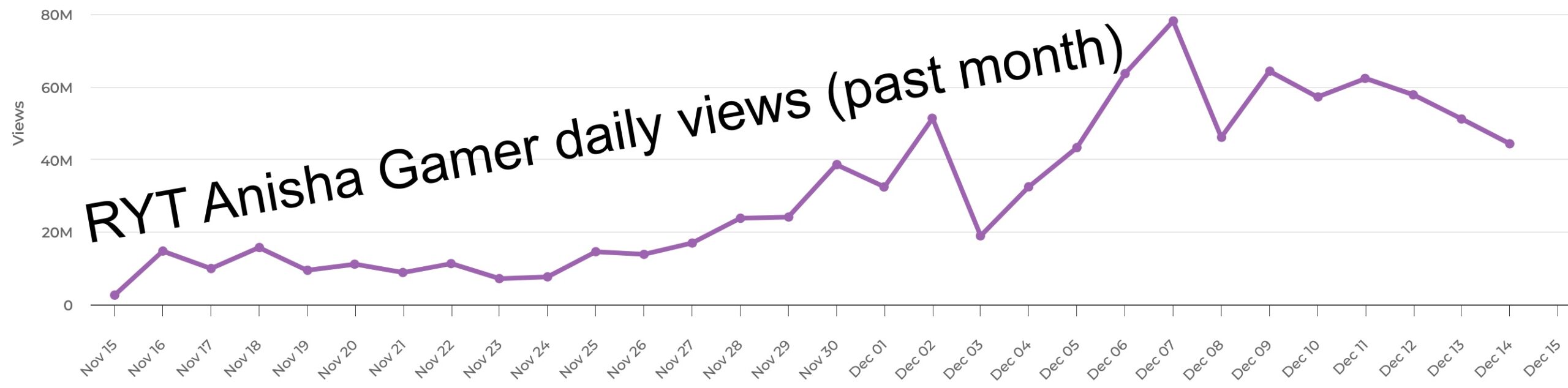
The Global Top 50 is still dominated by South Asian family channels, but even those hubs are using rurality as a way to draw in new viewers. One notable example is RYT Anisha Gamer, an Indian channel that finished 32nd in the latest Global Top 50. RYT Anisha Gamer has pushed its lifetime view count above one billion by combining two dependable short-form subjects: Cute kids and rural builds.
Data via Gospel Stats
This is one of those chicken-or-egg situations. It may be true that Indian family channels are favoring rural settings because viewers have indicated that they prefer that background to a more urban environment. At the same time, some of these creators are part of a shift that is bringing YouTube culture out of the cities and into the countryside.
That phenomenon has turned rural Indian villages into YouTube production hotspots. There’s no evidence that the trend will slow down, as long as farmers continue to have access to oddly satisfying equipment.
Channel Distribution
Here’s a breakdown of the Top 50 Most Viewed channels this week in terms of their countries of origin:
India: 21
United States: 10
Australia and Indonesia: 2
Argentina, Bangladesh, Brazil, Canada, China, Egypt, Germany, Hong Kong, Pakistan, South Korea, Spain, Taiwan, and United Kingdom: 1
This week, 39 channels in the Top 50 are primarily active on YouTube Shorts.
As always, keep up to speed with the latest Tubefilter Charts and all our news by subscribing to our newsletter. You’re going to love it. 👉 Newsletter.Tubefilter.com.
Each week, we handpick a selection of stories to give you a snapshot of trends, updates, business moves, and more from around the creator industry.
This week, the ironmen of YouTube unveiled their new digs, a streamer made a splash in the world of reality TV, and a legendary character revealed her New Year’s Eve getup.
Creator commotion
After 20 years on YouTube, Smosh has a new office. The channel originated by Ian Hecox and Anthony Padilla will operate out of a 32,000-square-foot studio located in Los Angeles. The Smosh team has reportedly doubled in size since 2023, and that growth has led the brand to expand its real estate footprint.
Druski is on the cover of Billboard. In a cover story, the pop music periodical tracked Druski’s rise from Instagram Live streamer to popular, ubiquitous comedian. For one of 2025’s biggest success stories, there’s no more wondering what coulda been. Druski has officially hit the big time.
iShowSpeed tops Kai Cenat to take the highest honor at the 2025 Streamer Awards. At QTCinderella‘s annual celebration of streamer culture, Speed snagged the top prize. In the Streamer’s Choice category, JasonTheWeen rode a big year to a deserved victory.
Pop culture minute
Angry Ginge was a celebrity, and he got out of there. The streamer known for his FIFA content endured physical trials and multiple rounds of fan voting to become the first content creator to win the U.K. version of I’m A Celebrity…Get Me Out Of Here. You see? Winning reality competition series is not just a thing U.S.-based creators do.
Beast Games season two will include a Survivor crossover. MrBeast filmed an episode of his Amazon Prime Video series in Fiji, and that gave him a chance to catch up with Jeff Probst and the rest of the Survivor gang. The collab doesn’t just extend to Beast Games — MrBeast associate Karl Jacobs is participating in an influencer version of the long-running reality show.
Matty Matheson cooked up a move to Netflix. The chef, creator, former Vice contributor, and The Bear cast member moved one of his shows to Netflix after originating it on YouTube. Netflix has made no secret of its plan to poach creator content, and the Matheson coup is just the latest example.
The biz
YouTube is adding stablecoin payouts through PayPal. Users in the U.S. who are fed up with fiat currencies can choose to have their YouTube earnings paid out via PayPal’s stablecoin. The move is a soft embrace of blockchain technology that affirms YouTube’s continued curiosity related to cryptocurrencies.
Steven Bartlett’s FlightStory is getting hotter, smarter, and richer. The Diary of a CEO host is going into business with Maggie Sellers Reum and her Hot Smart Rich brand. Through a seven-figure investment, FlightStory will bring increased scale to Hot Smart Rich, which currently encompasses a podcast and an accompanying newsletter.
Michelle Khare is in a Hot Wheels commercial this holiday season. Creators are becoming more popular as brand spokespeople, to which Michelle Khare said “challenge accepted.” She worked with Hot Wheels on both the creative and talent sides of her ad, which sees her shrunk down to become a bite-sized toy car driver.
Movers and shakers
TalkShopLive taps Sandie Hawkins as its new CEO. In her previous role, Hawkins oversaw TikTok Shop’s expansion into the U.S. market. Now she’ll lead a company that has used partnerships with platforms like YouTube to put itself at the epicenter of the ongoing live shopping boom.
Patreon hires Betsy McCormick as VP of Creator Success. The Qualtrics vet will look to ensure copacetic relations between Patreon and its creator community as she dives into the creator economy. In a statement, McCormick said that her career “has been deeply rooted in financial empowerment,” a quality that will serve her well in her new gig.
Music exec Charlotte Stahl moves on after five years at TikTok. Stahl was in charge of TikTok’s music partnerships in Europe, the Middle East, and Africa. The app hasn’t announced an immediate replacement, but its relationship with the recording industry has evolved considerably since Stahl first landed there in 2020.
The internet is a strange place
Hatsune Miku will be projected onto the side of a building for a New Year’s Eve party. The influential vocaloid character is going bigger than she’s ever gone before. Thanks to a gargantuan projection on the Tokyo Metropolitan Government Building, Miku will be able to look down on revelers as they ring in 2026.
Duolingo has put up “coming soon” signs at four former Hooters locations. The risqué chain has fallen on hard times, leaving a lot of abandoned nests for a fellow owl to buy up. The language learning app has explained what exactly it’s doing at these bygone Hooters, but I guess we’ll find out “soon” enough.
Generative AI is making artificial travel influencers now. I hear that ChatGPT and Claude just went on vacation to this amazing server farm in Mexico. You just have to go there.
Filed under: Articles, Featured, Homepage Feature, News by Sam Gutelle Comments Off on Have you heard? Smosh moves, Angry Ginge wins on TV, and Hatsune Miku gets bigger than ever
Some of the creators driving our $250 billion industry are pulling in thousands or even millions of dollars in income per month. But despite its volume, that income isn’t delivered in the sort of steady, dependable biweekly paychecks financial institutions like to see–meaning creators often struggle to access things like traditional business loans or lines of credit.
A few creator-specific financial services have popped up to fill that need, and the latest comes from a partnership between Kajabi, which describes itself as the “leading creator commerce platform,” and Parafin, a company that makes “white-labeled, AI-powered financing.”
Kajabi’s core business is offering a platform where content creators and other entrepreneurs can do things like build and sell courses and one-on-one coaching, take payments, and manage websites, email campaigns, and sales funnels. We chatted with one of their creator partners last year: self-dubbed “doctorpreneur” and Instagrammer Dr. Simone Ellis, who told us that between April and December, she sold over $150,000 worth of courses and coaching to fellow dental hygienists through Kajabi.
This new partnership with Parafin will launch Kajabi Capital, “an embedded capital program that grants Kajabi’s network of entrepreneurs access to fast and flexible financing,” Kajabi said in a press release.
(Being “embedded” just means Kajabi Capital will be added to the Kajabi platform, so creators won’t have to go to another landing page or download another app to apply. Instead, folks already working with Kajabi will go to the ‘Capital’ page on their usual Kajabi dashboard.)
In explaining why it decided to launch Kajabi Capital, Kajabi pointed to a June 2025 report from Goldman Sachs that found 81% of small business owners who have applied for business loans or lines of credit in the last year reported having difficulty accessing them.
“Kajabi Capital addresses this gap directly by embedding fast, flexible financing into the platform experts already use to run their businesses,” Kajabi said.
Financing will be available to “eligible U.S.-based” creators, it added, though it didn’t specify what eligibility requirements they have to meet. Creators who are approved for financing will receive it in “as little as one to two days,” and can use it for “a variety of business-scaling operations, including hiring new employees, running ad campaigns, or launching a new product.”
“Experts have been building trusted online businesses on Kajabi for years, long before the world fully recognized the power of the creator economy,” Steph Visessung, Kajabi’s VP of Commerce, said in a statement. “Our experts have told us loud and clear they need simpler, faster access to capital to keep growing. Kajabi Capital meets that demand, and our partnership with Parafin helps bridge the gap where traditional financial systems have fallen short, unlocking new ways for entrepreneurs to scale on their own terms.”
Sahill Poddar, co-founder and CEO at Parafin, added, “Kajabi is one of the most respected names in the expert economy, helping entrepreneurs turn their knowledge into thriving digital businesses. We’re proud to support Kajabi’s mission by providing quick and transparent access to capital, helping more experts grow on their own terms.”
Filed under: Homepage Feature, Kajabi by James Hale Comments Off on Kajabi is now offering creator financing, citing reports that 81% of small biz owners struggle to access capital