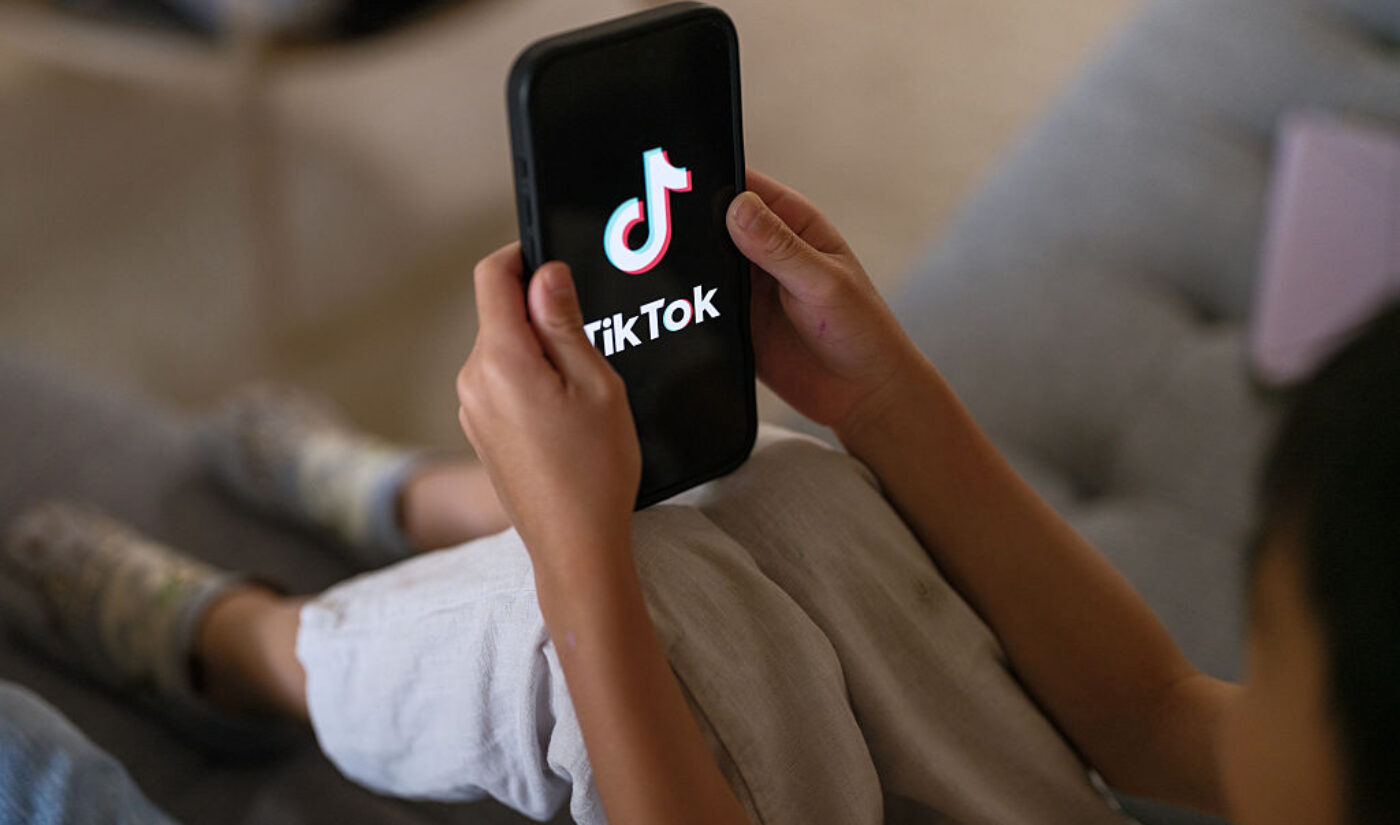
In summer 2021, a Wall Street Journal investigation found that TikTok’s recommendation algorithm could suss out new users’ interests in under two hours, and then drive them into ever-narrowing “rabbit holes” of content.
A few months later, around Christmastime, TikTok announced it was increasing its efforts to “safeguard and diversify recommendations.”
Those efforts included testing “ways to avoid recommending a series of similar content–such as around extreme dieting or fitness, sadness, or breakups–to protect against viewing too much of a content category that may be fine as a single video but problematic if viewed in clusters,” the platform said. (It deemed those clusters “filter bubbles.”)

Subscribe for daily Tubefilter Top Stories
But not every user would get access to those protections.
Without informing the public, TikTok reportedly ran an experiment where it sorted ~15 million users into a control group whose accounts would be fed by the default recommendation algorithm, with no safety net against patterns of potentially harmful content.
One of the people in that control group, 16-year-old Chase Nasca, “fell into a filter bubble where his account was recommended a repetitive amount of content surrounding Suicide and Self Harm and depressive topics,” according to an internal TikTok document recently reported by Bloomberg.
Nasca was placed in the control group in January 2022. He committed suicide a month later.
The same internal TikTok document showed that Nasca watched 7,563 videos in the last two weeks of his life. 73% of those contained themes like sadness, depression, and personal struggles. 10% of the videos were apparently found to violate TikTok’s own TOS.
Now, following Bloomberg‘s report, Sens. Marsha Blackburn (R-TN) and Richard Blumenthal (D-CT) have sent a joint letter to TikTok’s CEO Shou Zi Chew and Adam Presser, the CEO of TikTok’s U.S. operations, asking them to explain the algorithm experiment and why minors like Nasca were enrolled in the unprotected control group.
“We write regarding disgusting new reports that TikTok knowingly withheld a critical safety measure for millions of American users—including children—in order to determine whether protecting users would impact its financial bottom-line,” Blackburn and Blumenthal said in the letter. “These revelations raise serious questions about TikTok’s repeated assurances to Congress, parents, and the American public that it prioritizes the safety and well-being of young people over profit.”
About Nasca specifically, they added, “TikTok intentionally withheld from Chase the exact safety protections that were developed to interrupt precisely this deluge of abuse.”
Blackburn and Blumenthal’s letter includes a list of 13 requests for in-depth information about the “filter bubble” experiment, and gives TikTok a Sept. 1 deadline to respond.
This news comes as the Department of Justice announced a $400 million settlement with TikTok and its parent ByteDance over COPPA violations.
The DOJ’s suit, filed in 2024, accused TikTok of failing to protect children’s privacy and illegally collecting their personal information.
TikTok, which declined to comment on the settlement, agreed to pay $300 million immediately, and will pay another $100 million once the U.S. government vacates a 2019 consent decree with the Federal Trade Commission. It previously paid a $5.7 million fine over that case.
In its court filing for the DOJ case, TikTok said it’s developed systems that identify children under 13 who misrepresent their ages, and that it has thousands of moderators trained in handling underage accounts. Together, these systems and moderators have deleted tens of thousands of underage accounts, it said.
The Department of Justice did note that since it originally filed its complaint in 2024, TikTok “has undergone significant changes to its ownership, management, compliance functions, and privacy practices,” and has also “implemented extensive measures designed to strengthen safeguards for younger users, improve age-related controls, and enhance parental oversight.”
“Those developments have materially advanced the public interests underlying the Department’s litigation and have strengthened protections for millions of American families,” the Department said in an official press release.
As mentioned above, the algorithm experiment TikTok ran was in 2021/2022–so, again, a lot of things have changed. And not just at TikTok.
Here in 2026, entire countries have clamped down on keeping young people off social media, and platforms are increasingly introducing age verification systems (though that practice has sparked its own wave of privacy concerns).
But studies show that short-form content–regardless of its topic or the age of the viewer–can have negative effects on the brain, and we’re now in an era of internet where people are flooded with endless amounts of short-form every day, across every platform.
Platforms can’t–and shouldn’t be able to–stop adults from watching as much TOS-compliant content as they want to. On an individual basis, however, it might be worth thinking about how much you’re consuming, and when it’s time to unplug.