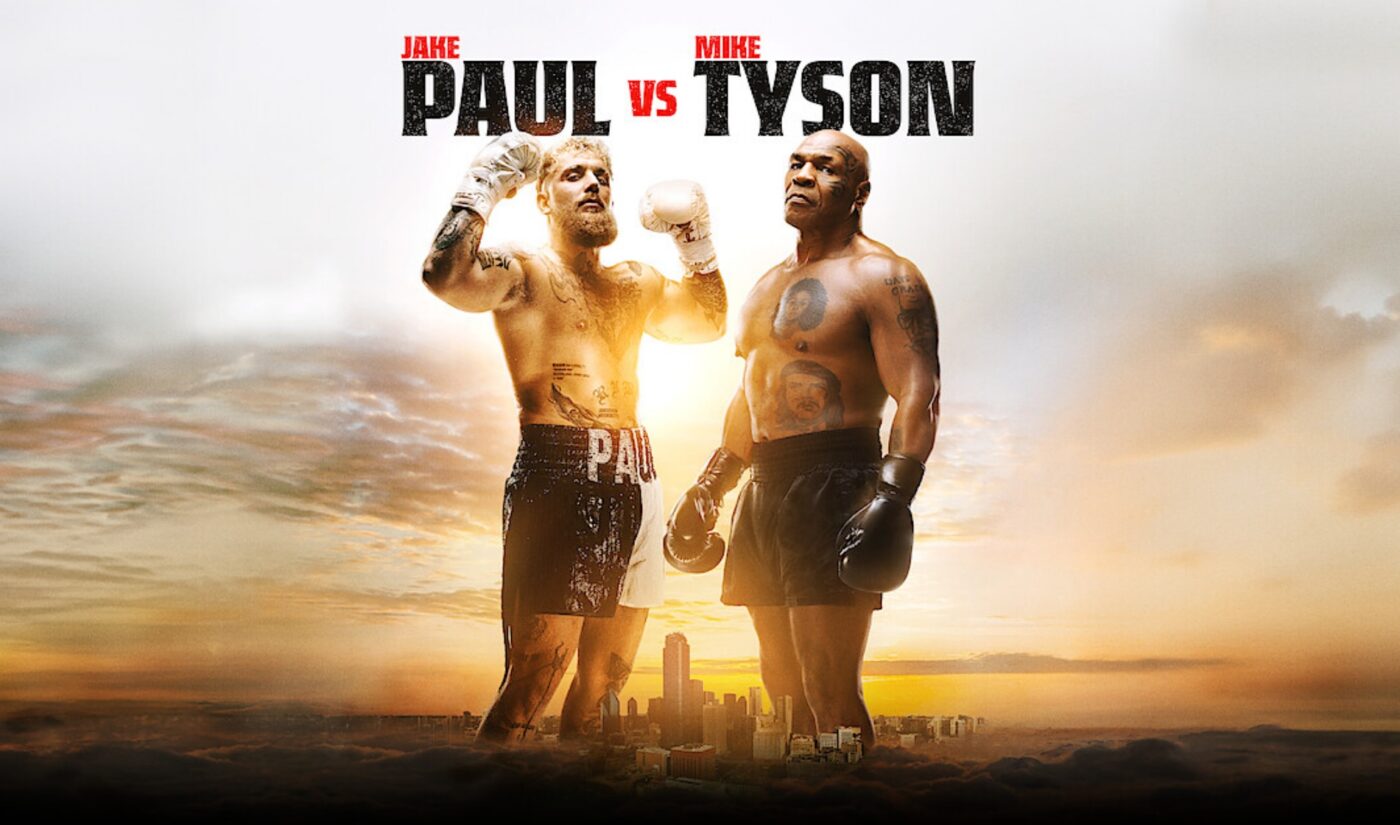
After months of hype, Jake Paul‘s big night has come and gone. On November 15, the rambunctious creator defeated boxing legend Mike Tyson in an eight-round tilt that ended in a unanimous decision.
Paul’s victory improved his professional record to 12-1 and cemented influencer boxing as a mainstream phenomenon. At the same time, the broadcast was plagued by technical difficulties, and the quality of the combat varied widely from fight to fight. Despite Paul vs. Tyson’s massive viewership, many observers will remember it as a failure, and broadcaster Netflix can learn a lot from the event’s mixed reception.
Let’s start with Netflix’s biggest positive: The fight peaked at 65 million concurrent viewers.
That number comes from official data released by Netflix. It’s the most viewership the streamer has ever received from one of its live events, and that wasn’t the only record Paul vs. Tyson shattered.

Subscribe for daily Tubefilter Top Stories
Netflix noted that the 70,000 attendees who spectated the fight at the AT&T Stadium in the Dallas area delivered $18 million in total gate revenue. That number is twice as big as the previous gate record for a combat sports event in Texas, and it represents the biggest gate figure for a U.S. boxing event outside of Las Vegas.
The co-main event, which featured a rematch between super lightweights Amanda Serrano and Katie Taylor, peaked at nearly 50 million concurrent viewers. Netflix noted that the clash will “likely” go down as the most-watched women’s professional sporting event in U.S. history. The contested decision went in Taylor’s favor, but regardless of the outcome, many viewers agreed that the fight was a barn burner and a triumph for women’s sports.
Netflix looked to capitalize on the fight’s big audience by drawing attention to some of its other original programs. Costumed Squid Game characters and Cobra Kai stars Ralph Macchio and William Zabka were shown in the crowd, giving announcers chances to promote upcoming new seasons for both of those shows. The Dallas Cowboys cheerleaders, the subjects of the acclaimed Netflix docuseries America’s Sweethearts, also made a fitting appearance at their home stadium.
Even the fight card featured some references to Netflix programming. The first bout of the evening pitted Whindersson Nunes against Neeraj Goyat. Nunes has three comedy specials on Netflix, and Goyat appeared on the show Ultimate Beastmaster: India.
Based on all those cross-promotions, it’s clear that Netflix wants to position itself as a creative community united by a shared distribution platform. That strategy aligns with Co-CEO Ted Sarandos’ rhetoric about Netflix being the home of storytellers. Unfortunately, Netflix may have lost some viewers’ trust even as it hyped its diverse programming slate.
The event’s advantages were canceled out by a sleepy headliner (which many viewers couldn’t watch at all).
The biggest negative of Paul vs. Tyson couldn’t be simpler: Netflix’s streaming experience couldn’t handle the massive traffic the event drew. Millions of viewers (myself included) encountered technical issues that prevented them from watching the hotly anticipated showdown. Instead of watching Paul and Tyson duking it out, we saw buffering messages and a fuzzy feed.
“omg did you see what just happened at Mike Tyson vs Jake Paul’s fight”
Netflix: pic.twitter.com/JE5adxv54N
— 🕸️ (@recreatings) November 16, 2024
It would be easier to excuse Netflix’s technical difficulties if the streamer hadn’t been through this before. Back in April, more than six million viewers tuned in to watch a reunion special for the fourth season of the popular reality series Love Is Blind. The raw audience numbers from the event suggested a success, but constant broadcast interruptions and glitches marred the experience.
At the time, Netflix Co-CEO Greg Peters attributed the issues to a bug that had gone unnoticed prior to the broadcast. Will he come up with a similar excuse for Paul vs. Tyson? How many times can Netflix make the same errors before customers lose faith in its live events? Should viewers who plan to tune into the streamer’s NFL Christmas Day slate prepare for buffering?
But even if you put those questions aside, the battle between Paul and Tyson fell short of its hype. Announcers built up the bout as a generational clash that could revive interest in boxing while cementing Paul as a legitimate fighter who has transcended his influencer roots. What we saw, however, was a timid Paul tiptoeing around an opponent more than twice his age. Viewers questioned whether the half-hearted Tyson was just in it for the money, and whether Paul took his foot off the gas during the fight’s sleepy second half. The weigh-in before the match offered more excitement than the match itself.
Netflix has about 65 million reasons to ignore the actual quality of the fight, but there are plenty of questions I’d love to see the creator headliner answer. Is this what Jake Paul wants? Throughout his boxing career, he has come off as an arrogant villain who beats up over-the-hill fighters while ducking opponents closer to his age (and getting beaten by one of the only in-form combatants he faced).
If Paul vs. Tyson was a referrendum on the growth of influencer boxing — and that’s definitely how Netflix positioned the event — then Paul deserves criticism for representing creators in a poor light. He insulted detractors, displayed an ego the size of AT&T Stadium, and appeared more interested in promoting his body care line than putting on an entertaining show. He seems to be following in his brother Logan’s footsteps, no matter the consequences.
On one hand, that’s always been Jake Paul’s brand, but maybe the “Problem Child” should grow up. His disappointing fight against Tyson might not be his “suicide forest” moment, but now would be a good time for him to reflect on the way he presents himself. Brash, uncompromising behavior is a good way to build a following on social media, but Paul wants to be more than just a creator. If he hopes to widen his reach to the masses, a look in the mirror would be a worthwhile step.