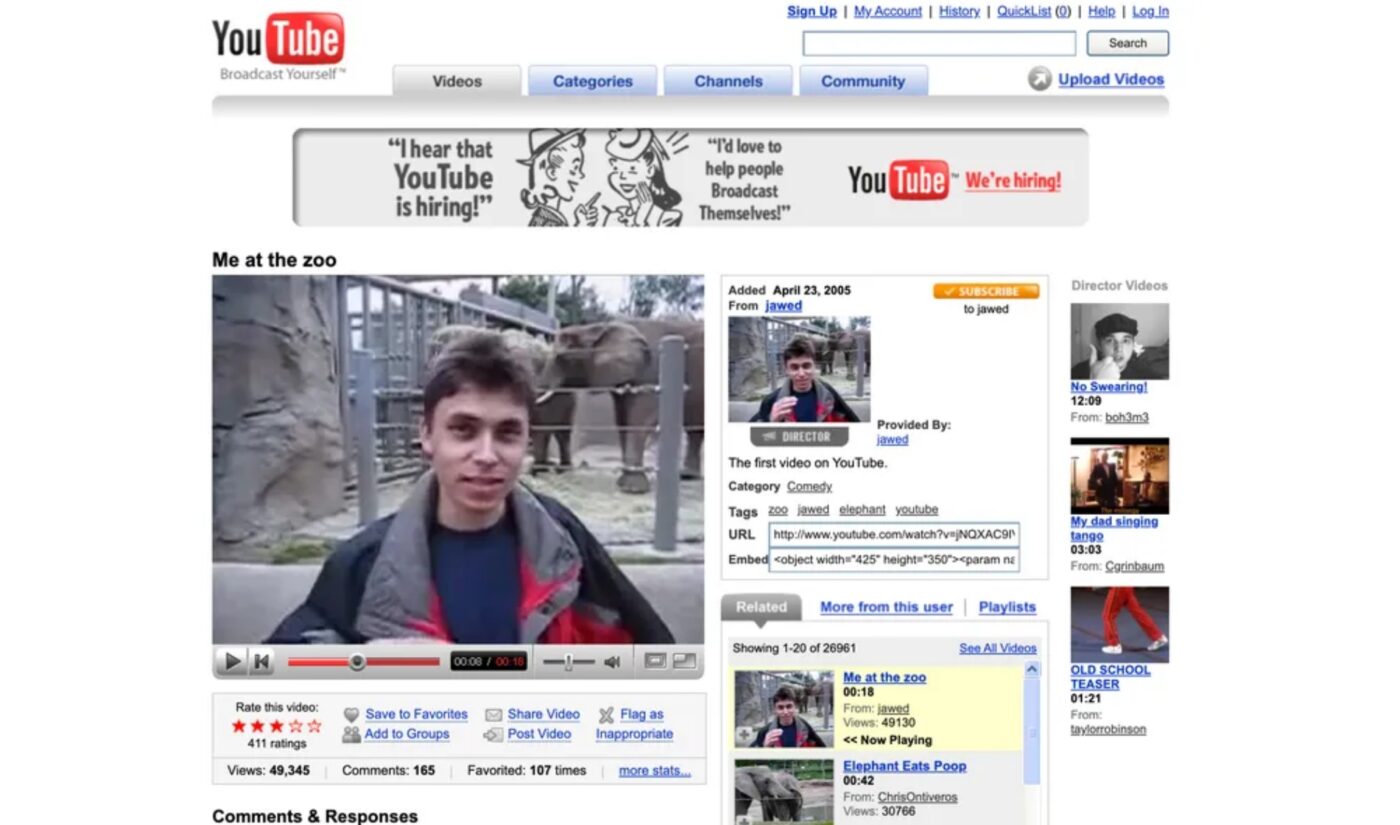
As YouTube celebrates its 20th birthday, it has become a cultural emblem, and a major museum is recognizing the platform’s important role in the history of mass media. London’s Victoria and Albert Museum has acquired the video file for “Me at the zoo,” YouTube’s first-ever upload.
“Me at the zoo” is now on display at the V&A’s Design 1900-Now Gallery, which examines innovative artifacts from the past 120 years. To put its newly-acquired video in the proper context, the V&A took a trip into the Wayback Machine to dig up the front-end code for YouTube’s original user interface. Curators even accented the exhibit with contemporaneous banner ads from 2006.
YouTube Co-Founder Jawed Karim recorded “Me at the zoo” during a trip to the elephant enclosure at the San Diego Zoo. Though it is nothing more than a mundane 19-second clip, “Me at the zoo” ultimately came to exemplify many of the cultural trends the YouTube era ushered in. As I wrote in my retrospective look at YouTube’s 20-year history, “Me at the zoo” is essentially the platform’s first vlog, and its grainy quality is the perfect representation of a platform that became a phenomenon by prioritizing personality and community over polished aesthetics.

Subscribe to get the latest creator news
For the 174-year-old V&A Museum, however, “Me at the zoo” is significant for other reasons. “As a cultural and social phenomenon, the YouTube watch page is not only emblematic of Web 2.0 and the rise of user-generated content, but also a prescient sign of what would become the creator economy and platform capitalism,” reads a post discussing the acquisition. “It reveals the ways in which early design decisions would become central to broader economic and cultural systems that define contemporary life.”
YouTube noted that the V&A’s exhibit also showcases iconography we now associate with the Web 2.0 era, including “badges, rating buttons, and sharing and recommendation features.” Karim’s video and its surrounding interface may not be as old as the typical museum piece, but visitors can learn a lot about the principles of the internet age by experiencing the inflection point where the user-generated revolution began. For that reason, when it comes to YouTube’s first video, Indiana Jones was right: That belongs in a museum.