When we here at Tubefilter began publishing our Gospel Stats Weekly Brand Reports, where we look at every sponsored video posted on YouTube each week, we saw some usual suspects. VPNs, energy drink and meal kit brands, financial services, internet browsers, mobile games…Between them, these businesses sponsor hundreds of videos each week, some to the point of memery.
But we also saw something else: Dozens upon dozens of videos sponsored by family-owned Florida-based law firm Morgan & Morgan.
If you’ve driven in the vicinity of pretty much any major American metropolis since Morgan & Morgan was founded in 1988, you’ve likely seen their big blue-and-yellow billboards. Some of these copious highway-sized ads proclaim Morgan & Morgan “America’s Largest Injury Law Firm” and reassure viewers that it operates “For the People.” Others boast about the $20+ billion it’s won in court on behalf of clients. Yet others are outfitted with region-targeted imagery and slogans, like its Philadelphia campaigns.

Subscribe to get the latest creator news
For personal injury firms, a $60 billion annual industry in the U.S., billboards–along with TV and radio ads–are their “bread and butter,” Shaul Wolf, Senior Director of Social & Creators at Morgan & Morgan, tells us.
The firm has relied on these methods of marketing for decades, but in recent years, it’s switched up its strategy in an attempt to appeal to a younger and more digital crowd.
With traditional advertising, this new strategy came in the form of cheekier slogans like “Size Matters” and a 2023 campaign where Morgan & Morgan intentionally ‘vandalized’ its own billboards, essentially accusing itself of being–as Jurassic Park so eloquently put it–full of “bloodsucking lawyers.” (That campaign played out exactly as Morgan & Morgan hoped, with people calling in to report the supposed ‘graffiti,’ therefore giving it the chance to read them a sales pitch while they were on the line.)
Then there’s the internet.
Wolf, who joined Morgan & Morgan in 2021, tells us he was originally on a different team in a different department within the firm. In that team, “There was floating around this idea of like, ‘Oh, influencers, we should work on influencers,’ something like that,” he says. “I jumped on it and was like ‘Yeah, I’ll take it.'”
Morgan & Morgan allocated a small test budget to investigate reaching Gen Z and Millennials (people in their 20s and 30s, compared to the industry’s usual clientele of 40 and up) by partnering with content creators, Wolf says.
The problem? “It completely failed. We worked with the worst influencers,” Wolf says. Despite that, “I loved it!” he laughs. “I told my boss that I wanted to switch and go all in on YouTube.” He thought that, with the lessons he’d learned from the test campaign, he could refine the firm’s approach and do things better.
That was three years ago, and now, Wolf leads an in-house social media team of six people. In partnership with dozens of creators, they publish an average of 230 pieces of branded content per month on YouTube alone.
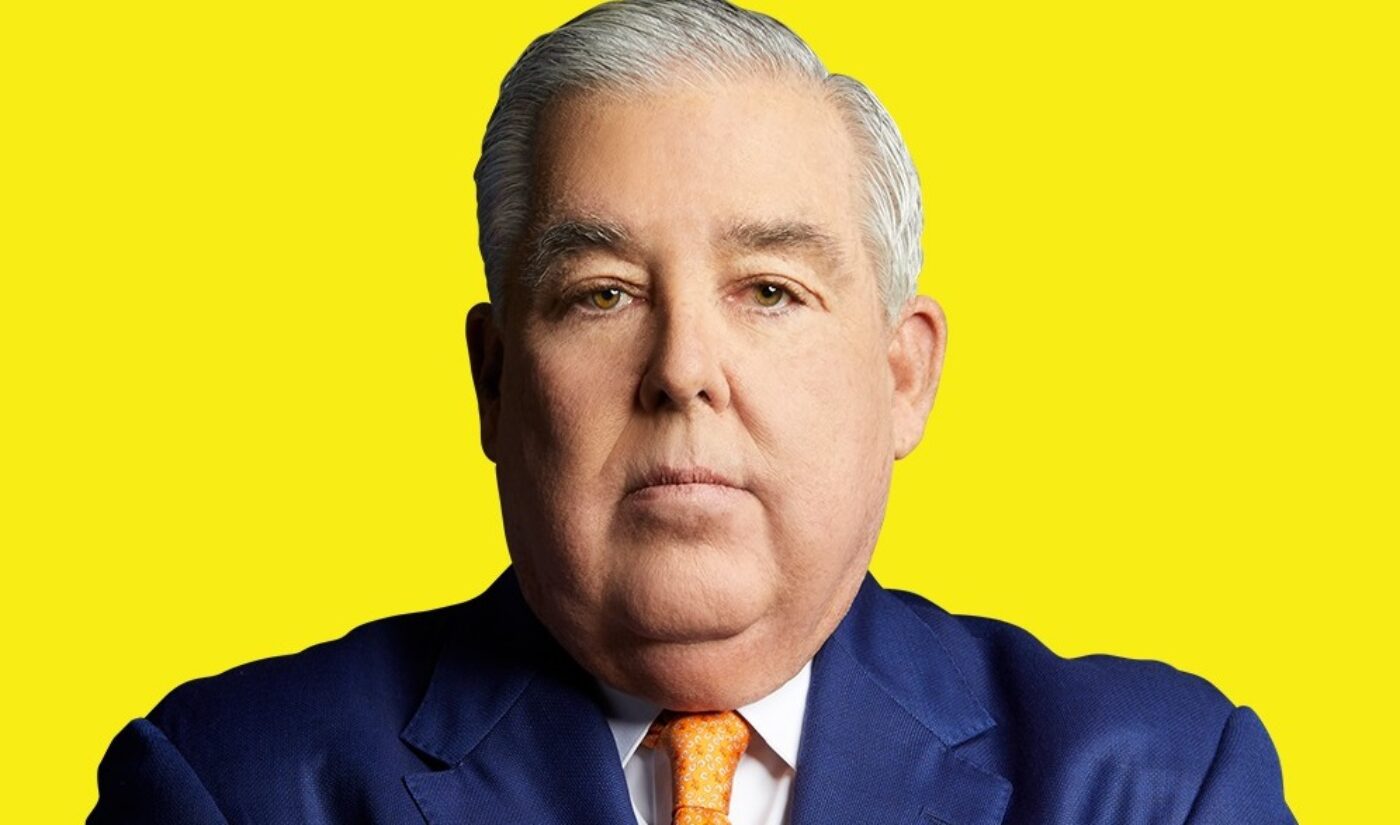
Recent examples include partnerships with man-on-the-street YouTuber Tyler Oliviera and culinary enthusiasts People Vs Food, as well as a multi-video sponsorship of hot-button debate channel Jubilee. That sponsorship has been particularly prominent: Not only did Morgan & Morgan get a 60-second ad spot in this video, it got more than half an hour of branded airtime by putting founder John Morgan (pictured above) on the hot seat in 20 People Confront a Billionaire.
Wolf says Morgan & Morgan looks at its creator program from both creative and economical standpoints.
For creative, part of building the program to success was learning how to choose creator partners where Morgan & Morgan marketing would fit naturally into their content, “rather than being an overt, salesy kind of ad read,” Wolf explains.
“If you’re a fashion influencer and you’re promoting a fashion brand, it makes sense. But if you’re a random creator promoting a law firm, it’s really out of context,” he says. “So instead, what we do is we work with people. Let’s say we work with an artist, and it’ll be like, ‘Draw a painting of our billboard.’ Or we work with a songwriter to write a funny song about us. It’s more in the niche of the creator and ties back to us.”
“We pretty much work with everybody,” he says, but “[w]e’ve found certain kinds of creators work better than others. So we’ve focused, at least in the last year or two, more on the niches that have just been converting better for us.”
A number of Morgan & Morgan’s current and regular creator partners are in the true crime/sensational news coverage niches–like Law&Crime Network, Levi Nichs, and Jay Reed, to name a few.
Wolf notes that compared to TV ads, which Morgan & Morgan has been running for over 30 years, “YouTube is very unique.”
“If you’re putting an ad on TV, it’s the same in-house-produced ad, and you’re just pumping it out on the networks,” he says. “But if you work with 100 creators, essentially, you have 100 pieces of content. That’s crazy value, to have so many unique creative pieces of content.”
That value-for-money plays into the economical side of this program. Wolf says a “real selling point” for convincing Morgan & Morgan to invest more in creator marketing is that the CPMs are competitive.
“If you buy a TV ad, you’re paying your fixed CPM, and it goes out onto the air,” he says. But TV, of course, is linear, and once an ad is played, it’s reached the end of its audience trail. YouTube videos, on the other hand, remain uploaded forever (ideally), and can attract new viewers for years.
“If you’re buying a YouTube video, you’re paying whatever flat rate [to the creator], and it’s clocking views for the next two or three years–at least for sure the next 12 months–and the CPM continues to decrease,” Wolf says.
Morgan & Morgan sees a decrease in CPM of between 30% and 50% in the 12 months after a sponsored video is posted, it says.
Wolf may have built this program from the ground up, but he’s not pausing to bask in success just yet. Managing Partner Dan Morgan (John’s son) recently said the goal is to 10x Morgan & Morgan’s creative budget for the next year, giving Wolf and his team a lot more cash to work with creators.
“It’s growing,” Wolf says. “[Creator marketing] is the future. It’s talking to people where they are, and not shoving ads down their throat.”