As companies like OpenAI whine that they can’t put out products without training their large language models on copyrighted material (including YouTube videos), more and more players within our industry are promising creators artificial intelligence-based services that only use their content with their consent. We’ve heard from AsqMe, from Spotter, and now there’s Icon, which pitches itself to businesses like this: “Partner with creators, turn 1 video into 20 videos with AI, and A/B test messaging to find winning ads.”
Icon’s core conceit banks on something YouTube asserted in July: that not all people are upset about generative AI being used to create deepfakes of them. (Worth noting: YouTube also, just this week, introduced more tools to help creators combat deepfakes.) Its business model pairs up brands and creators–one already on board is chess champ Alexandra Botez–and asks creators to film one video of themself with the product. Brands can then use that video as a foundation to make the creators appear to say whatever they want.
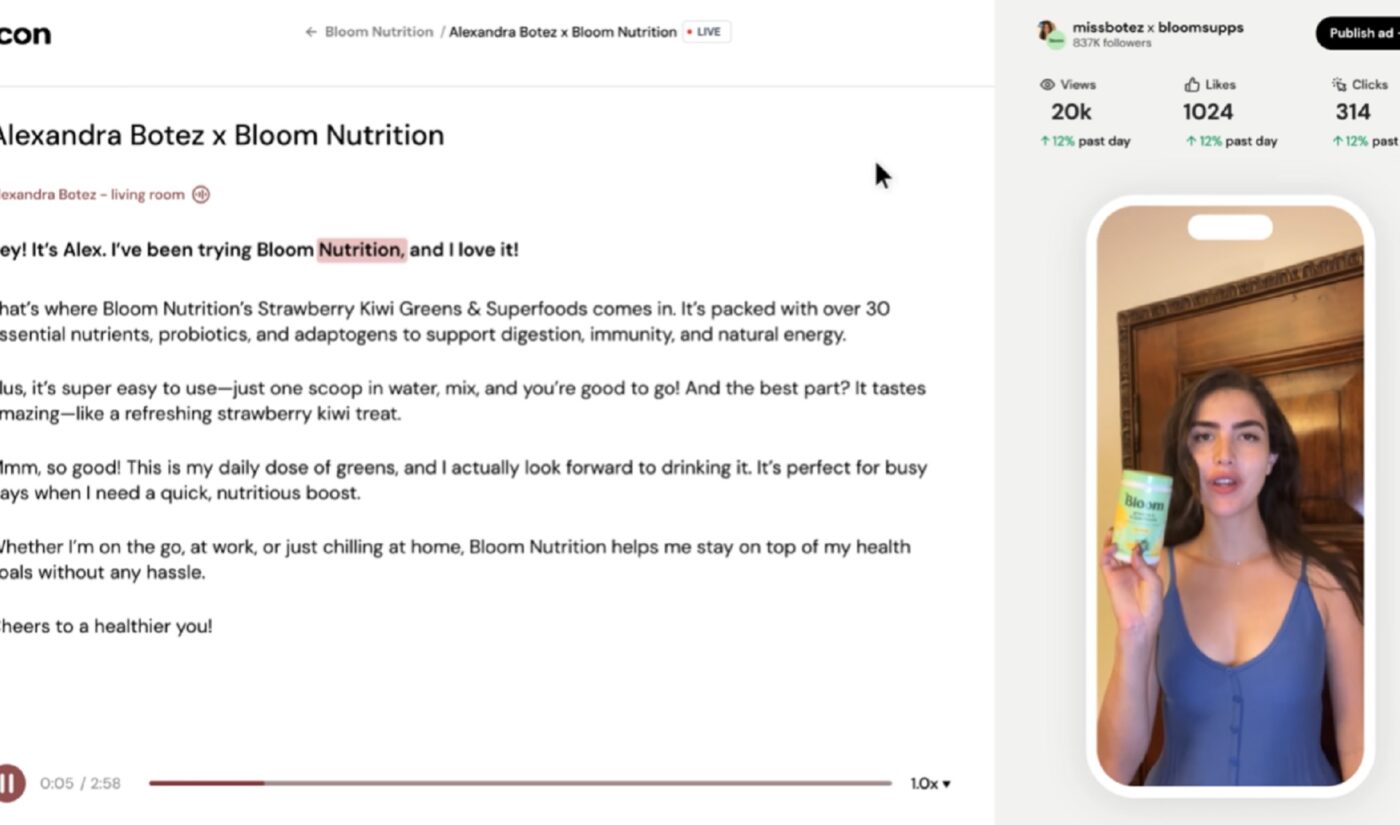
You can see that in action in Icon’s demo video, where its tech manipulates Botez to say, “I’ve been trying Bloom Nutrition whenever I’m traveling to chess tournaments because it’s so hard to stay healthy on the go, and I love it.” Botez didn’t actually say any of this; it’s just the brand’s messaging being puppeted out of her mouth.

Subscribe for daily Tubefilter Top Stories
That conceit will (more than understandably) creep out a lot of creators, many of whom approach sponsored content with the goal of keeping it as close in tone and style to their regular content, and many of whom praise brands who let them be in creative control of the branded messaging they share. Icon does say every video brands make during these partnerships must be approved by creators before it’s deployed as official advertising, so creators are meant to have a level of protection and control.
Since Icon’s main selling point being that companies can “turn 1 video into 20 ads,” there’s also a concern about creator pay. Obviously, in a normal partnership, a creator would be paid much more to appear in 20 videos than they would to appear in one. With Icon, creators are still only physically making one video, but their image, name, and likeness is being used in up to 10 variations (more on that 10 videos/20 videos discrepancy in a sec) generated by AI.
Icon says it charges brands a “$500-$50K/month partnership fee per creator.” That fee is “paid to creator, includes 10 approved videos per month, matchmaking, talent management, AI model processing, licensing, legal, whitelisting, onboarding, support & more.” We’re not sure why the number drops from “turn 1 video into 20” to 10 per month, but that’s according to Icon’s official pricing page.
Icon then turns and charges creators a 10% cut of that partnership fee; it says the cut “covers credit card processing fees, AI model processing, matchmaking, licensing, legal, onboarding, support & more.”
Some creators, like Botez, will see Icon’s business model as a fit for them. They film one base video, or perhaps one video per month, and give consent for that footage to be morphed into whatever brands see fit, in exchange for a payout of up to $50K. That amount won’t get endorsements from the world’s top creators, but it’ll get a few big players who may see this as less of a content-making deal and more of a minimum-effort licensing partnership, where they’re giving a brand permission to use their NIL.
On the brand side, Icon offers a way for them to A/B test a massive amount of ads, and then spray up to 10 variations all over social media. If one variation hits, the brand will probably go back to Icon and iterate on it to create more, similar marketing. If this sounds like what dropshippers do, you’re correct. And we’re not surprised, because Icon’s founder/CEO Kennan Davison‘s first company was Shopify service Skio, so he’s been deep in the world of ecommerce for years now and has likely seen dropshippers and other kinds of sellers megablast ads for thousands of DTC products.
“[B]rand-creator partnerships are painful to pull off,” Davison asserts in a LinkedIn post. “Two main issues often come up: mismatched audiences and bottlenecked content creation. Firstly, creator audiences don’t always match a brand’s target customers, limiting ad performance. Secondly, the process of filming and refining content can be mind-numbing, with endless reshoots making fast iteration nearly impossible. […] Our mission is to help anyone go viral with perfect storytelling and this is just the beginning.”
The post’s top commenter points out that Icon is making a dicey bet, since there’s a good chance AI-generated content featuring creators “is not gonna be viewed as authentic to audiences.”
Davison’s reply? “[A]s long as there’s authenticity behind the AI it is inevitable.”