Welcome to Streamers on the Rise, where we find streamers who are growing their channels, content, and audiences in extraordinary ways. Each week we’ll talk with a creator about what goes into livestreaming–both on and off camera.
Morgan Gold didn’t want his job anymore.
It was six years ago, he was in Washington, D.C., and every day he went to work, he knew where he really wanted to be.

Subscribe for daily Tubefilter Top Stories
On a farm.
Gold didn’t come from a farming family, and he had no experience running a large-scale operation. But he’d grown tomatoes on a rooftop in Brooklyn, and when he and his wife moved to D.C., they tore up their front lawn and traded grass for vegetable plots.
“I finally convinced my wife like, ‘Hey, I want to work on an even bigger scale and do trees and animals,'” Gold says. It was an intimidating prospect. They picked an area–New England–and began shopping for properties. Finally, they came upon a 160-acre former dairy farm in Vermont’s Northeast Kingdom that’d been unoccupied for nearly a decade. It was perfect.
That didn’t mean it was easy. They moved in, cleared the place out, and got started with ducks. Gold could go on about ducks all day, but to put it concisely, he chose them because everyone else in the area was producing chicken eggs, and he wanted to put out something different.
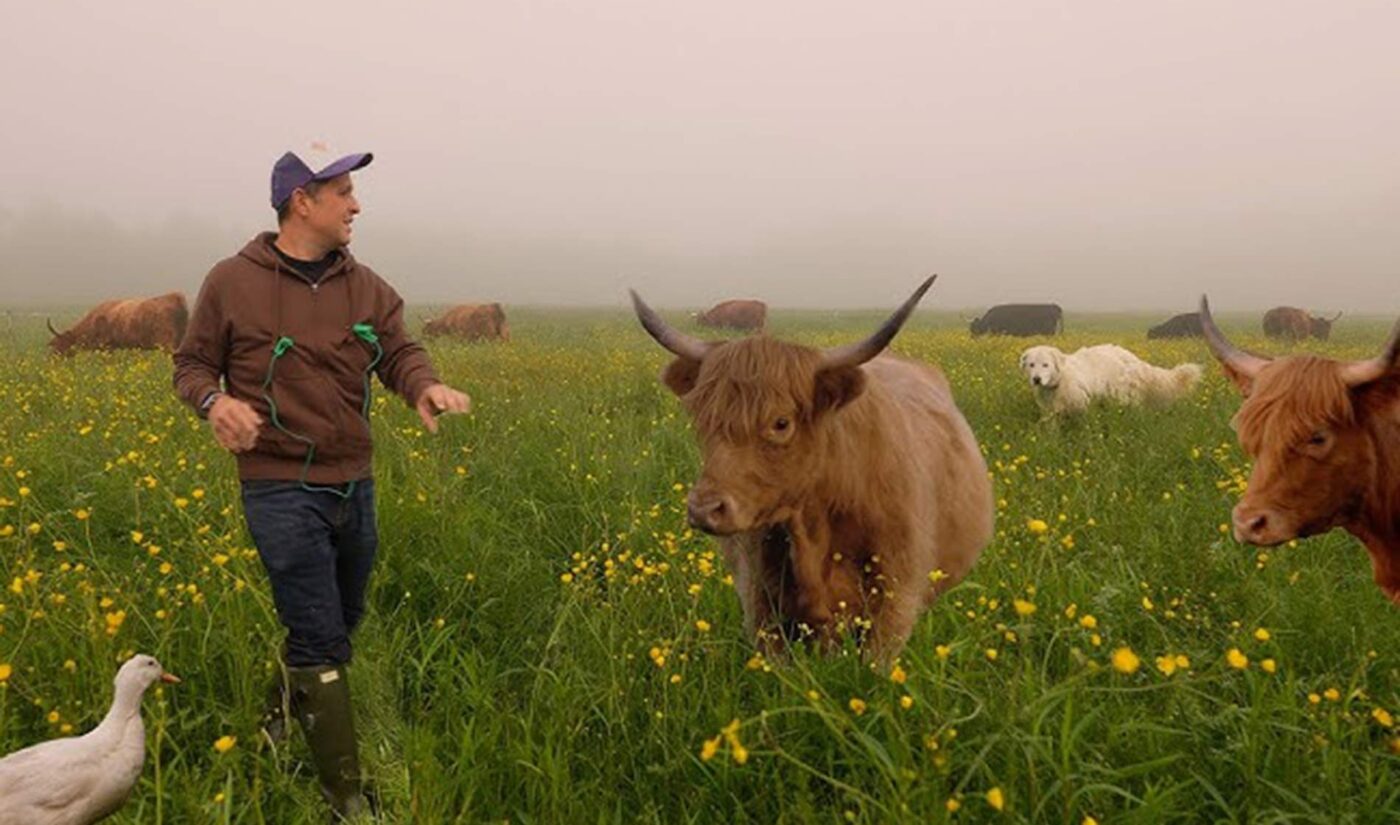
Nowadays, Gold Shaw Farm not only produces duck eggs, but also poultry meat and beef, as well as tree seedlings. It’s grown into a successful full-time operation–and you can get a glimpse of the inner workings on its official YouTube channel, where Gold regularly posts long-form VODs, Shorts, and regular “farm meeting” livestreams. He originally started uploading YouTube videos as a way to market his eggs, but now it, like the farm, has become a thriving business.
And Gold’s not stopping at farm products and duck eggs. He recently self-published his first children’s book, Toby Dog of Gold Shaw Farm, which tells the story of one of the farm’s livestock guardian dogs (with some other friends from around Gold Shaw, like barn cat Molly Murder Mittens).
We’ll let him tell you all about it below.
This interview has been edited for length and clarity.
Tubefilter: I’ve been following your YouTube presence for a while and you’re doing cool stuff, between long-form VODs, Shorts, and your livestreams. Really excited to get to talk to you.
Morgan Gold: Awesome, and I’m super excited to be here. Thank you for taking the time to do it. I really appreciate it.
Tubefilter: I’d love to just start with this: Pretend somebody’s reading or watching this and they haven’t seen your stuff. Give me a little bit of background about where you’re from, how you got into farming, and then how YouTube came into things.
Morgan Gold: Sure. My name is Morgan Gold. I run the Gold Shaw Farm accounts. Everything really started about six years ago when I was living in Washington, D.C., working a job that I really didn’t like, and I had this dream of starting a farm. My wife and I made the decision to leave the city and move out to a farm in the middle of nowhere, Vermont. We moved to a 160-acre dairy farm here in Vermont’s Northeast Kingdom.
I started raising ducks as the first agricultural enterprise for the farm. To help me promote and market the duck eggs that we were going to eventually have, I decided to try to document the process of starting this farm, being essentially a late-in-life farmer with no agricultural background. That’s where our YouTube channel came from. Then things took off with the YouTube channel, even more so than the duck eggs. Now we stand today, five-plus years later, where we’ve got four and a half million followers and subscribers across all the major social media platforms.
Tubefilter: You say you left the city. What city were you originally from?
Morgan Gold: Well, I’m originally from the Hartford, Connecticut area. I grew up in suburban central Connecticut, but then I went to college in Boston. Then my wife and I eventually moved to New York City, we were living in Brooklyn for a number of years. Then I took a job down in Washington, D.C. Prior to coming to Vermont, we were living right in the Capitol Hill neighborhood of Washington, D.C.
Tubefilter: All over the place.
Morgan Gold: Yes, very much like Northeast Kingdom. Sort of all up and down the northeast has been where I’ve spent my entire life. I used to live in Brooklyn. When I first moved to Brooklyn, it was like in Boerum Hill neighborhood. Then we moved out to Bed-Stuy for a couple years, and then to D.C.
Tubefilter: Now you’re in, as you said, the middle of nowhere.
Morgan Gold: Yes, it’s the second least-populated state in the United States, and we’re in the least-populated corner of that state, in a town of like 700 people.
Tubefilter: How did you pick that location? It’s a big jump from the city to that. And how did you pick ducks?
Morgan Gold: I started with actually growing tomatoes on a rooftop in Brooklyn. Then when we moved to Washington, D.C., and we were living in a rowhouse, we ripped up our front yard and put in garden vegetable beds, and that was where we were getting all our produce from. I finally convinced my wife like, “Hey, I want to work on an even bigger scale and do trees and animals,” and that sort of thing.
Since we were both from New England, we wanted to move to New England, but we didn’t really want to move back to Connecticut. That’s where we identified Vermont as a place that had the rural character, had a lot of open space and available agricultural land. Then also, though, felt culturally like something that would fit for us. That’s how we started looking in Vermont.
Then, much like I met my wife on the internet, I was going through real estate sites and looking for properties in Vermont that met the criteria size, worked in communities that we were interested in living in. Just trying to find that match was ultimately how we found this place, which had been on the market for six years. Nobody had been living here for seven or eight years. Just at the same time, though, it was this 160-acre former dairy farm that seemed pretty perfect for the things that I wanted to do with the farm in the long run, but because I didn’t have any experience with raising animals or working on a farm, I wanted to start small.
I actually left my job in D.C. and found a job here in Vermont that was like a 50% pay cut, but it would give me the time to actually start the farm. I started with ducks because everybody around here raises chickens, but I didn’t see a lot of people raising ducks for duck eggs. I figured this would be a good place to start at a small scale versus something more intimidating like cattle.
Tubefilter: Very interesting. It’s such an intimidating leap.
Morgan Gold: Well, it was a steep learning curve. Part of why I actually really got into making the videos was really trying to destigmatize it for folks who are not necessarily from agricultural backgrounds. I truly believe that the world does need more small farms and small farmers and more farmers coming from non-traditional backgrounds. Yet, if you look at the profile of the American farmer from a demographic perspective, you’re talking about like a 65-year-old White man who has lived in that community his entire life. Trying to get out there and show people that you can come from a lot of different places to start a farm, that’s been part of what I wanted to try to do with the channel.
Tubefilter: I did want to ask, I see that livestreaming is a big component of your content, and that’s interesting to me. It’s something I haven’t really seen before with your niche, so I’m really curious about that.
Morgan Gold: I enjoy going on livestreams because I find that it’s such a deeper, more intimate connection with folks who like to watch our videos and are curious about our farm. I really try to make each YouTube video, for example, a specific story and focus on a topic, and tell a good three-act story. When it comes to livestream, that’s an opportunity to just sort of hang out.
One of the things, though, I’ve struggled to try to balance is how much access to create and how to have some boundaries around it. I get requests all the time from folks who are like, “Oh, just put a livestream on your livestock guardian dogs or a livestream on your chicks or anything like that.” At a certain point, I think there’s the interest for it, but I’m not sure I want that because I enjoy being able to turn on the camera and turn off the camera. I’d be a little reluctant to go all in on livestreaming, but at the same time, I do know it’s an important part of the overall content mix that we try to create here.
Tubefilter: I saw you’ve done fundraisers, streams of significant length for fundraising purposes.
Morgan Gold: For example, last month, when Vermont was hit really hard with flooding, decided to do a 24-hour livestream where I popped on at 2:00 PM on Saturday and finally checked out 2:00 PM on Sunday, where it was just livestreaming, trying to get folks to donate so that we could raise some money to help some Vermont farms that were affected by the flooding. We ended up raising almost over $25,000 just from being able to flip on the cameras for a full day. I think that that’s a cool opportunity that I’m looking at other ways to do more of that in the future.
Tubefilter: Very very cool. You said that the business side of content is just as important as managing the farm, so I’m curious about how your daily or weekly schedule looks in terms of your time split.
Morgan Gold: Sure. A typical day on the farm usually looks like…It changes depending on the time of year, so a summer day on the farm right now is, I’m usually up around five o’clock in the morning. As the sun rises up, I get outside, and I might shoot a chore vlog where it’s basically a video of me doing my chores. Probably while I’m doing that, I’ll do a short-form video or two, whether it be Reels, or TikTok, or Shorts. Then I’m usually actually outside just working on projects.
For example, yesterday was, I think, more typical than today, but yesterday I was out there repairing a fence line and water line that had ruptured. I was also in the process of building some new shelving. We’re in the process of building a brand-new barn, and so I was doing some work on that. Then by about one o’clock, I’ll usually come inside, have lunch. In the afternoon, I’m typically doing, whether it’s editing or phone calls, whether it’s business side of the content creation part or business side of the farm itself, doing that sort of stuff. Work until about 5:00 there. Go outside to do a little more puttering around the farm. Have dinner around 6:00, 6:30. Then by about eight o’clock, I’m doing lockup and final chores. Then I’m usually out cold by 9:30, ten o’clock every night.
Tubefilter: I used to feel like getting up at 5:00 would be hell, but I’ve started waking up at 6:00 with the sun recently and I’m disappointed at how good it feels.
Morgan Gold: Yes. One of the things I’ve grown to really appreciate is my schedule is so much driven more by the sun and available daylight, in this day and age, than really anything else. The schedule I just described for you is very much what things look like over the summer. Come wintertime, I’m not getting up until 6:30. I might work out because I’m not as physically active in the winter months as I am in the summer months, where I don’t even bother working out. Then I’m getting inside, and I have time to just sit around and watch TV with my wife on a Tuesday night in the winter. It’s just a very different rhythm, but it’s so nice to have that cycle where there’s just seasons to your life.
I think one of the opportunities that I’ve had by being able to be a full-time farmer and create content on the side, essentially, has been, I’ve been able to match my lifestyle to where the sun is at. It’s a totally different way of living.
Tubefilter: Absolutely. What’s been the most surprising thing about establishing this life for yourself?
Morgan Gold: I think the most surprising thing was when I really moved up here to Vermont and started the farm, I was picturing making videos and content being a way that I would market myself. Like, “Oh, I need to be able to promote my duck eggs, and so let me make videos to do that because I like making videos and that’s fun to me,” and it was meant to be a distribution channel versus an income stream to itself.
Now when I look at our farm business, it’s essentially, we do eggs, we do meat, both beef and poultry, and we do tree seedlings. Those are our main agricultural businesses, but then at the same time, we have this content stream as well that– I think of it much more in terms of agrotourism. I have friends who run farms who do goat yoga, or they do maple sugaring tours, or that sort of thing where they’re inviting people onto their farm. I’m bringing my farm to other people by creating content.
I didn’t expect that, and that surprises me today, five years later, but I think it’s become a key part of how we’ve been able to keep this all moving and financially sustainable.
Tubefilter: I’m also really interested in the ducks, not gonna lie.
Morgan Gold: Oh, absolutely. Look, I could geek out with you on ducks for an hour or two, so let’s do it if you want.
Tubefilter: Let’s do it. Are there any finicky things about them? What was it like to get started?
Morgan Gold: I think the biggest thing with ducks that people don’t appreciate is they are crazy-messy animals. The reason people often focus their farms and homesteads on chickens is because chickens are relatively clean, they don’t make nearly the mess of ducks. Then actually when you’re butchering a chicken, it’s much easier than butchering a duck.
When it comes to ducks, they need to have water that they can dunk their heads in. They won’t be healthy if they don’t have that. You don’t need a pond, you don’t need lakes for them to swim in, but if they don’t have buckets or bowls of water that they can dunk their heads and clear their nostrils and wash their eyes, they will have health problems. Because of that, there’s lots of splashing and lots of water everywhere, and so their bedding gets wet when they’re ducklings, their coops get drenched and damp when they’re adults. How you manage that moisture is your biggest challenge as a duck-keeper, and so that’s probably the hardest part about ducks.
On the flip side of it, they are tremendous personalities. I love the personality of a duck far beyond a chicken. They are actually great for the land in terms of– chickens are often pecking and scratching. You think of a chicken foot and a chicken beak, those are very sharp instruments. That’s how they work. A duck is flat, their bill is flat, their feet are flat, and so it does a different thing for the land. In a lot of ways, if you manage them the right way, they can have less impact than chickens and be less destructive than chickens too.
There’s opportunities as well as challenges when it comes to the duck. The reality is if you’re keeping any animals, and I actually just made a video talking about this, you have to be constantly moving them. If you’re not moving them, they will overgraze, if they’re ruminants. They will create compaction, if they’re ducks and geese. They will rip everything up, if they’re pigs or chickens. Your responsibility, if you want to be taking care of the land as well as the animals, is find ways to keep them moving, keep them on fresh pasture. It keeps your animals healthier and it ultimately helps protect the ground as well, and so being able to rotate is a huge part of good regenerative farming.
Tubefilter: Is it just you and your wife working in the farm and working your content, or do you have any employees on either side?
Morgan Gold: Yes, so I’ve tried to keep the farm at a scale of, it’s something that I wouldn’t have a problem doing myself. I could have expanded things out much, much more, but then I would’ve had to have full-time employees. As far as the farm work goes, I will hire people to help me do projects. For example, I mentioned we’re building the barn and I’ve hired people to help build the barn, so I’m not just doing all that myself. For the day-to-day stuff, that’s entirely me. My wife, actually, she has a day job. She works as a nurse practitioner in a local emergency room here, and so she doesn’t have time to really do farm work, other than like she can cover night chores for me once in a while. I do all of that.
Then as far as the content side of it goes, I do all of the content creation, ideation, writing, all of that. I shoot everything entirely myself, unless you’re counting when I do animal-mounted cameras and that sort of thing. Then, yes, I got to give a camera credit to my barn cats, but beyond that, I’m shooting everything. Then I do have one editor who cuts probably about 80% of my videos on the long-form side. Having her there really helps me scale up, and that’s the only way I’d be able to sustain a pace where I’m doing three long-form YouTube videos a week, plus a lot of short-form content.
Then when it comes to different platforms, I work with Jellysmack to do a lot of my Facebook stuff. I don’t create my Facebook content directly. They’re taking my YouTube videos and my Shorts and repackaging them for Facebook, for example. It’s been such an awesome partnership with them. I’ve really appreciated their help on just a number of fronts.
Tubefilter: That’s good to know. Also, yes, speaking of your barn cats, I think the first video I ever saw of yours is the one with Molly.
Morgan Gold: Molly Murder Mittens. [laughs]
Tubefilter: Yes, Molly Murder Mittens leaving a mouse at your door. I have two cats here in NYC, and they certainly are little roach hunters.
Morgan Gold: That’s actually been one of my favorite parts about creating content, and I think maybe one of the things that we do a little differently than others, is I really try to tell stories from different character perspectives, and so it’s not always just my perspective as the farmer. If it’s mounting, for example, a camera on Molly and letting her explore the farm and showing people what that looks like, or talking about my dog, Abby, and her experience when she got injured a couple weeks ago and she had to live in the house for a few weeks, like what’s that like for a dog who’s lived her entire life outside to have to come inside for a few weeks?
I try to tell that story from that animal’s perspective, and I think that is a unique way to make my content. Then if I think about applying that to other things, I think there’s such an opportunity for content creators to shift their perspective from only their perspective to other “characters” in the mix of their content.
Tubefilter: That leads perfectly into the fact that you have a children’s book coming out.
Morgan Gold: I do. It’s Toby Dog of Gold Shaw Farm.
Tubefilter: Yes. I would love to hear about the conceptualization, and it sounds like you’ve been interested in storytelling for a long time.
Morgan Gold: Yes. Far and away, my favorite part about my life is the ability that I have to tell stories. I love the farming aspect and the work of building and creating on that front, but then I love to also tell stories about it. A couple years back, as my livestock guardian dog, Toby, came to the farm, I started thinking about things from his perspective of, “Hey, he’s this little puppy who’s left his family and come to a farm that he’s not familiar with, and there’s all these ducks and cranky barn cats. What does the world look like from his perspective?” I decided to write a book.
It’s a novel written for kids like eight or nine years old and up that essentially tells the story of coming to a farm, learning what it means to take on certain responsibilities and having some adventures and having some fun. That’s what the book is all about. It’s about a 20,000-word book. There’s going to be an audio version that I’m super pumped about where I narrate, and we brought in some actors to do the voices of the different characters. It’s got full illustrations, but it’s a different way to tell a story than a YouTube video or a TikTok.
What I’ve enjoyed is being able to branch out and go even broader than just a traditional approach of like, hey, let me just do some simple pictures and make it a book, but rather, let me try to tell a story that has some meaning, that has a message, that has character development, all those kinds of good things, and I’ve had so much fun doing it so far.
Tubefilter: How long did it take you to write?
Morgan Gold: I started it in the winter of 2020, put it down for a year, picked it back up in the winter of 2021 and finished it in the winter of 2021, and then paused it in the winter of 2022. Then I went through this long process of publishing and trying to figure out what made sense. I struggled in that part because I realized that my situation had evolved from when I first started it, where I had this larger audience. When I looked at the economics of publishing deals and some of the asks of publishers in terms of wanting control of content, or if I were to ever do something else with Toby, they’d want to own a piece of my dog, essentially; I honestly really struggled with that.
At the same time, publishers are always asking content creators in publishing proposals like, “What are you going to do to market and promote this book?” I realized since the tools are out there for self-publishing now, and I have an audience and I have an audience who’s familiar with the character of my dog to begin with, why don’t I just focus on self-publishing? For the last year, I’ve been working on that.
To answer your question very long-windedly, how did I get to writing the book? It was like three years it took to write it, but it was probably only three or four weeks of pure writing. It’s all the other stuff that comes along with it to get it to the place where it’s ready to go out there next month.
Tubefilter: Self-publishing is a very viable option. I’m not sure people realize how good it can be.
Morgan Gold: I mean, just even at the pure economics of it, right? In terms of if I look at what I’m getting for royalty per book for the way I’m going right now versus some of the publishing options that were on the table to me, it just almost doesn’t make sense. Then on top of it, they’re looking for a cut of it, and they’re looking for ownership of future activities. I’m surprised that so many content creators are still going down the traditional publishing path.
If I had to speculate, my theory is there’s certain airs of illegitimacy and impressions of, “If you’re self-publishing, you’re just doing a get-rich-quick, Amazon eBook type of thing.” There is that stigma. I think for content creators, you have to recognize how not to fall into that trap. Then there’s almost like a, “Hey, if I’m working with a traditional Big Four publishing house, I’m legit, I’ve arrived,” and it’s like a next milestone, but I honestly feel like there’s somewhere in between that, and there’s a lot of opportunity for content creators to do things a little bit differently in the next few years because I think there is an appetite for good stories.
I think there is an appetite for- I mean, heck, let’s even call it what it is, intellectual property and what that can look like as well, that not enough folks are truly exploring. I think a lot of content creators are a little bit shy in having those conversations about, “What is that publisher really bringing to this table in this day and age in 2023?”
Tubefilter: Absolutely. Just from the stuff I’ve seen on my side of the industry, I feel like there will be people or companies who step up to fill that gap in the next few years. Because certainly, creators are starting to go far beyond the, “I’m going to put out a T-shirt. I’m going to put out a mug,” kind of merch, and really expanding business-wise into things like original films, books. I really feel like that kind of production is going to come from somewhere.
Morgan Gold: Yes, I definitely see that as a niche. Because the struggle has been figuring out my distribution model, figuring out how to get into stores, figuring out which online platforms to use. That’s been the hardest part for me. Gosh, if somebody can make that turnkey, but they’re not looking for a chunk of my book and they’re not looking to severely constrain it, like, “Look, I’m happy to invest the capital to put up for the costs,” or I could have run this as a Kickstarter, there are methods for funding. It was never about the funding. It was about the execution. Yet, so many of the execution models for today are so derived on some sort of shared ownership, which I think is just a lot less attractive for creators.
Tubefilter: I’m sorry that it’s taken you a lot of effort and there aren’t solutions for you, but it really seems like it’s worked out for you.
Morgan Gold: Thanks. I think that the learning that I’ve had from this whole process, I wouldn’t trade it for the world. Because my writing time of year, much like I was talking about earlier, is very season-dependent. I’m in full tilt, get everything done before I have three feet of snow on the ground mode right now. Come October, I’m going to start writing another book, and it’s actually going to be a sequel to this book, talking about different animals on the farm. Because I’ve gone through the experiences of the last year-plus, it’s been such a good learning opportunity. I feel like now I’m super ready and super pumped to do it.
I just, quite honestly, love bringing these stories to life because I think for me– here’s the other thing. This is something that you get very close to the idea of death and dying and life cycles when you’re on a farm. I think about how I tell stories about my animals like, gosh, I love my dog, or you can see my little barn cat sitting on the couch behind me here, and I think about the stories. I know that for dogs and cats, relative to a human life, they’re finite, but the more I can bring their story to other people and share what they’ve meant to this farm and what they meant to me, it feels like I’m giving them a measure of immortality. It feels like a meaningful purpose to me.
I just love writing books like this and telling a story like this because it gives that opportunity to share what I love about Toby Dog so much with, really, anybody for generations to come.
Tubefilter: Yeah, that feeling of an immortality or a permanence.
Morgan Gold: Which is funny too, because I think that’s the one struggle with content creation, where it feels like it’s only becoming more ephemeral. I guess a long-form YouTube video sticks around. If I wanted to go back to my TikToks from last summer, it’s really hard to do and really hard to find them. TikTok is not helping you out in terms of surfacing and bubbling those up. It does feel like I make these videos and make so many videos in a given week, and they just will disappear 3, 6, 12 months from now, and be able to create stuff alongside of it that’s another companion to what I do that does have more staying power. It does create some meaning for me personally, for sure.
Tubefilter: Are you planning to do an in-person book launch, or what’s your plan for the release of the book?
Morgan Gold: I’m struggling a little bit. Part of it is, one of the downsides to being a farmer, particularly a livestock farmer, is it’s really hard to leave. I’ve got to find a farm-sitter. I’ve got right now, particularly, almost 100 geese, and about 30 ducks, and about 60 chickens, and a dozen cattle, and guard dogs and barn cats, and all this stuff going on, and so it’s really hard to leave.
What I’m looking at is doing some more virtual things, as well as doing more regional things. Part of what I’m working out right now, and I’ve only done it so far with one library which is a local one here, of doing readings at libraries. What I want to do is actually be able to charge a door fee, so that I can raise money for these libraries. Because, gosh, we need more support for our libraries and our communities here, whether it be in Vermont, and I imagine other places as well. Do a reading and be able to create an opportunity to interact with viewers of our content that I typically don’t have.
That’s part of what I’m going to do, but then also try to, again, raise money for folks who need it, I see that as an opportunity. Then I’ll also be doing, actually, a lot of live streaming as well because it is that opportunity to dive deeper. When the books are launched on September 18th, I’m going to be doing an overnight live stream that I’m working out the details on that right now as a way, again, to create that connection, particularly for somebody where it’s much harder for me to travel than, I think, a lot of other folks.
Tubefilter: Yes, understandably. I can’t even imagine having to find a farm-sitter. I stress enough finding someone for two cats.
Morgan Gold: Oh, it’s funny. Actually, I’m going away this weekend, and it’s the first time I’ve gone away since VidCon, which was the first time I went away all year. I’m just going away for the weekend, and it was very complicated just to do that. It’s a trip that I’m going with some friends from college that we try to get together for a weekend once a year. That’s really hard. That is one of the drawbacks to being a farmer.
Tubefilter: But it’s still worth it?
Morgan Gold: 100%. I would not change this life or trade any of it in the least bit, both the way things are set up today, as well as even the struggles and ups and downs and winding road that got me here. I think it’s all just been awesome, and I feel very, very, very lucky to be here.
Tubefilter: That’s good! Aside from writing another book, do you have any plans or goals you want to hit for the next year or so?
Morgan Gold: Honestly, I think there’s two fronts on it. I think number one, I’m continuing to expand out my farm and in particular, finding ways to support more agriculture in my region. I feel like it’s been great that I’ve been able to have this financially viable farm here for us, but I see so many of my neighbors who have farms financially struggling and finding business models that work. Trying to find a way that I can continue to grow my farm, but also help other farmers in the region is something I’m working at. I’m trying to solve that. That’s one big thing.
I think the other thing is trying to find a way to continue to expand out just beyond traditional farming content and focus on just telling great stories.
The videos that I make now, for example, like I’m just putting the touches on a series that I do called Farm Crimes, where I’m talking about tree poachers and people who are stealing trees, and trying to make that an educational piece for folks. The more I can try to do more broadly storytelling more than just our farm, that’s the other thing I’m trying to do from a content perspective.
It really is those two things of trying to expand and broaden the folks I can help, as well as the types of stories I can tell.
Tubefilter: Got you, perfect. Is there anything else you want to talk about? Anything else you want people to know about you?
Morgan Gold: Like I said earlier, I just feel very lucky to be able to do this, where I have this lifestyle that lets me do the two things I love the most: be outside, work at the farm, work with my animals, build things, have a job where it’s physically demanding and physically I can see my accomplishments, but then on the flip side, be able to pair that with a job where I get to be creative and tell stories and communicate ideas and emotions to other people. I feel insanely lucky that that’s what I get to wake up and do every single morning.
I think, overall, for folks, if they’re thinking about their content strategy, finding a way to pair the things that you love to what you do, I think is the most important aspect of it all, or else it just won’t be sustainable.
Tubefilter: Absolutely true. I see so many people who try to play into things that they aren’t passionate about and it goes badly every time.
Morgan Gold: Right. I see in online forums, because I am a student of content creation and trying to understand things, I see so much discussion of like, “How do I find my niche and what should I make? Oh, it seems like everybody’s doing these types of videos now, and so I got to come up with these types of things.” I feel it’s like, “Well, no. What do you love? What do you care about? What are you passionate about, and how do you bring that sense and feeling to other people? Even if it’s not making everybody want to be a farmer, how do I help people understand farmers more? How do I help people have stories that give meaning to their food?”
It’s looking for ways to bring what you love to others. I think that that’s at the core of finding what you talk about.