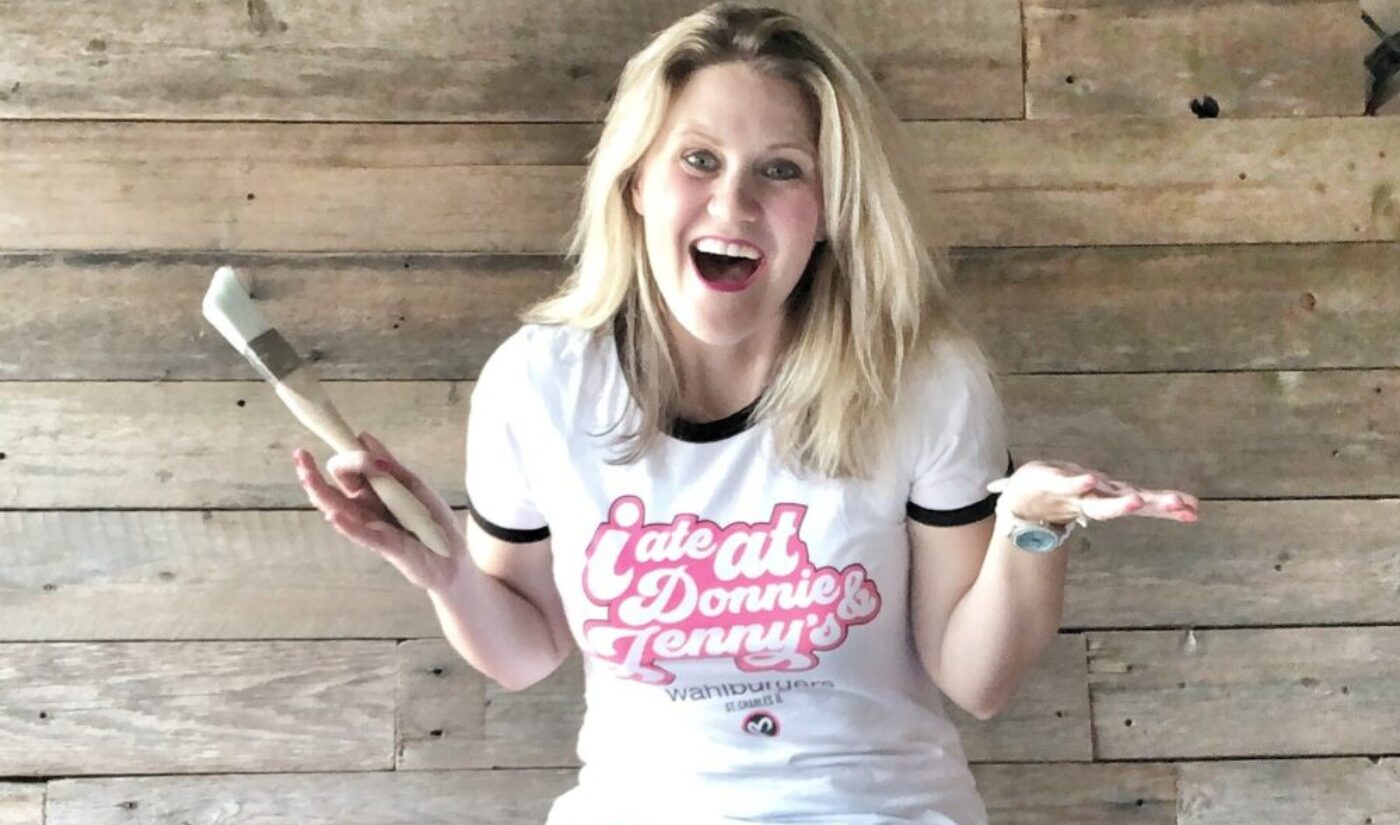
Kara Ward likes to call it “the worst April Fools’ joke ever.”
She and her husband had just bought their dream house. Ward was a busy stay-at-home-mom homeschooling their two kids, and her husband worked in events. Things were great.
It was 2020.

Subscribe for daily Tubefilter Top Stories
On April 1, her husband got the news: With lockdown in full swing for the foreseeable future, there would be no events happening, so there was no work for him to do–and therefore no job for him to have.
“Suddenly everything felt very uncertain,” Ward tells Tubefilter. The couple didn’t have much in savings. What they did have was debt. The mortgage to their dream house weighed heavy. To stay occupied, they started watching DIY YouTuber Christina Muscari. Inspired, they tried rehabbing some of their own pieces, then began casually refurbishing for family and friends. People (in true COVID style) would rock up and drop a piece of furniture off at the end of their driveway. Ward and her husband would refinish it and give it back.
“After a few pieces, we realized, ‘Wow, we’re actually pretty good at this,'” she says.
They decided to get more entrepreneurial with it: instead of waiting for people to offer them pieces, they began scouring Facebook Marketplace for cheap finds and then flipping them for a profit. It was grueling work, but money was coming in–and a year later, “we looked up—covered in sanding dust and paint—and realized that not only had we managed to keep our house, but we had completely crawled out of debt,” Ward explains.
Seeing the true scale of their accomplishment, she posted about it on a personal social media account. She didn’t expect anything to come of that post, but a day later, the team from financial advice expert Dave Ramsey reached out and asked if she and her family would like to guest star on his podcast. She said yes, but his show is a big production with a long lead time. This left her with three months between acceptance and filming the episode, and during that timeframe, Ramsey’s team started encouraging her to post video content about her work.
“They said, ‘You have television gold happening in your garage. You need to start filming this,'” she says.
So she did. And now, she documents her and her husband’s projects on Lemons to Lemonade Home, which has 140,000 subscribers on YouTube and 91,000 followers on Facebook. She never intended to become a content creator, just like she never really intended to become a full-time furniture remaker. But when her family found itself in dire straits, she had to get both innovative and creative–and by applying that same grit to making videos, she’s building an audience dedicated to supporting her continuing success.
Check out our chat with her below.
Kara Ward: My name is Kara, and my channel is Lemons to Lemonade Home. I started on YouTube back in 2021, really by accident. We can definitely get into more of that story later if you want, but basically I’m a very busy homeschool mom with two teenage kids. At the time, we were in a ton of debt, and I started flipping furniture to help us get out of it.
Along the way, someone said, “I can’t believe you haven’t picked up a camera to tell your story and show others how to do this.” That was kind of our lightbulb moment. We picked up a camera, ran with it, and it exploded. So here we are today.
Tubefilter: That’s amazing. I’d love to hear more of your story, especially because so many people started on social media around COVID time. I’m interested in how you ended up on YouTube specifically.
Kara Ward: Yes, that’s exactly what happened. April 1, 2020—I always say it was the worst April Fools’ joke ever—my husband lost the job he loved. He worked in events, and when COVID hit, there were no events, so there was no job. We had just bought a house that we loved, and suddenly everything felt very uncertain.
We started watching YouTube, and during that time people began dropping off furniture in our driveway—six feet apart, of course. We would take a piece, remake it, and give it back to them. After a few pieces, we realized, “Wow, we’re actually pretty good at this.”
That led us to picking up furniture from the side of the road and finding cheap pieces on Facebook Marketplace. We’d flip them and sell them for a profit. About a year into doing that, we looked up—covered in sanding dust and paint—and realized that not only had we managed to keep our house, but we had completely crawled out of debt.
It was really crazy. I took a silly Instagram picture showing how much money we had paid off and how quickly we did it and posted it on my personal social media. At the time, I didn’t know anything about social media, and it definitely wasn’t my end goal. This was literally just about feeding my family.
The next day, Dave Ramsey and his team reached out and asked if we would be on his podcast to share our story. We were so honored and said yes, but because it was still COVID, it took about nine months from that email to actually getting on the show.
During that time, talking with their producers, they kept saying, “Why haven’t you picked up a camera?” My husband and I were like, “Because we don’t know what we’re doing. We’re just trying to stay afloat.” And they said, “You have television gold happening in your garage. You need to start filming this.”
So that’s what we did. I went in completely blind. I’ve always recorded on my iPhone—I don’t have fancy equipment. It was just me for a long time. It took over two years before I could hire an editor. I learned everything as I went: watching YouTube videos on editing, lighting, thumbnails, how to deliver lines on camera—everything was brand new to me.
I feel like YouTube is kind of like riding a bike. You learn as you do it. You just have to press record and go. Your first videos—honestly, more than your first few—are not going to be perfect. Everyone hates watching their old content because it’s cringey, but that’s just part of the process.
By the time we got on the Dave Ramsey show, we had already started the YouTube channel. We were monetized by then—it took about five months, which is fairly quick for creators. About a year into YouTube, I was able to quit my full-time job.
Tubefilter: That’s so cool. Congratulations.
Kara Ward: Thank you so much.
Tubefilter: YouTube really is a very public record of growth. It’s vulnerable, but clearly your content is resonating with people.
Kara Ward: They seem to enjoy it.
Tubefilter: Looking through the comments, your community seems quite special.
Kara Ward: I love my community. They show up for me over and over again. I premiere my videos every Saturday morning at 9:30 central, and it’s always the same group of people in the chat. It feels like our weekly meeting—just checking in and catching up.
There are usually at least 50 people who show up every Saturday morning just to hang out and talk, and I never take that for granted. Even as the channel grows, that core group means so much to me.
Tubefilter: What was the first video that really took off for you?
Kara Ward: There’s one video—probably about two years old now—that’s still a big moneymaker for me every month. I’m holding up a bottle of bleach and talking about using bleach on furniture. That video took me from around 30,000 subscribers to about 60,000 subscribers in a week. That was my first real viral moment on YouTube.
Tubefilter: How did you learn to grow and retain your audience?
Kara Ward: Early on, I learned that if you’re entering an established niche on YouTube, you have to be first, best, or different. I wasn’t first, and I’m certainly not the best, but I am different—because of our story.
I leaned into the fact that over 80% of Americans carry more than $20,000 in debt. Debt affects so many people. It’s stressful and overwhelming. I wanted to make it fun and creative and give people hope—that even if they just pay one extra bill or one car payment, they can make progress.
So instead of just showing furniture before-and-afters, I talk about money. I talk about profits, what I’m saving for, and I weave our story into it. Even if someone never flips furniture, I want them to feel encouraged—that maybe they can try a side hustle or get more intentional about spending. It’s kind of a segue beyond just painting furniture.
Tubefilter: Are you both full-time in this now?
Kara Ward: My husband did get another job about a year after he lost his. He went in a different direction, not events. By the time he got hired, we crunched the numbers, and it didn’t make sense for me to go back to my job in medical business administration. I was making at least three times as much on YouTube, so I stayed full-time with the channel.
Tubefilter: What does an average day look like for you now?
Kara Ward: It’s busy, I won’t lie. Especially in the last year, things really picked up. Between homeschooling, content creation, partnerships, and creator events, it’s a lot. But it’s also really rewarding.
Tubefilter: How do you structure your video ideas now?
Kara Ward: It works both ways. Sometimes I start with a trend and look for a piece that fits it. Other times, I find a really unique piece and build a video around it. I’m always thinking about thumbnails and what will perform well on the channel.
It’s interesting because over the last five years, it’s shifted from “What will sell well locally?” to “What will perform well on YouTube?” Those are two very different things.
Tubefilter: Looking ahead to 2026, do you have any goals?
Kara Ward: I hit a lot of my goals for 2025, which I’m really grateful for. Moving forward, I want to step back and reevaluate. I’d love to grow the audience a bit beyond just furniture flipping and maybe build a smaller, more connected community—possibly through something like Patreon, livestreams, or more direct access.
Tubefilter: OK, last question: What has been your favorite part of becoming a YouTuber?
Kara Ward: You never know what’s going to happen next. The opportunities, the friendships—it’s wild. I never set out thinking I wanted to be a YouTuber. If you told the 2020 version of me that this is what life would look like five years later, I wouldn’t have believed you. I love adventure, and I’m kind of a fly-by-the-seat-of-my-pants person, so the fact that you never know what’s going to show up in your inbox tomorrow is really exciting.
Spotter is a Tubefilter partner.